Lunar New Year Activities for Kids: Chinese New Year Crafts
The best Lunar New Year activities for kids copy something families really do at the holiday: folding red envelopes, cutting red paper flowers for the window, racing as the twelve zodiac animals, scaring off the Nian monster with red and noise, and folding dumplings for New Year’s Eve.
Lunar New Year 2027 falls on Saturday, February 6, the first day of the Year of the Goat, so the school week before it has room for a craft a day. The fifteen activities here are sorted by where they fit: crafts for the week before, games for a party, a few first characters, then stories and food. For each one you’ll find the ages it suits, how many can join, how long it runs, what to set out, how it finishes and the snag to watch for. Treat the group sizes and times as a starting point. A class of 30 needs longer than three siblings at the kitchen table.
| Activity | Ages | Group | Time | What you need |
|---|---|---|---|---|
| Red envelopes with a wish | 4 and up | 1 to a class | 25 min | Red paper, glue stick, markers |
| Window paper-cuts | 6 and up | 1 to a class | 20 min | Red paper squares, kid scissors, tape |
| Paper lanterns | 5 to 10 | 1 to a class | 30 min | Printed template, scissors, glue |
| Zodiac animal headbands | 3 to 7 | 1 to a class | 20 min | Printed animals, paper strips, stapler |
| The Great Race | 4 to 8 | 12 to 24 | 20 min | Headbands, tape or a blue sheet |
| Chopsticks pick-up race | 5 and up | 2 to 6 | 15 min | Chopsticks, cotton balls, bowls |
| Zodiac memory match | 4 to 8 | 2 to 4 | 15 min | 24 printed animal cards |
| Lantern riddles | 6 to 10 | Any | 15 min | Paper slips, tape |
| Dragon dance parade | 4 to 10 | 6 to 15 | 10 min | Long sheet, a ball, a drum or pot |
| 红, the character for red | 3 to 8 | 1 to 6 | 10 min | One flashcard |
| 羊 for the Goat year | 3 to 8 | 1 to 6 | 10 min | One flashcard |
| 爷 and 奶 for the grandparents | 3 to 8 | 1 to 6 | 10 min | Two flashcards |
| Act out the Nian story | 3 to 8 | 4 to 25 | 10 min | Red scarves, pots and spoons |
| Fold dumplings | 5 and up | 4 to 8 | 1 hour | Wrappers, filling, water |
| Match the festival foods | 6 to 10 | 1 to a class | 10 min | One printed page |
Chinese New Year crafts for the week before February 6
Crafts belong at the start of the week because they turn into the decorations and gifts for the day itself. Stock up on red paper first. Red is tied to luck and celebration in Chinese culture, which is why paper-cuts, envelopes and lanterns are nearly all red.
Red envelopes with a wish
Who and how long: ages 4 and up, from one child to a class of 30, in about 25 minutes. Preschoolers can decorate while an adult does the folding.
What to prepare: red paper cut into 4¼ × 11-inch strips (one letter-size sheet makes two), glue sticks, gold or yellow markers and slips of plain paper for the wishes. Printed zodiac animals make good stickers for the front.
How to make it: fold the bottom of a strip up 4½ inches and glue the two side edges to make a pocket. Fold the last 2 inches down as the flap. Decorate the front, write a wish for the new year on a slip, and tuck it inside.
How it ends: children swap envelopes in pairs, or keep them to hand to a grandparent on New Year’s Day.
Where it goes wrong: at home, red envelopes usually hold money, and the customs around it trip up first-timers. New bills are preferred, and amounts with a 4 in them are avoided. Children are taught not to open an envelope in front of the person who gave it. In a classroom, keep it to wishes. Who hands an envelope to whom, and on which day, is explained in the red envelope section of Chinese New Year traditions.
Window paper-cuts
Paper-cuts hung on windows are called window flowers, chuāng huā (窗花), and they go up for the new year. They’re made by folding the paper before cutting, so one cut becomes a symmetrical pattern.
Who and how long: ages 6 and up who can cut along a pencil line with kid scissors, in about 20 minutes. For younger children, an adult cuts while the child draws the shapes.
What to prepare: 6-inch squares of thin red paper (origami paper works best), pencils, scissors and tape.
How to make it: fold the square in half, then in half again, to get a small square four layers thick. Draw half-hearts, triangles and half-circles against the folded edges. Cut along the pencil lines and open the paper out.
How it ends: tape each one to the window with the pencil marks facing out, so the clean side faces the room. A class gets a whole row of them.
Where it goes wrong: a child cuts straight across a folded edge from one side to the other, and the paper falls apart into two pieces. Leave part of every fold uncut. Thick construction paper also fights back at four layers, so use the thinnest red paper you have.
Paper lanterns for the Lantern Festival
The Lantern Festival closes the New Year season on the fifteenth day, Saturday, February 20, 2027. Each lantern needs one printed sheet, scissors and glue, and suits ages 5 to 10 with an adult close by for the slits.
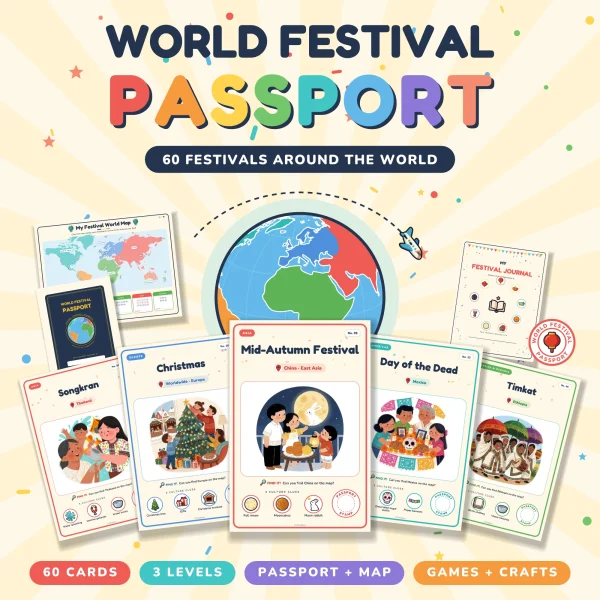
The lantern template is the first of eight craft pages in our World Festival Passport set. The five steps are written out in the Lantern Festival section of our traditions guide, along with the one line on the template that confuses people: cut the solid slits, not the dashed fold. Make the lanterns early in the week and they can hang until the twentieth.
Zodiac animal headbands
Who and how long: ages 3 to 7, any group size, in about 20 minutes. Headbands are the costume for the Great Race game below.
What to prepare: one printed picture of each child’s zodiac animal, construction paper cut into 2-inch strips, crayons, glue and a stapler. Two 12-inch strips stapled end to end go around most children’s heads.
How to make it: color and cut out the animal, glue it to the middle of a strip, then wrap the strip around the child’s head and staple it where the ends overlap.
How it ends: everyone wears their animal for the rest of the party, which makes it easy to call teams by sign.
Where it goes wrong: a child with a January or early February birthday gets the wrong animal, because the zodiac year turns over at Lunar New Year. Most kindergartners in a 2026–27 class are Rats or Oxen, and the line falls on February 12, 2021: children born before it are Rats.
Our Chinese zodiac signs page has the full date table. Turn the staples so the points face out, away from the hair.
Lunar New Year games for a class party or family afternoon
Once the crafts are done, the headbands and lanterns become props for the games. These five work for a classroom party, a playdate or the afternoon before a family dinner.
The Great Race
The Great Race is the folk tale behind the zodiac order. The Jade Emperor decided the years would be named for the animals in the order they reached him, and they had to cross a river to get there.
Who and how long: ages 4 to 8, ideally 12 children, one for each animal. With 24, two children share each animal. It takes about 20 minutes.
What to prepare: the headbands, a “river” made from two lines of tape about 10 feet apart (or a blue sheet on the floor) and a chair for the Jade Emperor on the far side.
How to play: a grown-up tells the story while the animals act it out. The Rat rides across on the Ox’s back, hands on its shoulders, and jumps off at the end to finish first.
The Ox comes second and the Tiger third, fighting the current. The Rabbit hops across on a log, the Dragon stops to make rain, and the Snake hides on the Horse’s hoof and startles it at the bank. The Goat, Monkey and Rooster cross together, the Dog stops to play in the water, and the Pig stops to eat and falls asleep.
How it ends: the children stand in a line beside the chair, Rat to Pig. That line is the zodiac order. Ask who’s eighth, because the Goat is the animal for 2027.
Where it goes wrong: the cat. In one well-known telling the Rat pushes the Cat into the river and the Cat drowns, which is a lot for a 4-year-old. Saying the Cat got there too late keeps the point without the drowning. A child from a Vietnamese family may tell you the Cat does have a year, and they’re right: the Vietnamese zodiac has the Cat in the Rabbit’s place.
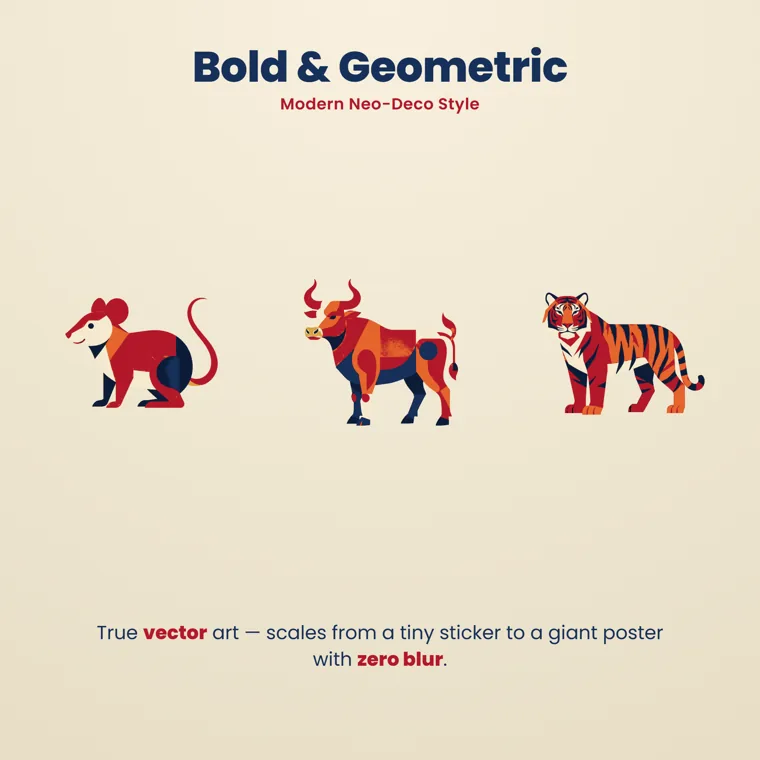
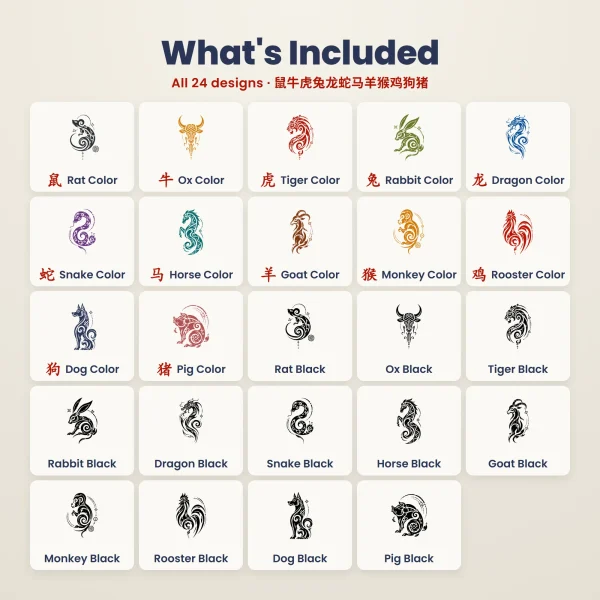
The rat, ox and tiger in the picture come from the red and orange style of our Chinese zodiac clipart. Buyers pick one of three styles, and each style has all twelve animals. Print the set once for the headbands and twice more for the memory game.
Chopsticks pick-up race
Who and how long: ages 5 and up, 2 to 6 players at a table or two relay teams, in rounds of one minute. Allow 15 minutes.
What to prepare: a pair of chopsticks and two bowls per player, a pile of cotton balls or large pom-poms, and a timer.
How to play: each player moves as many cotton balls as they can from one bowl to the other in a minute. For beginners, wrap a rubber band around the top ends of the chopsticks with a folded scrap of paper wedged between them, and the sticks turn into tongs.
How it ends: count the cotton balls in each bowl and play best of three.
Where it goes wrong: the game spills over to younger siblings at the same table. The American Academy of Pediatrics lists small balls and toys with small parts among things to keep away from young children. Under federal rules, toys meant for children under 3 can’t contain small parts. Swap pom-poms and dried beans for big cotton balls whenever a toddler is nearby.
Zodiac memory match
Who and how long: ages 4 to 8, 2 to 4 players, in about 15 minutes.
What to prepare: the twelve zodiac animals printed twice and cut into 24 cards. Print on cardstock, or the pictures show through the back.
How to play: lay the cards face down in a grid. Players turn over two cards at a time and name both animals out loud. A match stays with the player, who takes another turn.
How it ends: the player with the most pairs wins. Then lay the pairs out in race order and see who remembers it from the Great Race.
Where it goes wrong: 24 cards are too many for a 4-year-old. Start with three animals, six cards, and add pairs as they get easier. Our flashcard set suggests the same six-card start for its memory game.
Lantern riddles
Guessing riddles hung on lanterns, cāi dēngmí, is a Lantern Festival custom. Write one riddle on each slip of paper and tape it to a lantern or a doorway, then let the group guess. Ages 6 to 10 can play, and it fills about 15 minutes.
The riddles for 6- to 8-year-olds in our brain teasers for kids collection come with answers. Pick riddles about things in the room, or the group runs out of guesses and the game stalls.
Dragon dance parade
A dragon dance uses a long, flexible dragon carried on poles by a team, led by a dancer holding a ball that stands for a pearl. Drums and other percussion keep the time.
Who and how long: ages 4 to 10, 6 to 15 children, in about 10 minutes.
What to prepare: a long sheet or a length of fabric, a paper-plate dragon head for the front, a ball for the pearl and a drum. A pot and a wooden spoon will do for the drum.
How to play: one child walks ahead holding the pearl up high. The others line up under the sheet, holding its edges at waist height, with the head at the front. The pearl-holder weaves slowly around the room, and the dragon follows to the beat.
How it ends: the dragon catches the pearl at the door, and the next child takes a turn leading.
Where it goes wrong: the children at the back can’t see where they’re going, and on a tight turn the tail swings out fast. Keep the parade at a walk, make turns wide, and put the youngest near the head.
Learn a few Chinese characters before New Year
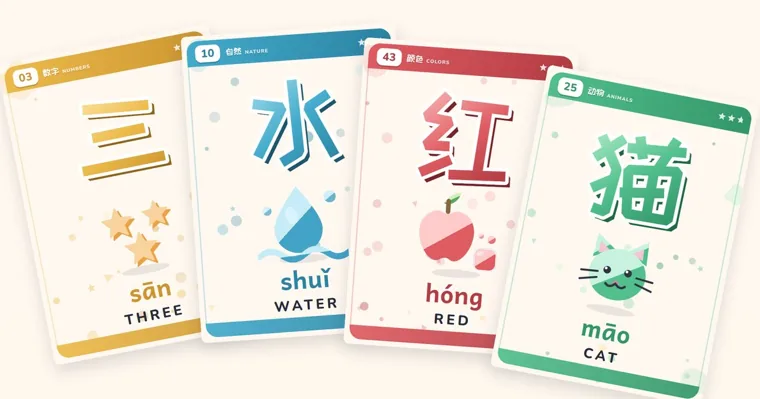
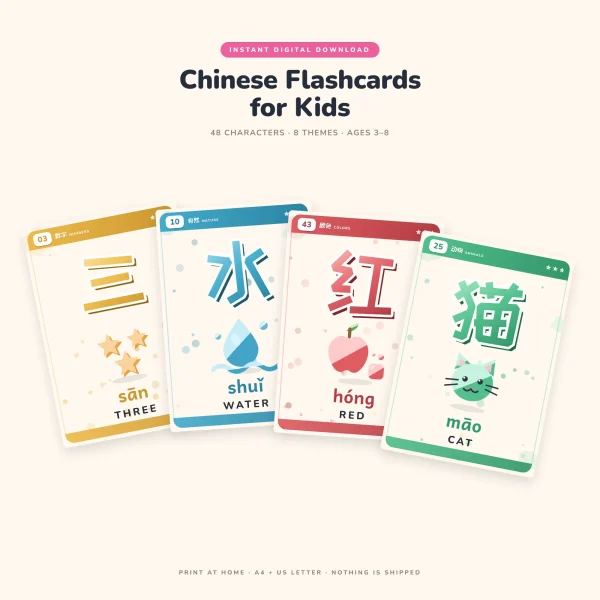
A few characters give the holiday words a shape, and four of the 48 cards in our Chinese character flashcards fit the season. Each card back numbers the strokes, gives two or three words using the character and an example sentence, then adds a tracing row and a small game. The set is marked for ages 3 to 8.
Our flashcard guide recommends five cards a day, so these three activities take about 10 minutes each.
红 (hóng), the character for red
Card 43 is 红, red, written in six strokes. Its three words connect straight to the crafts: 红色 is red, 红花 is a red flower, and 红包 is a red envelope.
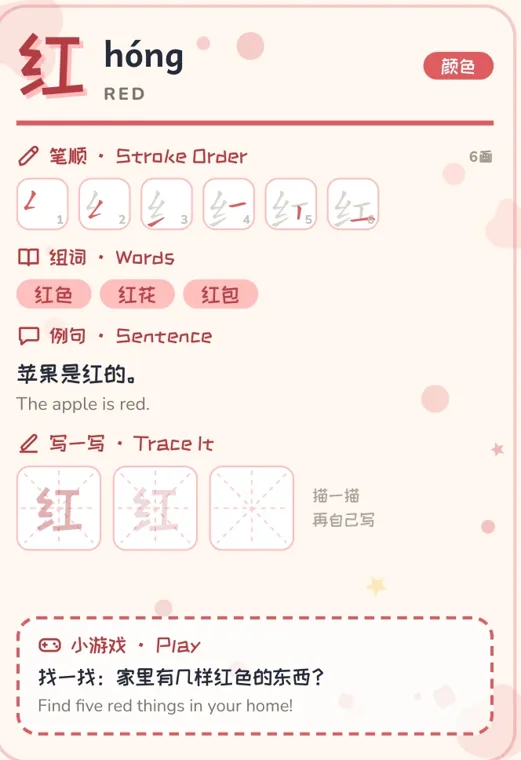
The game at the bottom sends the child to find red things around the house. The English line asks for five, while the Chinese line asks how many they can find. Five is a good number for a class: it fits in a short hunt and gives everyone something to bring back.
羊 (yáng) for the Year of the Goat
Card 30 is 羊, in six strokes, and it’s the animal of 2027. It’s labeled SHEEP. Its words are 小羊, lamb, 山羊, goat, and 羊毛, wool.
Children who’ve just worn goat headbands will ask why the card says sheep. In Chinese, 羊 covers both animals, and 山羊 is the goat. Our Year of the Goat guide explains why you’ll see 2027 called the Year of the Sheep too. The card beside it, 马 for horse, is the year that ends on February 5.
爷 and 奶 for the grandparents
Card 21 is 爷, six strokes, and its words include 爷爷, grandpa. Card 22 is 奶, five strokes, with 奶奶, grandma, and 牛奶, milk. The sentences are made for a family visit: 爷爷讲故事真好听, Grandpa tells the best stories, and 奶奶做的菜最好吃, Grandma’s cooking is the best.
Teach one word the week before visiting, then add a greeting. The catch is that 爷爷 and 奶奶 are Dad’s parents, while Mom’s parents are usually 外公 and 外婆. Our basic Chinese phrases guide has the New Year greetings and the right name for each side of the family.
Lunar New Year stories and food kids can help with
The last group belongs to New Year’s Eve and the days around it, when the family is home and dinner is the main event. On Friday, February 5, 2027, that means the reunion dinner.
Act out the Nian story
In the old story, the beast Nian came out at the start of each new year to eat crops and sometimes villagers. It turned out to be afraid of loud noise, fire and the color red, so people hung red lanterns and red scrolls on their doors.
Who and how long: ages 3 to 8, from four children to a whole class, in 10 minutes.
What to prepare: red scarves, ribbons or sheets of red paper, and a few pots with wooden spoons.
How to play: one person plays Nian and creeps toward the group. When the storyteller says “red,” the children wave their red. When they hear “noise,” they bang the pots. Nian runs off, and the story starts again with a new Nian.
How it ends: after three or four rounds, the red goes up on the door like the villagers’ lanterns.
Where it goes wrong: a preschooler gets truly frightened of the monster. Let an adult play Nian first and keep it silly, a Nian who trips and sulks. Children who don’t like loud sounds can wave red instead of banging. For the full story and firecracker safety, see the Nian section of the traditions guide.
Fold dumplings for New Year’s Eve
Jiaozi, Chinese dumplings, are one of the main New Year dishes in northern China, and many families eat them at midnight on New Year’s Eve. Their shape is said to look like the gold and silver ingots once used as money, so they stand for wealth.
Who and how long: ages 5 and up can fold, 4 to 8 people around a table, in about an hour with cooking.
What to prepare: a pack of round dumpling wrappers from an Asian grocery, a filling from your recipe, a small bowl of water, a damp towel to keep the wrappers from drying out and a floured tray.
How to make them: put a teaspoon of filling in the middle of a wrapper, wet the edge with a finger, fold it into a half-moon and pinch it shut. Older kids can add pleats along the edge. An adult cooks them, following the recipe.
How it ends: everyone eats the dumplings they folded, and the lopsided ones go first.
Where it goes wrong: two things. Kids overfill, and the dumplings burst in the pot, so stick to a level teaspoon. Some cooks also hide a clean coin in one dumpling for luck. Coins are on the American Academy of Pediatrics list of household choking hazards for children, so mark the lucky dumpling another way, with an extra pinch or a different fold.
Match the festival foods
Who and how long: ages 6 to 10, alone or as a class, in 10 minutes.
What to prepare: one printed copy of the food matching page from our World Festival Passport set, and a pencil.
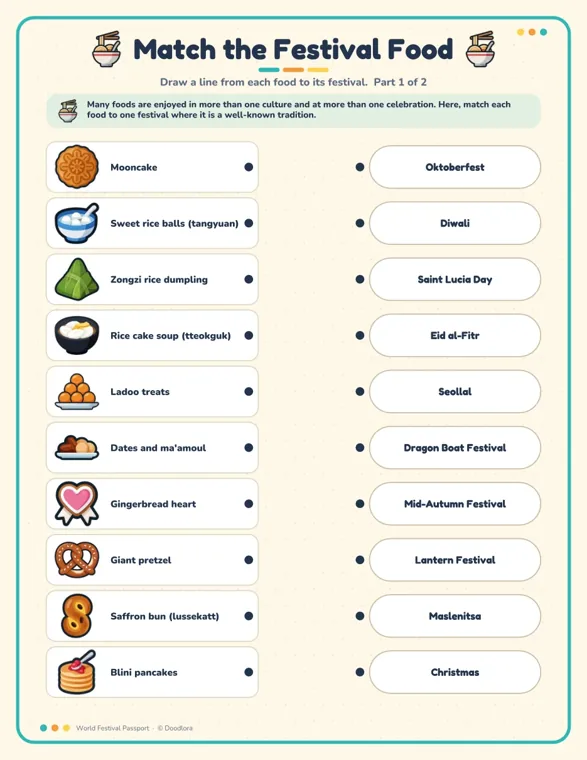
How to play: the child draws a line from each food to its festival. The page asks for one festival where each food is a well-known tradition, since many foods turn up at more than one.
How it ends: check the lines against the answer key at the back of the activity pages.
Where it goes wrong: children who know one Chinese festival food usually know mooncakes, and they match them to the New Year. Mooncakes belong to the Mid-Autumn Festival, and the triangle-shaped zongzi to the Dragon Boat Festival. The two New Year foods are tangyuan, sweet rice balls for the Lantern Festival, and tteokguk, the rice cake soup for Seollal, Korea’s New Year.
Fitting Lunar New Year into one class period or one afternoon
Few classrooms have time for all fifteen, and you don’t need them. A 45-minute class period fits four: the Nian story (5 minutes), headbands (15), the Great Race (15) and a chopsticks round (10). At home, an afternoon of envelopes and dumplings ends with the Nian game before dinner.
Ask the families in your class how they celebrate before you plan. Lunar New Year in Korea and Vietnam generally falls on the same day as the Chinese one.
Korean families mark Seollal, often with lucky bags rather than red envelopes. Vietnamese families celebrate Tết and call the lucky money lì xì. A child who says “that’s not how we do it” is usually describing one of these. Seollal and other new years that don’t begin on January 1 have their own section in holidays around the world for kids, which also plans a whole unit around them.
Printables from this article
Related articles
Clipart & SVG Cut Files
What Is Clipart? Meaning, Types and File Formats
What clipart is and where the name comes from, how line art, outlines, silhouettes and stencils differ, which files print or cut, and what a clipart license allows.
Clipart & SVG Cut Files
How to Use Clipart: PNG vs SVG, Print Size and Licenses
What's inside a clipart download, when to use the PNG or the SVG, how to size a design by the art you can see, and what the Personal and Commercial licenses allow.