What Is a Body System? Human Body Systems for Kids
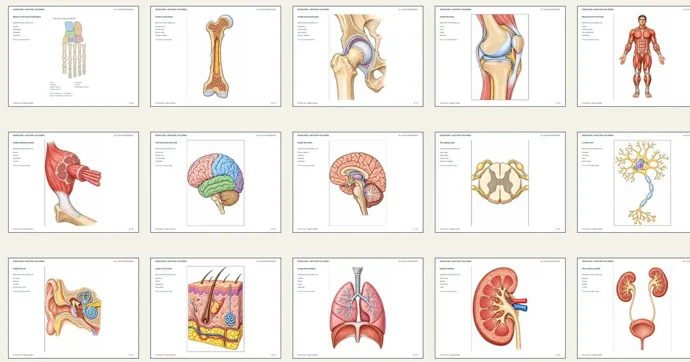
A system of the human body is a group of organs that work together on one big job, such as moving the body, moving blood or breaking down food. Wikipedia’s list of body systems puts the total at 11 to 12, because some books join two systems that others keep apart. For a child, the short version works best: bones hold you up, muscles move you, the heart and blood vessels carry blood, the lungs bring in air, the stomach and intestines handle food, and the brain and nerves run the whole thing.
Below you’ll find the common list in one table, then each system with its main parts, a way to explain it at different ages, and the coloring page that fits it. Every fact here is about how the body is built and what each part does. This page doesn’t cover illness or health advice; a doctor is the right person for those questions.
The 11 human body systems in one table
Most elementary science books use some version of the 11 systems below. Each row lists the parts that Wikipedia’s “List of systems of the human body” gives for that system, cut down to the ones a child can find on a diagram.
| System | Main parts | Main job |
|---|---|---|
| Skeletal | Bones, cartilage, ligaments, tendons | Holds the body up, protects organs, makes blood cells |
| Muscular | Skeletal, smooth and heart (cardiac) muscle | Moves the body and makes heat |
| Circulatory | Heart, arteries, veins, capillaries, blood | Carries blood, nutrients, oxygen and wastes around the body |
| Respiratory | Nose, mouth, throat, windpipe (trachea), bronchi, lungs, diaphragm | Breathing: oxygen in, carbon dioxide out |
| Digestive | Teeth, tongue, salivary glands, esophagus, stomach, liver, gallbladder, pancreas, small and large intestines | Breaks food down and takes in nutrients |
| Nervous | Brain, spinal cord, nerves, sense organs | Senses the world and controls the body |
| Urinary | Kidneys, ureters, bladder, urethra | Cleans the blood and gets rid of liquid waste (urine) |
| Integumentary | Skin, hair, nails, fat under the skin | Covers and protects the body, helps control temperature |
| Endocrine | Glands such as the pituitary, thyroid and adrenal glands | Sends messages around the body with hormones |
| Lymphatic and immune | Lymph nodes, lymph vessels, tonsils, spleen, thymus | Returns fluid to the blood and helps the body fight germs |
| Reproductive | Sex organs, which differ in female and male bodies | Makes it possible to have babies |
Wikipedia’s version has 12 rows because it lists the exocrine glands (tear glands, oil glands in the skin) on their own. It also notes that the endocrine and exocrine systems are sometimes counted together, which brings the total back to 11. Other books join the skeletal and muscular systems into one “musculoskeletal” system, or keep immune and lymphatic separate.
So if a worksheet says 11 and the library book says 12, neither is wrong. Tell your child that scientists group the same organs in slightly different ways, and pick one list for your lesson. Keep to that one list for the whole unit.
A second surprise for kids is that one organ can belong to two systems. The diaphragm is a muscle, yet it appears in the respiratory list because it pulls air into the lungs. The ovaries and testicles appear in both the endocrine list and the reproductive list. Pointing this out early saves arguments later about which box an organ “really” goes in.
How to explain body systems at different ages
The same topic needs a different depth for a 4-year-old and a 10-year-old. The age bands below are a rough plan; follow the child rather than the birthday.
| Age | What to explain | What to use |
|---|---|---|
| 3 to 5 | Outside parts first, then a few inside parts: brain, heart, lungs, stomach. One job per part. | Picture cards, a body puzzle, simple coloring pages |
| 5 to 7 | Organs that work as a team: food goes from mouth to stomach to intestines. Bones and muscles together. | Coloring pages with one system each, sorting cards by system |
| 8 to 10 | Most of the 11 systems by name, the main parts of each, and how two systems share a job | Labeled diagrams, a color key per system, short written answers |
| 11 and up | Inside views: heart chambers, layers of the stomach, inside a kidney | Detailed labeled coloring pages with real anatomical terms |
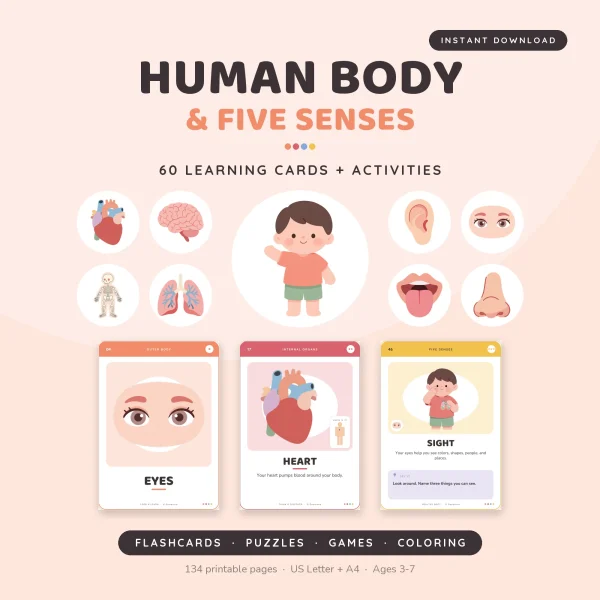
For preschoolers, a body system is too abstract on its own. Start with “Where is it?” and point to the spot on the child’s own body. Our human body and five senses activities set is built for ages 3 to 7 and follows that order. Its Level 1 cards show a picture and a name, and the Level 2 cards add one job in one sentence, like “Your heart pumps blood around your body.” The pack’s parent guide suggests stacking its three puzzles: My Body first, then My Skeleton on top, then Inside My Body. That shows a small child what sits under the skin, with bones giving shape and organs doing the work.
If you’re running a preschool “all about me” theme, the body fits next to it well. Our all about me crafts for preschool cover the outside of the body and the senses, so the inside parts can come in the following week.
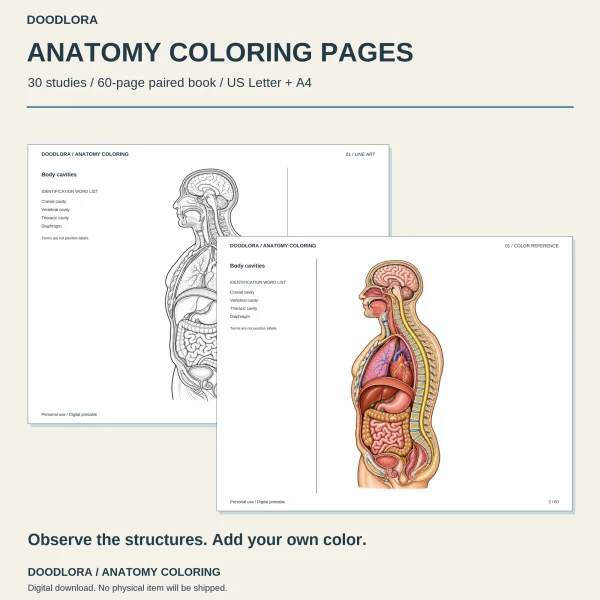
Children from about 8 upward can handle real terms. Kids like saying “esophagus” and “ventricle,” and a 9-year-old who can say “the small intestine has three parts” has learned something a cartoon can’t teach. Our detailed anatomy coloring pages are drawn as realistic line art with anatomical terms, written for older students and adults. A child in fourth or fifth grade can color them if an adult reads the terms aloud.
The skeletal and muscular systems: bones and muscles
The skeletal system is the body’s frame. KidsHealth (Nemours) says the adult human body has 206 bones, while a baby has about 300 at birth that later fuse together. That fact surprises most kids, and it gives them a reason to look at a skeleton picture closely: some of the bones they see on the page started as two or three.
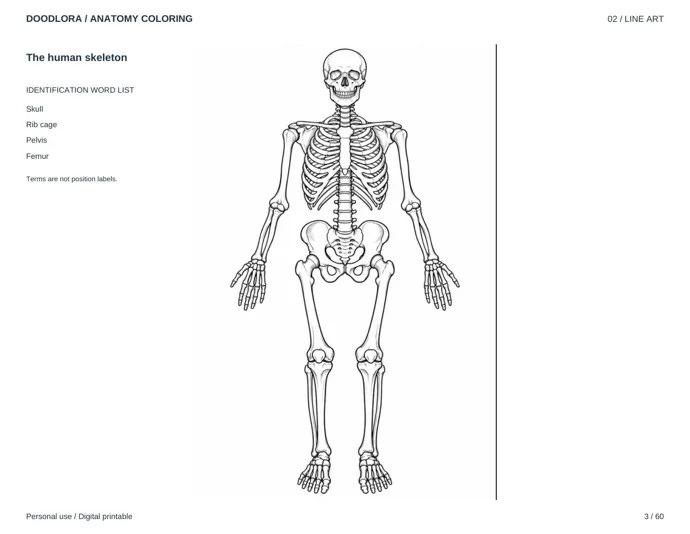
Study 02 of our anatomy coloring book is the whole skeleton from the front, and studies 03 to 17 zoom in on single parts, such as the skull from two sides, the spine, the rib cage, the pelvis, the hand, the knee and the inside of a long bone. Each study prints twice in a row, first as line art and then as a color reference. The word list on the left side is a list of terms to find, not labels. The page itself says “Terms are not position labels,” so a child needs the color page or an adult to locate each bone.
The muscular system sits on top of the skeleton and moves it. KidsHealth counts more than 600 muscles in the body and sorts them into three types:
- Skeletal muscles attach to bones and move when you decide to move, like kicking a ball.
- Smooth muscles line organs such as the stomach and bladder and work without you thinking about them.
- Cardiac muscle makes up the heart and also works on its own.
To show how the two systems share a job, have your child bend an arm and feel the upper arm with the other hand. The bones stay the same length; the muscle on the front gets shorter and fatter. Studies 18 to 20 in the anatomy book show the muscles from the front, from the back and inside one muscle, so an older child can color the same arm in the skeleton page and the muscle page and compare them.
The circulatory system: heart, blood vessels and blood
The circulatory system moves blood around the body. Its parts are the heart, the blood vessels and the blood itself. KidsHealth explains it with the vessels: arteries carry blood away from the heart, and veins carry it back. A simple way to remember it is “A for away.”
The heart has four chambers, two on each side. The two on top are the atria (one is an atrium), and the two on the bottom are the ventricles. A thick wall of muscle called the septum runs down the middle and keeps the left and right sides apart. Four valves act like doors that close behind the blood so it can’t flow backward.
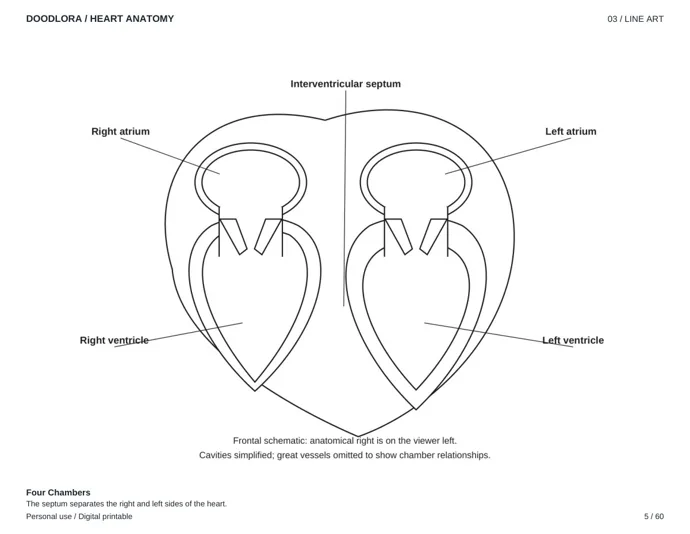
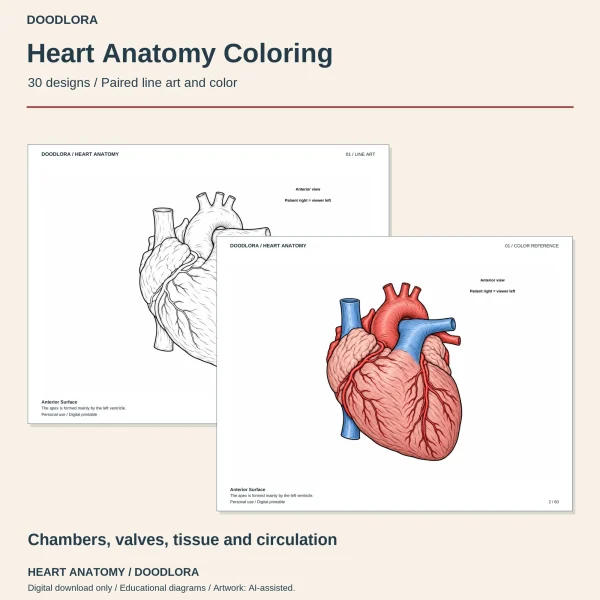
Here is the part that trips up almost every child: on a heart diagram, the “right atrium” is on the left side of the page. Diagrams show the body as if it were facing you, so its right is on your left. Design 03 in our human heart coloring pages says this in a note under the drawing. Before your child colors, have them stand facing you and ask which of their hands is closest to your left hand. Ten seconds of this prevents a whole page of colored-in mistakes.
The heart set has 30 designs, each printed as line art and then in color. Designs 21 to 23 follow blood on its two loops: from the heart to the lungs and back, then from the heart to the rest of the body and back. Design 23, “Trace One Complete Journey,” works well as the last page of a circulatory lesson, because the child traces with a finger before coloring.
The respiratory system: from the nose to the lungs
The respiratory system brings oxygen into the body and sends carbon dioxide out. KidsHealth traces the path of the air like this: in through the nose or mouth, down the trachea (windpipe), which splits into two tubes called bronchi, one going to each lung. Inside the lungs the bronchi branch into smaller and smaller tubes and end in tiny air sacs called alveoli. That’s where oxygen passes into the blood, and each person has hundreds of millions of them.
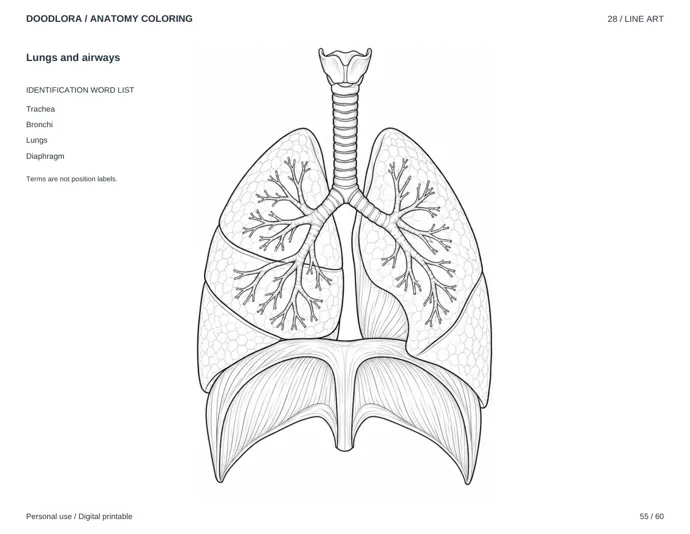
The branching tubes look like an upside-down tree, and kids remember that picture. On study 28 of the anatomy book, color the trachea and every branch in one color and the lung tissue in another. The tree shape jumps out once the two are different.
The diaphragm, the big muscle under the lungs, is the link to the muscular system. Have your child put a hand on the belly and take a slow breath: the belly moves out because the diaphragm pulls down and makes room for air. That is also why the respiratory and circulatory systems are best taught one after the other. The lungs bring in the oxygen, and the blood carries it everywhere.
The digestive system: the route food takes
The digestive system breaks food down into nutrients the body can use. The National Institute of Diabetes and Digestive and Kidney Diseases (NIDDK), part of NIH, describes it as a long tube with helpers along the way. The tube runs through the mouth, esophagus, stomach, small intestine and large intestine. Muscles in the walls squeeze food forward in waves, a movement called peristalsis.
NIDDK gives the parts in order. The small intestine has three parts: the duodenum, the jejunum and the ileum. The large intestine includes the appendix, cecum, colon and rectum. Three helper organs sit beside the tube: the liver makes bile, which helps digest fats; the gallbladder stores the bile; and the pancreas makes a digestive juice that it sends into the small intestine. The large intestine takes in water, and what is left becomes waste.
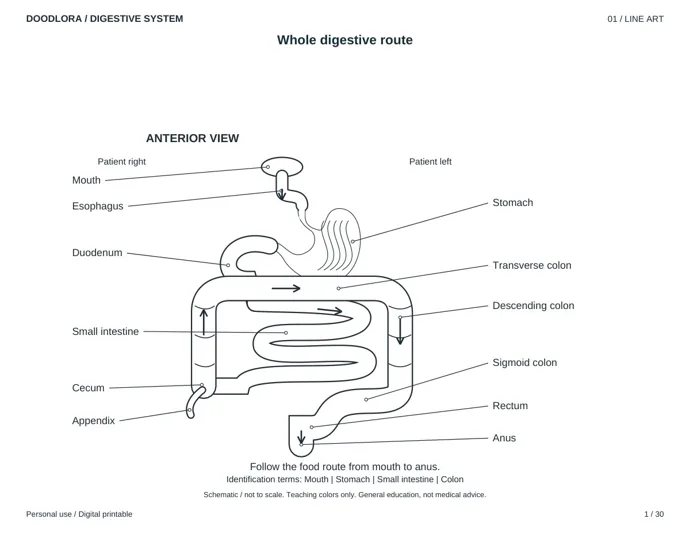
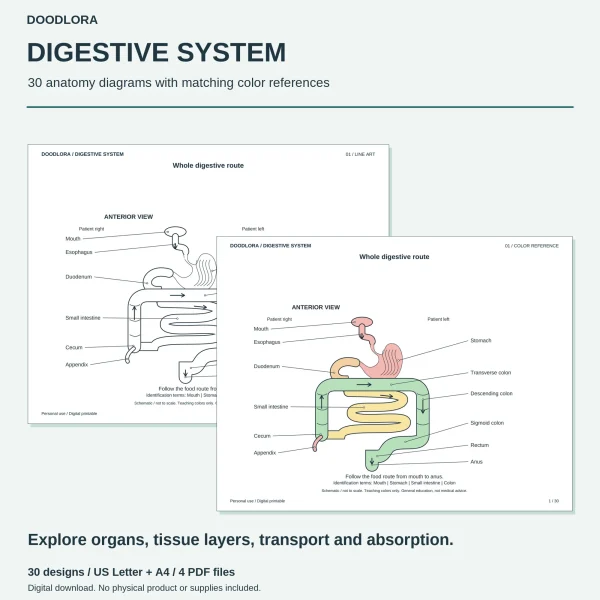
Page 01 of our digestive system coloring pages shows the whole route with arrows, and it marks “Patient right” and “Patient left” at the top. That is the same flipped view as the heart diagram, so the stomach appears on the right of the page even though it sits on the left side of the body. Each of the 30 pages has a one-line caption and four terms to find, and a separate file holds a color reference for every page.
A tracing game makes this system stick. Pick one food, such as a bite of apple, and have your child trace its whole trip on page 01 while naming each part out loud. Then color the parts in the order the food reaches them. Younger children can do the same trip on a simpler page; the “My Digestive System” coloring page in the five senses set has the stomach and intestines with no labels.
The nervous system and the five senses
The nervous system is the body’s control center and messenger service. Its parts are the brain, the spinal cord, the nerves and the sense organs. KidsHealth says the nervous system is made up of millions and millions of neurons, tiny cells that connect to each other. The spinal cord runs down inside the spine and links the brain to nerves going to the rest of the body.
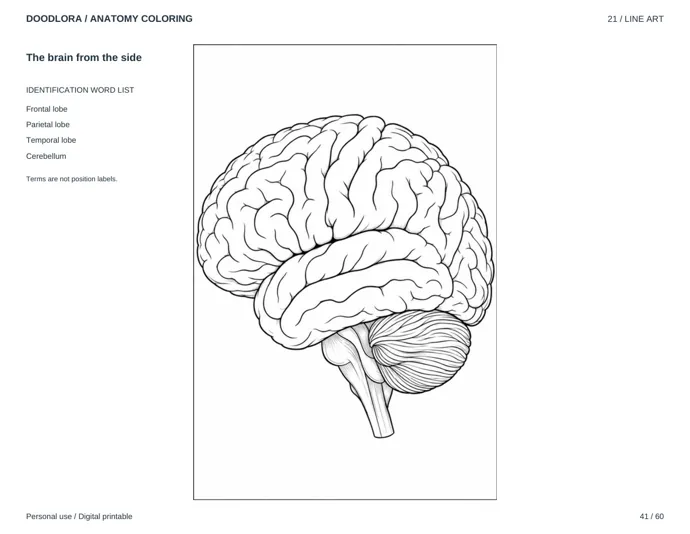
The cerebrum, the largest part of the brain, has two halves and controls movement, speech, thinking and what we see and hear. The cerebellum sits at the back, under the cerebrum, and the brain stem connects the brain to the spinal cord. Studies 21 to 24 of the anatomy book cover the brain from the side, the inside of the brain, the spinal cord and a single nerve cell. Studies 25 to 27 add the eye, the ear and the skin, so an older child can follow a message from a sense organ back to the brain.
For children under 7, the senses are the easiest door into the nervous system. Each sense has an organ that sends messages to the brain: the eyes see, the ears hear, the nose smells, the tongue tastes and the skin feels.
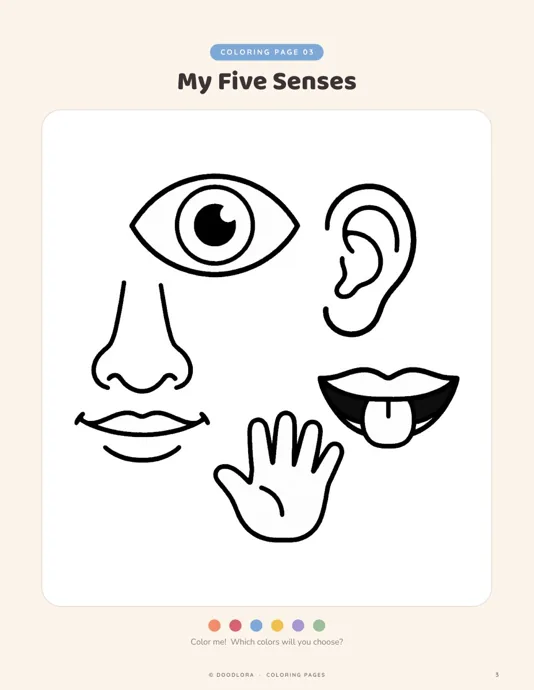
Coloring page 03 in our five senses set has six pictures for five senses: an eye, an ear, a nose, a hand, a pair of closed lips and an open mouth with the tongue out. A child who counts carefully will notice the extra one. Tell them both mouth pictures stand for taste and talking, and the tongue picture is the one that does the tasting. The same set has sorting mats for the five senses, which suit a short game after the coloring.
The urinary, skin, endocrine, immune and reproductive systems
These five systems come up less in early lessons, but older children ask about them. Here is what each one is made of, in one or two sentences you can say out loud.
- Urinary system. The two kidneys filter waste out of the blood and make urine. KidsHealth says each kidney is about 5 inches (about 13 cm) long, about the size of a computer mouse. The urine flows down a tube called the ureter into the bladder, which holds it, and leaves through another tube called the urethra. Studies 29 and 30 of the anatomy book show the inside of a kidney and the whole urinary system.
- Integumentary system (skin, hair and nails). KidsHealth describes three layers of skin: the epidermis on the outside, the dermis below it and the subcutaneous layer at the bottom. Study 27 of the anatomy book is a slice through those layers.
- Endocrine system. Glands such as the pituitary, thyroid and adrenal glands send chemical messages called hormones through the blood, while the nervous system sends its messages along nerves.
- Lymphatic and immune system. Lymph vessels and lymph nodes return fluid to the blood, and parts such as the spleen, thymus and tonsils help the body fight germs.
- Reproductive system. These organs make it possible to have babies, and they differ in female and male bodies. Many families and schools save this system for a separate conversation; follow your school’s plan or your own.
How body systems work together
No system works alone, and this idea is the best ending for a body systems unit. The digestive system breaks food into nutrients, and the circulatory system carries those nutrients to every part of the body. The respiratory system brings in oxygen, and the blood carries that too. The nervous system tells the muscles when to move, and the muscles pull on the bones.
A quick way to test understanding: give your child a job and ask which two systems share it. “Running for the bus” needs the muscles, bones, lungs, heart and brain. “Eating lunch” needs the teeth and stomach, and then the blood to carry what was eaten. If your child can name two systems for each job, they understand the main idea.
A body systems lesson with coloring pages
One system per session works better than a whole-body day. A 30- to 40-minute session fits a classroom period or an afternoon at home; these times are our planning suggestion, so shorten them for younger children.
Before you start. Print only the pages for that day’s system. The detailed anatomy, heart and digestive pages are landscape pages, so set the printer to landscape and “fit to page.” Our guide to printing coloring pages at home explains why thin lines sometimes print gray and how to fix it. You’ll need colored pencils or fine markers, because crayons fill in the small parts of a labeled diagram.
Make one color key for the whole unit. Choose one color per system and keep it on a card at the table: for example, tan for bones, red for muscles, pink and blue for heart and blood vessels. The colors on our pages are teaching colors, as the digestive set notes on every page, so the real organ doesn’t have to match. What matters is that the stomach is the same color on Tuesday as on Friday.
Run the session in four steps.
- Read the system’s main job from the table above and point to where it is on the body.
- Name the parts on the page together. For the anatomy book, use the color reference page to find each term in the word list.
- Color one part at a time, saying its name each time.
- Finish with one question: “What would happen to the food, the air or the blood at this step?” Or go back to “Which other system helps with this job?”
Older kids and layering. Children who want the bones or muscles to look rounded can try light layers of colored pencil. Our colored pencil blending guide shows how to layer two greens in a leaf, and the same layering works on a muscle or a lung.
Teaching at home. If you’re putting together a science unit for homeschool, one system a week fits most schedules, with the “work together” lesson at the end. Our post on how to start homeschooling covers record keeping, and a folder of finished coloring pages makes a simple record of the unit.
Common questions about human body systems
How many systems does the human body have?
Most kids’ books list 11 organ systems. Wikipedia gives 11 to 12, depending on whether the exocrine glands count as their own system or join the endocrine system.
How many bones and muscles are in the human body?
KidsHealth says a baby has about 300 bones at birth, which fuse into the 206 bones of an adult. It counts more than 600 muscles in the human body.
Can an organ belong to more than one system?
Yes. The diaphragm is a muscle and also part of the respiratory system. The ovaries and testicles appear in both the endocrine and the reproductive lists on Wikipedia’s list of body systems.
What age should kids learn about body systems?
Children of 3 to 5 can learn a handful of organs and one job each. From about 8, most children can learn the systems by name and match organs to them. Detailed labeled diagrams suit children from about 10 and up, with an adult nearby for the terms.
Printables from this article
Related articles
Printable Coloring Pages
Types of Christmas Trees: Fir, Spruce, Pine, Real vs Fake
Most real Christmas trees sold in the US are firs, spruces, pines or cypress. Firs have soft needles and the strongest scent, spruces have stiff branches for heavy ornaments, pines hold their needles longest, and Leyland cypress has almost no scent. Here is how each one looks, smells and lasts, and how to keep it fresh and safe.
Printable Coloring Pages
How to Draw a Strawberry: Easy, Cut, Cute and Realistic
Build the berry from a cone with wide shoulders, lay the cap over the top, set the seeds in offset rows that shrink toward the edges, save a white shine spot, and then try a cut berry, a cute face or a shaded realistic one.
Printable Coloring Pages
The 5 Food Groups: MyPlate, the Food Pyramid and Examples
The five food groups the USDA's MyPlate used from 2011 to January 2026 are fruits, vegetables, grains, protein foods and dairy. Here is what MyPlate listed in each one, the foods that land in a surprising group, how the food pyramid turned into MyPlate and then a new pyramid, and a sorting activity built on coloring pages.