All About Me Crafts for Preschool: Theme Activities & Ideas
The best preschool all about me crafts let a child show one true thing about themselves with their own hands: the color of their eyes, the letters in their name, the size of their hand this year. Choose by the time you’ve got and the mess you can tolerate. A face made from cut paper takes ten minutes at a kitchen table. A life-size body tracing needs floor space and most of a morning.
| Craft | Best age | Time | Mess | Needs an adult for |
|---|---|---|---|---|
| Paper plate self-portrait | 3–5 | 20–30 min | Medium | Cutting yarn hair |
| Mirror self-portrait | 4–5 | 15 min | Low | Holding the mirror steady |
| Build-a-face cut and paste | 2.5–5 | 10 min | Low | Cutting the pieces |
| Life-size body tracing | 3–5 | 45–60 min | Medium | Tracing the outline |
| Body puzzle | 3–5 | 15 min | Low | Cutting for younger 3s |
| Handprint and footprint page | 2.5–5 | 15 min plus drying | High | Painting the hand or foot |
| Fingerprint picture | 3–5 | 15 min | Medium | Wiping fingers between colors |
| Name collage | 3–5 | 20 min | Low | Writing the name to copy |
| Favorite things collage | 3–5 | 20–30 min | Low | Finding and cutting pictures |
| My family house | 3–5 | 20 min | Low | Writing names under faces |
| Height strip | 2.5–5 | 10 min | Low | Measuring |
| Feelings plate faces | 3–5 | 20 min | Medium | Cutting the plate in half |
| Five senses sort and booklet | 3–5 | 20 min | Low | Cutting picture cards |
| All about me book | 3–5 | Several short sittings | Low | Stapling |
If you only do one, make the build-a-face craft, then finish with the all about me book.
Together they cover appearance and personality, and both fit into short sittings.
Before you set anything out
Every craft below works with one child at a kitchen table or a class of 15 split into small groups. A little preparation decides whether it goes smoothly.
Use washable paint, and glue sticks rather than liquid glue, with the youngest children. A glue stick puts glue only where the child presses, so pieces don’t slide around on a wet puddle.
Do the precise cutting yourself for 2 and 3 year olds. Small pieces along a dashed line are difficult for new scissor users, and a ragged eye or mouth is upsetting to a child who wanted it to look right. With older preschoolers, hand over the big pieces and keep the small ones for yourself.
Leave out googly eyes, beads and buttons with any child who still puts things in their mouth. Drawn eyes and paper circles do the same job.
Write the child’s name on the back of every piece before anyone starts.
In a classroom, ten paper plate faces with yellow yarn hair look identical by lunchtime.
Print templates on cardstock if they’ll be cut into pieces or reused. Our guide on how to print coloring pages covers paper weight, scaling, and Letter versus A4 when a page comes out cropped.
Crafts about how I look
Most all about me preschool theme units start here. Each craft begins with the child noticing something about their own face or body, so keep a mirror nearby.
1. Paper plate self-portrait
One child or a group of 4–6 · 20–30 minutes · paper plates, crayons or washable paint, yarn, glue stick, scissors for the adult. Hold up a mirror and ask what color their eyes are, then their hair. The child colors the plate to match their skin, draws the eyes, nose and mouth, and glues on yarn hair you’ve cut to length. It’s finished when the face has all its parts and the child says it looks like them.
The snag is hair. A child with curly hair often wants curly yarn and there isn’t any. Twist the yarn around a pencil before gluing, or let them draw the curls in crayon instead.
2. Mirror self-portrait
One child at a time · about 15 minutes · a hand mirror or a mirror propped at table height, paper, crayons or markers. Ask the child to look, then draw only what they see: the outline of the face first, then the eyes, then everything else. Stop when they say it’s done, and date the back.
Repeat it at the end of the year. The two drawings side by side show the child’s development better than any description you could write. Four and five year olds get more from it than threes, who often draw a circle with a few lines and move on.
That still counts.
3. Build-a-face cut and paste
One child or pairs · about 10 minutes · a printed face page, scissors for the adult, glue stick or nothing if you’d like to reuse it. Cut out the eyes, nose, mouth, ears and hair. The child places each part on the blank face, says its name, and glues it down or leaves it loose to play again. It’s done when every part is on the face.
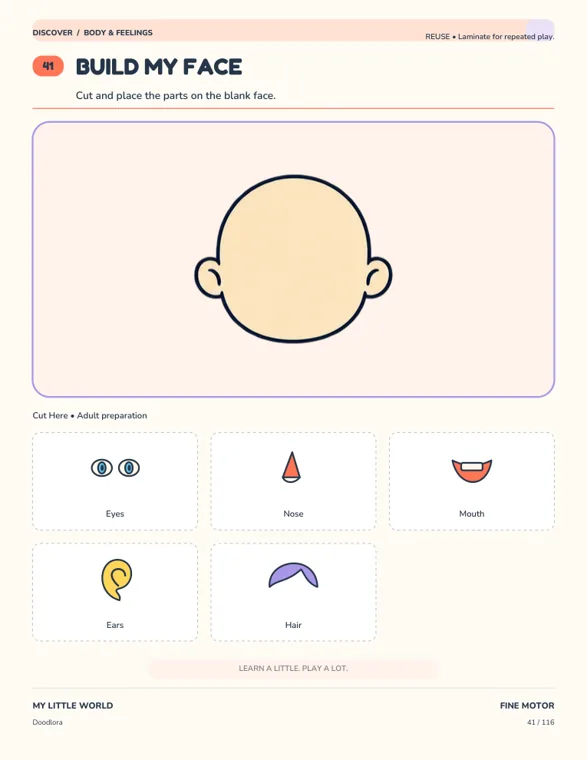
Our preschool activity book has three versions of this. Page 41, shown above, has one set of five parts. Page 48 mixes three eyes, three mouths, three hair styles and two pairs of glasses, so a child can make a face that matches their own or a silly one. Page 103 repeats the face parts on a separate cut-out sheet, so you can cut those and keep the play page whole.
The catch is that the parts are cartoon, not realistic. A child who wants their own eye color or hair color can color the piece before gluing it.
4. Life-size body tracing
One child at a time, or pairs taking turns · 45–60 minutes across two sittings · a roll of butcher paper or taped-together sheets, a thick marker, crayons, scrap fabric or paper for clothes. The child lies flat on the paper with arms a little away from the body. Trace around them with the marker. Then they color in their face, hair and clothes, and you label a few body parts together: head, arms, hands, legs, feet.
Children wriggle while you trace, especially around the hands. Trace the hands last and quickly, or trace them separately on a smaller sheet and glue them on. In a class, trace everyone on one day and color on the next, so nobody’s waiting on the floor.
5. Body puzzle
One child or a small group · about 15 minutes · a printed puzzle on cardstock, scissors, glue stick. Cut the puzzle into its pieces. The child places each one on the board and names the part it shows. Glue the pieces down when they fit, or laminate the board and keep them loose.
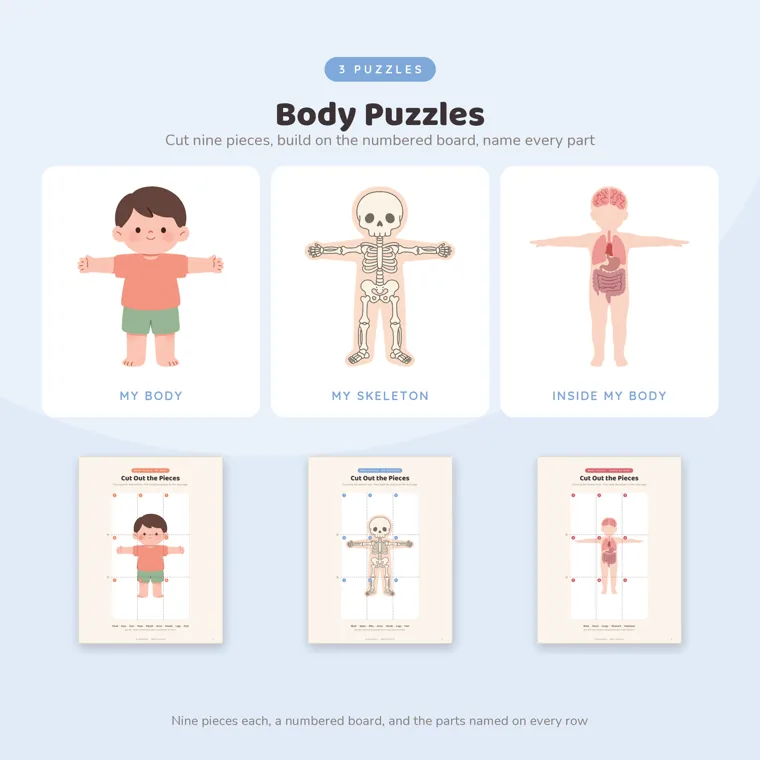
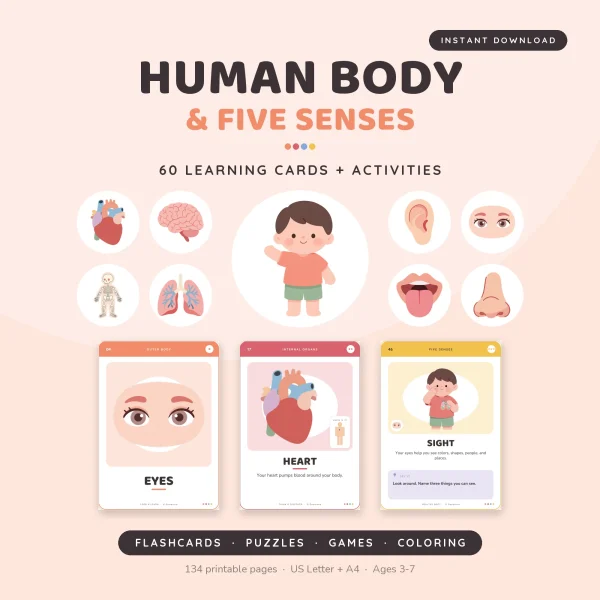
The My Body puzzle in our five senses set is nine pieces, and the cut-out page lists the parts to say: head, eyes, ears, nose, mouth, arms, hands, legs and feet. Younger children match the numbers on the pieces to the numbered board. The parent guide suggests older children cover the numbers and build from the picture alone, which turns it into a real puzzle again.
Pin the finished body beside the child’s life-size tracing. It’s the same set of parts at two sizes, and children enjoy finding them on both.
6. Handprint and footprint page
One child at a time · about 15 minutes plus drying · washable paint, a brush, cardstock, wipes and a bowl of water nearby. Brush paint onto the child’s palm and fingers, then press the hand flat on the cardstock and lift straight up. Do the foot the same way on a second sheet while the child sits. Write the name and date under each print.
A brush gives a cleaner print than dipping the hand in a tray, because the paint goes on thin. Thick paint fills the gaps between fingers and the print comes out as a blob. Have the wipes open before you start.
A painted foot walking to the sink is the real hazard.
7. Fingerprint picture
One child or a group of 4 · about 15 minutes · washable ink pads or a little paint on a plate, paper, a fine marker. The child presses a fingertip on the ink, then on the paper, to make a few prints. Use the marker to turn each print into something: a bug, a balloon, a face for each person in the family. It’s finished when every print has become something.
Kids press too hard and smear. Demonstrate one light press-and-lift first, and keep a damp cloth for wiping between colors.
Crafts about what I like and who I’m with
The next four crafts move from the child’s body to their name, their favorites and their family. They suit four and five year olds best, since they ask for decisions and explanations.
8. Name collage
One child or a group of 4–6 · about 20 minutes · paper, glue stick, crayons, and letter cut-outs, magazine letters or letter stickers. Write the child’s name in large letters across the top of a sheet. The child finds each letter from the pile and glues it below yours in order, then decorates around it. It’s finished when the whole name is copied.
Our preschool book has an alphabet cut-out sheet on page 101, A to Z on one page, which saves hunting through magazines. Print an extra copy for names with a repeated letter, like Anna or Bobby, because the sheet has each letter only once.
9. Favorite things collage
One child or a group · 20–30 minutes · old magazines or catalogs, safety scissors, glue stick, paper. Ask four questions: favorite color, food, animal and toy. The child finds or draws one picture for each and glues them onto a sheet with their name in the middle. It’s done when there’s an answer for all four.
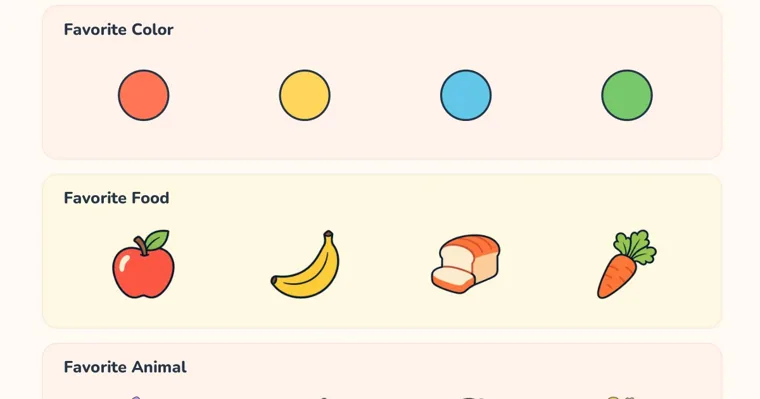
If magazines aren’t handy, page 5 of our preschool book does the same thing as a circle-one page, with four rows (color, food, animal, toy) and four choices in each. It’s a good alternative for threes who aren’t ready to cut. For more layouts, our collage ideas list has an all about me page with the name cut from headlines.
10. My family house
One child or a group · about 20 minutes · paper, a simple house shape drawn or cut by you, crayons, glue stick. The child draws one face in each window for the people who live with them, and you write the names underneath. Pets count. It’s done when every person in the home has a window.
Families come in many shapes, and a fixed template with “Mom” and “Dad” labels leaves some children out. Use blank windows and let the child decide who goes in them. Give extra windows to a child who wants grandparents or a second home.
11. Height strip
One child at a time · about 10 minutes · a long strip of paper or ribbon, tape, marker, crayons. Stand the child against a wall with the strip taped behind them. Mark the top of the head, cut the strip at the mark, and write the name and date on it. The child decorates their strip, and the strips hang side by side on the wall.
Measure again at the end of the school year and tape the new strip beside the old one. Children love seeing the difference. Take shoes off both times, or the comparison isn’t fair.
Crafts about how I feel and what I notice
Feelings and senses are part of most all about me activities for preschoolers. These two crafts give a child vocabulary for both.
12. Feelings plate faces
One child or a group of 4–6 · about 20 minutes · two paper plates per child, crayons, a craft stick, glue or tape. Each child draws a happy face on one plate and a sad face on the other. Tape them back to back on a craft stick to make a two-sided face. Ask how they’re feeling right now, and the child turns the stick to show you.
Our preschool book uses six feelings on its check-in page (page 4): happy, sad, angry, sleepy, surprised and calm. Start with two and add more plates over the week. Calm is the one children rarely have a picture for, so draw that one together.
13. Five senses sort and booklet
One child or a small group · about 20 minutes · five sheets of paper or printed sorting mats, picture cards, glue stick, stapler. Label five sheets with see, hear, smell, taste and touch. Cut out small pictures, and the child decides which sense notices each one and glues it on that sheet. Staple the five sheets into a booklet with “My Five Senses” on the cover.
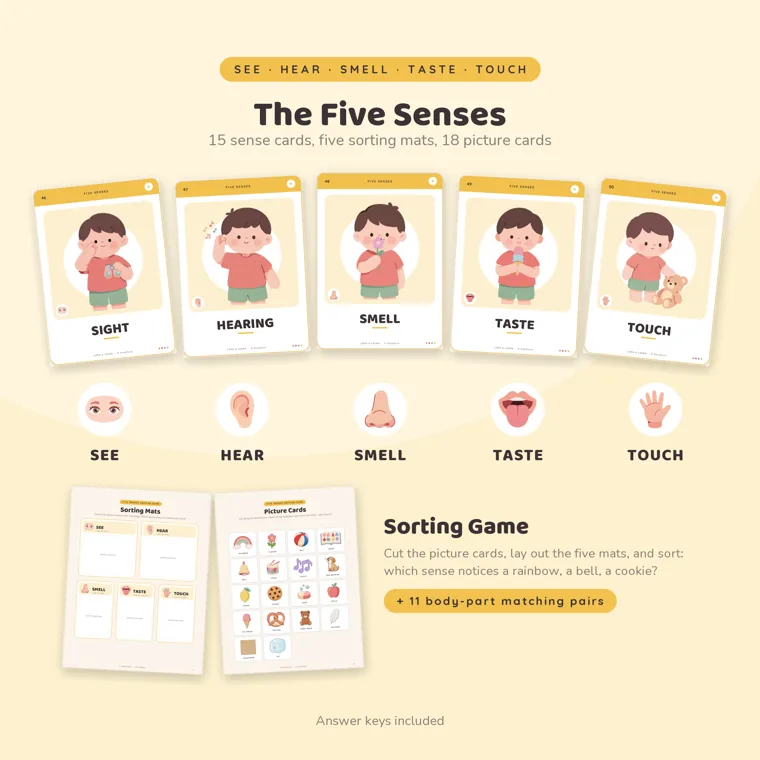
Our five senses set has the five sorting mats ready, each labeled with its body part (“I use my eyes,” “I use my ears” and so on), plus a page of 18 picture cards and an answer key. Expect disagreements about some cards. A flower can be seen and smelled, and a lemon is both smell and taste. The answer key gives one good answer per card and says many things fit more than one sense, so let the child explain the choice instead of marking it wrong.
The parent guide in that set adds a feely bag for touch: hide a teddy, a spoon, a sponge and a stone in a bag, and the child describes each one without looking. It’s a good warm-up before the sort.
Finish with an all about me book
14. All about me book
One child · 5–10 minutes a sitting over a week · printed pages or folded paper, crayons, stapler, a cover sheet. Collect one page a day, then staple them together on the last day. A child can’t fill a whole book in one go, and they shouldn’t have to.
A simple order that works:
- Cover: name and a self-portrait (craft 2 fits here).
- All about me: name, age, favorite food, favorite animal.
- How I feel today: circle or draw one face.
- My favorite things.
- My morning: what I do after I wake up.
- Handprint or a traced hand, with the date.
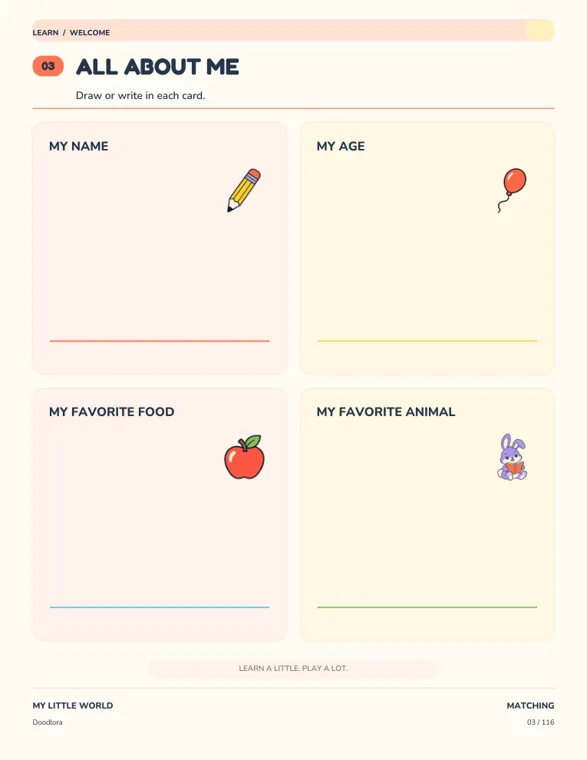
Pages 2 to 6 of our preschool book are built for this. Page 2 is a this-book-belongs-to page with name, age, favorite color and favorite animal. Page 3 is the all about me page shown above. Page 4 is the feelings check-in, page 5 the favorite things, and page 6 a six-step morning routine to say in order, from wake up to go to school. Add the handprint page and you’ve got a book.
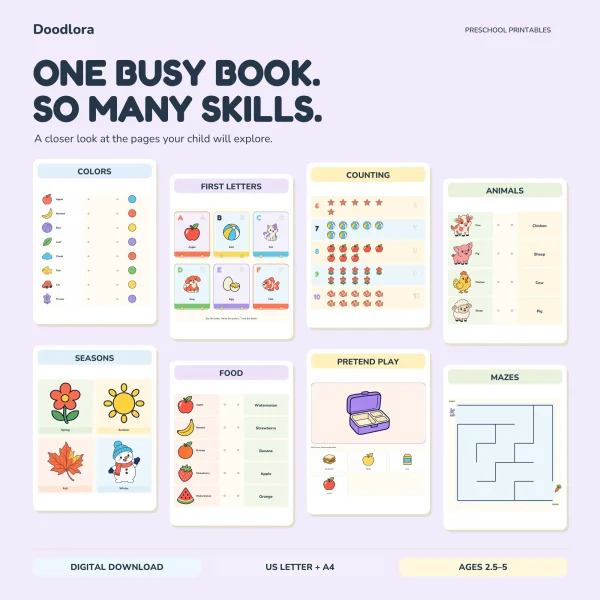
The book’s cover marks it for ages 2.5 to 5. The rest of its 116 pages go on to colors, letters, numbers and animals, so the same printout carries on past the all about me week.
For a child who isn’t writing yet, the child draws in the box and you write the word they say on the line. Write exactly their words.
“I like noodles with nothing” is a better answer to keep than “pasta.”
Running an all about me week in a class
A week works better than a single craft day. Children who were absent still get to finish their book, and nobody’s rushed.
- Monday. Mirror self-portraits for the book cover. Start the height strips.
- Tuesday. Build-a-face and the all about me page.
- Wednesday. Handprints. Do them in groups of four while the rest of the class has free play.
- Thursday. Feelings plates and the five senses sort.
- Friday. Family houses, then staple the books and share.
For sharing, a short circle where each child holds up one page works for preschoolers. Older classes can try the All About Me Bag from our icebreaker games for kids, where children bring three small things from home.
Before you hang anything in a hallway, check what the crafts reveal. Full names with birthdays and photos are the details families sometimes prefer to keep off a public wall. First names and a drawing are usually enough.
At home with a 3 year old, one craft a day after breakfast is plenty. Our activities for 3 year olds has more table activities in the same spirit.
Printables from this article
Related articles
Kids Activity Books
Letter M Craft Ideas: Monkey, Mouse & Mushroom for Preschool
Twelve letter M crafts grouped by who is at the table, from a foil-print moon for one toddler to monkeys swinging on a paper-chain vine for a whole class, with ages, minutes, supplies, steps and where each one tends to go wrong.
Kids Activity Books
Letter R Crafts for Preschool: Raccoon, Rabbit & Rainbow
Eleven letter R crafts grouped by what the child is into, from a sticky tissue rainbow for 2-year-olds to a raccoon shadow puppet, with ages, minutes, supplies, steps and the usual slip.
Kids Activity Books
Letter D Crafts: Dinosaur, Dog & Donut Ideas for Preschool
Eleven letter D crafts sorted by age, from a play dough D for 2-year-olds to a fuse bead dinosaur footprint, with supplies, times, steps and the snag in each one.