How to Start Homeschooling: Steps for Beginners
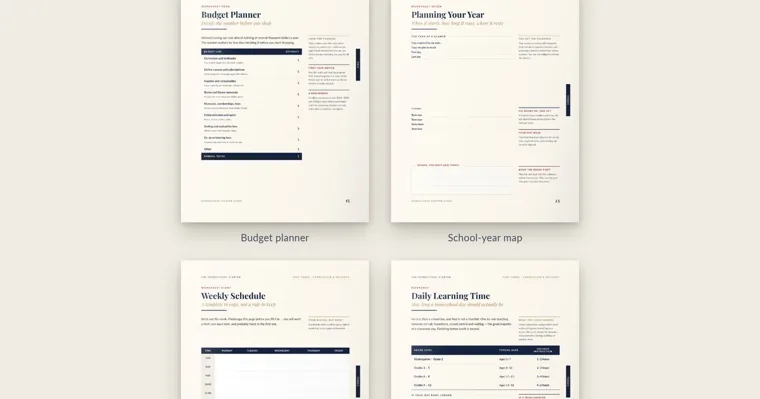
To start homeschooling, read your own state’s homeschool law first, file whatever notice it asks for, and buy curriculum only after that. If your child is enrolled in a school right now, withdraw in writing before or alongside that notice, and request the school records on the way out. The rest is ordinary family work: a short daily routine, a binder of records, a weekly plan for seeing other kids, and a first month that runs slower than you expect.
That order is how we built our Homeschool Starter Guide, and this page walks through each step for a family starting from zero, whether it’s August or the middle of the school year. Nothing here is legal advice. Homeschool rules differ by state and get revised, so your state’s own education pages have the final word.
Start with your state’s homeschool law
There is no single national homeschool law in the United States. The Supreme Court has largely left the question to the states, and the level and type of regulation varies widely from one state to the next. So the first job is finding your state’s rules, not reading a general checklist.
Go to your state department of education’s website and look for its homeschool page. If searching “homeschool” turns up nothing, try the other names state laws use: home instruction, alternative instruction or competent private instruction. State pages are usually short, often a page or two. Read the official text once yourself rather than relying on a friend’s summary from another state, or a forum post from a few years ago.
While you read, write down the answers to these questions:
- Do you have to notify anyone? Many states require a notice to the local school district or the state, and many want it again every year.
- Do you need approval before you start? Two states, Rhode Island and Massachusetts, require approval from the local school district before homeschooling begins.
- Is there a yearly assessment? Some states ask for a standardized test or an annual review of a portfolio of work. Florida asks for a yearly assessment of the child’s work, and Oregon requires a standardized test at the end of 3rd, 5th, 8th and 10th grade.
- Is there a deadline, and which documents go with the notice? Put the date in your calendar the day you find it.
- Do you have to tell anyone when you stop? Florida and Arizona require a notice when you end homeschooling.
It also helps to know which kind of law your state has, because that tells you which statute to read:
| How the state law is built | Examples | Where your rules come from |
|---|---|---|
| Homeschool treated as a private school | California, Indiana, Texas | The rules for private (usually non-accredited) schools |
| Compulsory attendance law, no homeschool wording | New Jersey, Maryland | The wording of the attendance statute itself |
| A statute written for homeschooling | Maine, New Hampshire, Iowa | The homeschool or home instruction statute |
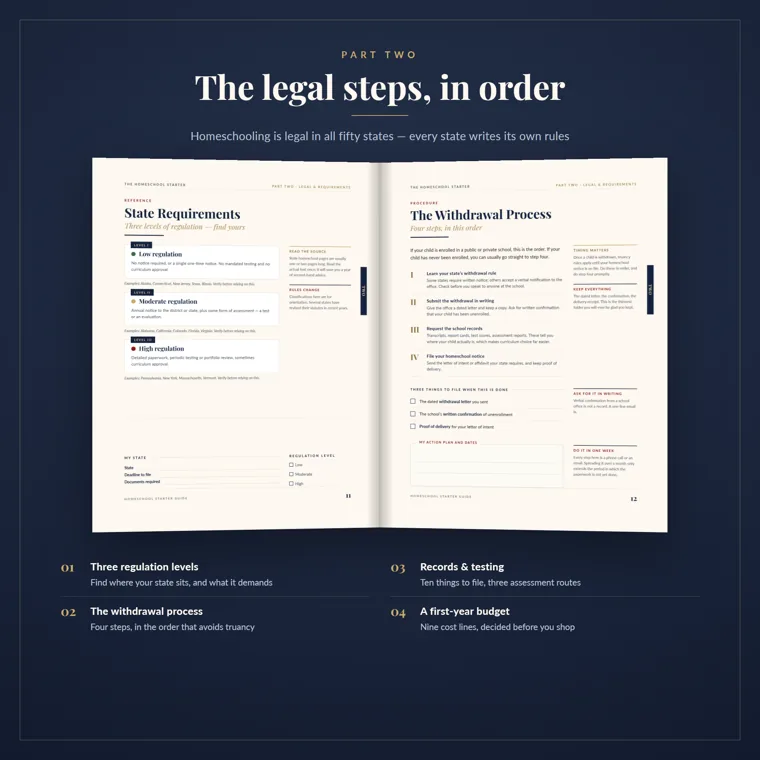
The classification comes from the Wikipedia article on homeschooling in the United States. Our Homeschool Starter Guide has a State Requirements page with a blank row for your state’s filing deadline and required documents. Fill that row in from the official page and not from the examples printed above it, since state laws change.
Leaving school in the middle of the year
If your child is enrolled in a public or private school, the order matters more than the speed. Work through these four steps in sequence:
- Learn your state’s withdrawal rule. Some states want written notice; others accept a verbal notice to the school office. Check this before you talk to anyone at the school.
- Withdraw in writing. Hand the office a dated letter, keep a copy, and ask for written confirmation that your child is no longer enrolled.
- Request the school records. Ask for transcripts, report cards, test scores and any assessment reports. They show where your child actually is, which makes choosing curriculum much easier.
- File your homeschool notice. Send the letter of intent or affidavit your state requires, and keep proof that it arrived.
Do step four promptly. Until the notice is on file, your child can look like a student who simply stopped coming to school. In Texas, for example, the only notice the law asks for is a single letter to the district when a child leaves public school, which is exactly why that letter shouldn’t wait. If your child has never been enrolled, you can usually skip straight to step four.
Keep a thin folder with three things in it: the dated withdrawal letter, the school’s written confirmation and the proof of delivery for your notice. A phone call to the office is not a record; a one-line email back from the school is.
A child who leaves school partway through the year often needs several weeks to settle. Plan those first weeks lightly, with reading aloud, library trips and one or two short lessons a day, and don’t read a quiet start as a sign that homeschooling is failing. If you can, file the paperwork just before a school break, such as the days around Thanksgiving or the winter holidays, so the setup happens while nobody is missing class.
Pick an approach before you buy curriculum
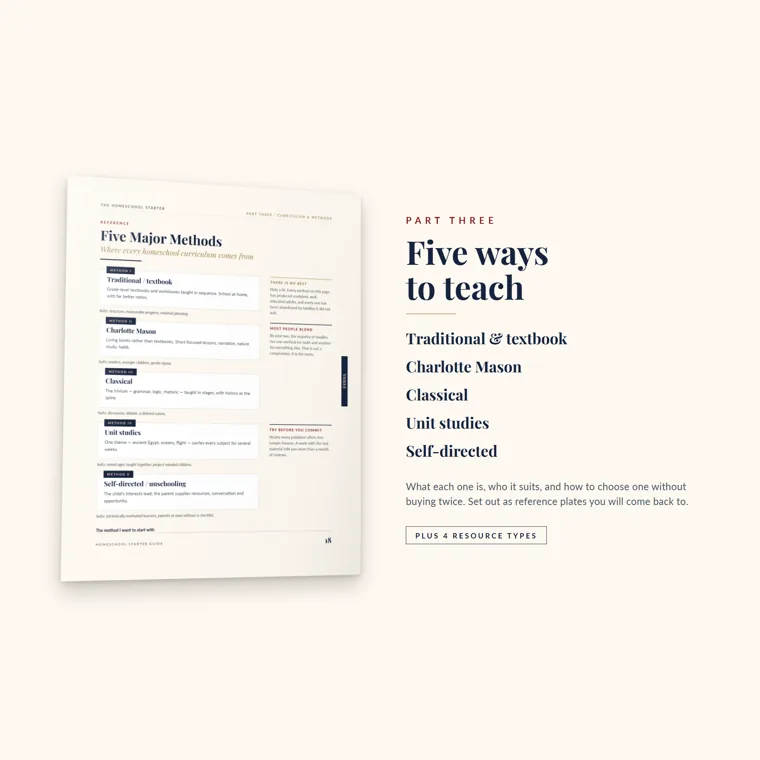
New homeschoolers usually choose between five broad approaches: traditional textbook and workbook programs, Charlotte Mason, classical, unit studies, and self-directed learning. You don’t need to pick a camp for life. Pick the one that fits why you’re homeschooling and what a normal weekday looks like in your house. A parent who wants unhurried mornings shouldn’t buy a program with six graded subjects a day.
Then choose materials in about a week, not a season:
- List the subjects you must cover. If your state names required subjects, its homeschool page lists them. Cover those first and stop worrying about everything else for now.
- Look at no more than three options per subject. Read reviews, request sample lessons, and ask a local homeschool group which programs people dropped and why. Most publishers offer free samples.
- Trial one or two subjects for a month before buying the rest.
Before you pay, ask four questions about any program: how much preparation it needs from you each week, whether the books are consumable or can pass to a younger child, what the return window is and whether there’s a placement test, and whether you could drop it mid-year without breaking everything else.
The most common beginner mistake is buying a complete boxed curriculum for every child before the first day. Start lean and add what’s missing after the first month, when you know your child’s pace. Non-consumable books also circulate in homeschool groups, often for a third of the new price.
How many hours a day to homeschool
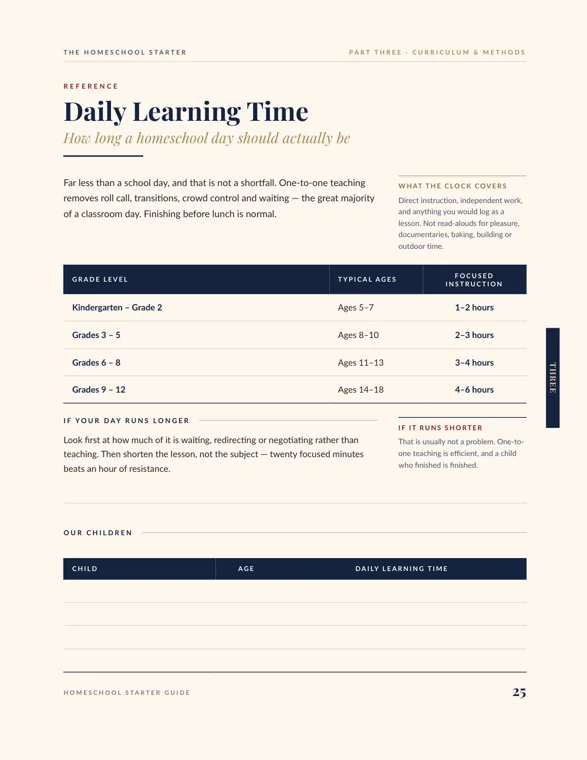
A homeschool day is much shorter than a school day, and that isn’t a shortfall. One-to-one teaching skips roll call, transitions, crowd control and waiting, which take up much of a classroom day. Finishing lessons before lunch is normal.
These are the ranges our starter guide suggests for focused lesson time each day. Treat them as a starting point, not a rule:
| Grade | Ages | Focused lesson time per day |
|---|---|---|
| Kindergarten to 2nd grade | 5 to 7 | 1 to 2 hours |
| 3rd to 5th grade | 8 to 10 | 2 to 3 hours |
| 6th to 8th grade | 11 to 13 | 3 to 4 hours |
| 9th to 12th grade | 14 to 18 | 4 to 6 hours |
Those hours cover direct teaching, independent work and anything you’d log as a lesson. Read-alouds for fun, documentaries, baking, building and outdoor time come on top. If your state counts days of instruction, track those in your attendance record as well, since the law’s count is what matters for compliance.
For the daily plan, put the two hardest subjects first, while attention is fresh, and keep the afternoon lighter and easy to drop on a bad day. Leave real gaps in the week. A schedule with no white space tends to fall apart in the second week. When a lesson turns into a standoff, shorten the lesson, not the subject; twenty focused minutes does more than an hour of resistance. Younger children who can’t read a timetable yet may follow a picture schedule for the day more easily.
Keep records from the first day
Good records are a legal requirement in many states and useful in all of them. They make re-enrollment and transcripts easier later, and on a hard week they show how far your child has come. Rebuilding a year backwards is miserable work, so start on day one.
A three-ring binder with one divider per category works better than an app in the first year. File these:
- Your letter of intent or affidavit, with proof it was received
- A curriculum plan listing what you mean to cover, by subject
- A daily or weekly log, where a few lines a day is enough
- An attendance record of days of instruction, if your state asks for one
- A reading log and book list
- A few samples of work per subject, per term
- Assessment or test results and a progress note each term
- Receipts for education spending, in case your state has a tax credit or education savings account
- Photos of projects and field trips, which fill out a portfolio nicely
If your state requires an assessment, there are generally two routes: a nationally normed standardized test, or a portfolio of work reviewed by an evaluator. Check which one your state accepts. If yours has no assessment requirement, testing every year or two is still a simple way to check your own teaching. In states that do require one, the assessment deadline is the one date in the year that can’t slip, so put it in the calendar the day you file.
Plan time with other kids on purpose
Homeschooled children don’t get friends by default from a building, so you schedule that time on purpose. The usual places are a homeschool co-op with weekly shared classes, sports teams and swim clubs, library programs, museum and science center classes (often cheaper on weekday daytimes), scouting and nature groups, faith and community youth groups, music lessons and theater, and volunteering.
Go for depth over volume. Two children your child really likes, seen every week, do more than a calendar full of acquaintances. Over-scheduling is a common reason a first homeschool year collapses by November. Start with one regular activity and add a second only once the routine holds.
Your first 90 days
Break the start into three 30-day stretches and judge the whole experiment at day 90, not day 9:
| Days | Focus |
|---|---|
| 1 to 30 | File every legal requirement and keep the proof. Order curriculum and the first supplies. Set up a learning space. Run a trial routine for two weeks, then leave it alone. |
| 31 to 60 | Write down what is working and what isn’t. Change the schedule, not the child. Add one outside activity. Start the record binder properly. |
| 61 to 90 | Keep the routine that survived. Join one community, online or local. Check progress against why you started. |
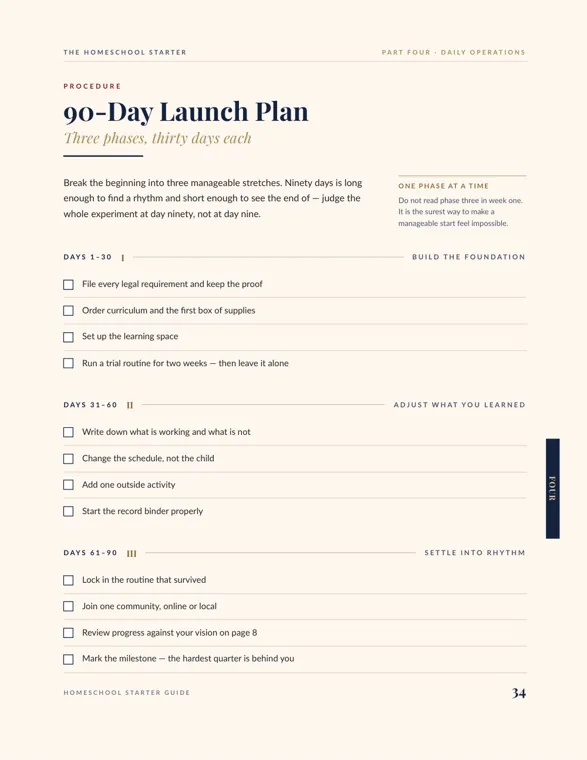
Don’t read the third phase in the first week. A long to-do list makes a manageable start feel impossible. The third month is when the novelty has worn off and the routine hasn’t set yet, so that’s the time to re-read your reasons, notice small wins such as a finished unit or a book read alone, and look back at last month’s log instead of comparing yourself with the polished family online.
When something goes wrong
Nearly every first year runs into the same four problems.
Your child won’t cooperate. This is usually a mismatch of pace, method or time of day rather than defiance. Try a shorter lesson, a different hour, or a hands-on version of the same material, and remember that a child fresh out of school may need weeks to settle.
You teach something wrong. You will now and then, just as classroom teachers do. Say “let’s look that up” together. For subjects beyond you, an online class, a tutor or a co-op class is normal practice, not a failure.
Your child is behind grade level. Then you are teaching at the right level. Slow down, fill the gap properly and move on; one-to-one teaching closes gaps faster than a class of thirty.
You feel isolated. This is the one to take seriously, because loneliness drives many families to quit. Contact one local group this week. Just one, not four.
Burnout is the fifth problem, and it’s preventable. Take a break before you need one, and change whatever isn’t working without treating it as a verdict on you.
If you decide to go back to school, your records make re-enrollment smoother, and in some states, Florida and Arizona among them, you also need to file a notice that homeschooling has ended.
A printable plan for the first year
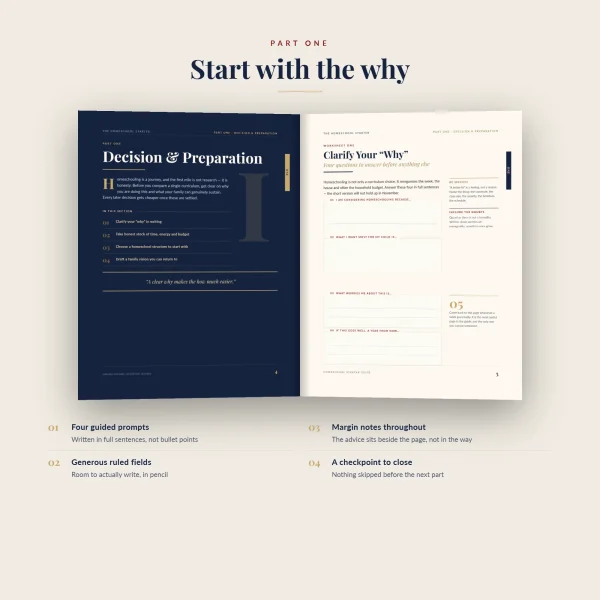
Our Homeschool Starter Guide is 36 printable pages in four parts: the decision, the legal steps, curriculum and methods, and daily life. It includes worksheets for your reasons, budget, subjects, school year and weekly schedule, plus the withdrawal steps, a records checklist and the 90-day plan. It doesn’t pick a curriculum for you, and it tells you to confirm your state’s current rules before filing anything. It comes as two PDFs of the same pages, one in US Letter and one in A4.
Printables from this article
Related articles
Printable Guides & Magazines
Year of the Goat 2027: Fire Goat Dates, Years and Customs
When the 2027 Year of the Goat starts and ends, every Goat year with its exact dates, why 2027 is a Fire Goat, what tradition says about Goat people, and what to do when it's your own year.
Printable Guides & Magazines
Chinese Zodiac Signs: 12 Chinese Zodiac Animals by Year
The twelve Chinese zodiac animals in order, the years that belong to each, what tradition says about them, and how to work out your own sign from your birthday.
Printable Guides & Magazines
Chinese New Year Traditions: Lunar New Year 2027, Day by Day
Fourteen Chinese New Year traditions in the order families keep them, with the 2027 dates, what to prepare at home, how to explain each one to kids and the step that usually goes wrong.