How to Draw an English Bulldog: Easy Face, Body and Puppy
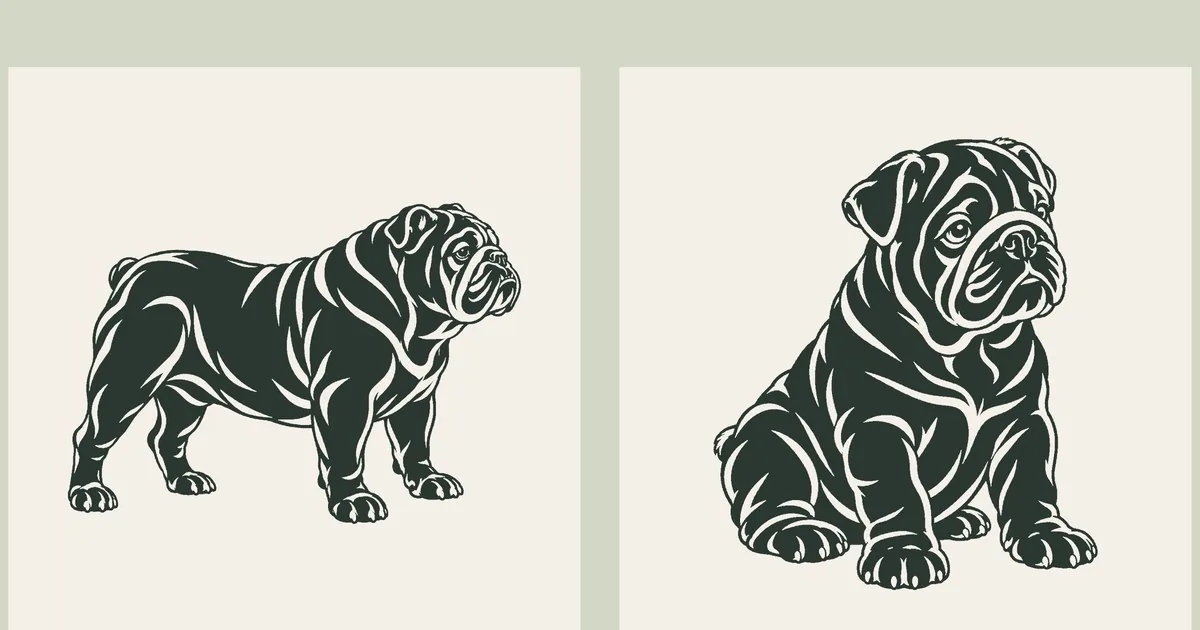
An English bulldog drawing works when everything is wide and low. The head is broad and set close to the shoulders, the nose is pushed up between the eyes, a thick fold of skin arches over it, and the lower jaw sticks out past the upper one. Underneath sits a deep chest on short, thick legs. Get those five things down and the rest is wrinkles. The proportions do the identification work, and the skin folds only add character and expression. This guide gives two methods, a front-facing head in 8 steps and a standing dog from the side in 9, followed by a simpler cartoon bulldog, a puppy and the details that separate it from a French bulldog or an American bulldog.
Choose the face or the whole dog first
The two methods don’t depend on each other, so start with whichever one you need. A school mascot, a pet portrait or a card usually wants the head. A dog walking across a page, or a drawing lesson about body shape, wants the side view.
| Version | Steps | Pencil time (our estimate) | Good for |
|---|---|---|---|
| Front-facing head | 8 | About 15 minutes | Mascots, portraits, cards; ages 8 and up |
| Standing dog from the side | 9 | 20 to 25 minutes | Learning the body shape; ages 9 and up |
| Cartoon bulldog | 5 | About 10 minutes | Ages 5 to 7 with an adult nearby |
The supply list is short. A No. 2 or HB pencil keeps the early construction lines light enough to erase, and a kneaded eraser lifts them without smearing. A black fine-liner is optional for permanent outlines, and brown, tan and gray colored pencils cover nearly every bulldog coat. Any copy paper works for practice sketches. Planning to print one of our outline pages to keep beside you? Read how to print coloring pages at home first, because its section on gray or broken lines matters for drawings this detailed.
How to draw an English bulldog face from the front
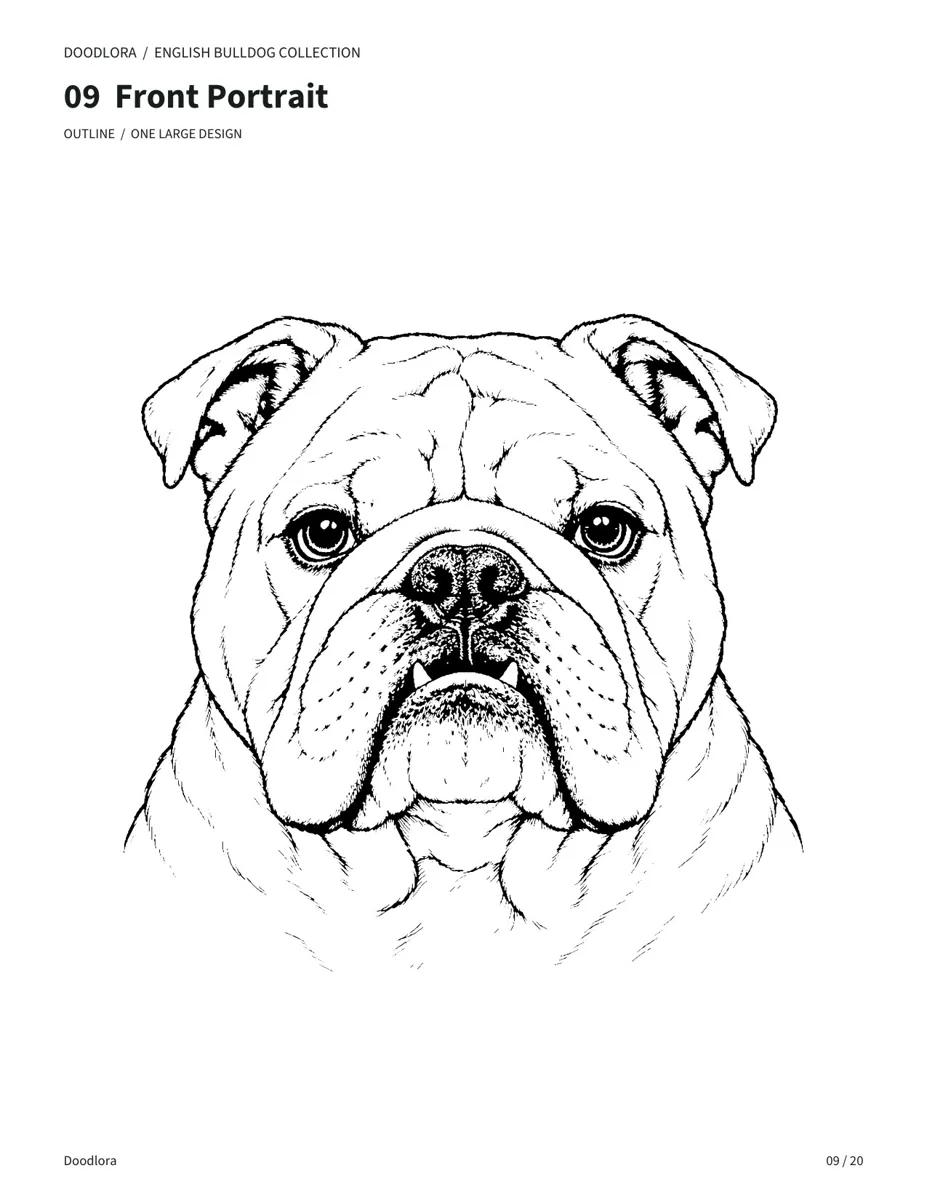
This is the view on most bulldog mascots, and it’s the easier of the two methods because the face is symmetrical, so every measurement on the left side simply repeats on the right. The page below is the front portrait from our English bulldog outline set. Keep it beside you as you work through the steps. The eyes sit just above the middle of the head, and the top of the nose lines up with them.
Step 1: Draw a wide, flat-topped head shape
Sketch a rounded shape that is wider than it is tall, with a fairly flat top and full cheeks that bulge at the sides. Draw a light vertical line down the middle and a horizontal line just above halfway down. A tall oval or a circle makes the head look like a different breed straight away, so keep it wide.
The cross lines give you a place for the eyes.
Step 2: Place the eyes low and far apart
Draw two round, dark eyes on the horizontal line, one on each side, with a wide gap between them. On our front portrait the space between the eyes is several eye-widths. Wikipedia’s Bulldog entry describes the eyes as round, black and wide-set, so shade them in fully and leave only a small white highlight.
With the eyes in, the nose goes between them, higher than feels natural.
Step 3: Push the nose up between the eyes
Draw a broad nose with two large nostrils right on the center line, with its top edge about level with the bottom of the eyes. Placing the nose this high is the single change that makes a dog face read as a bulldog. If you put it halfway down the face, the dog grows a longer muzzle and starts to look like a mastiff.
Now wrap the nose in the fold known as the rope.
Step 4: Arch the nose roll over the nose
Draw a thick fold of skin that curves over the top of the nose like an upside-down U, starting low on one cheek and ending low on the other. Wikipedia calls it a rope or nose roll. Draw it with two lines, not one, so it looks like a raised ridge.
The face below the nose hangs from this fold.
Step 5: Hang the jowls on either side
From each end of the nose roll, draw a heavy, drooping lobe of lip that hangs down and outward, like two curtains parted in the middle. Let the bottoms of the jowls come down about as low as the chin, so the face looks broadest at the bottom. Wikipedia lists drooping lips as a breed feature, and these jowls are what give a bulldog its grumpy look.
Between the two jowls, the chin pushes forward.
Step 6: Show the underbite and the lower teeth
In the gap between the jowls, draw a broad, rounded chin that sits slightly forward of the upper lip. Add two small pointed lower teeth sticking up over the top lip near the corners of the mouth. That underbite is in Wikipedia’s description too, an upturned lower jaw with pointed teeth, and on our portrait it shows as exactly those two teeth.
The head shape still needs its ears.
Step 7: Fold the small rose ears at the top corners
At each top corner of the head, draw a small ear that folds back on itself so part of the inside shows, with the tip turned down and outward. This is the “rose ear.” The French Bulldog article on Wikipedia describes rose ears as ears that fold at the tip, as with the standard for Bulldogs. Keep them small. Big ears turn the dog into a beagle.
The last step adds the skin that makes the face look heavy.
Step 8: Add the brow wrinkles and the neck, then ink
Draw two or three short curved folds across the forehead and a short crease between the eyes. Below the head, flare the outline out into a wide neck and chest with a few loose folds of skin hanging underneath. Pen over the final contours, give them a minute, and rub out the cross lines from step 1.
How to draw a standing English bulldog from the side
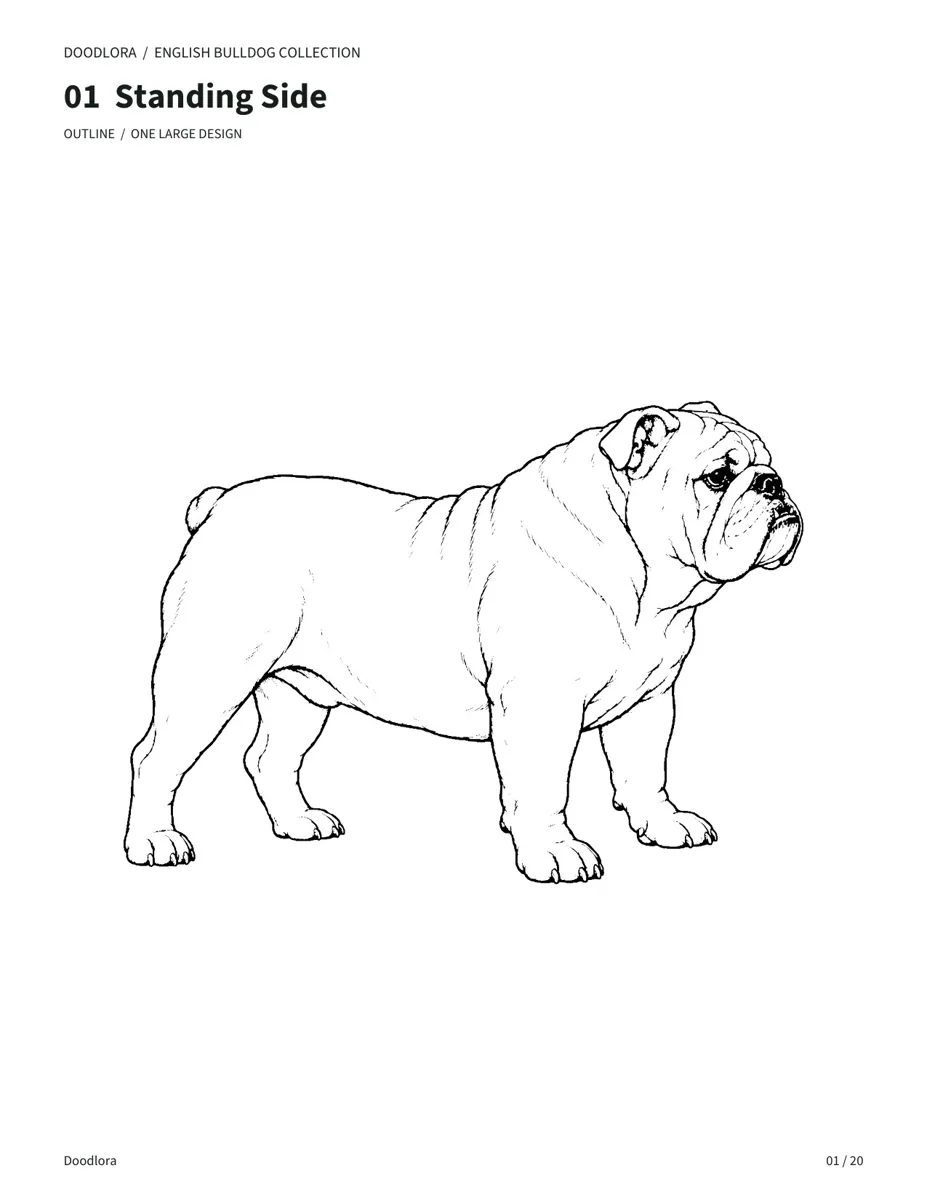
The side view is about proportions more than detail. We measured the standing dog on the first page of the full-page outline PDF in the same set. The head takes up more than a third of the dog’s total height, and the legs below the chest are only about half as long as the chest is deep. Those two ratios matter more than any wrinkle.
Step 1: Draw a deep, low body box
Draw a ground line, then a long box with rounded corners above it. Make the front end deeper than the back end, because the chest hangs low between the front legs while the belly tucks up toward the hips. Leave a gap under the box only about half as tall as the chest is deep.
Next comes the head, which goes on almost without a neck.
Step 2: Set a large head right on the shoulders
At the front top corner of the body, draw a big, squarish head. Its top should sit only a little higher than the shoulders, since a bulldog carries its head low and its neck is short and thick. Wikipedia describes the breed’s wide head and shoulders. If the head reaches high above the back, the dog looks like it’s craning.
The face on that head is almost flat.
Step 3: Flatten the face and push the jaw forward
Draw the front of the face as a nearly vertical line. Place the nose near the top of that line, barely ahead of the forehead. Then let the lower jaw and chin jut out a little in front of the nose. From the side, the underbite shows up as a chin that’s further forward than the nose, which is the opposite of most dogs.
Below the jaw, the skin hangs loose.
Step 4: Hang the jowls and the neck folds
Draw a drooping lip that hangs below the jaw line, then two or three loose folds of skin running from under the chin down to the chest. Wikipedia mentions this hanging skin under the neck. Draw a fold over the nose as well, the same nose roll as in the front view, seen edge-on.
Next, the front legs carry all that weight.
Step 5: Plant short, thick front legs under the chest
Draw the near front leg as a thick column coming straight down from the front of the chest, with a broad paw and short toes. Put the far front leg just behind it, partly hidden. Keep both legs short. On our standing page they are about half the depth of the chest.
The back legs are lighter and have a visible bend.
Step 6: Add the back legs with a bend at the hock
Under the hips, draw the thigh as a rounded shape, then bring the lower leg down and slightly back to a bend (the hock) before the paw. Draw the far back leg partly hidden behind the near one. Make the back legs a little slimmer than the front legs, since the weight of the dog sits up front.
Behind the hips sits a small tail.
Step 7: Tuck in a short, low tail
At the back of the hips, draw a short stub of a tail set low. Wikipedia says a bulldog’s tail can hang straight down or curl into a tight corkscrew, so either works. Give it a long, waving tail and the breed disappears.
Now return to the head for the ear and the eye.
Step 8: Place the rose ear and the eye
Draw a small folded ear at the back top corner of the head, and a round dark eye just above the nose roll, near the front of the face. The ear should be no bigger than the eye-to-nose distance. On our standing dog, the ear sits behind the forehead, well back from the face.
The last step is the skin across the body.
Step 9: Add the shoulder wrinkles, ink and erase
Draw a few curved folds where the neck meets the shoulders and one or two across the chest. Leave the back and hips mostly smooth, since too many lines everywhere make the dog look crumpled rather than heavy. Once the outline is inked and dry, the step 1 box can come out with the eraser.
An easier cartoon bulldog for younger kids
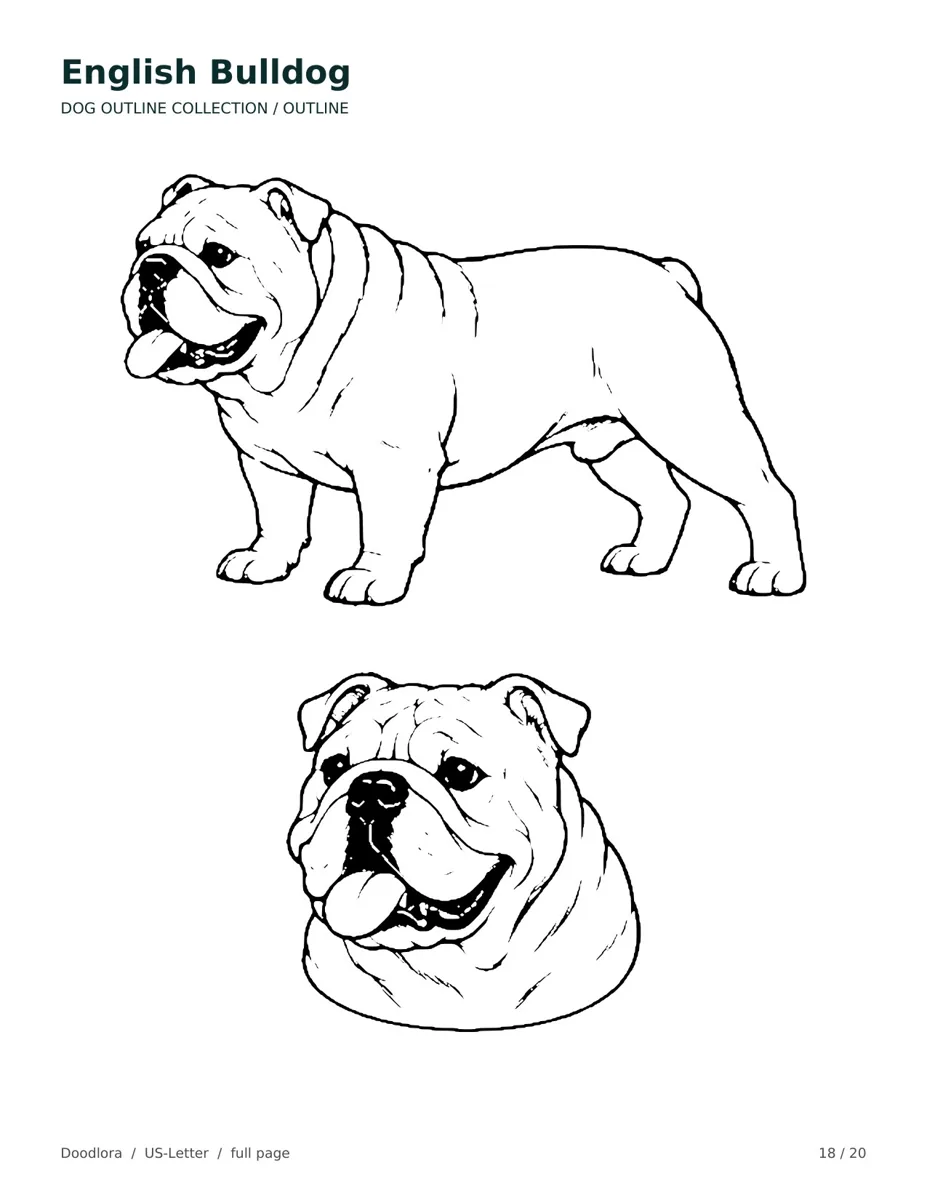
For a five- to seven-year-old, skip the proportions and draw the happy bulldog that shows up on stickers and T-shirts. The English bulldog page in our dog silhouettes and outlines set is drawn in this friendlier style, with an open mouth and a tongue hanging out. It’s one of 20 breeds in that set, each with a body and a head drawing.
Read one step aloud, wait until everyone has drawn it, then read the next:
- Draw a big bean shape lying on its side for the head, wider than it is tall.
- Put a wide black triangle nose near the top middle, and two dot eyes beside it.
- Draw a big smile under the nose, curving up at both ends, and hang a tongue from the middle.
- Add two tiny ears on top that flop over at the tips.
- Under the head, draw a short, round body and four stubby legs, then add a few curvy lines on the forehead for wrinkles.
A smile and a tongue make the cartoon look friendly, and for most young kids that personality matters more than anatomical accuracy. For an older child who asks for a “tough” bulldog, switch to the front-view steps above and point out the underbite.
English bulldog, French bulldog or American bulldog?
These three breeds share a name and get mixed up in drawings, and a few searches for bulldog drawing tutorials turn up an American bulldog under the same label. Each one has a clear tell, and all three are described on Wikipedia.
| Feature | English bulldog | French bulldog | American bulldog |
|---|---|---|---|
| Ears | Small rose ears, folded at the tip | Tall, upright bat ears | Not part of its Wikipedia description |
| Face | Short muzzle, nose roll, underbite with an upturned jaw | Flat face, large square head | Longer muzzle in the Standard type, shorter in the Bully type |
| Body | Wide head and shoulders, stocky and muscular | Muscular, with a soft, loose coat that forms wrinkles | Large, stocky and heavily built, with muscular shoulders and forearms |
| Size | About 40 to 50 lb in the US standard | At most 28 lb in the AKC standard | 60 to 119 lb, 20 to 28 in tall at the withers |
The ears settle most arguments. According to Wikipedia, the judge at the Westminster show in 1897 chose only French bulldogs with rose ears as winners, and the breed standard written by the new French Bull Dog Club of America preferred the upright bat ear instead. That bat ear is now the French bulldog’s signature characteristic, so folding the ears is your best protection against an accidental Frenchie.
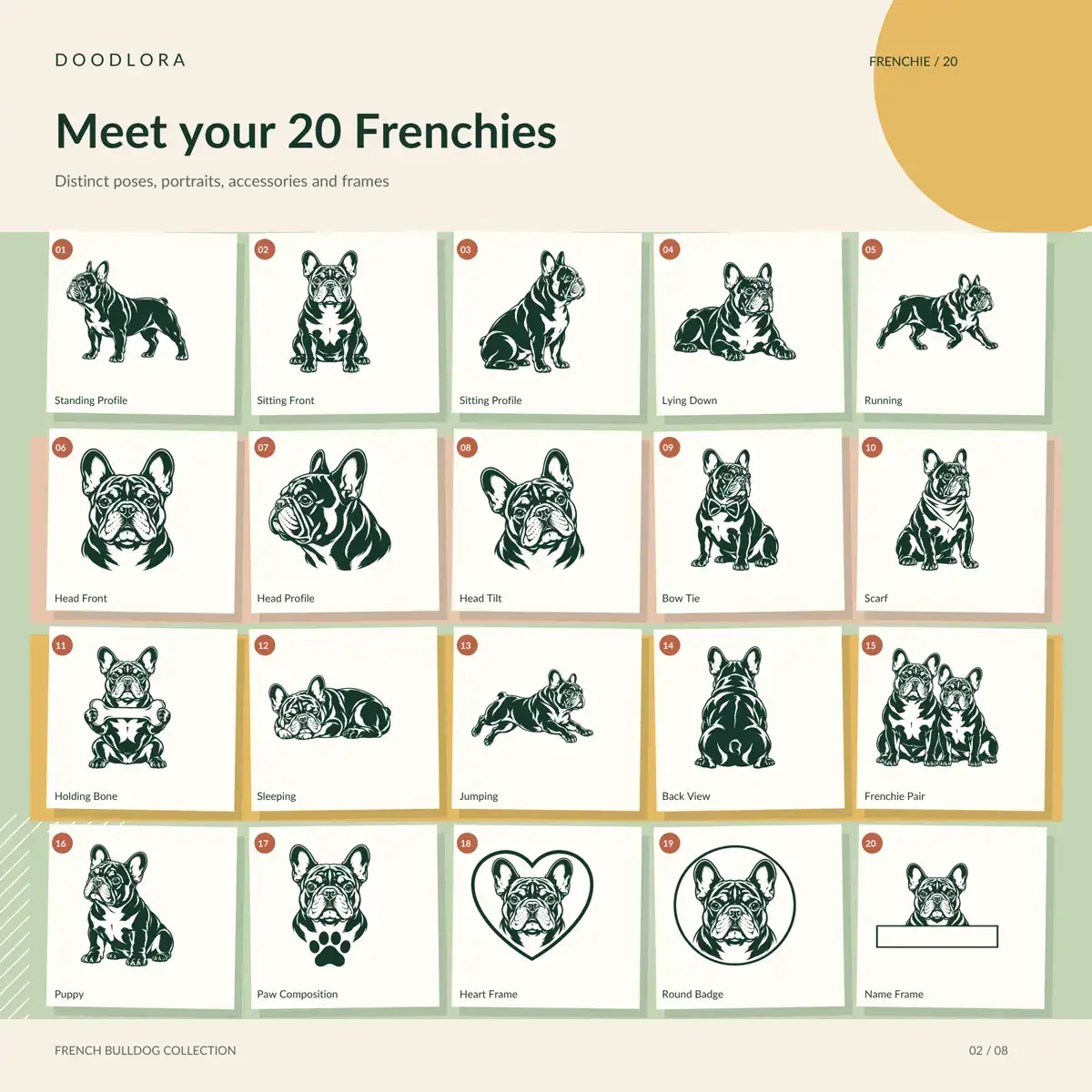
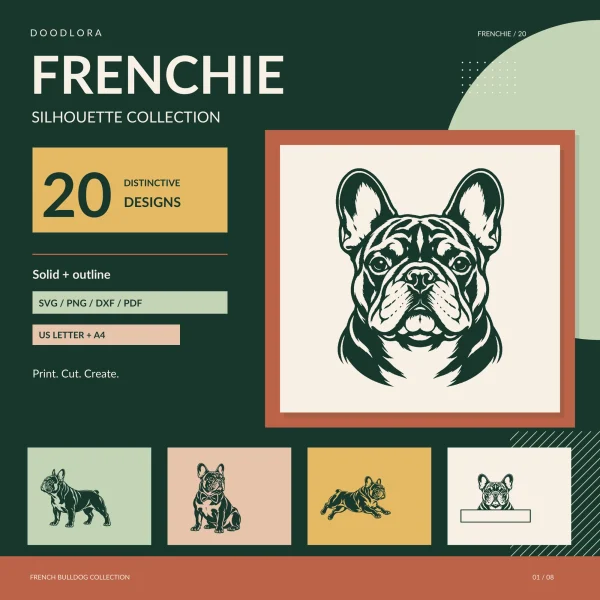
Our French bulldog silhouette set is useful here as a side-by-side check. Even in the back view and the sleeping pose, the ears stand straight up. If your English bulldog’s ears point up at all, fold them down.
The American bulldog is the other common mix-up. It’s a much bigger dog, 20 to 28 inches at the withers, and the Standard type has a longer muzzle and a squarer head. If your drawing has a longer nose and a tall frame, it’s drifting toward an American bulldog. Go back to short legs and a pushed-in face.
Drawing an English bulldog puppy
A bulldog puppy uses the same features, rearranged. Look at design 12, the seated puppy, in the grid further down this page. Its head is huge compared with the body, the paws look oversized, and the folds on the face and body are looser and rounder than on the grown dog.
To draw one, start with the front-view head steps but make the head almost as wide as the whole body will be. Draw the body as a short pear shape sitting under it, with the front legs straight down and the back legs folded flat on the ground. Give the paws big round toes. Soften the brow wrinkles into a few gentle curves, and leave out the lower teeth, since a closed mouth looks younger. Turning the head a little to one side, as on our seated puppy, adds personality without any extra detail.
Six mistakes that turn a bulldog into another breed
- The nose sits halfway down the face. Move it up so its top lines up with the bottom of the eyes. A low nose gives the dog a long muzzle.
- The ears stand up or are too big. Shrink them and fold the tips over. Upright ears make a French bulldog, and long hanging ears make a hound.
- The skull comes out as a perfect circle. Widen it and flatten the top. A bulldog head is broader than it is tall.
- The legs are long. Cut them down to about half the depth of the chest. Long legs make it look like a bigger, rangier breed.
- There’s no underbite. Push the chin forward and show two lower teeth. Without it, the face loses the bulldog scowl.
- Wrinkles cover every inch. Keep the heavy folds on the face, neck and shoulders, and leave the back and hips smooth.
Coloring red, fawn, brindle and piebald coats
Wikipedia lists the bulldog’s coat colors as red, fawn, white, brindle and piebald, and the coat is short, flat and sleek. That means you color with smooth, even layers, not long fur strokes.
For a fawn or red dog, lay down a light tan over the whole body, then add a warmer reddish brown in the folds and under the jowls, where the shadows are deepest. A white bulldog needs almost no color at all. Shade the folds with a pale gray and leave the rest as bare paper.
Brindle is the hardest coat, and it takes the most patience. Start with a fawn base, then draw thin, broken dark brown stripes that run roughly down the body, following the curve of the ribs. Keep them irregular. Piebald means patches of color on white, often over one eye, one ear or across the back. Outline each patch lightly before you fill it so the edges stay clean.
Leave the nose and the eye rims black whatever the coat color. If your shading looks streaky, this colored pencil blending guide shows how to build smooth layers and burnish the last one.
Printing our bulldog outlines as practice pages
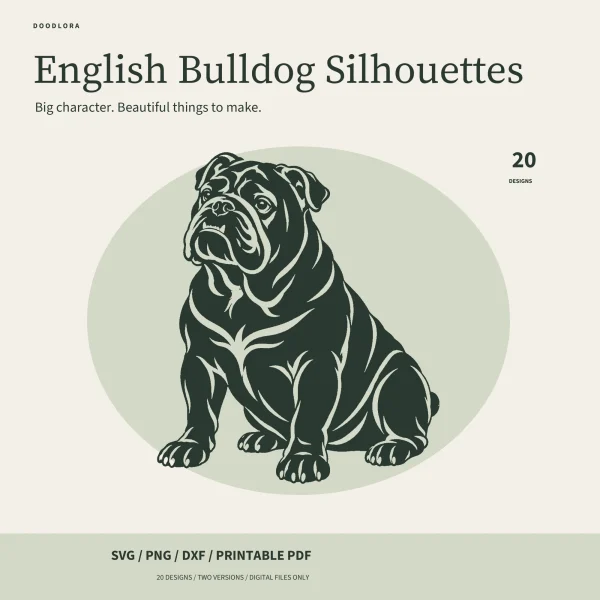
Tracing one of our outlines first gets the proportions into your hand before you draw on your own. The English bulldog set has 12 PDFs, US Letter and A4, and every one holds 20 pages with one design per page. Pick a single large copy, four copies or six copies to a sheet, in either solid silhouettes or line drawings. At 100 percent scale the full-page dogs measure about 6 inches across, so switch off any fit-to-page option.
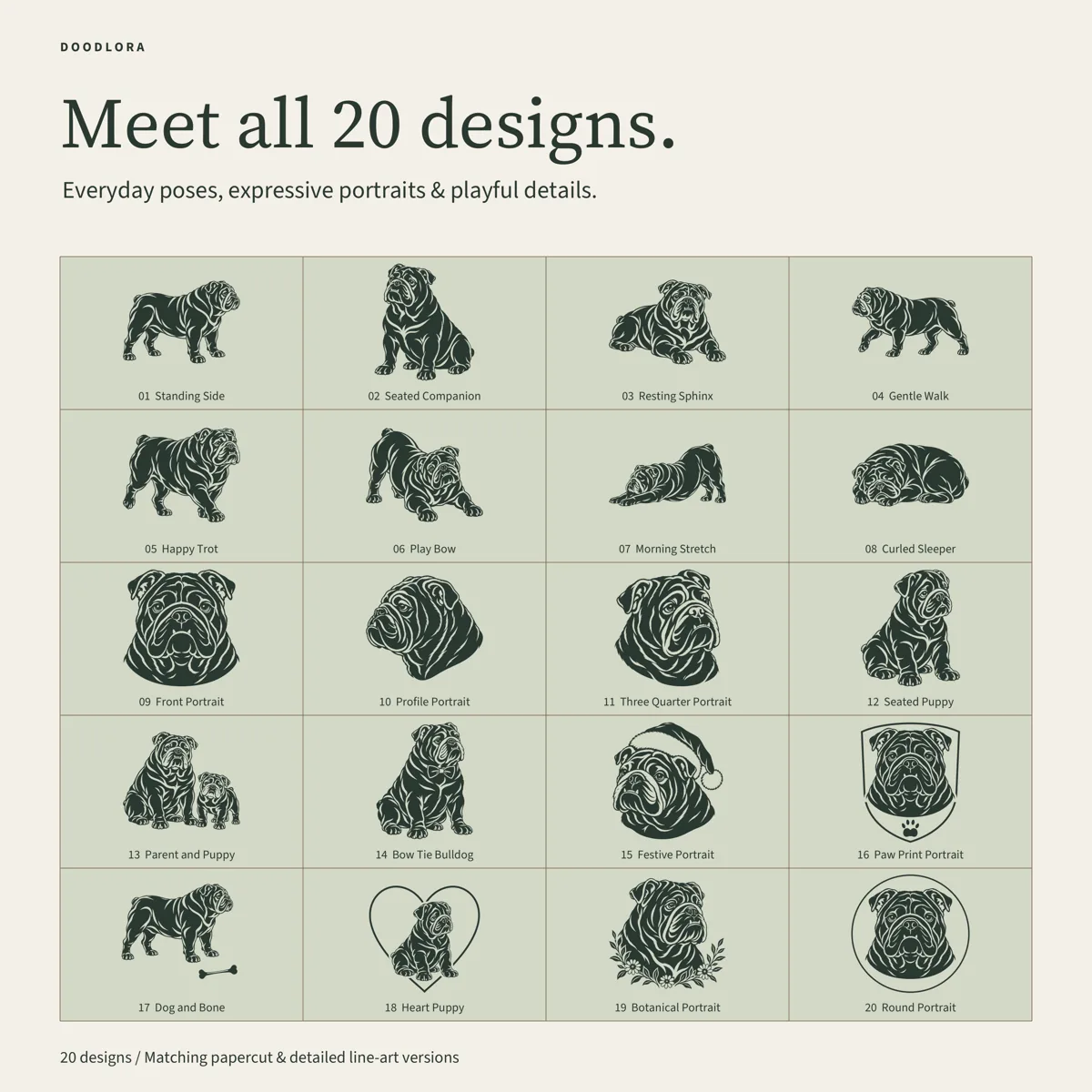
For a bulldog mascot drawing with a team or a class, print the six-per-page front portrait so each student gets a small copy to keep beside their paper. As a rough plan for a 45-minute art period, allow 5 minutes to point out the nose roll, the jowls and the rose ears on the printout, about 20 minutes for the 8 front-view steps, and the rest for inking and color. Students who finish early can try the profile portrait, design 10, which shows the underbite from the side.
Teens and grown-ups drawn to the papercut style can study the solid versions. Each one turns the wrinkles into pale gaps in a dark shape, which is a useful demonstration of which folds actually matter.
Want to make something with the drawing instead? Our dog crafts page includes printed breed portraits to color and cut out, and a sponge-painted silhouette stencil. For another four-legged animal with very different proportions, how to draw a horse builds a long-legged body from two circles.
Printables from this article
Related articles
Outlines & Stencils
How to Draw a Mallard Duck: Drake, Hen and Flying Poses
A swimming mallard drake in ten pencil steps, the changes that turn it into a hen, a flying pose, a pair on the water and the color marks that make the bird read as a mallard.
Outlines & Stencils
Turtle Crafts for Kids: Paper Plate and Sea Turtle Ideas
Twelve turtle crafts sorted by age, each with time, materials, steps and the snag to watch for, plus how to use a printed turtle outline as a cutting template.
Outlines & Stencils
Bird Crafts for Kids and Adults: Owl, Nest and Feeder Ideas
Thirteen bird crafts grouped by who is making them, from a toddler's handprint bird to a framed papercut and a cold-weather pinecone feeder, each with ages, time, supplies, steps and the snag to plan for.