How to Draw a Dog: Easy Puppy and Dog Face Steps
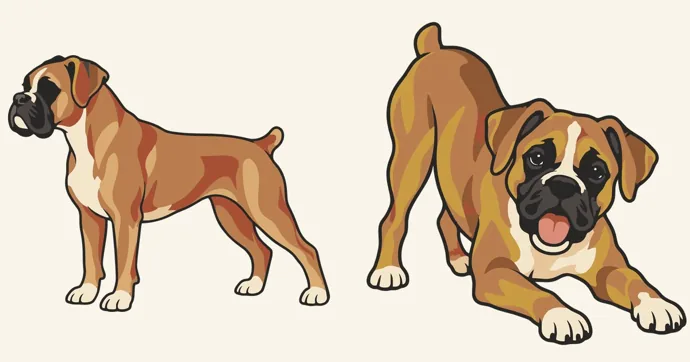
Every dog, from a Chihuahua to a German shepherd, comes out of the same short list of shapes: a round skull, a muzzle that sticks out from it, a bean-shaped body, four legs and a tail. Draw those lightly in pencil, then decide three things: what the ears do, how long the muzzle is and how the tail is carried. Those three characteristics are what turn “a dog” into a Lab, a corgi or a poodle. The one part that trips people up is the back leg. It bends backward partway down because a dog stands on its toes, and once that bend sits in the right position, the drawing becomes recognizable as a dog instead of a horse or a table.
Below you’ll find three versions: a sitting cartoon puppy for young kids, a dog face seen from the front, and a whole dog standing side-on. Then come the breed changes, other poses, coloring, a classroom plan and fixes for the drawings that go wrong.
Which dog to draw first
A 5-year-old and a 12-year-old need different dogs, so match the version to the artist. The minutes below are rough guesses for pencil work only, never clocked, and the ages are loose; plenty of 6-year-olds will want the standing dog anyway.
| Version | Steps | Pencil time (estimate) | Works well for |
|---|---|---|---|
| Sitting cartoon puppy | 6 | About 10 minutes | Ages 4 to 7, or anyone’s first dog |
| Dog face, front view | 7 | About 15 minutes | Pet portraits, cards, ages 7 and up |
| Standing dog, side view | 8 | 20 to 25 minutes | Learning the body and legs, ages 9 and up |
You need very little. A regular No. 2 or HB pencil, pressed lightly, makes construction lines you can erase. Any eraser works, though a kneaded one lifts graphite without smudging. Inking the finished outline with a black felt-tip pen is optional. Brown, tan, black, gray and a pink for the tongue cover most coats. Not sure whether a 4-year-old should get crayons or markers? Our coloring tips sort the choice by age. Ordinary printer paper handles practice sketches; for marker coloring, slide a spare sheet below so the ink doesn’t reach the table.
How to draw a cute sitting puppy (easy version)
This is the dog to start with. It faces you, so both sides match, and it hides the tricky back legs under its body.
- Head. Draw a large circle near the top of the page, about the size of a jar lid. Puppies have big heads, so don’t shrink it.
- Muzzle. Inside the lower half of the circle, draw a smaller flattened oval for the snout. Put a rounded triangle nose at the top of that oval and a small “w” under the nose for the mouth.
- Eyes and ears. Place two dots or small circles for eyes just above the muzzle, a little wider apart than the nose. Hang two floppy teardrop ears from the top corners of the head, pointing down.
- Body. Under the head, draw a pear shape that is narrow at the neck and wide at the bottom. It should be about the same height as the head.
- Legs and paws. Draw two straight front legs down the middle of the pear, each ending in a rounded paw with two short lines for toes. At the bottom corners, add two wider ovals for the back paws peeking out from the sides.
- Tail and finish. Curl a short tail out from one side of the bottom. Trace the lines you want to keep with marker, erase the rest and add a spot over one eye or a collar.
That oversized head, the short pear body and the paws lined up along the bottom create the impression of a puppy rather than a grown dog.
How to draw a dog’s face from the front
A front view works for pet portraits, birthday cards and name tags. The trick is to keep everything symmetrical, so draw one light vertical line down the middle first and check each feature against it.
- Skull. Draw a circle for the top of the head. Then draw a second, slightly flattened circle that overlaps its lower third. That second shape is the muzzle seen from the front.
- Guide lines. Run the vertical line through both circles. Add a horizontal line across the big circle a little below its middle; the eyes sit on this line.
- Eyes. Draw two almond shapes on the horizontal line, each about one eye-width away from the center line. Shade the pupil and leave a tiny white spot in each one so the eyes look wet and alive.
- Nose. At the top of the muzzle circle, on the center line, draw a rounded, upside-down triangle. Add two comma-shaped nostrils and a short line running down from the bottom of the nose.
- Mouth. From the end of that line, sweep two curves out and down to either side, like a wide, soft “w”. For a happy dog, open the mouth below this line and drop a pink tongue down the center.
- Ears. This step decides the breed more than any other. Either hang floppy ears down the sides of the skull or stand two triangles up from the top. The next section shows which breeds get which.
- Neck and fur. Draw the cheeks bulging slightly past the skull, then two lines down for the neck. Add a few short, flicked strokes on the chest and around the ears instead of outlining every hair, and erase the guide lines.
The eyes are where most front-view dogs go wrong, because the whole expression depends on them. Too high and the dog resembles a teddy bear; too close together and the expression turns worried. Keep them on that lower line and a full eye-width apart.
How to draw a standing dog from the side
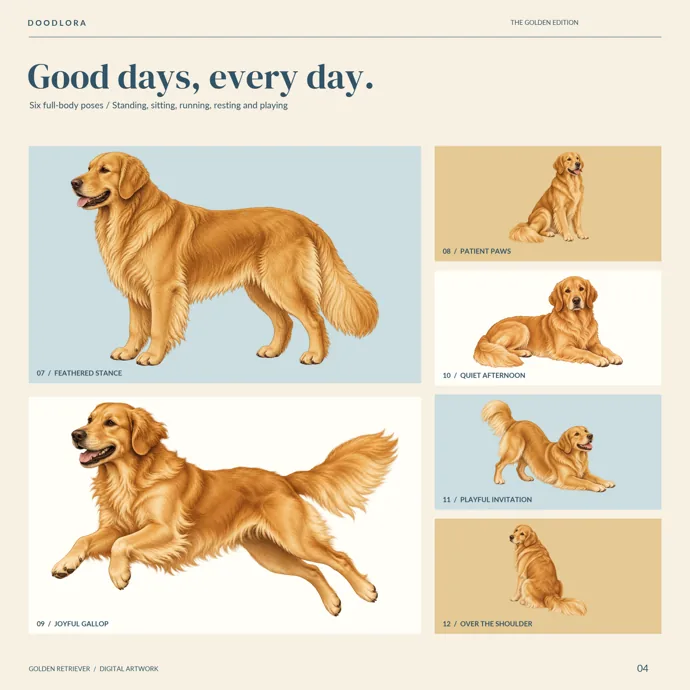
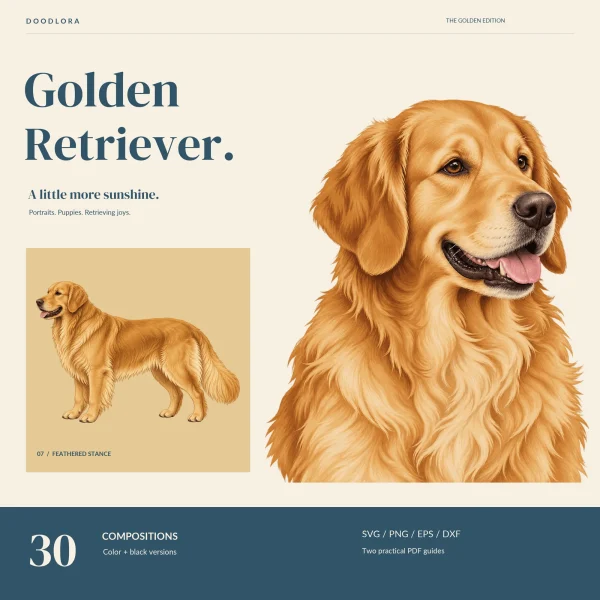
Side-on is the classic way to show a dog’s silhouette, and it’s the version that teaches leg construction and overall proportions. Keep the standing golden retriever (design 07) from our set nearby while you draw, just to check proportions; it doesn’t need to be copied.
- Chest and hips. Draw a large circle for the chest on the left and a slightly smaller one for the hips on the right, leaving a gap of about one circle between them. Join their tops with a nearly flat back line and their bottoms with a belly line that curves up toward the hips.
- Head. Draw a circle for the skull above and in front of the chest, about half the chest’s size. Add a box-shaped muzzle sticking forward from the lower front of it.
- Neck. Connect the back of the skull to the top of the chest with one curve, and the jaw to the front of the chest with another. A dog’s neck is thick and angled forward, not a thin upright stick.
- Front legs. Draw two fairly straight columns down from the chest. Give each a slight forward bend just above the paw, then an oval paw pointing ahead. The front legs are roughly as long as the chest is deep.
- Back legs. Start with a big thigh shape coming down from the hip circle. Below it, angle the leg backward to a sharp point, then down and slightly forward again to the paw. That backward point is the hock. It matches the human ankle, and it sits high because dogs walk on their toes, with the rest of the foot lifted off the ground. Get this zigzag right and the drawing reads as a dog.
- Tail. Pull the tail from the top of the hip circle, where the back line ends. Whether it hangs down, curls over the back or sticks straight up depends on the breed and the mood.
- Ears, eye and nose. Place the eye on the side of the skull where it meets the muzzle, add the nose at the tip of the muzzle and set the ear on the back of the skull.
- Outline and fur. Go over the outside edge in one confident line, flicking a few short strokes where the coat is long: chest, belly, the back of the legs and the tail. Erase the circles.
The dog-leg shape, as people call that zigzag, is so typical that it’s named after the animal. Wikipedia’s article on digitigrade animals credits walking on the toes for “the distinctive hooked shape of dog legs.”
How to draw a puppy instead of a grown dog
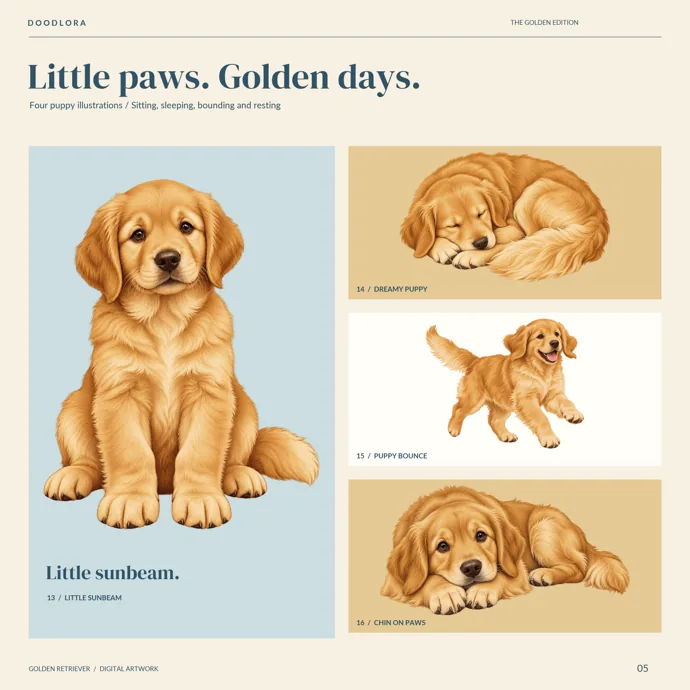
A puppy uses the same steps with different proportions. Compare the four puppies in our golden retriever set with the adults above and the changes are easy to spot.
- Bigger head. Make the skull almost as wide as the chest. On an adult dog it’s closer to half.
- Shorter muzzle. Shrink the snout to a short, rounded bump. A long nose makes any puppy look older.
- Lower eyes, rounder shape. Set the eyes a little lower on the face and draw them as circles, not almonds.
- Chunkier legs and big paws. Draw short, thick legs that end in oversized round paws.
- Softer outline. Use curves everywhere. Puppies have almost no sharp angles, so even the hock bend can be a gentle curve.
The sitting puppy in the easy version above already follows these rules, which is why it’s the best first drawing for young kids.
Ears, muzzle and tail: drawing different dog breeds
Draw the same body three times and change only the ears, the muzzle and the tail, and you’ll get three different breeds. Our dog SVG set has twelve breed portraits drawn in the same charcoal line style, and that side-by-side comparison makes the differences immediately visible.
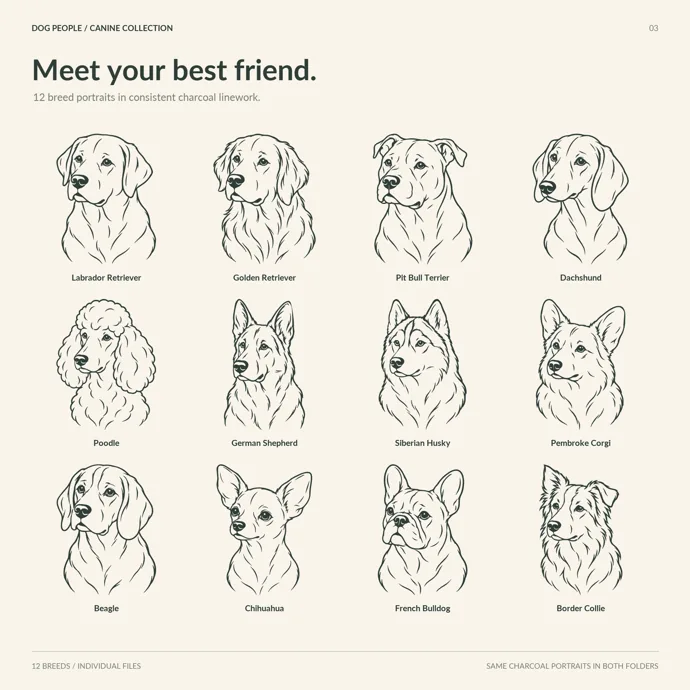
Here’s what to change for the breeds people ask for most. The ears and muzzles follow the heads in our portrait sheet, and the tail and body notes are common ways to draw each breed rather than something taken from our sets; real dogs vary.
| Breed | Ears | Muzzle | Tail and body |
|---|---|---|---|
| Labrador | Medium, hanging close to the cheeks | Broad and medium length | Thick tail, straight and tapering; short smooth coat |
| Golden retriever | Hanging, with wavy fur | Medium length | Long feathered tail; fringes on chest and legs |
| German shepherd | Large, upright and pointed | Long and narrow | Bushy tail hanging low; back slopes down toward the hips |
| Beagle | Long, hanging well below the jaw | Medium, square at the end | Upright tail; compact body |
| Dachshund | Long, hanging | Long | Very long body on very short legs |
| Poodle | Hanging, covered in curls | Long and slim | Curly outline everywhere; draw bumpy curves, not a smooth line |
| Chihuahua | Very large, upright, angled out | Very short | Tiny body, round head, big eyes |
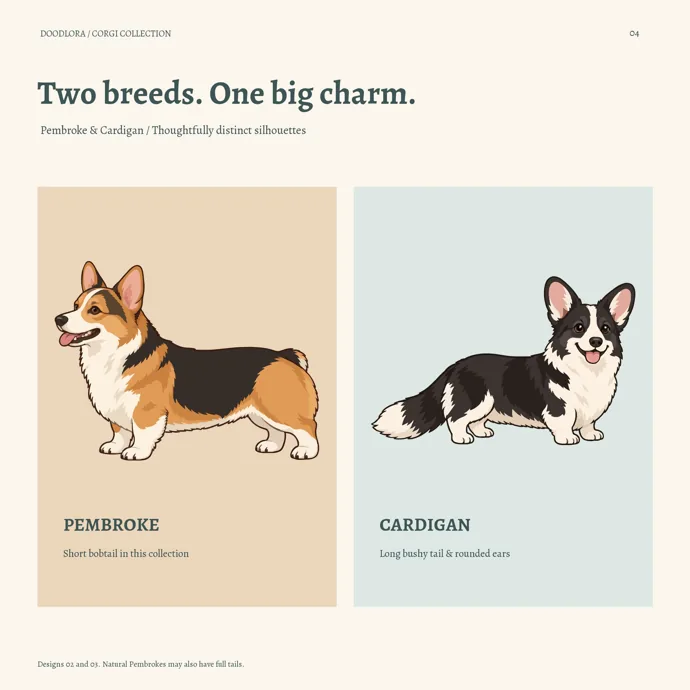
| Corgi | Large, upright | Medium, fox-like | Long body, short legs; tail depends on the type (below) |
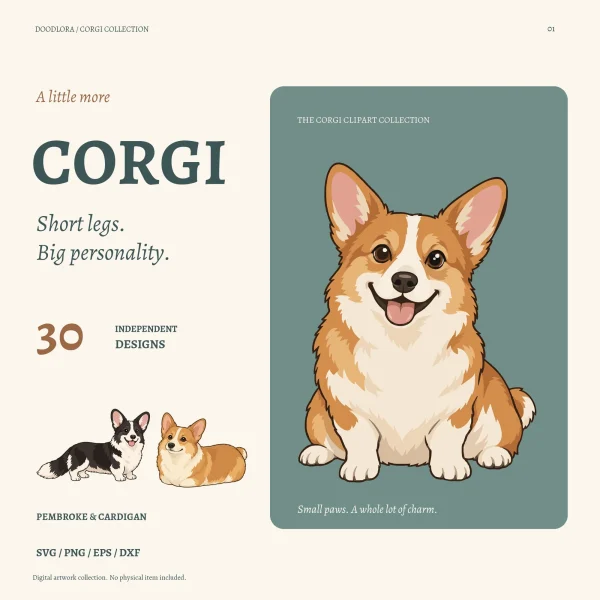
A corgi is the best example of the tail mattering. According to Wikipedia’s Welsh Corgi article, the Cardigan has large, rounded ears and a long, fox-like tail, while the Pembroke’s tail is much shorter, through breeding or docking. Our corgi set shows both side by side.
Bulldogs follow different rules. The face is flat, the jaw sticks out and the legs are short and wide, so they get their own walkthrough in how to draw an English bulldog.
Sitting, lying down and play bow poses
Once the standing dog works, every other position uses the same circles, rearranged. The movement comes from where you place them.
- Sitting. Draw the chest circle high and the hip circle low and behind it, almost on the ground. The back leg folds into a big rounded thigh with the paw sticking forward beneath it. The front legs stay straight.
- Lying down. Lower both circles until they rest on the ground line. Stretch the front legs forward with the paws side by side, and tuck the back leg against the hip so only its paw and thigh show.
- Play bow. Lower the chest almost to the ground with the front legs flat and stretched forward, and lift the hips high with straight back legs. Put the tail up. This is the “let’s play” pose, and it shows off the hock well.
- Running. Stretch the body long and reach the front legs forward and the back legs behind, so the dog is almost flat in the air. The leaping golden retriever in the six-pose image above is a good one to study.
- Head tilt. Draw the same front-view face, but tip the center line about 20 degrees. Every feature follows the tilted line, and one ear can flop farther than the other.
Coloring fur, coats and markings
Color in layers, starting light. Lay down the palest color over the whole coat first, then add the darker color where the markings go and in the shadows: under the ears, under the chin, the belly and the inside of the far legs.
- Golden or tan dogs. Yellow-orange as the base, light brown in the shadows, and a few brown strokes following the fur direction.
- Black dogs. Don’t fill them solid black or every detail disappears. Use dark gray as the base and save black for the shadows, the nose and the outline. Leave a thin pale line along the top of the back and head where light would hit.
- White dogs. Leave the paper white and add pale gray or pale blue only in the shadows.
- Spots and patches. Draw the patch outline lightly first. A beagle-style dog gets a dark “saddle” across the back, and a boxer or pit bull often has a white blaze down the face and a white chest.
Draw fur strokes in the direction the hair grows: away from the nose on the face, down the body and toward the tip on the tail. Patience matters more than technique here: three light layers look richer than one heavy one.
Drawing dogs with kids
Kids love drawing their own pet or a neighbor’s dog, and that personal connection holds their attention far longer than a random example.
- Ages 4 to 5. Stick to the sitting puppy. Let them draw the head circle first, then talk them through one shape at a time (“now a pear under the head”). Expect wobbly lines and celebrate the ears.
- Ages 6 to 8. Try the sitting puppy, then the front-view face. Show them how floppy ears versus pointy ears changes the dog, and let them pick.
- Ages 9 and up. Move to the standing dog and the hock bend. Have them draw the same dog three ways, each with different ears, muzzle and tail, and guess each other’s breeds.
A 35-minute class plan
This plan fits a regular class period or a scout meeting. Times are a plan, not something we’ve timed in a room.
| Time | What happens |
|---|---|
| 5 minutes | Show the breed portrait sheet and ask which dogs the class can name. Point out ears, muzzle and tail. |
| 10 minutes | Everyone draws the sitting puppy together, one step at a time on the board. |
| 10 minutes | Each student adds ears, a muzzle and a tail for a breed they choose, or for their own dog. |
| 5 minutes | Color one patch and the nose. |
| 5 minutes | Pair up and guess each other’s breed. |
Keep supplies to pencils, erasers and crayons or markers. Scissors and glue aren’t needed at all; if you want to turn the drawings into something, our dog crafts have paper projects for that.
When your dog drawing looks wrong
Most problems come from one shape drawn in the wrong proportion. Find the symptom, then fix that shape.
- It looks like a cat. The muzzle is too short and the ears too pointed and small. Lengthen the snout so it clearly sticks out from the skull, and make the nose bigger.
- It looks like a bear. The ears are round and sit on top of the head, and the legs are thick columns. Move the ears to the sides, give them a fold or a point, and add the hock bend to the back legs.
- It looks like a horse or a table. The back legs are straight, or they bend forward at the knee like a person’s. Redraw them with the backward point partway down.
- The legs look like sticks. Give the top of each leg a thigh or shoulder that blends into the body, and taper the leg down to the paw.
- The head is floating. The neck is too thin or too long. Make it thick and short, and connect it to the front of the chest, not the top.
- The face looks sad. The eyes are too close or tipped down at the outer corners. Spread them a full eye-width apart and lift the corners of the mouth.
Using our dog clipart as drawing references
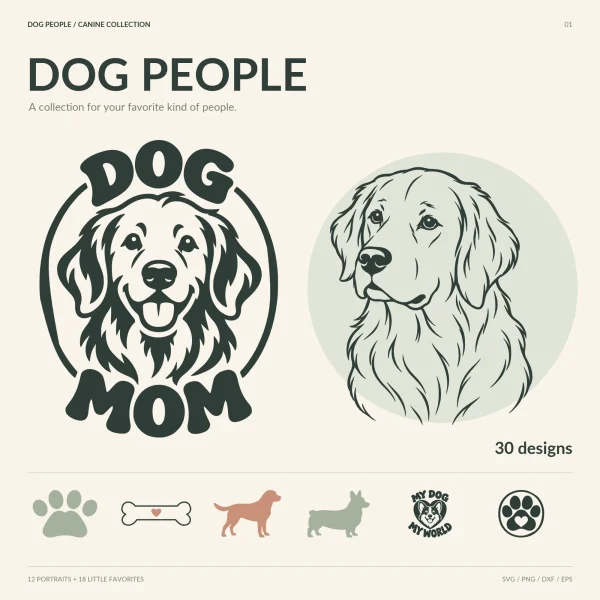
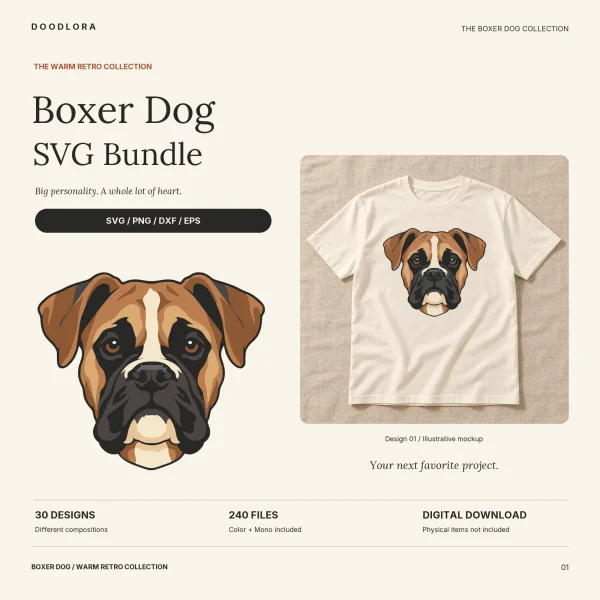
Our dog sets are digital clipart, not drawing guides, but they work well as reference sheets beside your paper. The dog SVG set includes the twelve breed portraits shown above, one per file, which is handy for comparing ears and muzzles. The golden retriever clipart has 30 designs, including six full-body poses and four puppies, for practicing poses. The corgi clipart shows both corgi types, and the boxer dog clipart has six full-body poses in a flat, bold style that’s close to how a cartoon dog is drawn.
Use them to understand the overall silhouette, the pose and where the markings sit, then draw your own lines. A finished drawing can sit next to a printed clipart dog on a card or a page; how to use clipart covers printing and sizing those.
Dog drawing questions
Which dog should a beginner try first?
A sitting puppy seen from the front. It’s symmetrical, made of circles and a pear shape, and the back legs are mostly hidden. After that, a front-view face with floppy ears is the next easiest.
Why does my dog drawing look like a cat?
Usually the muzzle is too short and the ears are small triangles on top of the head. A dog’s snout sticks out clearly from the skull, and the nose is big and rounded. Lengthen the muzzle first and most of the cat look goes away.
Which way do a dog’s back legs bend?
Partway down, the back leg points backward, then the lower part goes down and slightly forward to the paw. That backward point is the hock, the same joint as a human ankle. It sits high because dogs stand on their toes.
How do I draw a dog’s nose?
Draw a rounded, upside-down triangle, like a soft heart shape, with two comma-shaped nostrils. Leave a small white highlight on top so it looks shiny, and add a short line down to the mouth.
How do I make a dog drawing look cute?
Use puppy proportions: a big head, short muzzle, round eyes set low, and large paws. A slight head tilt and an open mouth with a tongue make any dog look friendlier.
Once you can draw one dog, draw the same dog in three poses on one page, then swap the ears and the tail. A dozen dogs later, that repetition builds the confidence to sketch almost any breed without a reference.
Printables from this article
Related articles
Clipart & SVG Cut Files
How to Draw a Truck: Easy Pickup, Big Rig and Cartoon
Split a pickup into three parts before you draw a single wheel: a bed, a cab and a hood. Keep the roof about 2.2 wheels tall and the bed rail level with the hood, and the truck looks right even before the details go on.
Clipart & SVG Cut Files
How to Draw a Train: Steam Engine, Cars and Tracks
Split the page into a 10-square grid, lay a long boiler tube across the middle, set a box cab at the back and a tall stack at the front, hang two big driving wheels under the cab end, then couple cars behind and run the rails to a vanishing point.
Clipart & SVG Cut Files
Hawk vs Falcon: Wings, Size, Hunting Style and Eagles
A falcon has long, narrow wings that taper to sharp points and flies on steady, quick wingbeats; a hawk has broader wings with rounded tips and either soars in slow circles or flaps hard and glides. Falcons kill with a notched beak and hawks with their talons, and eagles are the largest, heaviest-billed members of the hawk family.