How to Draw a Boat: Easy Sailboat, Speedboat and Ship Steps
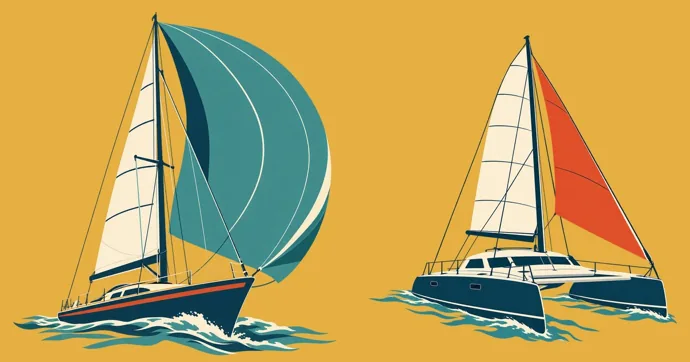
A boat drawing starts with the water, not the boat. Rule a level waterline across the page, then sit the hull down into it so the bottom of the boat is hidden, and the boat floats instead of hovering. The simplest sailboat is that hull, one mast and two triangles, and a pencil version needs roughly a quarter of an hour, a planning figure rather than a timed one.
The guide covers the supplies and the parts of a boat, a sailboat in seven steps, then a speedboat and a big steamship built on the same hull idea. After those come water and reflections, simpler boats for each age, and the slips that tip a boat over or sink it on paper.
Supplies, time and ages for a boat drawing
The kit is what an ordinary school pencil case holds:
- a pencil with a light touch, an HB or a No. 2
- an eraser
- a ruler, for the waterline and the mast
- plain copy paper, turned wide rather than tall
- a black felt-tip pen to go over the finished outline
- crayons, colored pencils or markers for color
A wide page matters more than it sounds. Boats are long and low, so a tall sheet leaves an empty sky above a tiny hull. The tall exception is a sailboat drawn close up, where the mast needs height.
| Boat | Good starting age | Pencil time (our estimate) | The hard part |
|---|---|---|---|
| Sailboat | 5 and up | 10 to 15 minutes | Keeping the mast straight |
| Speedboat | 7 and up | 15 minutes | The pointed, raised bow |
| Big ship | 8 and up | 25 to 30 minutes | Lining up rows of portholes |
The parts of a boat you’ll draw
Knowing six or seven names makes the steps easier to follow, because “the front” and “the pointy end” don’t always mean the same thing on paper. Every boat in this guide is built from these:
| Part | What it is | How it looks in a drawing |
|---|---|---|
| Hull | The body of the boat that sits in the water | A long bowl shape, flat on top, curved underneath |
| Bow | The front | The higher, more pointed end |
| Stern | The back | Lower and squarer |
| Deck | The flat top of the hull | One line along the top edge |
| Mast | The tall pole that holds the sails | A long, thin upright rectangle |
| Boom | The pole along the bottom of the mainsail | A short rectangle sticking back from the mast |
| Mainsail and jib | The two sails | A big triangle behind the mast, a smaller one in front |
| Waterline | Where the hull meets the water | A level line across the hull |
The easy sailboat below is a sloop. Wikipedia’s entry on the sloop describes it as a sailboat with a single mast, usually one headsail in front of the mast and one mainsail behind it. That front sail is the jib. So two triangles, one on each side of one pole, is not a kid’s shortcut. It’s the way the most ordinary small sailboat is actually rigged. For a lesson that puts sailboats next to ferries, tugboats and submarines, our guide to types of transportation sorts water vehicles alongside land and air ones.
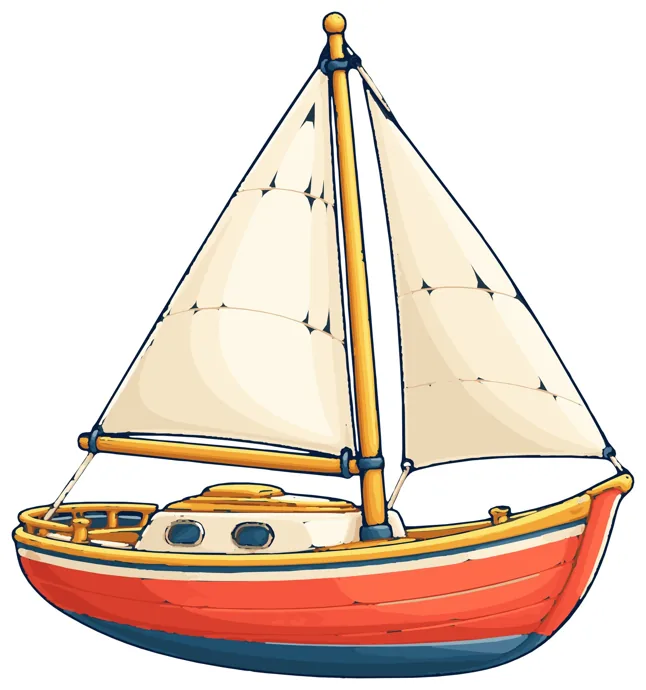
How to draw a sailboat in 7 steps
The sailboat comes first because every other boat reuses its hull. Draw lightly until step 7, since a few guide lines have to come off at the end.
Step 1: Rule the waterline
Draw a level line across the page, a little below the middle. Keep it straight with a ruler. Everything above it is sky and boat, everything below it is water, and a slanted line here makes the boat look like it’s sliding downhill.
Step 2: Draw the hull as a shallow bowl
Start the deck line just above the waterline, about a third of the way in from the left edge, and run it across to about two-thirds. Raise the right end slightly, because that end is the bow. From the left end, the stern, curve a line down and forward under the waterline. Bring it back up to meet the bow at a point. The finished shape is a bowl tipped a little upward at the front, and its lowest part sits below the waterline.
Step 3: Add the deck edge and a small cabin
Draw a second line just under the deck line, following it all the way along, to give the hull a rim. Then put a low rectangle with rounded corners on the deck, slightly toward the stern. Two small circles on its side become the cabin windows.
Step 4: Stand the mast in the middle of the boat
Draw the mast as two parallel lines rising straight up from the deck, in front of the cabin. Make it tall, about as tall as the hull is long or a little taller. Use the ruler so it stands at a right angle to the waterline. A mast that leans looks broken even when every other line is right.
Step 5: Add the boom and the mainsail
A little above the deck, draw the boom as a short, thin rectangle sticking back from the mast toward the stern. Its end should stop above the back of the boat, not past it. Now draw the mainsail as a triangle. Its tall side runs down the mast, its bottom side rests on the boom, and the third side joins the top of the mast to the end of the boom. Bow that third side outward slightly, as if wind is filling the sail.
Step 6: Add the jib in front of the mast
From near the top of the mast, draw a line down to the tip of the bow. Then draw a second line from the bottom of that one back toward the mast, a little above the deck. Close the triangle. The jib is narrower than the mainsail and a little shorter. Leave a small gap of sky between the two sails so they read as two pieces of cloth.
Step 7: Add a flag, then ink and erase
Put a small triangle flag at the top of the mast, pointing the same way the sails bulge. Go over the keepers in black pen, give the ink a minute, then rub out the pencil. Also erase the part of the hull under the waterline if you plan to draw water over it. Add a few curved lines inside the sails for seams, and the sailboat is done.
How to draw a speedboat
A speedboat keeps the same waterline and the same idea of a higher bow, but it has no mast. All its character is in the hull, which is long, low and pointed like a wedge.
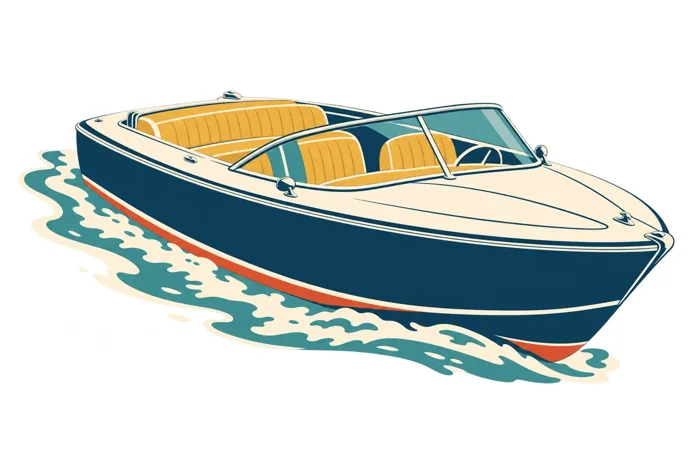
- Draw a long, thin hull. Make it about four times as long as it is deep, much flatter than the sailboat’s bowl. Raise the bow end well above the waterline, so the front looks lifted out of the water.
- Point the bow sharply. Bring the bottom line up to meet the deck in a sharp point, not a curve.
- Add a stripe along the side. One line running from bow to stern, just below the deck, makes the hull look smooth and fast.
- Put in the windshield. Draw a slanted rectangle leaning back, about a third of the way from the bow.
- Add seats and a motor. Two or three rounded bumps behind the windshield are seats. A small box hanging off the stern is the outboard motor.
- Draw the spray behind the boat. A curl of white water at the stern and a V of lines spreading back from the bow show speed. Spray drawn in front of the boat looks like it’s crashing.
How to draw a big ship
A ship is the sailboat’s hull made much longer and taller, with floors stacked on top instead of sails. Our ship clipart’s classic steamship is a good model because every piece is simple: a dark hull, a cream upper section and two round funnels.
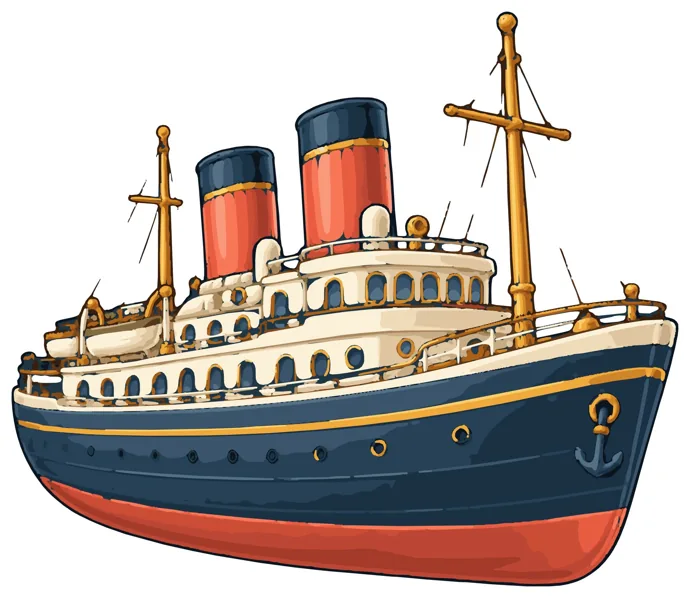
- Draw a long, deep hull. Use the same bowl shape, but make it about three times as long as it is tall. Keep the bow higher, and give it a slightly squarer stern.
- Stack the decks. Draw a rectangle on top of the hull, shorter than the hull at both ends. Draw a second, shorter rectangle on top of that. Stepping each layer in is what makes the ship look tall and solid.
- Add the funnels. Two upright rectangles with flat tops sit on the top deck, near the middle. Make them the same width and lean them back very slightly.
- Add masts. One thin pole near the bow and one near the stern, each with a short crossbar near the top.
- Line up the portholes. Draw a faint ruler line along the hull and space small circles evenly on it. Draw arched windows along each deck the same way. The guide line keeps them level. Erase it when you ink.
- Finish with an anchor and a stripe. A small anchor shape near the bow and a line along the hull where the dark color changes to red.
A tugboat is a fast variation for kids who find the ship too long. It uses a short, round hull, one tall cabin, one funnel and a row of black tires hung along the side.
Water, waves and a reflection under the boat
The water is what makes a boat sit in a picture rather than on top of it. Start by erasing or covering the bottom of the hull, so the waterline cuts across the boat. Then add a few short, curved lines touching the hull on both sides. Those small ripples at the waterline do more than a whole sea of waves.
For bigger water, our step-by-step guide to drawing waves covers the quick curl symbol, a full curling wave and foam near the shore. Keep waves behind and beside the boat smaller than the hull. A wave taller than the boat changes the story to a storm.
A reflection only shows on calm water. Draw it straight down under the boat, flipped upside down, and much simpler:
- Use the same colors as the boat, but lighter.
- Break the reflection into short horizontal dashes, with gaps of water between them.
- Make the mast’s reflection a wavy line rather than a straight one.
- Stop it before it reaches the same length as the real boat.
If the boat is sailing into a sunset, its reflection sits on top of the path of light from the sun. Our sunset drawing guide explains how that path works and how to color it.
Easier boats for kids, by age
Young children can draw a boat that looks like a boat long before they can manage a mast at a right angle. Pick the version that matches the hand, not the grade.
| Age | The boat | How it goes | Time |
|---|---|---|---|
| 3 to 4 | Half-circle sailboat | A half circle, flat side up, for the hull. One straight line up from the middle. One triangle next to it. A wavy line underneath. | About 5 minutes |
| 5 to 6 | Two-sail boat | A trapezoid hull, wider at the top. A mast. One big triangle and one small one. Blue crayon waves across the bottom. | About 10 minutes |
| 7 to 9 | The 7-step sailboat or the speedboat | Full steps above, with an adult or older sibling checking the mast is straight. | 15 to 20 minutes |
| 10 and up | The steamship, plus a reflection | Ruler guide lines for the portholes, and a broken reflection under the hull. | 30 minutes or more |
For the youngest group, a filled-in shape is easier than an outline. A dark silhouette of a sailboat, a hull and two sails colored in one color, reads instantly as a boat, and it hides wobbly lines.
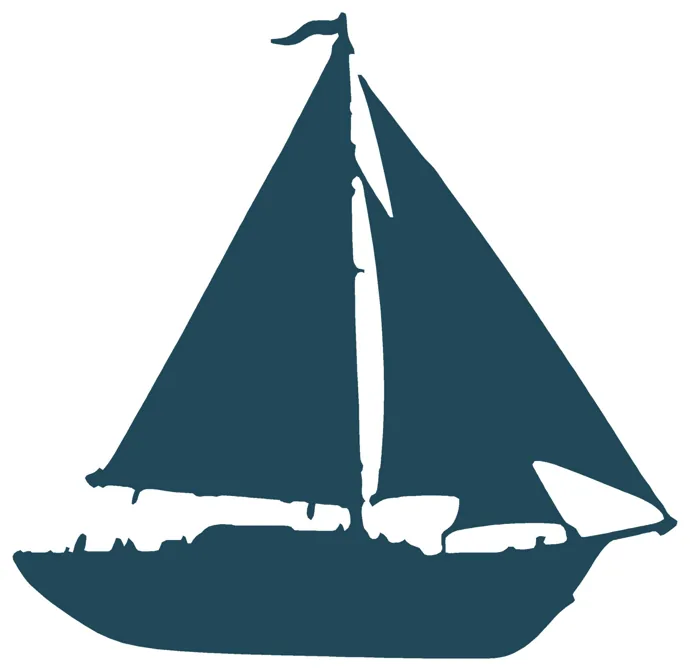
Once a single boat comes easily, older kids can turn the page into a harbor. A beach, a lighthouse on a rock and two or three boats at different sizes make a full page. The beach drawing guide shows how to set the horizon and shoreline so the boats sit at the right distance.
Boat drawing mistakes and how to fix them
The same seven slips turn up in almost every early boat drawing.
The boat floats above the water. The whole hull sits on top of the waterline, so the boat looks like it’s hovering. Erase the bottom third of the hull and draw ripples touching the sides.
The sails touch the water. The boom was drawn too low, or the mainsail runs past the stern. Raise the boom above the deck and stop the sail at the back of the boat.
The mast goes through the bottom. Kids often draw the mast all the way down through the hull. Start it at the deck line instead, so it stands on the boat.
The hull is a flat rectangle. A boat with a straight bottom looks like a box. Curve the underside, and lift the bow.
Both ends look the same. If you can’t tell which way the boat is going, raise and point the bow, flatten the stern, and let the flag and the sails bulge toward the front.
The sails are on the wrong side. The big sail goes behind the mast, over the boom, and the smaller jib goes in front, down to the bow. Swapped sails make a sailboat look like it’s going backward.
The portholes wander. Freehand rows of circles drift up or down along a long hull. Rule a faint guide line first, then erase it after inking.
Using boat clipart as a drawing reference
A drawing goes faster with a picture to look at, and a clean cartoon boat is easier to copy from than a photo. Every image in this guide comes from our own clipart sets, and each is a good model for one kind of boat.
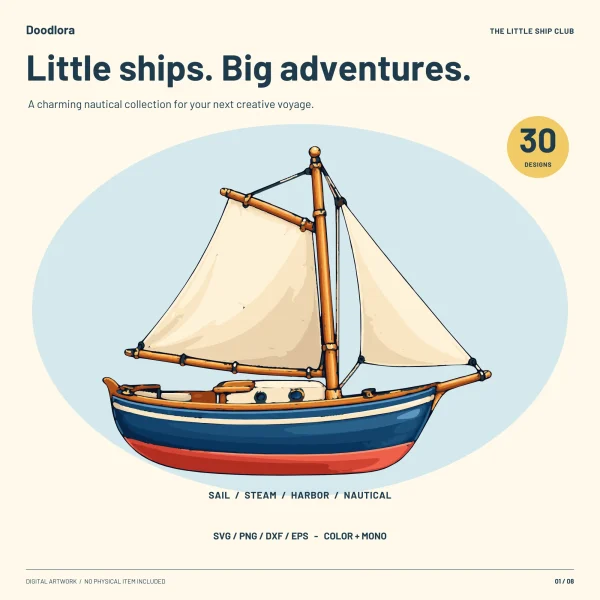
The ship clipart is drawn like painted wooden toys, with chunky hulls and thick outlines that are easy for kids to read. Design 02 is the Bermuda sloop pictured above, and the set’s eight sailing ships run from a gaff cutter to a junk and a Nordic longship. The steamships and tugboats cover the big-ship section.
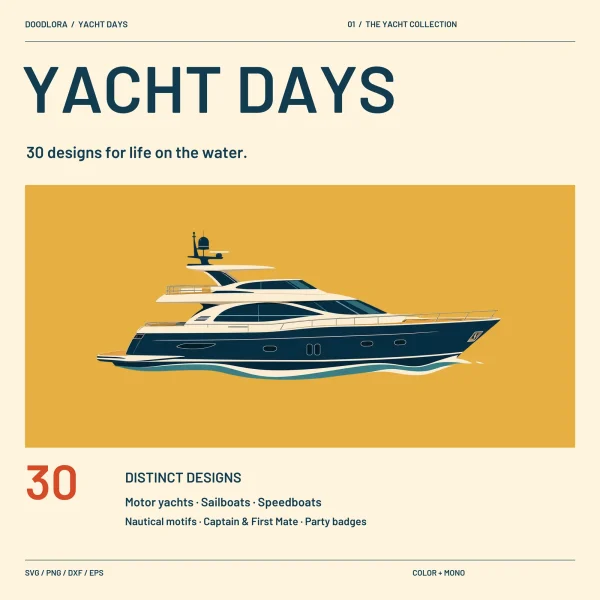
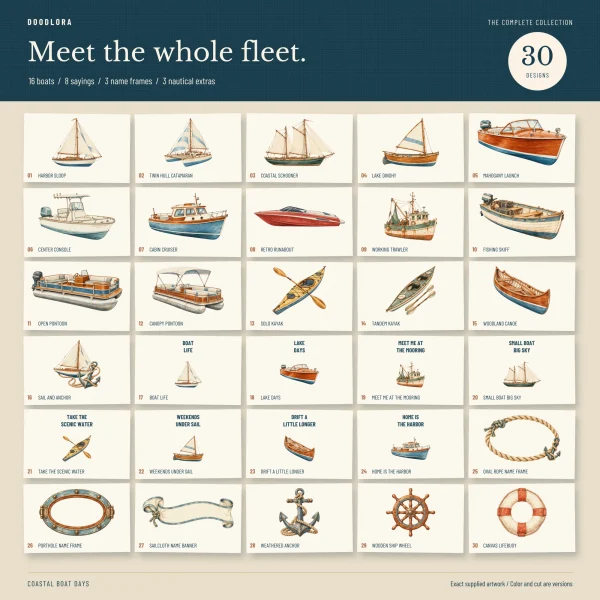
The yacht clipart suits older kids and adults who want a sleeker boat to copy. Design 09 is the open-bow speedboat in the speedboat section, and designs 14 to 17 are flat navy boat silhouettes. The boat clipart adds pontoons, kayaks and a canoe, and every design comes with a one-color cut version like the silhouette above.
Print a single design on plain paper and put it next to the drawing. The files come with a personal license, which covers home use and a teacher using them with their own class. Trains, cars and planes in the same styles are in the clipart shop.
Boat drawing questions
What’s the easiest boat to draw?
A sailboat is the easiest. It’s a half-circle hull, one straight mast and one or two triangles. A three-year-old can draw a recognizable one with a crayon in a few minutes.
Which way should the sails face?
The big mainsail goes behind the mast and the smaller jib in front. Curve the outer edge of both sails toward the bow, so the wind looks like it’s pushing the boat forward.
How do you draw a boat that looks like it’s moving?
Draw a curl of white spray at the stern and a V of ripples spreading back from the bow. Tip the hull so the bow sits a little higher than the stern.
How do you draw a boat from the front?
Draw a tall, narrow V for the hull, flat across the top. Stand the mast straight up from the middle of the deck line. From the front, the sails look like thin slivers on either side of it rather than full triangles.
Printables from this article
Related articles
Clipart & SVG Cut Files
How to Draw a Truck: Easy Pickup, Big Rig and Cartoon
Split a pickup into three parts before you draw a single wheel: a bed, a cab and a hood. Keep the roof about 2.2 wheels tall and the bed rail level with the hood, and the truck looks right even before the details go on.
Clipart & SVG Cut Files
How to Draw a Train: Steam Engine, Cars and Tracks
Split the page into a 10-square grid, lay a long boiler tube across the middle, set a box cab at the back and a tall stack at the front, hang two big driving wheels under the cab end, then couple cars behind and run the rails to a vanishing point.
Clipart & SVG Cut Files
Hawk vs Falcon: Wings, Size, Hunting Style and Eagles
A falcon has long, narrow wings that taper to sharp points and flies on steady, quick wingbeats; a hawk has broader wings with rounded tips and either soars in slow circles or flaps hard and glides. Falcons kill with a notched beak and hawks with their talons, and eagles are the largest, heaviest-billed members of the hawk family.