How Do Hot Air Balloons Work? Parts, Steering and Facts

A hot air balloon works because hot air is lighter than cold air. A burner under the open mouth of the balloon heats the air inside the big fabric bag, called the envelope. Warm air is less dense than the cooler air around it, so a balloon full of it weighs less than the same volume of outside air, and the surrounding air pushes it up. That upward push is buoyancy. To go higher, the pilot fires the burner again. To come down, the pilot lets the air cool or opens a vent at the top to let some hot air out.
There is no engine pushing the balloon forward and no steering wheel. A balloon drifts with the wind, and the pilot picks a direction by climbing or sinking into a layer of air that is moving the way they want to go.
Below are the parts of a balloon and what each one does, how a flight goes up and comes down, how pilots steer, the first flights in 1783, a set of quick facts, and a flame-free classroom demo that shows the idea with a plastic bag and a hair dryer.
Why warm air makes a balloon float
Air has weight, and so does every bag of air. When you heat air, it spreads out and gets less dense, meaning the same amount of space holds less air. A balloon full of warm air is therefore lighter than an equal-sized bubble of cool air outside it, and it rises for the same reason a beach ball pops up when you push it under water. Scientists call this Archimedes’ principle: anything sitting in air or water is pushed up by a force equal to the weight of the air or water it pushes aside. Kids who enjoy sink-or-float tests are already playing with the same idea, and our science activities for kids have more experiments in that vein.
How much lift a balloon gets depends mostly on the gap between the temperature inside the envelope and the temperature outside. So the same balloon gets more lift on a cold day than on a hot one. The gap has a ceiling, too. Most envelopes are nylon fabric, and the air inside them is limited to roughly 120°C (250°F).
One detail surprises most people: the envelope is open at the bottom. It does not need to be sealed, because the air inside is at about the same pressure as the air around it. The hot air stays in because it rises to the top of the bag, the same way warm air collects near the ceiling of a room.
The parts of a hot air balloon
A hot air balloon has three main pieces: the envelope that holds the hot air, the burner that heats it, and the basket that carries the people and the fuel. Here is what each part does.
| Part | What it is | What it does |
|---|---|---|
| Envelope | The big fabric bag, usually ripstop nylon or polyester | Holds the heated air that lifts everything |
| Gores | The long panels sewn together from the bottom of the envelope to the top | Give the envelope its shape; a balloon can have as few as 4 or more than 24 |
| Load tapes and crown ring | Strong webbing sewn up the envelope to a metal ring about 1 foot across at the very top | Carry the weight of the basket up through the fabric |
| Mouth | The open bottom of the envelope, lined with fire-resistant fabric | Lets the burner flame and hot air in |
| Parachute vent | A round fabric flap at the top of the envelope | Lets hot air out so the balloon slows, stops climbing or comes down |
| Burner | A metal unit between the basket and the mouth that burns propane | Heats the air; the pilot fires it with a valve called the blast valve |
| Pilot light | A small flame that stays lit in the burner | Lights the propane each time the pilot opens the valve |
| Fuel tanks | Metal cylinders of liquid propane | Feed the burner |
| Basket | Usually woven wicker or rattan | Carries the pilot, passengers, tanks and instruments |
| Instruments | Altimeter, variometer (shows how fast you climb or sink), temperature gauges, often GPS | Tell the pilot height, climb rate, envelope heat and speed over the ground |
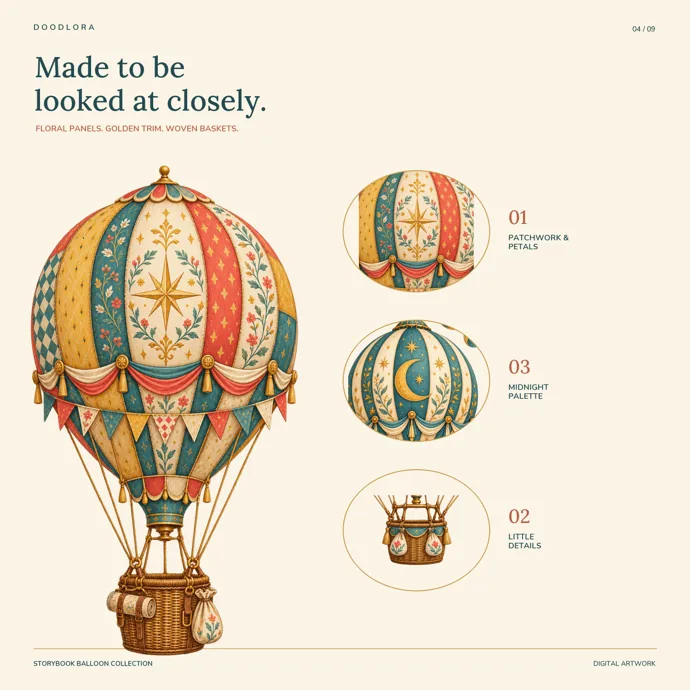
When kids look at a picture of a balloon, the stripes running from top to bottom are worth pointing out. Each stripe is a gore, a separate panel of fabric. Real envelopes are made the same way, from panels cut and sewn together from the bottom of the bag to the top.
Why baskets are still made of wicker
Wicker and rattan sound old-fashioned for an aircraft, but they have stuck around because they are light, strong and durable. Baskets come in sizes from just big enough for two people to large enough for thirty. Some big ones have walls inside to divide the passengers, and many have small holes woven into the sides as footholds for climbing in.
What the burner sounds like and why some are quiet
A balloon burner turns liquid propane into gas, mixes it with air and shoots a flame up into the mouth of the envelope. Each burner puts out about 2 to 3 megawatts of heat, and bigger balloons carry two, three or four burners together. Some burners also have a second, slower valve called a whisper burner. It makes a different sound, and pilots use it when flying over farm animals so they are less likely to spook them.
How a balloon goes up, levels off and comes down
A flight is a cycle of heating and cooling. The pilot never has a way to push the balloon down, only ways to make it lighter or heavier than the air around it.
- Filling it up. On the ground, the crew partly fills the envelope with cold air from a big gas-powered fan. Then the pilot uses the burner to heat that air and finish the inflation.
- Taking off. More heat makes the air inside lighter still. When the whole balloon, basket and people included, weighs less than the air it pushes aside, it lifts off.
- Climbing. The pilot opens the blast valve, the burner heats the air, and the balloon rises.
- Slowing down. To slow a climb, the pilot stops heating or opens the parachute vent at the top for a moment to let some hot air out.
- Coming down. To start down, the pilot lets the air cool or opens the vent again. Some balloons also have small side vents that turn the balloon, which helps line up a rectangular basket for landing.
- Landing. The pilot lets out more hot air, either by turning down the burner or by opening the vent, and the balloon settles to the ground.
How do hot air balloons steer?
A hot air balloon can’t be steered the way a plane or a car can. It moves with the air around it, so if the wind blows east, the balloon goes east. What a pilot can do is change height. Wind often blows in different directions or at different speeds at different heights, so by climbing or sinking, a pilot can catch a layer of air moving closer to the direction they want.
Because the balloon moves along with the air, ordinary airspeed instruments are useless in it. Pilots use GPS to see their speed and direction over the ground instead.

A helpful way to explain it to a child is to think of the sky as a stack of rivers. Each layer flows its own way, and the pilot can’t paddle. All they can do is float up or sink down into the river going the right way. That gives the pilot rough control over direction, never precise steering.
The first hot air balloon flights
Hot air balloons were the first flying machines to carry people. They were developed in France by two brothers, Joseph-Michel and Jacques-Étienne Montgolfier, and the first big flights all happened in 1783.
| Date | Where | What happened |
|---|---|---|
| June 4, 1783 | Annonay, France | The brothers flew an unmanned balloon of sackcloth lined with paper in front of local officials. It flew about 2 km (1.2 miles) in 10 minutes. |
| September 19, 1783 | Palace of Versailles | The first passengers were animals: a sheep, a duck and a rooster rode in a basket under the balloon in front of King Louis XVI and Queen Marie Antoinette. |
| About October 15, 1783 | Paris | The first people went up, in a balloon tied to the ground. Étienne Montgolfier went first, and later that day Jean-François Pilâtre de Rozier rose about 25 meters (82 feet), the length of the rope. |
| November 21, 1783 | Paris | The first free flight with people aboard. Pilâtre de Rozier and the Marquis d’Arlandes flew about 900 meters (about 2,950 feet) above Paris, covered about 9 km (about 5.6 miles) and landed after 25 minutes. |
The animal flight came first because nobody knew whether living things could survive high in the sky. The sheep stood in for a person, and the duck and rooster were there to compare with it. Kids usually like knowing that the very first air travelers were farm animals.
Hot air balloon facts
These quick facts are good for a report, a fact card or a curious kid’s questions.
- Balloons can’t go to space. Like every aircraft, a hot air balloon needs air to float in, so it can’t fly above the atmosphere. For what lies beyond it, our space facts for kids pick up where the air runs out.
- The most common size carries 3 to 5 people. Its envelope holds about 2,800 cubic meters (about 99,000 cubic feet) of air.
- The smallest balloons carry one person and have no basket. These are called hoppers or cloudhoppers.
- The biggest sightseeing balloons can carry more than two dozen people.
- Fuel is propane. It is carried as a liquid in metal tanks made of aluminum, stainless steel or titanium.
- A burner flame is powerful. One burner gives off about 2 to 3 megawatts of heat.
- Balloons come in odd shapes. Besides the classic teardrop, balloons have been built in many shapes, including rocket ships.
- Pilots carry instruments, not a steering wheel. The main ones show height, how fast the balloon is climbing or sinking, and how hot the air inside the envelope is.

How to explain hot air balloons to kids
The whole idea fits into three sentences that a child of about 5 can follow, and older kids can add the words “density” and “buoyancy” on top.
- Ages 4 to 6: “Hot air is lighter than cold air. The fire heats the air inside the balloon. Light air floats up, so the balloon floats up too.”
- Ages 7 to 9: Add that the balloon has no engine and goes wherever the wind blows, and that the pilot lets hot air out of a hole at the top to come down.
- Ages 10 and up: Add density (the same space holds less warm air than cold air) and buoyancy (the surrounding air pushes up on the balloon with a force equal to the weight of the air it pushes aside).
A quick check that works at any age: blow up an ordinary party balloon and let go. It falls. NASA’s classroom guide uses this question too: your breath is a little warmer than the room, but not nearly hot enough to lift the weight of the rubber.
A flame-free bag balloon demo for the classroom
This demo comes from NASA’s aeronautics guide for teachers. It uses a hair dryer as the only heat source, so there is no flame anywhere in the room. By our planning estimate, it takes about 20 to 30 minutes for a class of elementary students working in groups of four, including decorating time.
What you need. The supplies are cheap and mostly already in a classroom. Each group of four gets its own bag, and one hair dryer serves the whole class.
- A large, thin plastic bag, such as a dry-cleaner bag or a 5-gallon trash bag, one per group
- Paper clips to weigh down the bottom edge
- String
- Small scraps of paper or stickers for light decorations
- One hair dryer for the whole class
- A party balloon for the comparison question
How to do it. Groups take turns at the hair dryer while the others finish decorating. These are NASA’s steps, with the adult jobs marked.
- Have each group decorate its bag with a few small, light pieces. Heavy decorations keep it from rising.
- Tie a string around the top of the bag.
- Clip paper clips evenly around the open bottom edge so the bag hangs straight.
- An adult holds the hair dryer on high, pointed up, with the open end of the bag held over it.
- Let the bag fill with hot air. When the students feel it tugging upward, they let it go.
- Ask why it rose. The heated air inside the bag is lighter than the classroom air.
Watch-outs. Most problems come from the hair dryer or a bag that is too heavy. Here is how to head them off.
- An adult runs the hair dryer. Keep the nozzle a little below the bag so the hot plastic doesn’t touch it and melt.
- Switch the dryer off before the bag is released. That way kids see the bag rise on warm air alone, and not just get blown upward by the dryer’s airstream.
- Thin bags work best. If the bag won’t lift, try fewer paper clips or a thinner, lighter bag. NASA’s guide suggests testing different bags and different numbers of clips as a follow-up experiment.
- Put the bags away afterward. A big plastic bag is not something to leave lying around a room with toddlers or babies, so collect them at the end.
- Keep it flame-free. Use only the hair dryer. Don’t swap in candles or any other flame to make it rise faster.
A label-the-parts page
After the demo, a picture of a balloon to label pulls the whole lesson together. Print one large balloon on a sheet and have kids write in the envelope, the gores, the ropes, the basket and the top, then add an arrow showing where the burner would go and another arrow showing hot air rising. The six line-art balloons in our hot air balloon clipart are drawn in fine brown ink lines, so they print like coloring outlines, and the set’s guide says the detailed line art works best printed large, so give one balloon a whole page.
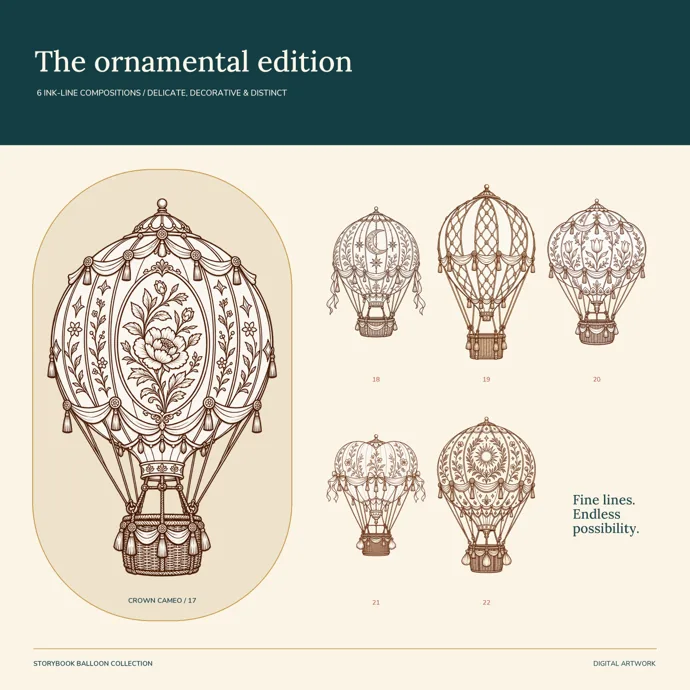
A hot air balloon card also fits right into the air group of a types of transportation sorting game. Blowing one balloon up to fill a page is a sizing question, and how to use clipart explains when the PNG is big enough and when to switch to the SVG.
Quick answers
Does a hot air balloon have an engine? No. The burner only heats the air. Nothing pushes the balloon forward, so it travels with the wind.
What keeps the hot air from falling out of the open bottom? Hot air rises, so it collects at the top of the envelope. The air inside is at about the same pressure as the air outside, so the bottom doesn’t need to be sealed.
Can a hot air balloon fly against the wind? No. It always moves with the air around it. The pilot can only climb or sink into a layer where the wind blows a different way.
How does a hot air balloon land? The pilot lets the air inside cool or opens the vent at the top to let hot air out, and the balloon slowly sinks to the ground.
Who flew the first hot air balloon? The Montgolfier brothers built it. The first free flight with people aboard, on November 21, 1783, carried Pilâtre de Rozier and the Marquis d’Arlandes over Paris.
Printables from this article

Related articles
Clipart & SVG Cut Files
How to Draw a Truck: Easy Pickup, Big Rig and Cartoon
Split a pickup into three parts before you draw a single wheel: a bed, a cab and a hood. Keep the roof about 2.2 wheels tall and the bed rail level with the hood, and the truck looks right even before the details go on.
Clipart & SVG Cut Files
How to Draw a Train: Steam Engine, Cars and Tracks
Split the page into a 10-square grid, lay a long boiler tube across the middle, set a box cab at the back and a tall stack at the front, hang two big driving wheels under the cab end, then couple cars behind and run the rails to a vanishing point.
Clipart & SVG Cut Files
Hawk vs Falcon: Wings, Size, Hunting Style and Eagles
A falcon has long, narrow wings that taper to sharp points and flies on steady, quick wingbeats; a hawk has broader wings with rounded tips and either soars in slow circles or flaps hard and glides. Falcons kill with a notched beak and hawks with their talons, and eagles are the largest, heaviest-billed members of the hawk family.