Fish Crafts for Kids: 14 Ideas, Plus Rainbow Fish Crafts
The easiest fish craft for a two-year-old is a handprint fish, and it takes about 10 minutes plus drying time. Preschoolers do well with a paper plate fish. After reading The Rainbow Fish, a class can make one big fish with a shiny scale from every child. Kids from about six can weave a paper fish or make a fish mobile. Older kids and adults can try a koi streamer or a foam-plate fish print.
Here’s the quick way to pick. The ages and times are our planning estimates, so stretch them for a slow, chatty table.
| Craft | Ages | Time | Main supplies | Mess |
|---|---|---|---|---|
| Handprint fish | 2–5 | 10 min + drying | Washable paint, paper | Paint |
| Paper plate fish | 3–6 | 20 min | Paper plate, stapler, crayons | Low |
| Tissue paper suncatcher fish | 3–7 | 20 min | Contact paper, tissue paper | Low |
| Bubble wrap scale print | 3–7 | 15 min + drying | Bubble wrap, paint | Paint |
| Coffee filter fish | 3–8 | 15 min + drying | Coffee filters, washable markers, spray bottle | Damp |
| Shiny scale fish (Rainbow Fish) | 3–7 | 20–30 min | Fish outline, colored paper, foil | Low |
| Class sharing fish (Rainbow Fish) | 4–8, whole class | 30–40 min | Butcher paper, paper scales, foil | Low |
| Cupcake liner scale fish | 4–8 | 25 min | Cupcake liners, glue | Low |
| Paper strip fish | 6–10 | 10 min each | Paper strips, stapler | None |
| Woven paper fish | 6–10 | 30–40 min | Construction paper, scissors | Low |
| Fishbowl collage | 5–10 | 30 min | Printed fish and plants, glue | Low |
| Fish mobile | 7–12 | 45 min | Fish outlines, string, stick | Low |
| Koi streamer | 9 to adult | 45–60 min | Large paper, tissue, koi outline | Low |
| Foam-plate fish print | 9 to adult | 30–45 min | Foam tray, paint, roller | Paint |
Fish crafts for toddlers and preschoolers (ages 2 to 5)
Young kids need a craft they’ll finish before their attention runs out. Each one below has one main action, such as pressing, sticking or stapling, and a clear finish. Draw the eye with a marker for anyone under 3. Federal toy rules treat small parts as a choking hazard for children under 3 years of age (16 CFR Part 1501), and a loose googly eye is exactly that kind of part.
Handprint fish
This one is for one child at a time, with an adult holding the paint. Allow about 10 minutes, then leave it to dry.
You need washable paint, a paper plate for the paint, a sheet of heavy paper and a damp cloth. Brush paint across the child’s palm and four fingers, keeping the thumb out. Press the hand flat on the paper with the fingers pointing sideways, so the fingers become the tail and the palm becomes the body. Add an eye and a few bubbles with a marker once it dries.
It’s done when the eye goes on. The snag is too much paint: a thick coat slides when the hand presses down, so the fish comes out as a smear. Brush a thin layer and press once, straight down.
Paper plate fish
A paper plate fish suits two to six preschoolers around one table, with about 20 minutes.
You need one paper plate per child, scissors for the adult, a stapler or glue, and crayons or markers. Cut a wedge out of the plate like a slice of pie. The gap becomes the fish’s open mouth. Staple or glue that wedge to the opposite edge, point first, and it becomes the tail. The child then colors scales, draws an eye next to the mouth and adds fins.
The fish is finished when the tail is attached and the eye is on. Cut the wedges before the children sit down. Stapling a wedge to a wobbly plate is the slow part, so you’ll want to do it yourself while they color.
Tissue paper suncatcher fish
This works for one to six children aged 3 to 7, with about 20 minutes. There’s no glue, which keeps it tidy.
You need clear contact paper, tissue paper torn or cut into small squares, a black marker and tape. Draw a big fish shape on the paper backing, or trace one from a printed outline. Peel the backing and tape the sheet to the table sticky side up. Children press tissue squares onto the sticky side until the fish is covered. Lay a second sheet of contact paper over the top, then cut around the fish.
It’s done when the fish is cut out and taped to a window. The snag is curling: loose contact paper rolls up and sticks to itself, so tape all four corners down before anyone starts. Don’t skip this.
Bubble wrap scale print
This fits a small group of two to four children, with 15 minutes plus drying time.
You need a fish shape cut from heavy paper, a square of bubble wrap, washable paint and a brush or small roller. Paint the bumpy side of the bubble wrap. Lay it paint side down on the fish, press gently with flat hands and lift it straight up. The round dots look like scales.
The print’s done when the paint is dry and the eye’s drawn on. Too much paint fills the gaps between the bubbles and prints a flat blob, so brush a thin coat and test one press on scrap paper first.
Coffee filter fish
This fits one to six children aged 3 to 8, with 15 minutes plus drying time.
You need round coffee filters, washable markers, a spray bottle of water, a tray and a sheet of paper. Children scribble colors all over a flat filter. Spray it lightly on the tray and watch the colors run together. Once dry, fold the filter in half and glue it to the paper as the fish body, then cut a tail from a second filter.
It’s done when the body and tail are glued down. Permanent markers won’t spread when wet, so check that the markers say washable. One or two sprays are enough; a soaked filter tears when you lift it.
Rainbow Fish crafts to make after story time
The Rainbow Fish is a picture book written and illustrated by the Swiss author Marcus Pfister, first published in German in 1992 and translated into English by J. Alison James. It’s best known for its message about selfishness and sharing and for the shiny foil scales on its fish. The crafts here borrow that idea of one special scale. The children design their own fish. They don’t copy the one in the book.
These suit a preschool or kindergarten class, a library story time or a family reading at home. Read the book first, then hand out the materials while the story is still fresh.
Shiny scale fish
This works for one child or a full class aged 3 to 7, with 20 to 30 minutes.
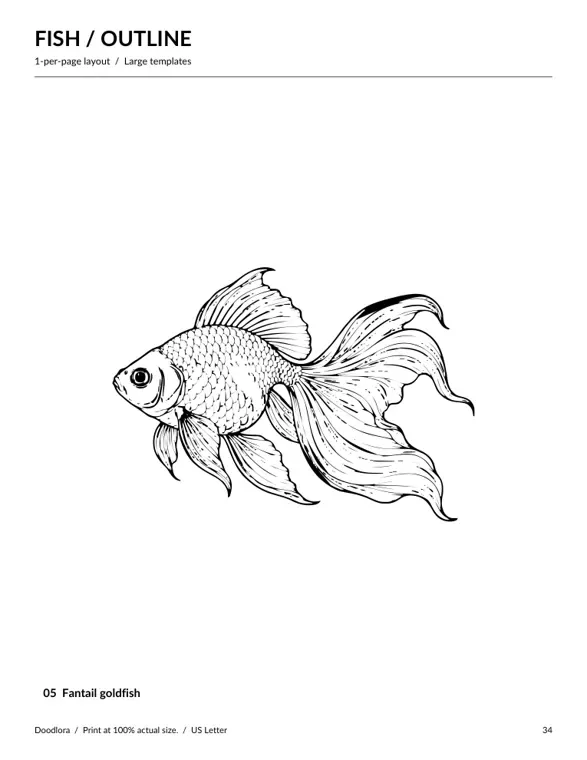
You need a printed fish outline for each child, small squares of colored paper, one square of aluminum foil or foil paper per child, and glue. A full-page outline with a large body leaves room for fat fingers and big paper scales. The fantail goldfish in our fish outline collection prints on its own page, page 34 of the US Letter PDF, with every scale already drawn in.
Children glue colored squares over the body, then add their one shiny scale anywhere they like. The craft is done when the body is covered and the foil scale is on. The snag is the foil: glue sticks don’t hold it well, and it peels off by pickup time. Use a dot of liquid school glue or a small loop of tape on the back.
Class sharing fish
The whole class can work on this one at once, with children aged 4 to 8 and 30 to 40 minutes.
You need a large fish drawn on butcher paper, one paper scale per child cut to the same size, crayons, and foil squares. Hand each child one scale to decorate. Older children can write or dictate one way they shared something that week. Each child adds a small piece of foil to their scale, then glues it onto the big fish.
It’s done when every child’s scale is on the fish. Cut all the scales from one template so they overlap neatly. Mixed sizes leave bare patches, and the last children won’t have anywhere to stick theirs. Start gluing from the tail end and work toward the head, so each row overlaps the one behind it.
Cupcake liner scale fish
This suits one to six children aged 4 to 8, with about 25 minutes.
You need a fish shape cut from heavy paper, paper cupcake liners in several colors, one foil liner, and glue. Flatten the liners and cut each one in half to make two half-moon scales. Children glue the halves in overlapping rows, curved edge toward the tail, and save the foil half for one special scale.
It’s done when the rows reach the head and the eye is drawn on. Start the rows at the tail and work toward the head. If a child starts at the head, each new row covers the curved edges of the last one and the scale pattern disappears.
Fish crafts for school-age kids (ages 6 to 10)
Children this age can cut, fold and staple on their own. That means you can set out the supplies, explain once and let them work. These crafts take more than one step, but the finished fish stands up, hangs or holds a whole scene.
Paper strip fish
This works for any number of kids aged 6 to 10, at about 10 minutes per fish. It’s a good one for filling the last part of a class period.
You need strips of construction paper about 1 inch wide and 11 inches long, a stapler, and a marker. Lay two strips together and staple one end; this becomes the nose. Bend each strip outward into a curve to make the body shape. Bring the loose ends together about 3 inches from the end, cross them over, and staple. The ends that stick out past the staple become the tail.
It’s done when it stands up on its side and has an eye. The snag is pulling too hard. Tight curves crush the body flat. Keep the bend loose, and staple the tail while the body is still round.
Woven paper fish
This fits a small group or a class of kids aged 6 to 10, with 30 to 40 minutes.
You need a fish shape cut from construction paper, scissors, a ruler and contrasting paper strips about ¾ inch wide. Fold the fish in half lengthwise and cut slits from the fold toward the edge, stopping about an inch short. Unfold it. Weave the strips over and under through the slits, pushing each one tight against the last. Trim the ends and glue them down at the edges.
It’s done when the body is full of strips and the ends are glued. Don’t cut through the edge. That splits the fish into pieces. Draw a line about an inch in from the edge before cutting, and stop every slit at it.
Fishbowl collage
This fits one to four kids aged 5 to 10, with about 30 minutes. It’s a calm craft for a rainy afternoon.
You need a bowl shape cut from paper (or a clear plastic cup turned on its side), printed fish and water plants, scissors, glue and crayons. Children cut out the fish, plants and bubbles. They arrange them inside the bowl, glue them down, then draw sand and pebbles along the bottom.
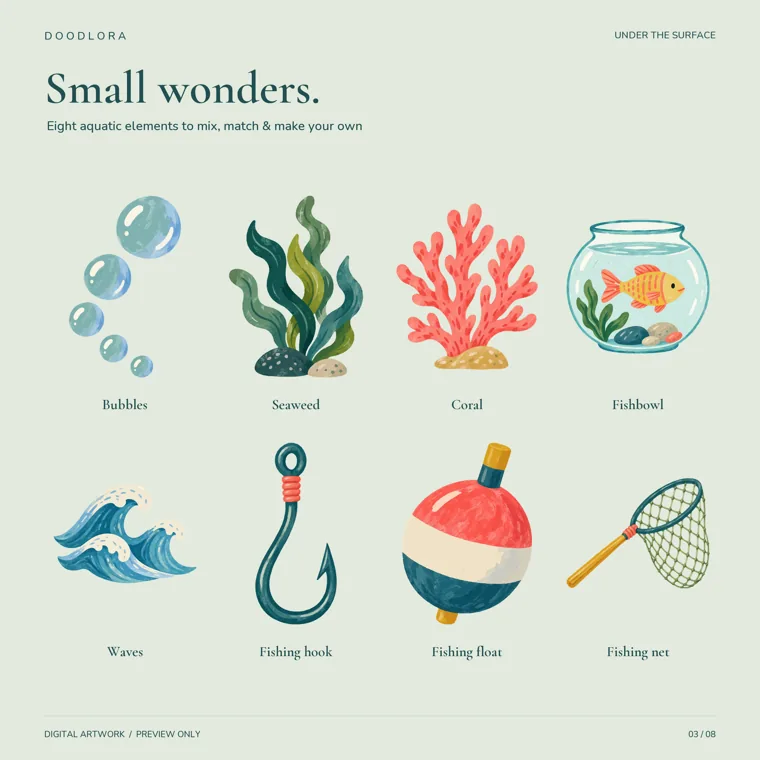
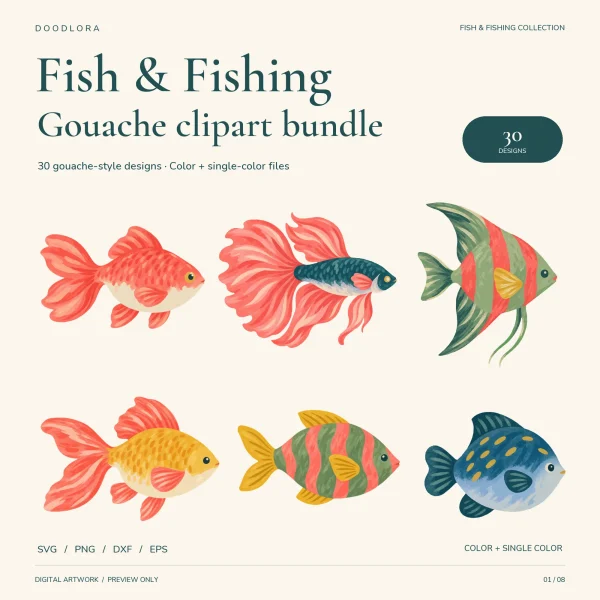
Our fish clipart set has the scenery pieces as separate files: bubbles, seaweed, coral, a fishbowl and waves. The clipart files aren’t a printable sheet. They’re PNGs and vectors, so place a few on one page in any document program before you print. The how to use clipart guide walks through that step.
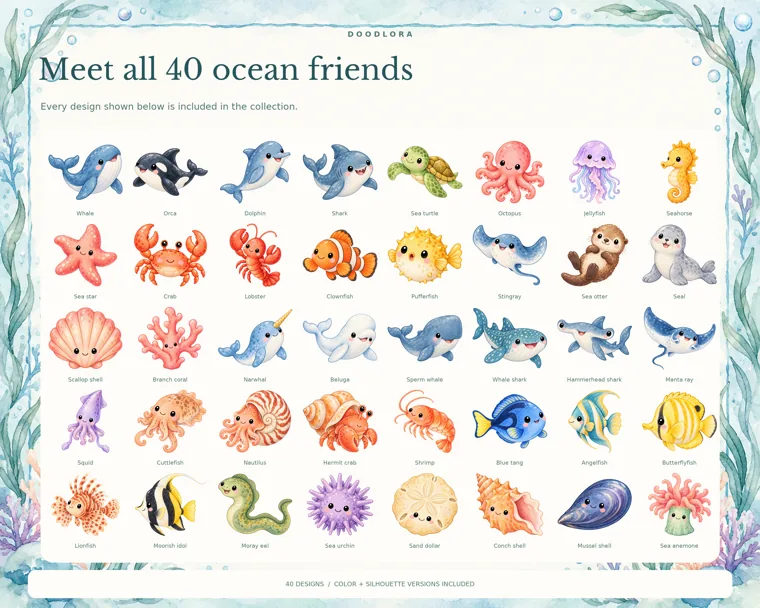
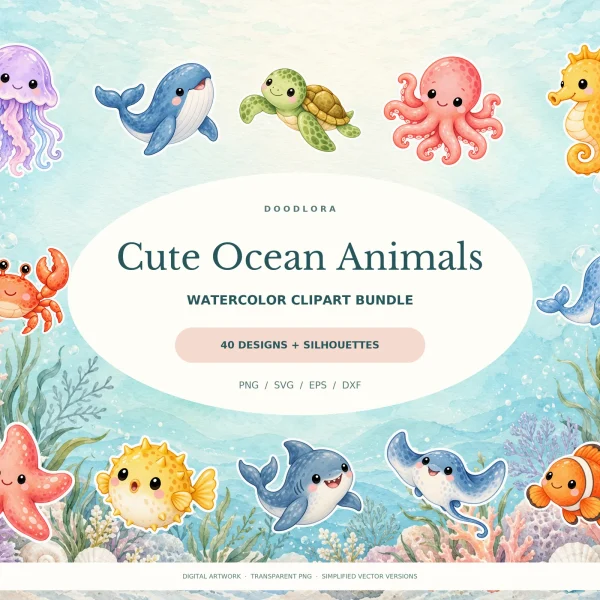
For a reef scene instead of a bowl, the watercolor sea animals clipart includes a clownfish, blue tang, angelfish, butterflyfish, moorish idol and pufferfish among its 40 animals. Each PNG is 1254 pixels square, which comes to about 4.2 inches across at 300 dpi.
The collage is done when everything is glued down and the sand is drawn in. Have children lay out every piece before any glue comes out. Gluing as they go fills the bowl with fish before there’s room for plants.
Fish mobile
This suits one to four kids aged 7 to 12, with about 45 minutes.
You need four to six fish printed on cardstock, crayons or markers, a hole punch, string or fishing line, and a stick or embroidery hoop. Color both sides of each fish, punch a hole near the top fin, and tie each fish on a string of a different length. Tie the strings along the stick, then hang the stick from one longer string at its center.
Our fish outlines print four to a page as well as full size. Page 51 of the US Letter PDF holds the goldfish, betta, angelfish and porcupine puffer together, a good mix of shapes for one mobile.
It’s done when the stick hangs level. Every fish in that set faces left, so you’ll have a blank back on each cutout. Hold each fish against a sunny window and trace the lines through onto the back before coloring. Then balance the stick by sliding the strings, not by cutting them shorter.
Fish crafts for older kids, teens and adults
These take longer and use sharper tools or wet paint, so they work best with ages 9 and up, or with a younger child working next to an adult. Both make something you can hang up afterward.
Koi streamer
This fits one to four people aged 9 to adult, with 45 to 60 minutes.
Koinobori are carp-shaped windsocks flown in Japan for Children’s Day on May 5, and their name means “carp streamer.” In a traditional set, the biggest black carp stands for the father, a red or pink one for the mother, and smaller carp in other colors for each child. A paper version makes a good family project, with one carp per person.
You need a large sheet of paper (about 12 × 18 inches) per carp, tissue paper strips, glue, tape, markers and string. Draw a large eye near one short edge and scales along the body. Glue tissue strips along the opposite short edge for the tail. Roll the sheet into a tube, tape the seam and punch two holes at the mouth for the string.
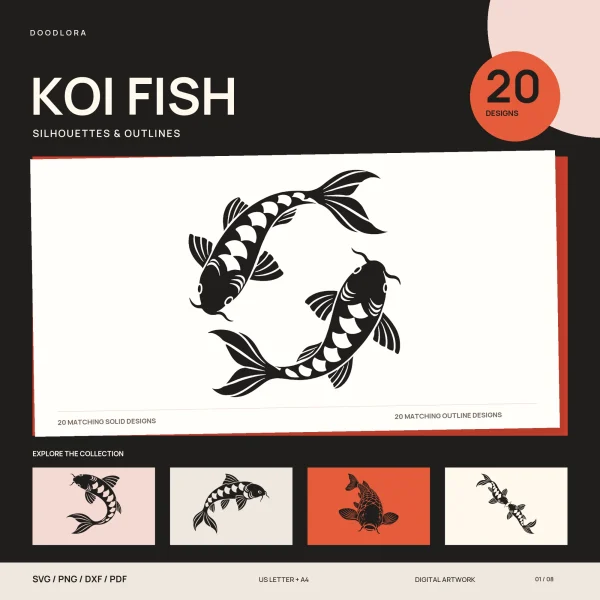
A koi outline gives you the scale pattern to copy. The solid style in our koi fish outlines shows each scale as a white crescent. The first design, Silk Current, is a single koi on a slant, and the pair and lotus scenes work for a banner instead of a tube.
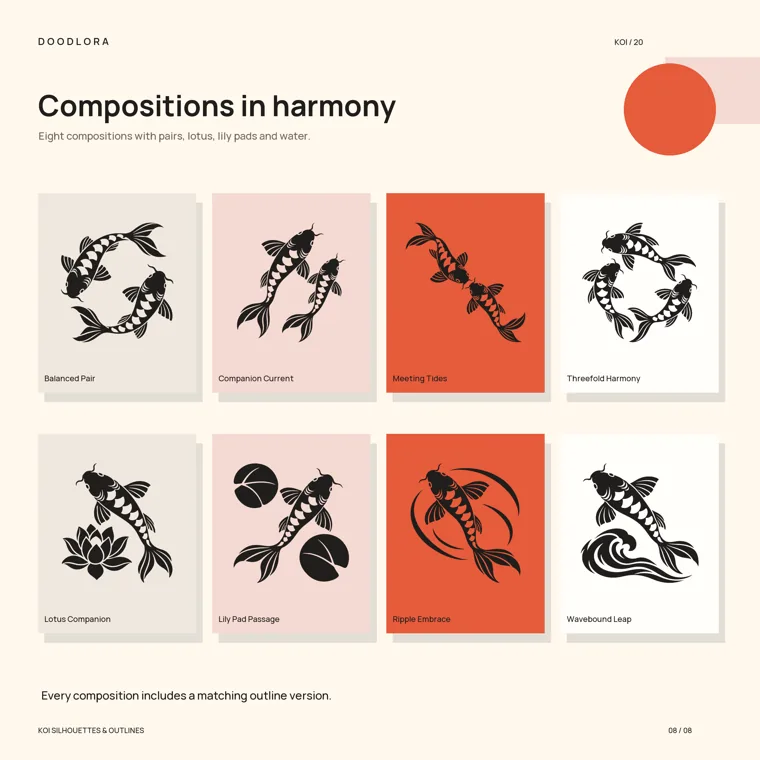
It’s done when the streamer catches air from a fan or a breeze. Tissue tails tear when they’re wet, so bring the streamer in before it rains.
Foam-plate fish print
This suits one to six people aged 9 to adult, with 30 to 45 minutes. It’s a simple form of printmaking.
You need a clean foam tray or plate with the curved edge cut off, a dull pencil, washable paint or block printing ink, a small roller (a brush works too), and paper. Draw a fish into the foam, pressing hard enough to dent it. Roll a thin coat of paint over the surface, lay paper on top and rub with your palm. Peel the paper back from one corner.
It’s done when you’ve pulled one clean print. You can re-ink the plate for a few more. The snag is that the print comes out reversed. A fish drawn facing left swims right on the paper, and any letters come out backward. Draw names and words in mirror writing, or leave them off and add them with a marker afterward.
How to pick a fish template
A template saves time when children are too young to draw a fish shape they’re happy with. It also helps when a whole class needs fish of the same size. Match the template to the craft:
- Coloring, mosaic and scale crafts: use a line drawing with a big body and visible scales.
- Cutting, stencils and prints: use a solid silhouette. One shape with no inner lines is easier to cut and trace.
- Class projects: print one design at the same size for every child, so the work hangs evenly on a wall.
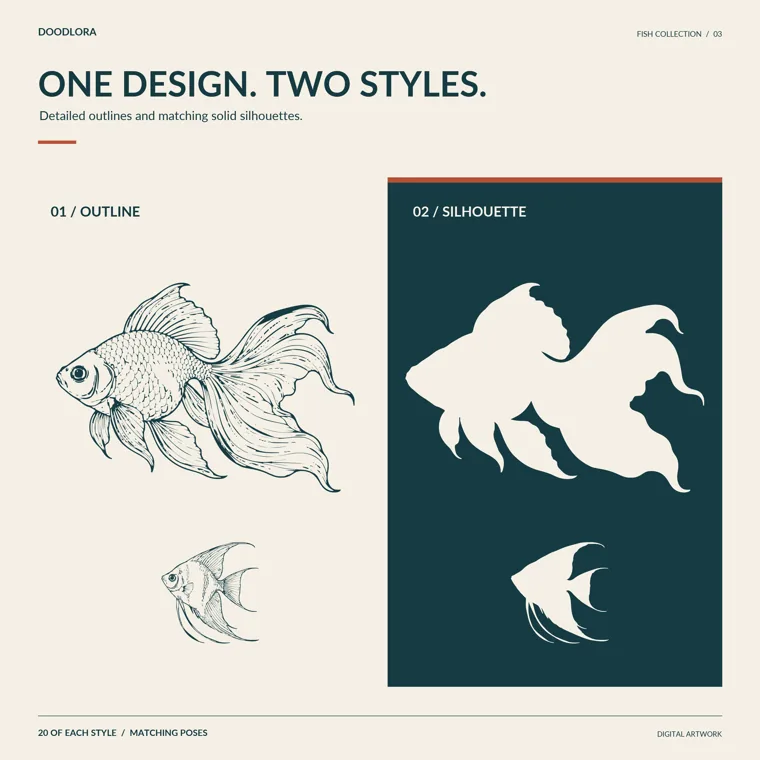
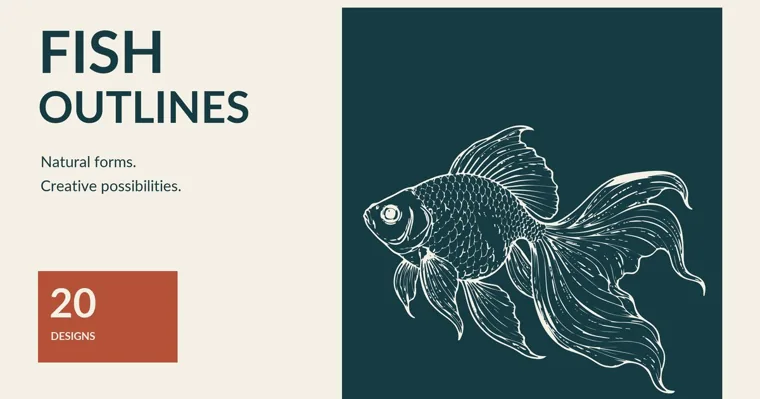
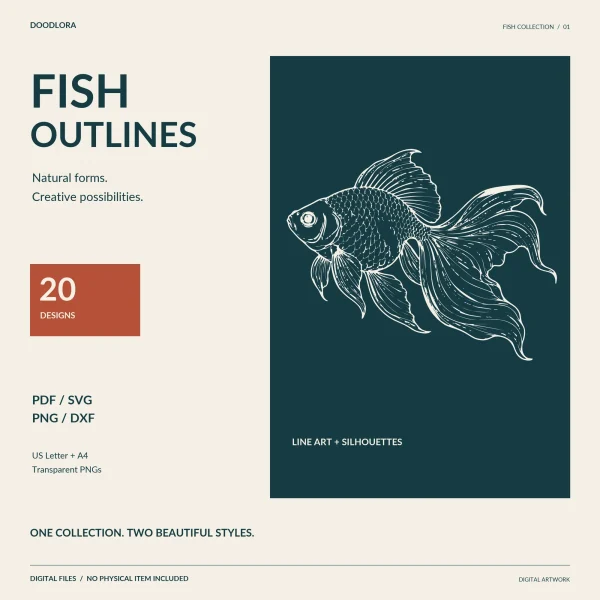
The fish outline collection has 20 designs in both styles. The US Letter PDF puts the silhouettes on pages 1 to 29 and the line art on pages 30 to 58. Each style has one fish per page, then four or six to a page for smaller crafts. Print at 100% so the fish don’t shrink; our guide to printing coloring pages covers that setting for each type of printer.
For more cut-and-glue ideas beyond fish, the collage ideas guide has projects for mixed ages.
Printables from this article
Related articles
Outlines & Stencils
How to Draw a Mallard Duck: Drake, Hen and Flying Poses
A swimming mallard drake in ten pencil steps, the changes that turn it into a hen, a flying pose, a pair on the water and the color marks that make the bird read as a mallard.
Outlines & Stencils
Turtle Crafts for Kids: Paper Plate and Sea Turtle Ideas
Twelve turtle crafts sorted by age, each with time, materials, steps and the snag to watch for, plus how to use a printed turtle outline as a cutting template.
Outlines & Stencils
Bird Crafts for Kids and Adults: Owl, Nest and Feeder Ideas
Thirteen bird crafts grouped by who is making them, from a toddler's handprint bird to a framed papercut and a cold-weather pinecone feeder, each with ages, time, supplies, steps and the snag to plan for.