 1 / 6
Dinosaur Outlines: 20 Cute Designs from Triceratops and Spinosaurus to Four Mini Shapes
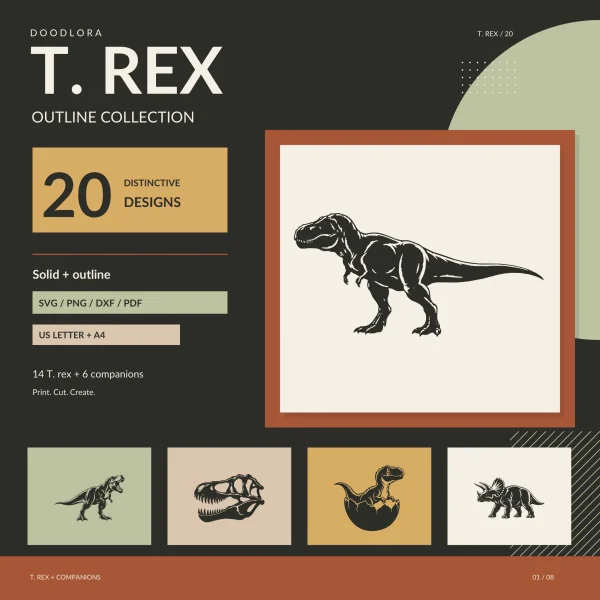
Chunky cartoon dinosaurs with big heads and stubby arms, fourteen kinds in all, including a T. rex standing, running and sitting, plus four extra-simple minis. Every design is a plain edge with nothing drawn inside, supplied as a filled black shape and as a hollow outline.
$3.99
Buy any 3 or more printables and save 20% at checkout.
- Download right after payment — link works for 30 days, up to 5 downloads
- Files arrive as a ZIP with your license PDF inside
- Secure checkout by Stripe · Refund policy
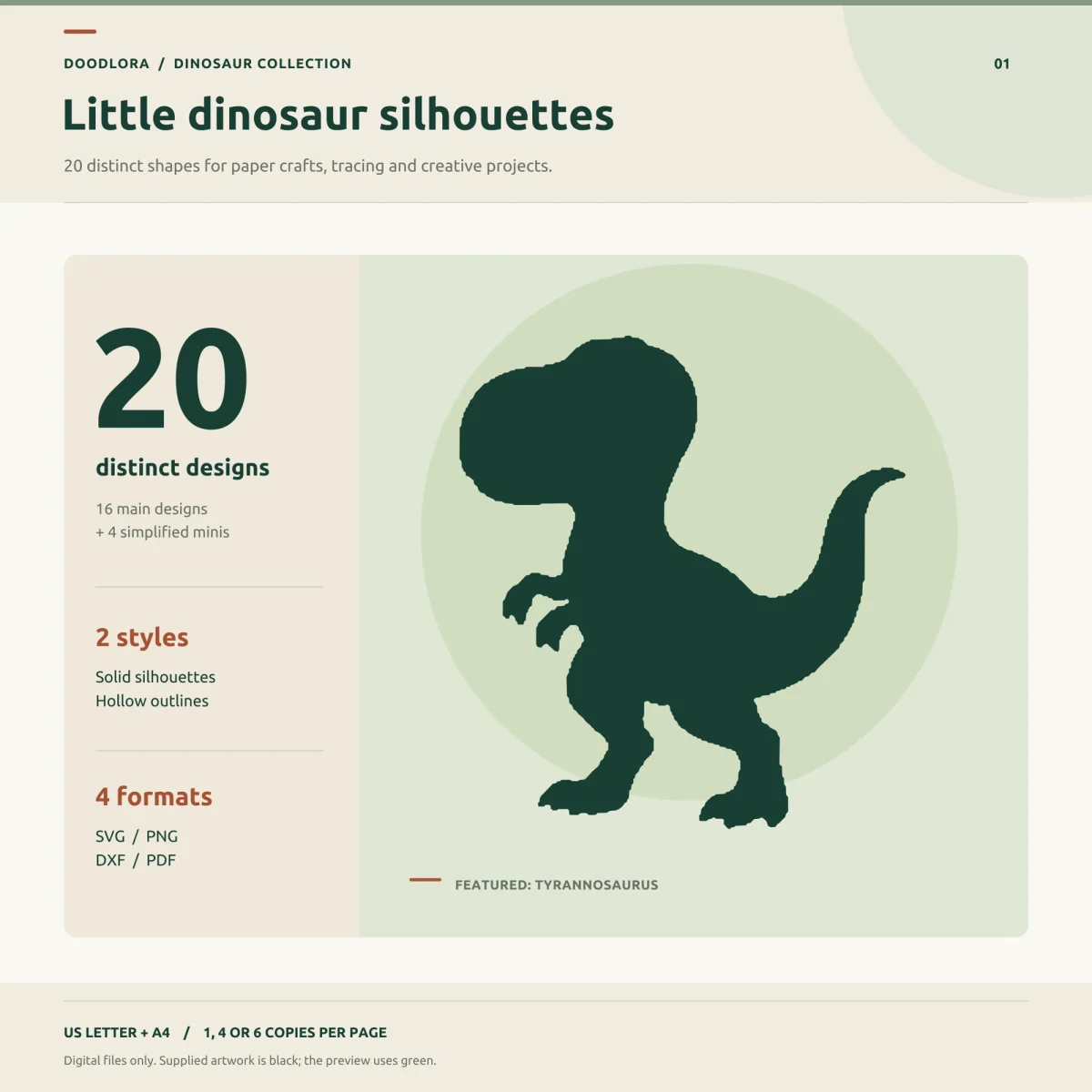
Big round heads, thick legs and short stubby arms make these dinosaurs look like toys rather than fossils. There are 20 of them, and none has anything drawn inside the edge: no eye, no mouth, no scales. You get each one twice, once as a filled black shape and once as a hollow outline that follows the same edge.
Fourteen kinds, and a T. rex three times
The first 16 designs are the main set. Tyrannosaurus appears in three of them: standing upright with its tail curled up (01), running with its jaws open (15) and sitting down with its feet sticking out in front and its tail curving up behind (16).
The other thirteen are one of each. Triceratops walks with three horns and a scalloped frill, stegosaurus carries a row of rounded plates and a spiked tail, and brachiosaurus holds its neck straight up. Velociraptor is the leanest of the lot, caught mid-stride with its claws out. Ankylosaurus has a knobbly back and a tail that arches up to a round club, parasaurolophus and corythosaurus stand tall with their crests, and diplodocus stretches out low with a long whip of a tail. Spinosaurus has its sail, styracosaurus a crown of long frill spikes, ceratosaurus a nose horn and a bumpy ridge, and pachycephalosaurus a domed head. Design 08 is a pteranodon with its wings spread.
The four minis
Designs 17 to 20 are a rex, a long-necked dinosaur, a stegosaurus and a triceratops drawn even more simply, with plumper bodies and fewer points along the edge. Each is one smooth contour, which suits small pieces like labels, journal stickers or the front of a folded card where a spiky tail would get lost.
One piece or a narrow band
Because no solid design has holes, every black silhouette cuts out as a single piece. The outline is drawn as a thin closed band with an outer and an inner edge. Cut both and you get a hollow dinosaur frame. If you only want a pen line for drawing or tracing, the notes suggest keeping the outer contour and deleting the inner one in your software. Small claws on the raptor and the T. rex arms are the fiddly spots, so cut a test piece in your own paper before a batch. Nothing in the notes says the files were test-cut on a machine.
Millimeters in the DXF
The DXF files are set in millimeters, not inches, on a 203.2 mm square, which is the same 8 inches as the SVG canvas and the 2400-pixel PNGs. The largest dinosaurs reach about 180 mm (7 inches) across inside that square. Some software trims a DXF to the drawing itself on import, so compare the size before you scale anything.
On paper, each PDF page carries the dinosaur’s name at the top and a page number at the bottom. A single design on a US Letter page runs up to about 6.5 inches across, four to a page about 3.1 inches and six to a page about 2.5 inches, all copies of the same dinosaur. Print at Actual Size so those sizes hold.
Questions
- Is the pteranodon a dinosaur?
- No. Design 08 is a pteranodon, a flying reptile, and the notes that come with the files say so. It's in the set as a prehistoric companion to the dinosaurs.
- Do the solid shapes have eyes or holes cut into them?
- No. Each solid file is a single closed shape with nothing cut out, so there are no eyes, mouths, scales or loose inner pieces. The outline version is the same edge drawn as a narrow band.