Desert Animals List: Where They Live and How They Survive
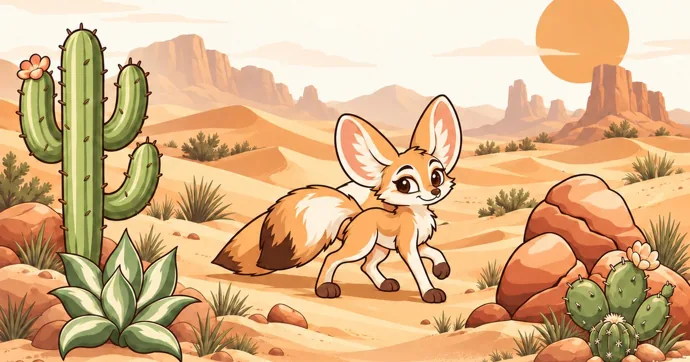
Desert animals stay alive in three main ways. Most avoid the heat by sheltering in burrows or coming out only at night and in the cool hours around dawn and dusk. Many get most or all of their water from food, so they rarely or never drink. Others shed heat through their bodies, like a jackrabbit’s oversized ears or a vulture’s bare legs. The kangaroo rat of the American Southwest does two of these at once: the National Park Service says it never needs to drink in its whole life, and it retreats to its burrow in extreme weather.
The table below sorts 23 animals that live in the desert by region, with each one’s main trick. The sections after it go desert by desert, from the Sonoran, Mojave and Chihuahuan deserts of North America to the Sahara, the Kalahari and Namib, Australia’s interior and the cold Gobi.
Desert animals list at a glance
| Animal | Desert or region | How it handles heat or lack of water |
|---|---|---|
| Kangaroo rat | Deserts of western North America | Never needs to drink; gets water from the seeds it eats |
| Desert tortoise | Mojave and Sonoran | Spends at least 95% of its life in burrows |
| Desert bighorn sheep | Desert mountains of the Southwest | Goes days without drinking, then drinks several gallons |
| Black-tailed jackrabbit | Western North America | Releases body heat through its huge ears |
| Coyote | North American deserts, grassland and cities | Hunts in the cool of night and early morning |
| Greater roadrunner | Southwestern U.S. and Mexico | Naturally high body temperature lets it work by day |
| Javelina (collared peccary) | Sonoran | Eats prickly pear pads, spines and all; rests through midday |
| Gila monster | Southwestern U.S. and northwestern Mexico | Lives mostly underground; stores fat in its tail |
| Burrowing owl | Deserts and grasslands of the Americas | Moves into other animals’ old burrows |
| Turkey vulture | Southwestern deserts, including the Sonoran | Cools off by wetting its own legs |
| Rattlesnakes | North American deserts | Shelter in holes and crevices; some active in the heat |
| Arizona bark scorpion | Sonoran | Hides in small holes and crevices |
| Dromedary camel | Sahara and the Arabian Peninsula | Survives losing more than 30% of its body water |
| Fennec fox | Sahara to the Sinai | Big ears shed heat; gets water from prey |
| Addax | Sahara | Can go long periods without water |
| Sand cat | Sahara, Arabia and the Middle East | Furry soles protect its feet from hot sand |
| Arabian oryx | Arabian Peninsula | Can go several weeks without water |
| Meerkat | Southern Africa | Deep burrows with steady temperatures |
| Gemsbok | Kalahari and Namib | Doesn’t depend on drinking water |
| Namib fog-basking beetle | Namib | Catches morning fog on its back |
| Red kangaroo | Western and central Australia | Pants, licks its forearms and recycles water in its kidneys |
| Thorny devil | Central Australia | Skin channels carry water to its mouth |
| Bactrian camel | Gobi Desert | Eats snow in winter; the wild species drinks salty water |
If you need animals for one particular desert, use one section of this table rather than the whole list. A report on the Sonoran Desert that mixes in a fennec fox or a meerkat is mixing continents. If you are building a whole class lesson around this list, our science activities for kids have hands-on experiments to pair with it.
How desert animals survive heat and thirst
Hiding from the heat is the most common trick. Death Valley National Park’s animal page says many animals there rest through hot summer days and come out at night, and you can read their night moves in tracks on the dunes the next morning. Burrows do the same job by day. Wikipedia notes that meerkat burrows, for example, hold a steadier temperature than the ground above them.
Getting water from food is the second trick. The kangaroo rat lives on the water in seeds, the fennec fox gets moisture from its prey, and the gemsbok doesn’t depend on drinking at all. These animals also lose less water to begin with. The kangaroo rat, for one, makes very concentrated urine and dry droppings.
The third trick is getting rid of heat that builds up anyway. Big thin ears full of blood vessels work like radiators. Vultures wet their bare legs so evaporation cools them, and red kangaroos lick their forearms for the same reason. A few animals, like the roadrunner, simply run hot: their normal body temperature is high enough that midday heat bothers them less.
North American desert animals: Sonoran, Mojave and Chihuahuan
The deserts of the U.S. Southwest and northern Mexico have the animals American readers are most likely to see in person. Saguaro, Joshua Tree and Death Valley national parks each keep a page on their wildlife, and most of the facts in this section come from those pages.
Kangaroo rat
Kangaroo rats live in dry country across western North America, usually on sandy or soft soil that is easy to dig. They hop on their big hind legs like tiny kangaroos. Death Valley’s animal page says they don’t need to drink water at all in their lives, because they live on the water released as they digest seeds. They also hold on to water by making very concentrated urine and dry droppings. During storms and extreme heat or cold they stay in their burrows.
Desert tortoise
The desert tortoise lives in the Mojave and Sonoran deserts. Wikipedia says at least 95% of its life is spent in burrows, which lets it live where ground temperatures go above 140°F. Death Valley’s park page adds that, depending on the weather, a tortoise may be active above ground for only about three months of the year. It rests through the hottest stretch and hibernates through the cold, and it can live up to 80 years. Joshua Tree National Park lists it as federally threatened, since its numbers have dropped sharply. For how a tortoise differs from other turtles, see our tortoise vs turtle guide.
Desert bighorn sheep
Desert bighorn sheep climb the steep mountains and canyons around desert valleys. Death Valley’s page says they can go several days without drinking and can lose up to a third of their body weight to dehydration. When they find water again, they drink several gallons at a time and recover quickly. Wikipedia notes that some go weeks or months without visiting water, getting by on moisture from plants and rainwater caught in rock pools.
Black-tailed jackrabbit
This hare is the long-eared rabbit shape of the Southwest. Its ears are its air conditioner. When it rests in the shade, warm blood from its core flows through the blood vessels in its ears and gives heat off to the air, as Death Valley’s page explains. It gets most of its water from juicy plants rather than from drinking. Jackrabbits also come out mostly in the dark, which helps them hide from predators.
Coyote
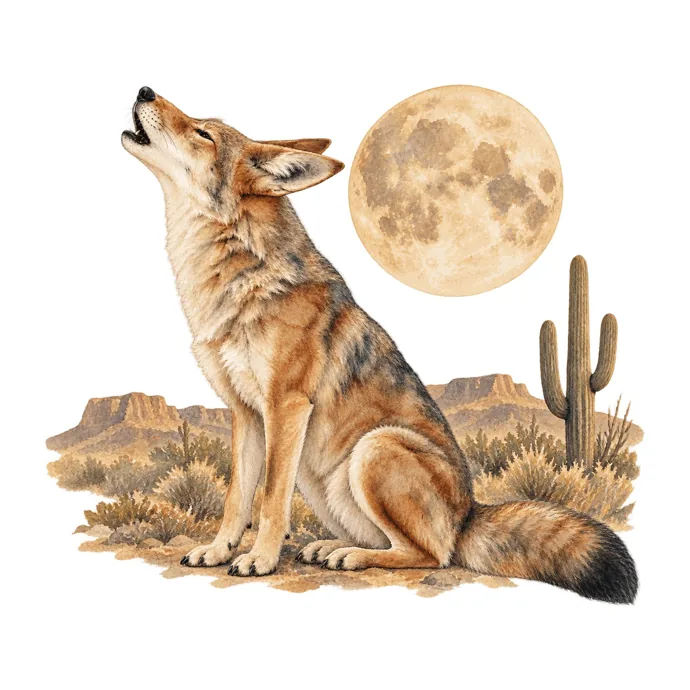
Coyotes do well in grassland, in cities and in deserts full of cactus, kangaroo rats and rattlesnakes. Wikipedia says desert coyotes tend to be paler, more fawn or whitish-gray, than coyotes at high elevations. In Death Valley they hunt during the cool nights and early mornings, which saves energy for chasing prey. On a sand dune you might find a coyote’s long, straight running stride crossing the zigzag trail of a jackrabbit.
Greater roadrunner
The roadrunner can fly a little but spends most of its time on the ground and runs, at up to about 20 mph. It eats almost anything small it can catch, including insects, scorpions, lizards, mice and young rattlesnakes. Death Valley’s page says roadrunners can stay active in the heat of the day because their normal body temperature is already high, about 104°F. Wikipedia adds that fossil evidence shows roadrunners lived in sparse forests until around 8,000 years ago and only later moved into deserts.
Javelina (collared peccary)
Javelinas look like small wild pigs but belong to a different family. Saguaro National Park describes an adult as about 18 inches tall and 40 to 60 pounds. Javelinas live and travel in herds. Their favorite food is prickly pear cactus, which they eat pads, spines and all, sometimes stomping the pads flat first. In summer they feed in the early morning and evening and spend the middle of the day under big trees, in caves or below rock overhangs. They will usually run from people, but a javelina that feels cornered or is guarding its young can act aggressively, so give a herd plenty of room.
Gila monster
The Gila monster is the largest lizard in the United States. It is also the only venomous lizard found there. It grows to about 22 inches long, with beaded black skin banded in pink, orange or salmon. Saguaro National Park says it spends most of its time underground in burrows, which is its main defense against heat and drought. In summer it comes out mostly at night. A single meal can be up to 35% of its body weight, and it stores the extra as fat in its tail and belly. The park’s advice is simple: if you see one, enjoy it and take photos, but don’t try to touch or bother it. Gila monsters are protected by state law everywhere they live.
Burrowing owl
This small, long-legged owl lives in open country, including grassland and desert, across North and South America. Despite its name, it rarely digs its own home. Wikipedia says it usually moves into burrows dug earlier by badgers, foxes or other animals. Unlike most owls it is often active by day, but it avoids the heat of midday.
Turkey vulture
Turkey vultures soar over deserts looking and smelling for dead animals, and they can find a carcass by the gases it gives off. Their cooling trick is not pretty. Saguaro National Park notes that vultures urinate on themselves to shed heat, and Wikipedia explains that the evaporation cools the blood vessels in their bare legs and feet. The white streaks on a turkey vulture’s pink legs come from this habit.
Rattlesnakes
Rattlesnakes are part of every North American desert. Joshua Tree National Park has 26 snake species, and seven of them are rattlesnakes. The western diamondback ranges across the southwestern U.S. and Mexico, and like all rattlesnakes it is venomous. Most desert snakes shelter from the heat in burrows and crevices, though Death Valley’s page names the sidewinder as one that is known for being out in the heat. If you see a rattlesnake, don’t touch it, don’t try to catch it or move it, and walk around it at a distance.
Arizona bark scorpion
The Arizona bark scorpion is a small, light brown scorpion common in the Sonoran Desert of Arizona and northwestern Mexico. Wikipedia calls it the most venomous scorpion in the United States. Like other desert scorpions, it hides in cracks and crevices during the day. Death Valley’s safety page gives the best advice for all of these small animals: watch where you put your hands and feet, because snakes, lizards and scorpions hide in small holes and cracks. Never pick up a scorpion.
Sahara and Arabian desert animals
The Sahara stretches across northern Africa, and the deserts of the Arabian Peninsula continue east from it. Water here can be days of travel apart, so most of the animals in this section can go a long time without drinking.
Dromedary camel
The dromedary is the one-humped camel, kept today mainly in Africa and on the Arabian Peninsula. Its hump does not hold water. Wikipedia says the hump is made of fat bound together with fibrous tissue. The real water trick is in its body. A dromedary can tolerate losing more than 30% of its body water, and it is the only mammal with oval red blood cells, which keep blood flowing when it is dehydrated. Thick double eyelashes and bushy eyebrows help keep blowing sand out of its eyes.
Fennec fox
The fennec fox is a small fox known for its unusually large ears. It lives in the deserts of North Africa, from Western Sahara and Mauritania east to the Sinai Peninsula. Wikipedia says the ears do two jobs: they give off heat and they pick up the sound of prey moving underground. The fox gets much of its water from the animals it eats, though it drinks when it finds water. Families dig sand burrows that can cover as much as 1,300 square feet.
Addax
The addax, also called the white antelope or screwhorn antelope, is native to the Sahara. Wikipedia says it can live without water for long periods. It is also in serious trouble. The IUCN lists it as critically endangered, and it has disappeared from much of its old range because of unregulated hunting.
Sand cat
The sand cat is a small wild cat of sandy and stony deserts far from water, recorded across the Sahara, the Arabian Peninsula and the Middle East. Its sandy fur blends into the ground. Long hair covers the soles of its paws and insulates its pads against the extreme temperatures of desert ground.
Arabian oryx
The Arabian oryx is an antelope of the Arabian Peninsula. It can go several weeks without water. Its story is a rare conservation success. Wild Arabian oryx were gone by the early 1970s, but herds kept in zoos and reserves were released back into the wild starting in 1980. It now lives again in Oman, Saudi Arabia, the United Arab Emirates, Jordan and Syria, with about 1,000 animals in the reintroduced herds.
Kalahari and Namib desert animals
The Kalahari and the coastal Namib cover much of southwestern Africa, in Namibia, Botswana and South Africa. In the Namib, even early morning fog can be a source of drinking water.
Meerkat
Meerkats are small mongooses that live in dry, open country in Botswana, Namibia and South Africa. Wikipedia describes their burrow systems as about 16 feet across with around 15 openings and two or three levels of tunnels. The burrows stay at a steadier temperature than the surface and protect meerkats from harsh weather and extreme heat or cold. Meerkats are active by day, mostly in the early morning and late afternoon, and they keep watch constantly, diving underground at any sign of danger.
Gemsbok
The gemsbok is an oryx of southwestern Africa. It lives mainly in the Kalahari and Namib deserts. Wikipedia says it doesn’t depend on drinking water to meet its needs. It is most active at dawn and dusk, when temperatures are bearable and predators are easiest to spot.
Namib fog-basking beetle
This small darkling beetle, Stenocara gracilipes, lives in the Namib Desert and drinks fog. On foggy mornings it stands on a ridge of sand, faces into the breeze and tilts its body at about 45 degrees. Tiny fog droplets stick to bumps on its hard wing covers and keep collecting until a drop grows heavy enough to roll down its back to its mouth.
Australian desert animals
Much of central and western Australia is dry scrubland and sandy desert. Two of its best-known animals solve the water problem in completely different ways.
Red kangaroo
The red kangaroo is the largest kangaroo, the largest land mammal native to Australia and the largest living marsupial. It ranges through western and central Australia, in scrubland, grassland and desert. On hot days it rests in the shade, pants, sweats and licks its forearms so evaporation cools the blood near the skin. Wikipedia says it can survive long periods without water because its kidneys reabsorb water from its urine.
Thorny devil
The thorny devil is a lizard covered in conical spines, found only in Australia, mostly in the arid scrubland and desert of the center. It moves slowly, freezing and rocking as it walks. Its skin is the trick. Its ridged scales let it collect water just by touching it, usually with its legs, and capillary action carries the water along channels in the skin to its mouth. After cold nights it also gathers dew, rubbing against damp ground and shoveling moist sand onto its back.
Gobi desert animals: life in a cold desert
Not every desert is hot all year. The Gobi, in Mongolia and northern China, has extreme temperatures and snow on its hills in winter, so its animals have to handle cold as well as drought.
Bactrian camel
The two-humped Bactrian camel lives mostly in the Gobi, on stony plains, steppe, sand dunes and desert mountains. In winter, when snow and ice may be the only water around, Bactrian camels eat snow, and they can eat dry, prickly, salty or bitter plants that other grazers avoid. The Bactrian camels people keep are domestic animals. A separate species, the wild Bactrian camel, survives in very small numbers in China’s Lop Nur reserve and Mongolia’s Great Gobi A Strictly Protected Area. Wikipedia says the wild species can survive on water saltier than seawater, which domestic camels cannot.
Seeing desert animals in a national park
If you visit Saguaro, Joshua Tree, Death Valley or another desert park, plan to watch wildlife in the early morning and evening. That is when javelinas, coyotes, jackrabbits and many birds are moving, and it is also the safest time for you to be out in summer. Saguaro National Park says javelinas are most often seen simply crossing the road, so drive slowly at dawn and dusk.
The parks agree on a few rules, and they protect both you and the animals:
- Don’t feed any wildlife. Death Valley’s safety page says human food is bad for animals and gets them used to people, and animals that come to rely on people often have to be removed. Saguaro National Park asks neighbors not to put out food for javelinas for the same reason.
- Watch from a distance. Use binoculars or a zoom lens instead of walking closer. Death Valley asks visitors to enjoy its animals from a distance, and a javelina that feels cornered can turn aggressive.
- Don’t touch or catch snakes, scorpions, Gila monsters or any lizard. Watch where you put your hands and feet, and don’t reach into holes, under rocks or into cracks you can’t see into.
- Leave baby animals where you find them. Saguaro’s javelina page says a baby that looks abandoned usually isn’t; the mother ran off when you came close and will return when you leave.
- Take care of yourself. Death Valley’s safety page says to drink at least a gallon of water a day and not to hike at low elevations when it’s hot. Summer days there can reach 130°F.
Using desert animal clipart for a lesson or report
Pictures make the “where does it live” question easy to see in a desert lesson. Our clipart sets work best as labels, sorting cards and report covers. Use the facts in this article, not the drawings, for anything about how an animal really looks.
A sort-by-desert activity
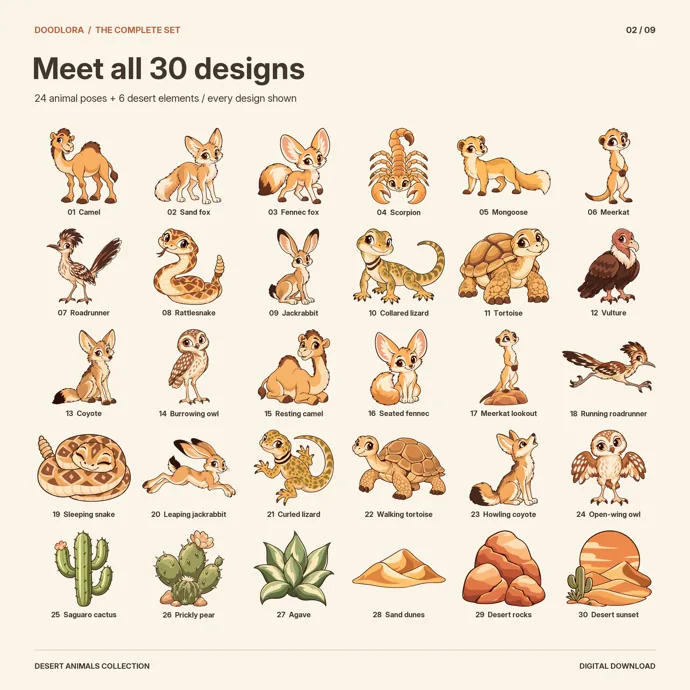
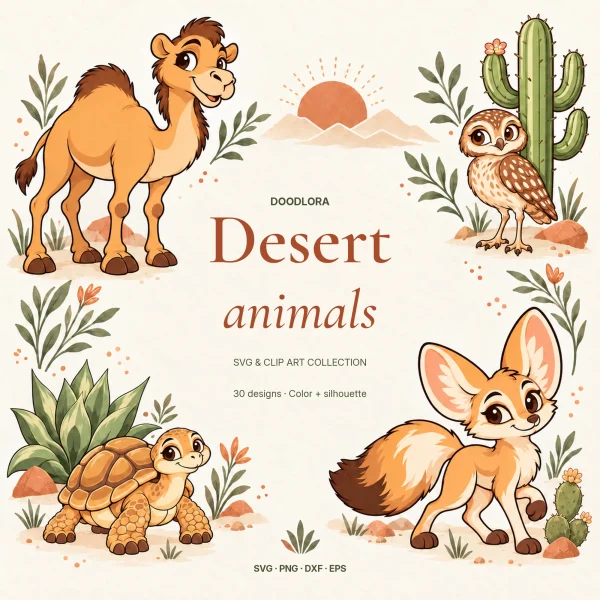
Our Cute Desert Animals Clipart has 30 designs: 24 animal poses covering 14 kinds of animals, plus 6 scenery pieces (a saguaro, a prickly pear, an agave, dunes, rocks and a sunset). Every design comes in color and as a solid black silhouette. That mix is useful, but it also hides a trap. The set puts North American animals and African animals side by side, so it isn’t a picture of any one real desert.
Turn that trap into the lesson. Print the color designs, cut them apart and have students sort them onto a world map or into two columns:
- North American deserts: roadrunner, rattlesnake, jackrabbit, tortoise, coyote, burrowing owl and vulture.
- Sahara, Arabia and southern Africa: camel, fennec fox and meerkat.
- Check before sorting: the sand fox, mongoose, collared lizard and scorpion. Have students look each one up first, since a “sand fox” or a “scorpion” could come from more than one desert.
Then have each student write one survival trick under each animal, using the table at the top of this page. This set has a personal license, which covers a teacher printing it for their own students, but not selling what you make with it.
One hump or two
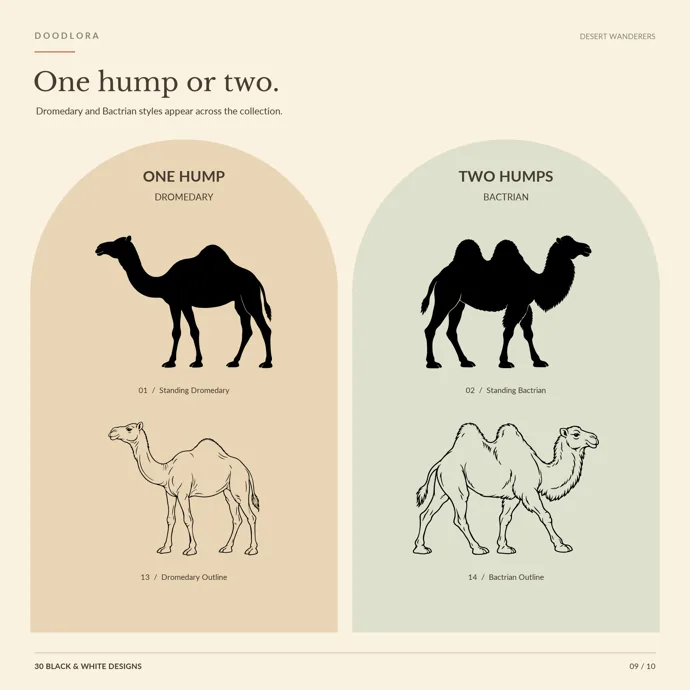
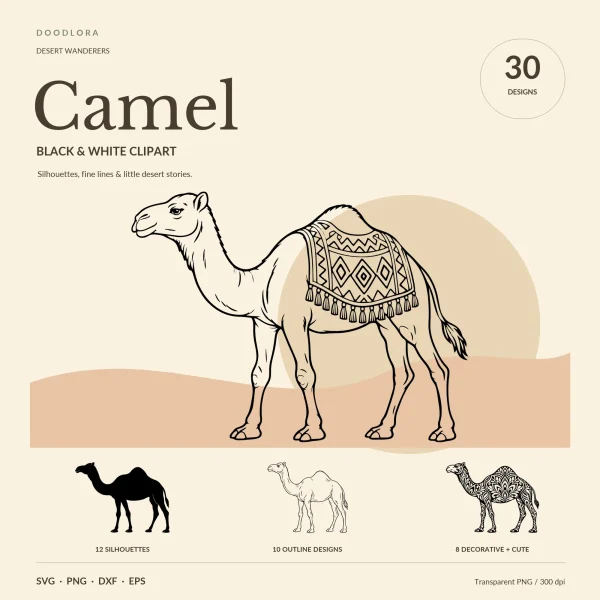
The camel clipart is all black, 30 designs in silhouette, line drawing, geometric and cartoon styles. Designs 01 and 02 are a standing dromedary and a standing Bactrian camel drawn at the same scale, which makes a quick quiz: one hump for the Sahara and Arabia, two for the Gobi. Pair it with the camel-hump myth from the dromedary section above, since many students arrive believing the hump holds water.
A Sonoran Desert poster
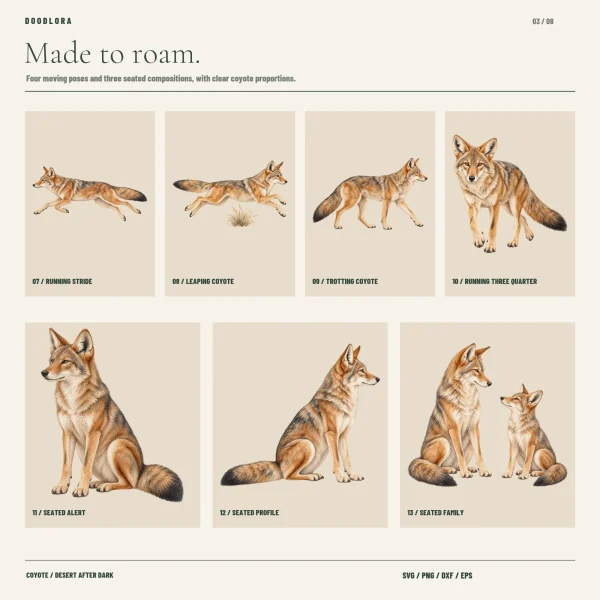
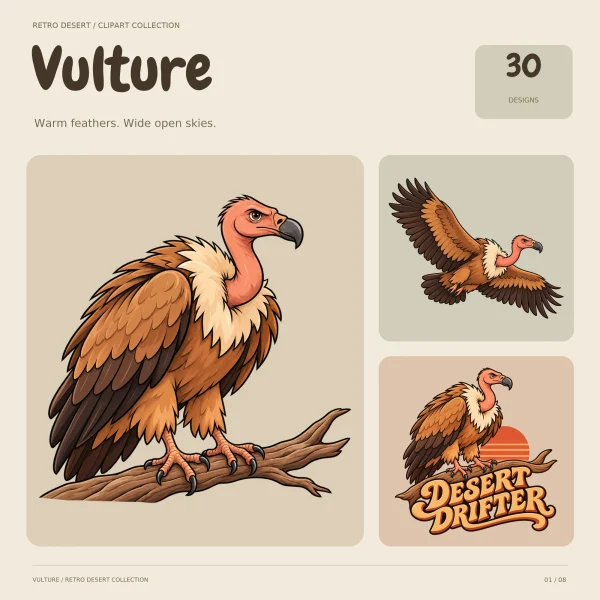
For a poster or report cover about the American Southwest, the coyote clipart has painted coyotes plus saguaro, prickly pear, yucca and mesa pieces. The vulture clipart adds retro cartoon vultures on red rocks and dead branches. Both sets also have a commercial license, with the terms on each product page. For more ways to place clipart on a page, see how to use clipart.
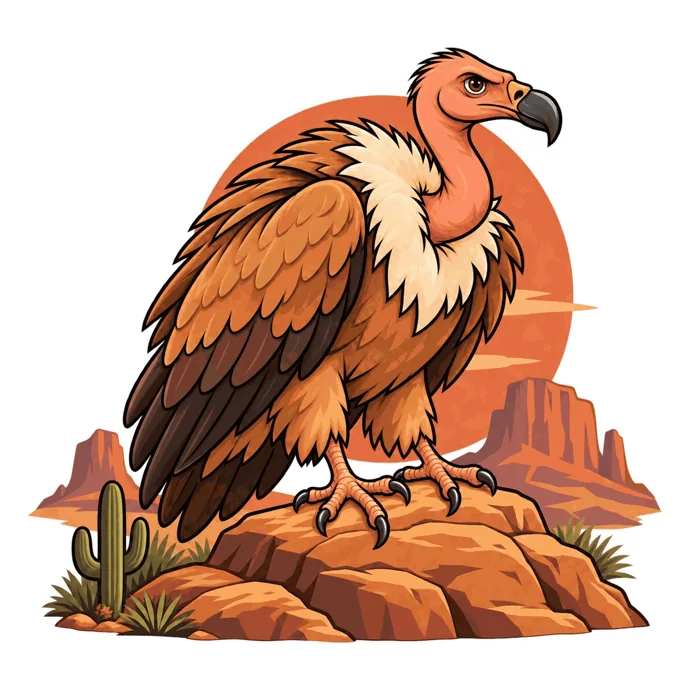
One caution on the vulture set: the birds are decorative cartoons, not drawings of a real species. For a report on the turkey vulture, use its real features from the section above, such as its pink legs and its habit of soaring and smelling for food, and use the clipart only as decoration.
If the unit ends with a hands-on project, our animal crafts have ideas that fit alongside a desert lesson.
Printables from this article
Related articles
Clipart & SVG Cut Files
How to Draw a Truck: Easy Pickup, Big Rig and Cartoon
Split a pickup into three parts before you draw a single wheel: a bed, a cab and a hood. Keep the roof about 2.2 wheels tall and the bed rail level with the hood, and the truck looks right even before the details go on.
Clipart & SVG Cut Files
How to Draw a Train: Steam Engine, Cars and Tracks
Split the page into a 10-square grid, lay a long boiler tube across the middle, set a box cab at the back and a tall stack at the front, hang two big driving wheels under the cab end, then couple cars behind and run the rails to a vanishing point.
Clipart & SVG Cut Files
Hawk vs Falcon: Wings, Size, Hunting Style and Eagles
A falcon has long, narrow wings that taper to sharp points and flies on steady, quick wingbeats; a hawk has broader wings with rounded tips and either soars in slow circles or flaps hard and glides. Falcons kill with a notched beak and hawks with their talons, and eagles are the largest, heaviest-billed members of the hawk family.