Coyote vs Wolf: Size, Ears, Tracks and Howls Compared
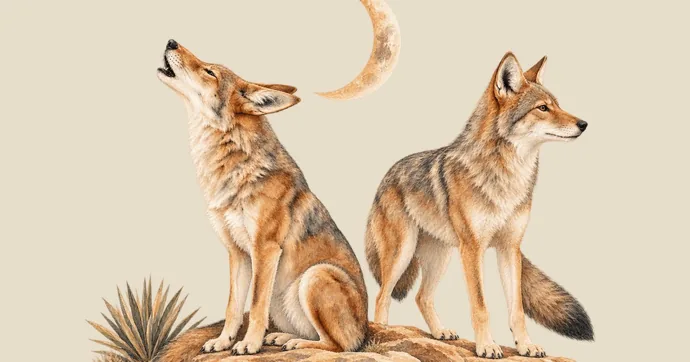
Coyotes and gray wolves are two separate species, and size is the first thing that gives them away. The International Wolf Center lists a gray wolf at 26 to 32 inches tall and 60 to 130 pounds, and a coyote at 16 to 20 inches and 20 to 50 pounds. Next, look at the head. A coyote has a narrow, pointed muzzle and ears that look too big for its face, while a wolf has a broad muzzle, a large blocky head and short, rounded ears. Watch the tail as it moves: a coyote carries it pointing down, and a wolf holds it out level. In mud or snow, a wolf print is about 4.5 inches long and a coyote print about 2.5. At night, coyotes yip and bark in short, high bursts, and a wolf’s howl is lower and longer.
Where you’re standing matters just as much. Coyotes live in every one of the lower 48 states, cities included, but wild gray wolves in the U.S. are found in Alaska, the Great Lakes states, the northern Rockies and the Northwest, with a small reintroduced population of Mexican wolves in the Southwest. The International Wolf Center’s first piece of advice is to check whether you’re inside wolf range at all. There’s also a third animal in the mix, the red wolf, which sits between the other two in size and lives in the wild only in eastern North Carolina.
Six field marks that separate a coyote from a wolf
Use several of these together. Any one of them can mislead you on its own, especially in a blurry trail camera photo or a quick look across a field.
Size and build
A wolf is not just a bigger coyote; it’s built differently. The International Wolf Center describes the coyote’s legs as short for its body, with small, narrow paws. A wolf has long legs for its body and large, heavy paws. Wikipedia adds that the wolf has a deep rib cage and a heavily muscled neck, while the coyote has a thinner frame overall.
Winter fur blurs this. A wolf’s winter coat is very dense, with long guard hairs that almost form a crest over the shoulders, so judge the legs and the head rather than the overall bulk when there’s snow on the ground.
Muzzle and head
From the side, a coyote’s face comes to a fine point. Its head is small and triangular, and the muzzle is narrow. A wolf’s head is large and blocky, with a wide forehead and a broad, blunt muzzle, so the face looks heavier from every angle.
Ears
Compared with the size of the head, a coyote’s ears are large, tall and pointed. A wolf’s are small for its head, with rounder tips. Wikipedia lists longer ears among the main features that set the coyote apart from the gray wolf.
Tail
A coyote carries its tail pointing down when it walks or runs. A wolf holds its tail out horizontally. This is one of the better clues from a distance, with one catch: a nervous or submissive wolf also lowers its tail and its ears, so a single low tail on a large animal doesn’t prove it’s a coyote.
Tracks
The International Wolf Center gives these track sizes:
- Coyote: about 2.5 inches long and 1.5 inches wide
- Gray wolf: about 4.5 inches long and 3.5 inches wide
The coyote’s print is long and narrow, and the wolf’s is nearly twice as long. A large pet dog can leave a print close to wolf size, so look at the pattern too. The International Wolf Center notes that a wolf’s track tends to be rectangular with the toes pointing forward, and its hind feet usually land right in the front prints, leaving a straight line. A dog’s toes splay out into a rounder print, its hind feet land a little inside the front prints, and its trail wanders. Muddy or snowy tracks are already a common item on a nature scavenger hunt, and these two sizes give kids a way to judge what made them, as long as they look and don’t touch anything they find.
Voice
Coyote calls are higher and shorter, often described as yippy and mixed with barks and yelps. When two or more members of a coyote group meet up again, they often break into a group yip howl. A wolf’s howl is lower-pitched and drawn out. Two things can fool you here. Both animals also growl, bark, whine and yelp, and wolf pups make higher-pitched calls from late spring to early fall, which can sound coyote-like.
Coat color is the clue to skip. Coyotes run from gray to reddish brown, with rusty legs and ears and a pale throat and belly. Wolves can be gray, tan, black or white, and in parts of the Rocky Mountains of Alberta and British Columbia many are black. A gray-brown animal could be either one.
Coyote vs gray wolf vs red wolf chart
Coyote and gray wolf figures are from the International Wolf Center. Red wolf figures are from the Endangered Wolf Center, which gives height at the shoulder. Ranges and pack details are from Wikipedia.
| Coyote | Gray wolf | Red wolf | |
|---|---|---|---|
| Height | 16–20 in | 26–32 in | About 27 in at the shoulder |
| Length, nose to tail | 43–53 in | 54–78 in | About 4.3 ft |
| Weight | 20–50 lb | 60–130 lb | 45–80 lb |
| Head and muzzle | Small, triangular head; narrow, pointed muzzle | Large, blocky head; broad muzzle | Broad head and muzzle |
| Ears | Large for the head, pointed | Small for the head, rounded tips | Rounded |
| Track (length × width) | About 2.5 × 1.5 in | About 4.5 × 3.5 in | Paw about 3 × 3.5 in |
| Tail when moving | Carried pointing down | Held out level | – |
| Coat | Gray to reddish brown, rusty legs and ears | Gray, tan, black or white | Brown and buff, black along the back, reddish head and legs |
| Voice | Short, high yips, barks and yelps | Long, low howl | Longer, deeper howls than a coyote’s |
| Usually seen | Alone or in pairs, though families live together | In packs; North American packs average 8 | In packs of about 5 to 8 |
| Main food | Small mammals like rabbits and rodents, plus insects, fish, fruit and grass | Deer and other large hoofed mammals, plus hares and beavers | – |
| Where in the U.S. | Every lower-48 state, plus Alaska | Alaska, Great Lakes states, northern Rockies, Northwest; Mexican wolves in the Southwest | Eastern North Carolina only |
The red wolf column is the one that trips people up in North Carolina. The Endangered Wolf Center says coyotes in the red wolf recovery area are sometimes mistaken for red wolves because they look alike, and the broader head and muzzle, rounder ears and longer, deeper howl are what set the wolf apart. There’s one more clue there: most adult red wolves wear bright orange tracking collars, while some coyotes in the area wear white ones, so an orange collar is a strong hint.
Where coyotes and wolves live
Coyotes moved into old wolf country
Before Europeans arrived, coyotes lived mainly in the Southwest, the Plains and northern and central Mexico. During the 1800s they began spreading north and east, and they spread faster after 1900 as land was cleared and wolves were wiped out. They now range over almost the whole continent, from Panama to northern Alaska, and urban coyotes are common in many cities. That’s why a coyote sighting in a suburb, a city park or a farm field in any state isn’t unusual.
Gray wolves went the other way. They were wiped out across most of the lower 48 and have since come back to parts of their old range, partly on their own and partly through reintroductions in Yellowstone and Idaho. In the Midwest they’re concentrated in the Great Lakes states of Minnesota, Wisconsin and Michigan, and they also occupy much of the northern Rockies and the Northwest. The Mexican wolf, a subspecies of the gray wolf, was saved through captive breeding and reintroduced in the Southwest.
The big “coyotes” of the Northeast
If you’re in New England, New York or eastern Canada and you see a coyote that looks too large to be one, you’re probably looking at an eastern coyote. It’s a larger form that came from coyotes mixing with the last wolves in the Northeast, and some people call it a coywolf. According to Wikipedia, it’s bigger and roams farther than a western coyote but is still smaller than a gray wolf. So in the Northeast the size gap narrows, and the ears, muzzle and tail matter more than weight.
The red wolf
The red wolf is the rare one. Wikipedia describes it as intermediate in size between the coyote and the gray wolf, and it’s listed as critically endangered. The Endangered Wolf Center says it once lived across the whole southeastern U.S. and now survives in the wild only in eastern North Carolina. Scientists have argued for decades about whether it’s a separate species or a wolf-coyote mix; the Endangered Wolf Center points to genetic studies showing it’s distinct from both coyotes and gray wolves.
Howls, yips and the moon
Wolves howl to bring the pack together, usually before and after a hunt. They also howl to raise an alarm near a den, to find each other in a storm, when crossing unfamiliar ground, and to reach other wolves far away. Under the right conditions a wolf’s howl can be heard over an area of up to 50 square miles.
The coyote’s best-known call is the lone howl, which changes quickly in tone and pitch. The yip-and-howl chorus you hear after dark is often a group of coyotes greeting each other after time apart.
What wolves don’t do is howl at the moon. Wikipedia is direct about it: the phases of the moon don’t affect wolf vocalization, and the wolf silhouetted against a full moon is an image from art, not something the moon causes.
If you see a coyote or a wolf
On a trail or in a national park
Yellowstone National Park’s safety rules are a good standard for any park. Stay at least 100 yards from wolves and at least 25 yards from all other animals, which includes coyotes. Never walk closer to get a photo; binoculars or a long lens will give you a better view anyway. If the animal moves toward you, back away to keep the distance.
If a wolf is too close or doesn’t seem afraid of people, the park’s advice is to stand tall and hold your ground, group up with the people around you, and tell a ranger as soon as you can. Don’t pick up wolf scat, either. It can carry tapeworm eggs that cause hydatid disease in people.
Never feed any wildlife. The park warns that animals that get used to human food can become aggressive toward people and may have to be killed.
Around your home
Coyotes are the ones most people meet near home. The Washington Department of Fish and Wildlife says never to feed coyotes, because coyotes that people feed lose their fear of humans and can become aggressive. Feeding birds or squirrels can draw coyotes in too, and so can garbage, fallen fruit and pet food. If coyotes live near you, the department’s advice is:
- Keep cats indoors and dogs on a leash.
- Feed pets inside. If you have to feed them outdoors, do it in the morning or at midday and pick up the bowls and spilled food well before dark.
- Avoid walking your pet in the early morning and late evening.
- Keep an eye on young children and pets where coyotes are seen or heard.
- Never run from a coyote. Stand tall instead.
Can they interbreed, and other things people wonder
Is a coyote a kind of wolf?
No, but they’re close relatives in the same genus, Canis. The coyote’s scientific name is Canis latrans, and the gray wolf’s is Canis lupus. Older names for the coyote include prairie wolf and brush wolf, which adds to the confusion.
Can coyotes and wolves interbreed?
Coyotes have never been known to mate with gray wolves in the wild. They do interbreed with eastern wolves and red wolves, and genetic studies show that most North American wolves carry some coyote DNA.
Do wolves and coyotes get along?
Not usually. Where they live together, wolves dominate. Wikipedia notes that wolves killing coyotes is common in North America, especially in winter when coyotes scavenge wolf kills. There are no records of coyotes killing wolves, though a group of coyotes may chase a lone wolf.
How fast can a coyote run?
Up to 45 miles per hour, according to the National Park Service.
Is it a wolf or a big dog?
The International Wolf Center notes that most dogs have smaller paws, broader chests and patterned coats, while a wolf looks lankier, with a larger head. The tracks help too: a dog’s trail wanders and its toes splay, and a wolf’s trail runs straight.
Picking art for a desert theme or a North Woods poster
For a school report, a science fair board or a bulletin board, use real photos for anything that teaches identification. Drawings, including ours, are for the title, borders, section headers and cover art. They’re decorative, and they don’t always get the field marks right.
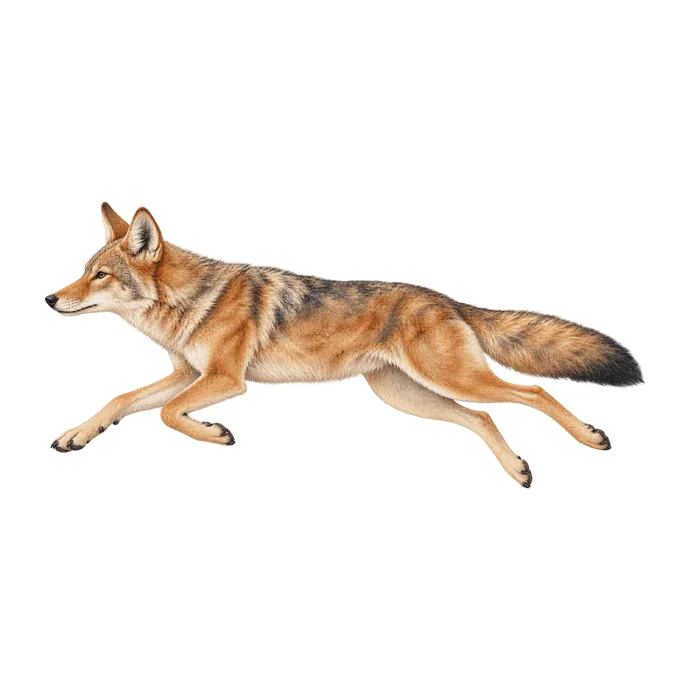
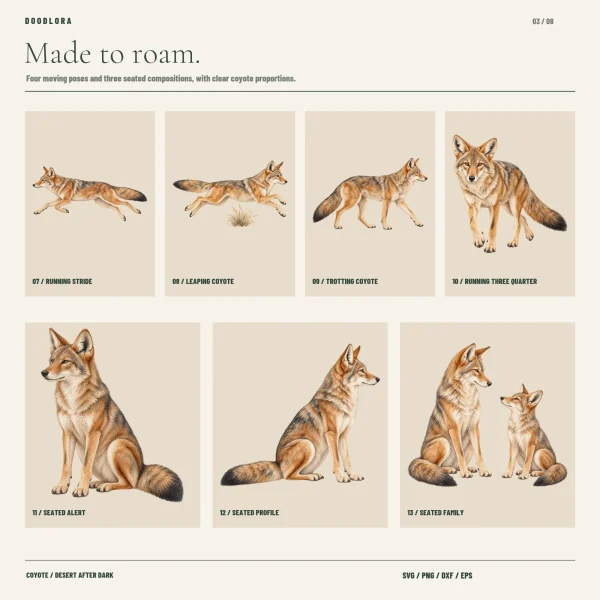
Our coyote clipart has 30 designs: 6 howling coyotes, 4 running, leaping or trotting, 3 seated, 4 moonlit desert scenes, 6 desert graphics (saguaro, prickly pear, yucca, mesas, a canyon path and mountains under a moon), 2 stalking and pouncing silhouettes, 2 paw-track designs and 3 lettering designs reading DESERT SOUL, WILD AT DUSK and ROAM FREE. Each comes in a warm desert color version and a grayscale one. It suits a Southwest theme, a desert habitat unit or a coyote report.
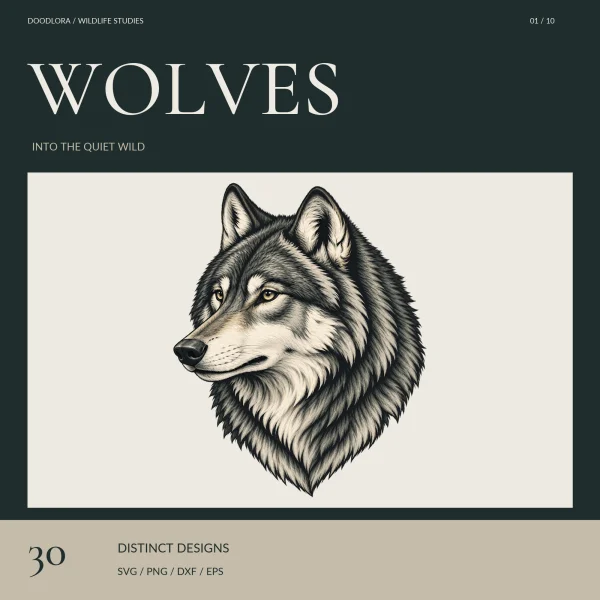
Our wolf clipart is all gray wolves, 30 designs in slate, cream and forest green: 6 head portraits, 5 full-body poses, 4 moon scenes, 4 forest and mountain scenes, 3 designs with ferns or flowers, 3 low-poly geometric wolves, 2 paw prints and 3 pack or family scenes. Every design also comes in one dark slate color. It fits a North Woods or cabin theme, a winter display or a wolf report.
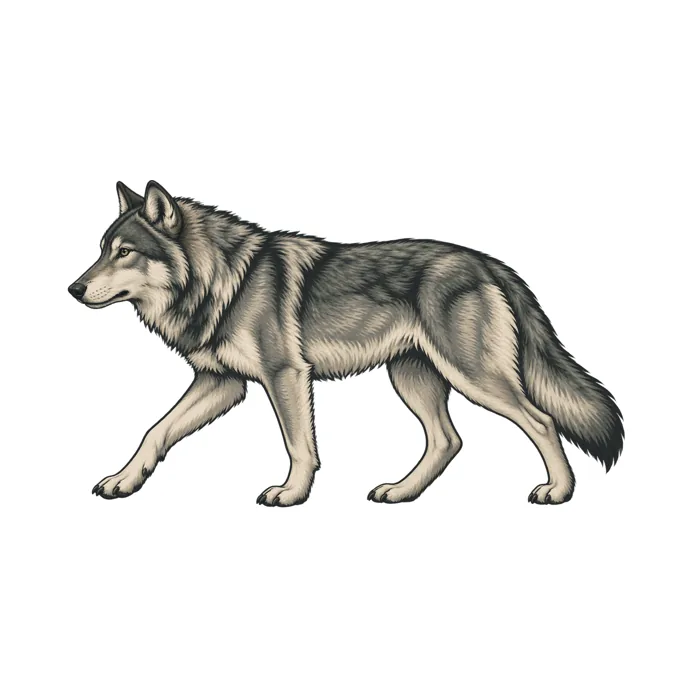
A few things to check before you build a side-by-side poster:
- Scale them to real life. At 26 to 32 inches against 16 to 20, a wolf is about 1.6 times a coyote’s height, so make the wolf drawing that much taller. Placed at the same height, the two animals will look like equals.
- Each set has only its own animal. There are no wolves in the coyote set and no coyotes in the wolf set, so for a comparison you’ll need one design from each.
- The paw prints are stylized. The coyote set’s two track designs are four-toed canid prints with claw marks, not drawn to a real track’s measurements. Don’t use them to teach track size; use the numbers in the chart.
- The color versions don’t match. The coyote set’s second version is grayscale and the wolf set’s is dark slate, so pick the color versions if you want the two to sit well together.
Each set includes transparent PNGs that are 3600 pixels square, with 300 dpi written into the files, along with SVG and DXF files. The coyote’s painted texture appears only in the PNGs; its SVG and DXF files are simplified flat versions. The wolf set’s DXF files hold the one-color version only. The wolf PNGs were enlarged from smaller originals, and the coyote notes say its painted sources were resized to fit the canvas, so print a test at your final size before a large poster. For cut projects, the coyote set’s notes suggest starting near 8 to 10 inches wide for shirts, 4 to 6 inches for decals and 3 to 4 inches for paper tags, and they say those are starting points, not tested minimum cutting sizes. Set the width after you import a DXF, since the coyote’s DXF files have no unit assigned. Not sure which of those files to open? Our plain-English guide to clipart file types sorts that out, and the clipart layout walkthrough covers placing and resizing a design on a page. Both sets are offered with a commercial license in addition to the personal one, and the terms are on each product page.
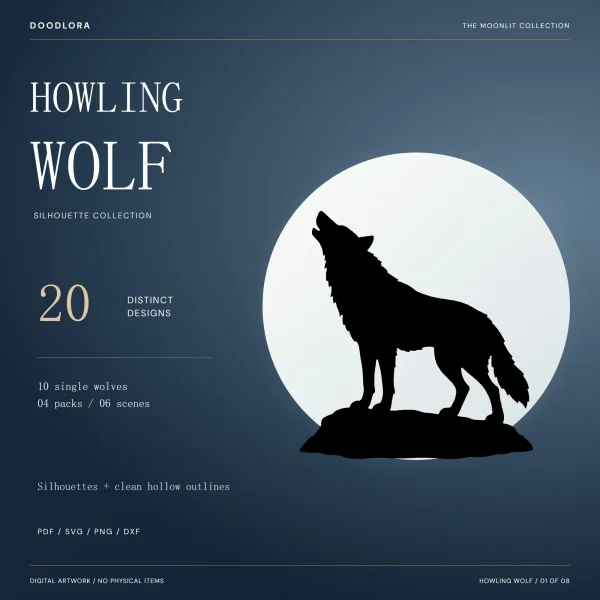
For a cut file or a stencil, a painted wolf is more detail than you need. The howling wolf silhouettes set has plain black wolves with their heads thrown back, and each one also comes as a line drawing with fur detail.
Printables from this article
Related articles
Clipart & SVG Cut Files
How to Draw a Truck: Easy Pickup, Big Rig and Cartoon
Split a pickup into three parts before you draw a single wheel: a bed, a cab and a hood. Keep the roof about 2.2 wheels tall and the bed rail level with the hood, and the truck looks right even before the details go on.
Clipart & SVG Cut Files
How to Draw a Train: Steam Engine, Cars and Tracks
Split the page into a 10-square grid, lay a long boiler tube across the middle, set a box cab at the back and a tall stack at the front, hang two big driving wheels under the cab end, then couple cars behind and run the rails to a vanishing point.
Clipart & SVG Cut Files
Hawk vs Falcon: Wings, Size, Hunting Style and Eagles
A falcon has long, narrow wings that taper to sharp points and flies on steady, quick wingbeats; a hawk has broader wings with rounded tips and either soars in slow circles or flaps hard and glides. Falcons kill with a notched beak and hawks with their talons, and eagles are the largest, heaviest-billed members of the hawk family.