Chinese Radicals: List of Common Radicals and the Kangxi 214
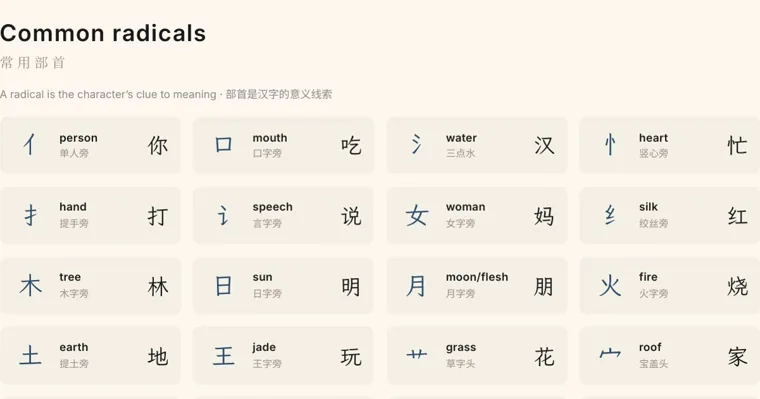
Chinese radicals are the parts of a character that a dictionary files it under, and most of them hint at meaning. 河 (river), 洗 (wash) and 汤 (soup) all carry 氵, the water radical, so a dictionary lists them together. The classic set is the 214 Kangxi radicals. Mainland China’s 2009 standard table uses 201.
You don’t need all 214 to get started. A few dozen radicals turn up again and again in everyday characters, and knowing them changes how a new character looks to you: a familiar part plus one other piece, instead of a tangle of strokes. Below is what a radical is, why the count depends on the list, a table of common ones, how they change shape, how to look a character up, and where guessing meaning from them goes wrong.
What a Chinese radical is, and what it isn’t
A radical is a component chosen to index a character. The Chinese word is 部首 bùshǒu, “section header”, because each radical heads a section of the dictionary. 妈 (mom) is filed under 女 (woman), 说 (speak) under 讠 (speech), and 林 (woods) under 木 (tree).
Most radicals carry meaning because most characters are built from two kinds of parts. Over 80% of Chinese characters are phono-semantic compounds, according to the Wikipedia article on Chinese character radicals. One part gives a broad category of meaning and the other suggests the sound. In 妈, the 女 says “woman” and the 马 (mǎ, horse) is there for its sound, close to mā.
The radical is usually that meaning part, but not always. Some radicals are just a stroke pulled out of a character so it has somewhere to be filed. In many dictionaries 九 (nine) sits under 乙, and 丁 sits under 一. Neither radical tells you anything about the meaning.
Radicals matter for writing too, because a bigger character is written one component at a time. Our stroke order guide shows how that works, part by part.
How many Chinese radicals are there?
There’s no single number. Each dictionary tradition settled on its own list, and the three counts you’ll see most often come from different centuries.
| List | When | Number of radicals | Where you’ll meet it |
|---|---|---|---|
| Shuowen Jiezi, by Xu Shen | 2nd century AD | 540 | History of Chinese writing |
| Zihui, then the Kangxi Dictionary | 1615, then 1716 | 214 | Traditional-character dictionaries, Unicode, most “radical lists” online |
| China’s Table of Indexing Chinese Character Components (GF 0011-2009) | 2009 | 201 main + 100 associated forms | Dictionaries for simplified characters |
The 214 are called the Kangxi radicals after the 1716 dictionary, which listed 47,035 characters under them. The Zihui had already cut the list to 214 in 1615 and sorted characters under each radical by their remaining stroke count. That radical-and-stroke method is still how paper dictionaries work.
Simplified characters needed a new list, because simplification changed several radicals (言 became 讠, 金 became 钅). The 2009 table gives 201 main radicals plus 100 associated forms. Smaller dictionaries cut further: the Oxford Concise English–Chinese Dictionary uses 188.
For a learner the exact count doesn’t matter much. If you study simplified characters, your dictionary or app uses something close to the modern table. Kangxi numbers are still worth knowing, because Unicode and most online radical charts are built on them. Wikipedia notes that the Kangxi set is the de facto standard few dictionary makers can ignore.
Chinese radicals list: 29 common radicals with meanings
These 29 are among the radicals a beginner meets most often in everyday characters. The Kangxi number is the radical’s place in the 214 list, so you can find it in any Kangxi chart. The pinyin and meaning are for the radical’s full form, which can look quite different from the shape it takes inside a character.
| Kangxi no. | Shape in characters | Full form | Meaning | Example characters |
|---|---|---|---|---|
| 9 | 亻 | 人 rén | person | 你 nǐ you · 他 tā he · 休 xiū rest |
| 18 | 刂 | 刀 dāo | knife | 刻 kè carve · 刮 guā scrape · 别 bié don’t |
| 30 | 口 | 口 kǒu | mouth | 吃 chī eat · 喝 hē drink · 叫 jiào call |
| 32 | 土 | 土 tǔ | earth | 地 dì ground · 城 chéng city wall · 坐 zuò sit |
| 38 | 女 | 女 nǚ | woman | 妈 mā mom · 姐 jiě older sister · 好 hǎo good |
| 40 | 宀 | 宀 mián | roof | 家 jiā home · 室 shì room · 安 ān safe |
| 61 | 忄 (left), 心 (bottom) | 心 xīn | heart | 忙 máng busy · 快 kuài fast · 想 xiǎng think |
| 64 | 扌 | 手 shǒu | hand | 打 dǎ hit · 推 tuī push · 拿 ná take |
| 72 | 日 | 日 rì | sun | 明 míng bright · 早 zǎo early · 晚 wǎn evening |
| 74 | 月 | 月 yuè | moon | 期 qī period · 朗 lǎng clear · 朋 péng friend |
| 75 | 木 | 木 mù | tree | 林 lín woods · 树 shù tree · 桌 zhuō table |
| 85 | 氵 | 水 shuǐ | water | 河 hé river · 洗 xǐ wash · 汤 tāng soup |
| 86 | 火 (left), 灬 (bottom) | 火 huǒ | fire | 烧 shāo burn · 灯 dēng lamp · 热 rè hot |
| 94 | 犭 | 犬 quǎn | dog | 狗 gǒu dog · 猴 hóu monkey · 狼 láng wolf |
| 96 | 王 | 玉 yù | jade | 玩 wán play · 球 qiú ball · 珠 zhū pearl |
| 109 | 目 | 目 mù | eye | 看 kàn look · 睡 shuì sleep · 眼 yǎn eye |
| 118 | ⺮ | 竹 zhú | bamboo | 笔 bǐ pen · 筷 kuài chopstick · 笑 xiào laugh |
| 120 | 纟 | 糸 mì | silk | 红 hóng red · 线 xiàn thread · 纸 zhǐ paper |
| 130 | 月 | 肉 ròu | meat, flesh | 脸 liǎn face · 脚 jiǎo foot · 胖 pàng fat |
| 140 | 艹 | 艸 cǎo | grass | 花 huā flower · 茶 chá tea · 草 cǎo grass |
| 142 | 虫 | 虫 chóng | insect | 蛇 shé snake · 虾 xiā shrimp · 蚊 wén mosquito |
| 149 | 讠 | 言 yán | speech | 说 shuō speak · 话 huà words · 语 yǔ language |
| 154 | 贝 | 貝 bèi | shell | 贵 guì expensive · 财 cái wealth · 货 huò goods |
| 157 | ⻊ | 足 zú | foot | 跑 pǎo run · 跳 tiào jump · 路 lù road |
| 162 | 辶 | 辵 chuò | walk | 过 guò pass · 远 yuǎn far · 进 jìn enter |
| 163 | 阝 (right side) | 邑 yì | city | 那 nà that · 都 dū capital · 部 bù part |
| 167 | 钅 | 金 jīn | gold, metal | 钱 qián money · 铁 tiě iron · 银 yín silver |
| 170 | 阝 (left side) | 阜 fù | mound | 阳 yáng sun · 院 yuàn courtyard · 陆 lù land |
| 184 | 饣 | 食 shí | eat, food | 饭 fàn meal · 饿 è hungry · 饮 yǐn drink |
Which radicals cover the most characters
Counted across the whole Kangxi Dictionary, the biggest sections are 艸 grass (1,902 characters), 水 water (1,595), 木 tree (1,369), 手 hand (1,203) and 口 mouth (1,146), per Wikipedia’s Kangxi radicals article. Many of those are rare plant names and old words, though.
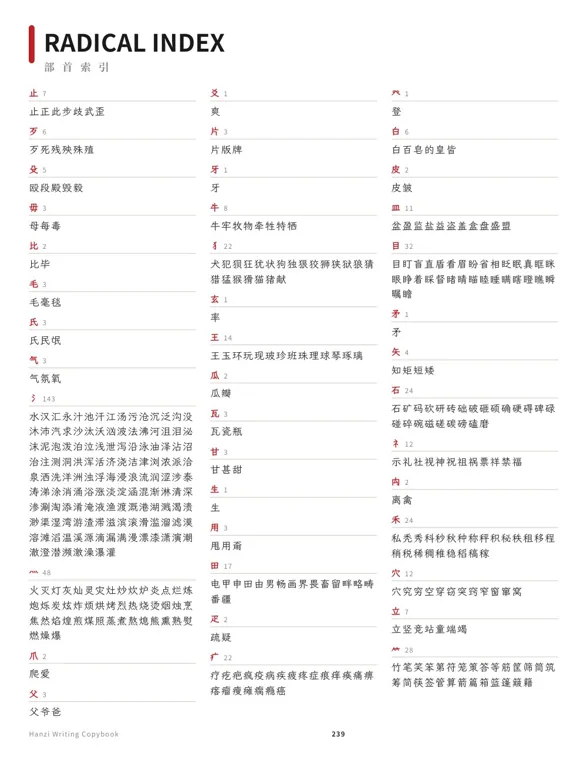
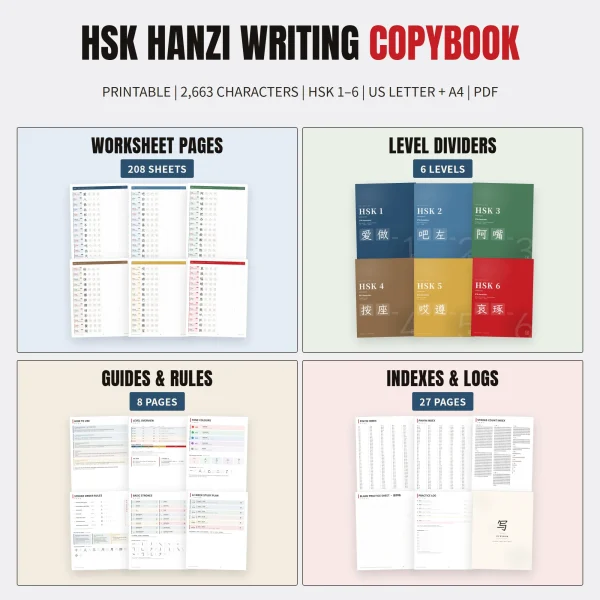
In a learner’s set the order shifts toward everyday verbs. Our 2,663-character copybook prints a count beside each radical in its index: 扌 hand comes first with 166 characters, then 氵 water with 143 and 口 mouth with 140. Learn those three early and a good share of new characters will already have one part you can name.
Where radicals sit, and how they change shape
A radical can sit on any side of a character, and its position often changes its shape. Semantic parts tend to go on the left or top and sound parts on the right or bottom, but Wikipedia calls these loose rules with plenty of exceptions. Chinese names for radicals usually say where they sit: 旁 páng means a side, 头 tóu the top, 底 dǐ the bottom and 框 kuàng a frame.
| Position | Radicals | Chinese name you’ll hear |
|---|---|---|
| Left side | 亻 氵 扌 讠 纟 犭 钅 饣 | 单人旁 “single person side”, 三点水 “three drops of water” |
| Right side | 刂 阝 (city) | 立刀旁 “standing knife side” |
| Top | 艹 宀 ⺮ | 草字头 “grass on top”, 宝盖头 “treasure lid” |
| Bottom | 心 灬 | 四点底 “four dots at the bottom” |
| Wrapping around | 囗 门 辶 | 国字框 “frame of 国”, 走之底 “walking base” |
The squeezed forms to recognize
Several common radicals have a narrow form for the left side and keep their full form elsewhere. Spot both and you won’t think they’re different radicals.
- 人 becomes 亻 on the left (他), but 从 keeps two full 人.
- 心 becomes 忄 on the left (忙) and stays 心 at the bottom (想).
- 手 becomes 扌 on the left (打), but stays 手 at the bottom of 拿.
- 水 becomes 氵 on the left (河).
- 火 stays 火 on the left (烧) and turns into four dots, 灬, at the bottom (热).
- 刀 becomes 刂 on the right (别), but stays 刀 at the bottom of 分.
- 犬 becomes 犭 on the left (狗).
Simplified characters add one more layer. 言, 金, 食 and 糸 have their own simplified side forms, 讠, 钅, 饣 and 纟. A traditional text writes them 訁, 釒, 飠 and 糹, so 银 (silver) is 銀 there. If you plan to read traditional characters later, learn the full form next to the simplified one.
How to look up a Chinese character by its radical
Looking a character up by radical takes four steps, and the radical-and-stroke method described in Wikipedia’s radicals article works the same way in most paper dictionaries.
- Pick the radical. If you’re unsure, try the part on the left, on top, or the part that wraps around the rest.
- Find that radical’s section. The radical table at the front of the dictionary lists radicals by stroke count.
- Count the strokes in the rest of the character.
- Go to that stroke number inside the section and scan for your character. If it isn’t there, go back to step 1 and try the other part.
Here’s 妈 worked through. The left part, 女, is a three-stroke radical, so it’s near the front of the radical table. The rest of the character, 马, takes three strokes. Under 女, the characters with three extra strokes include 妈.
Counting strokes is where most lookups fail, so practice it on characters you already know. 马 looks like more than three strokes until you’ve written it a few times. If counting keeps tripping you up, most phone dictionaries let you draw the character with a finger or pick its parts from a grid, which skips the radical step entirely.
Why the same character turns up under different radicals
Two dictionaries won’t always file a character under the same radical. Wikipedia puts it plainly: apart from simple cases, you can’t assume the same character is indexed the same way in two different dictionaries.
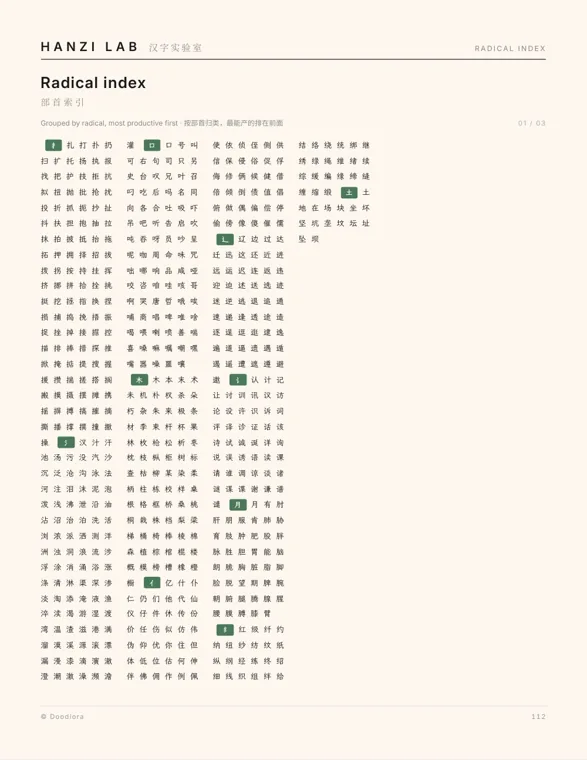
Our own two workbooks show it. The writing workbook’s radical index lists 和 (and, peace) under 禾 (grain), the part on its left. The copybook’s index files 和 under 口 (mouth), the part on its right. Both choices are defensible, and a learner who checks only one section will decide the character is missing. When a lookup fails, the fix is almost always to try the other component.
Guessing meaning from radicals, and where the guess goes wrong
A radical gives you a category, not a definition. 河, 洗 and 汤 really are about water, and 说, 话 and 语 really are about speech. That’s often enough to remember a character once you’ve looked it up.
Guessing meaning from the radical alone goes wrong in a few predictable places:
- The meaning drifted. 很 means “very” but carries 彳 (step). 笑 (laugh) sits under bamboo. 被, a grammar word marking the passive, sits under 衤 (clothing) because its first meaning was “quilt”.
- One shape, two radicals. 月 on the left of 脸 (face), 脚 (foot) or 胖 (fat) is a squeezed form of 肉, flesh, which is why so many body words carry it. In 期 and 朗 it really is the moon. In 朋 (friend) it’s neither.
- Same mark, opposite sides. 阝 on the left (阳, 院, 陆) comes from 阜, a mound. On the right (那, 都, 部) it comes from 邑, a city. Wikipedia counts them as two different radicals.
- The radical is only a filing peg. 九 under 乙 and 丁 under 一 are there because the dictionary needed somewhere to put them.
- The sound part misleads too. 马, 妈, 吗 and 骂 share 马 and sound alike (mǎ, mā, ma, mà), but the tones differ, and many sound parts give only a rough hint.
Treat the radical as a memory hook you confirm in a dictionary, not as a translation. Radicals today work mainly as dictionary tools and learning aids, and the Wikipedia radicals article notes they’ve grown increasingly disconnected from meaning and sound.
How to learn Chinese radicals without memorizing all 214
Learn radicals through characters you’re already studying, not as a separate list of 214 to memorize. A short routine that fits a self-taught adult or a parent working with a child:
- Start with ten. 亻, 口, 氵, 扌, 讠, 女, 木, 心 / 忄, 艹 and 辶 all head large groups in our copybook’s radical index. Learn each one with two characters from the table above that you already know.
- Name the radical before you write. Each new character gets one spoken sentence: “妈 is 女 plus 马.” It takes five seconds, and it’s what makes the next character with 女 easier.
- Keep a reference sheet in view. A printed page of radicals next to your practice sheets saves flipping back to a list.
- Add the rest as they show up. When a new radical appears in a character you need, add it then. The 214 list is for looking things up, not for learning in order.
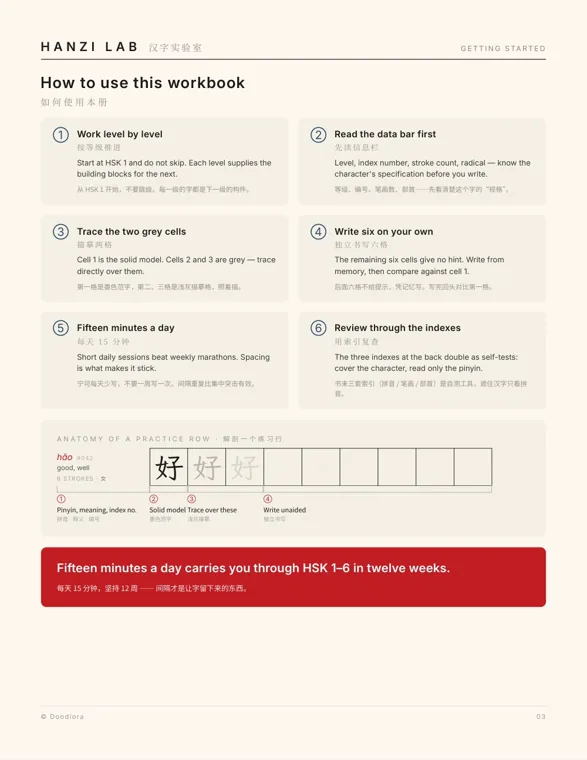
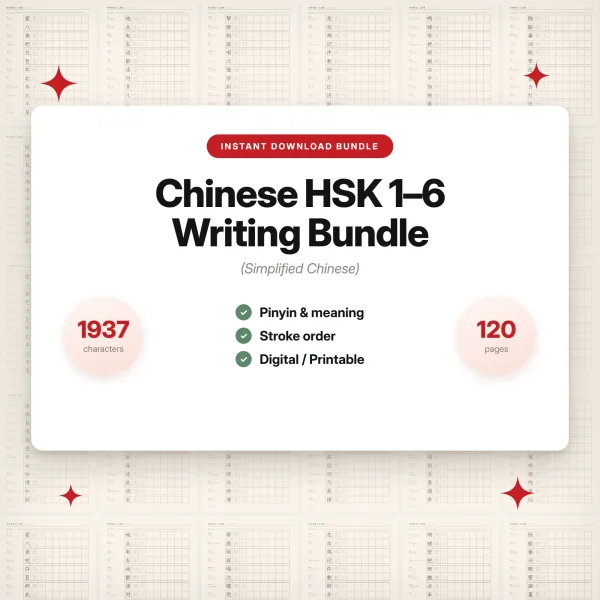
Our Chinese character writing workbook has the reference sheet built in. Page 6 lists 48 common radicals, each with its English meaning, its Chinese name and one example character. Every practice row names the character’s radical, and three radical index pages at the back group its 1,937 characters by radical. The 2,663-character copybook also prints the radical and stroke count on every row, and its radical index runs from page 237 to page 242.
A radical sort for kids
Children who already read a dozen characters can learn radicals as a sorting game. Write 8 to 12 characters they know on index cards, two or three for each of three or four radicals, such as 妈, 姐, 好, 河, 洗, 他 and 你. Ask them to sort the cards into piles that share a part, then name the shared part and what it means. Ten minutes is plenty for one round.
The animal radicals make a good second round. 狗 (dog) and 猴 (monkey) both carry 犭, and 蛇 (snake) carries 虫. If your child knows the animals from the Chinese zodiac signs, those characters are already familiar.
When the characters turn into words and sentences, our list of basic Chinese phrases is the next step. The rest of our printables are on the Chinese learning page.
Printables from this article
Related articles
Chinese Learning Printables
How to Teach Kids Chinese: Pinyin, Characters, First Words
A home plan for parents teaching Mandarin to young children: what to do at each age, a 10-minute daily routine, the first words and characters, and how to tell it's sticking.
Chinese Learning Printables
How to Say Happy New Year in Chinese: Sayings & Replies
The Mandarin greeting syllable by syllable, which wish fits grandparents, coworkers and kids, what to say back, and the four-character sayings families use at Chinese New Year.
Chinese Learning Printables
What Is Pinyin? Tones, Rules and How to Read a Pinyin Chart
What pinyin is, how a syllable is built from an initial, a final and a tone, the spelling rules that trip learners up, and how to read a pinyin chart or type pinyin.