What Is Pinyin? Tones, Rules and How to Read a Pinyin Chart
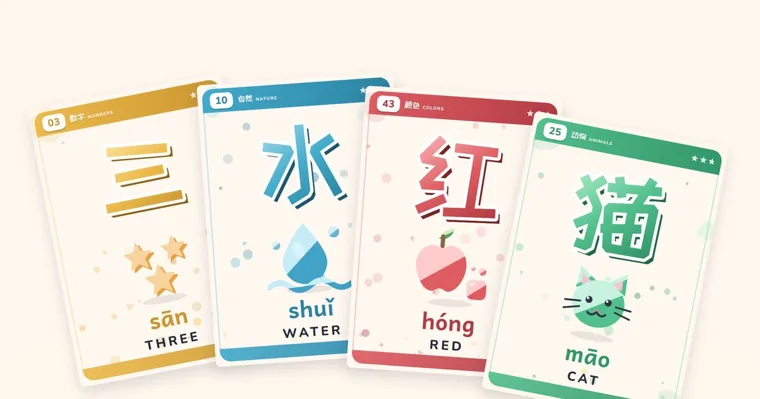
Pinyin is the official system for writing the sounds of Standard Chinese (Mandarin) in the Latin alphabet. It turns a character such as 猫 into māo: the letters tell you the sounds, and the mark over the vowel tells you the tone. Pinyin doesn’t replace Chinese characters. It’s a pronunciation guide that sits beside them in dictionaries, textbooks and children’s books, and it’s how most people type Chinese.
You can learn to read it in a few sittings if you know three things: how a syllable is built, which letters don’t sound the way English spells them, and a short list of spelling rules. The sections below cover those, then how to read a pinyin chart and how to type pinyin on a phone or computer.
Where pinyin came from and who uses it
The full name is Hanyu Pinyin. Hanyu means the Han (Chinese) language, and pinyin means “spelled sounds.” A group of Chinese linguists developed it in the 1950s, and the economist Zhou Youguang (1906–2017) is the one most often called “the father of pinyin.” The system was approved in 1958 at the Fifth Session of the 1st National People’s Congress.
From there, pinyin spread well beyond China’s classrooms:
- The International Organization for Standardization adopted it as ISO 7098 in 1982.
- The United Nations began using it in 1986.
- Taiwan made Hanyu Pinyin its official romanization in 2009, replacing Tongyong Pinyin.
Pinyin also replaced older spellings such as Wade–Giles, which is why older English books and some signs in Taiwan show different spellings of the same place. In mainland China, pinyin is the main way people type Chinese. Taiwan is the big exception: most people there type with bopomofo (zhuyin), a separate phonetic script.
How a pinyin syllable is built: initial, final and tone
Every Chinese character is one syllable, and pinyin spells each syllable in up to three parts. Knowing the parts makes a pinyin chart much easier to read.
| Part | What it is | In 猫 māo |
|---|---|---|
| Initial (声母 shēngmǔ) | The consonant at the start, if there is one | m |
| Final (韵母 yùnmǔ) | The vowel part, which may end in n or ng | ao |
| Tone | The pitch, shown by a mark over a vowel | ā, first tone |
There are 21 initials. Pinyin charts usually list them in this order: b, p, m, f, d, t, n, l, g, k, h, j, q, x, zh, ch, sh, r, z, c, s. Some syllables have no initial at all, such as 二 èr or 鱼 yú, and those are the ones where the y and w spelling rules below come in.
The four tones and the neutral tone
Mandarin has four tones plus a light, unstressed neutral tone. The same spelling with a different tone is a different syllable, so the mark matters as much as the letters. The table uses characters from our flashcard set.
| Mark | Tone number | Pitch | Example |
|---|---|---|---|
| ā | 1 | High and level | 三 sān, three |
| á | 2 | Rising | 红 hóng, red |
| ǎ | 3 | Low, dipping | 水 shuǐ, water |
| à | 4 | Falling | 四 sì, four |
| a | none | Light and short | the second 奶 in 奶奶 nǎinai, grandma |
Older typewriters couldn’t print these marks, so tones were written as numbers after the syllable, and you’ll still see that form in some dictionaries and online: ma3 is mǎ. Our guide to basic Chinese phrases shows how the tones sound in greetings, thank-yous and introductions.
Pinyin letters English speakers misread
Pinyin uses the Latin alphabet, but several letters stand for sounds English spells differently. Reading them as English is the most common beginner mistake, and the comparisons below are only close matches, not exact ones.
| Pinyin | Close to | Example |
|---|---|---|
| x | the sh in push | 小 xiǎo, small |
| q | the ch in punchy, with a puff of air | 去 qù, to go |
| j | the ch in churchyard, with no puff of air | 鸡 jī, chicken |
| zh | the j in jack, tongue tip curled back, no puff of air | 中 zhōng, middle |
| z | the zz in pizza, no puff of air | 字 zì, character |
| c | ts with a puff of air | 菜 cài, vegetables |
| e | the u in duh, said further back | 哥 gē, older brother |
| ü | ee said with rounded lips | 绿 lǜ, green |
One more trap: the i in zi, ci, si, zhi, chi, shi and ri is not an ee sound. In 四 sì and 字 zì it’s a short buzz that carries on from the consonant, so sì sounds nothing like the English word “see.”
Pinyin spelling rules that trip learners up
Pinyin has a handful of spelling rules that make words look different from how they sound. Each one has a reason, and once you know it, the spelling reads clearly.
When ü keeps its two dots
The ü sound is written with two dots only after l and n, where the dots are needed to tell two different syllables apart: 绿 lǜ is green, while lù is a different syllable. After j, q, x and y, the dots disappear because u can’t follow those letters anyway, so 鱼 is written yú, not yǘ. Read ju, qu, xu and yu with the rounded ü sound every time. Seeing yu and saying “you” is the classic mistake.
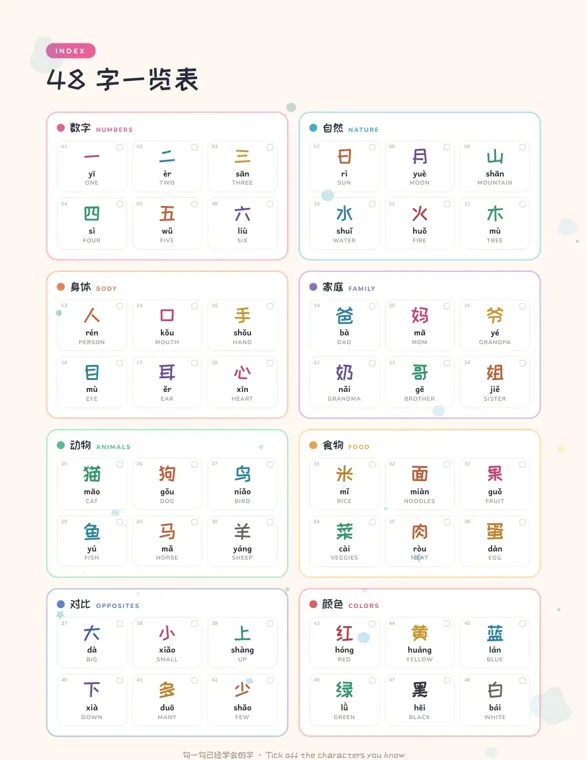
On the index page of our Chinese character flashcards, all 48 characters sit in eight theme boxes with their pinyin. The same page also shows where the tone mark goes when two vowels meet, in 六 liù and 水 shuǐ.
y and w at the start of a syllable
A syllable with no initial consonant gets a y or w in front so you can see where it starts. On its own, i becomes yi, u becomes wu and ü becomes yu, and finals such as ia and uo become ya and wo. That’s why 一 is spelled yī and 五 is spelled wǔ. The y and w are mostly there for the eye, so say yī as plain ee with a high tone, not “yee.”
The apostrophe between syllables
When a syllable starting with a or e follows another syllable in the same word, an apostrophe marks the break. 西安 is Xī’ān, two syllables, and without the apostrophe xian would read as one syllable. 女儿, daughter, written as one word, is nǚ’ér.
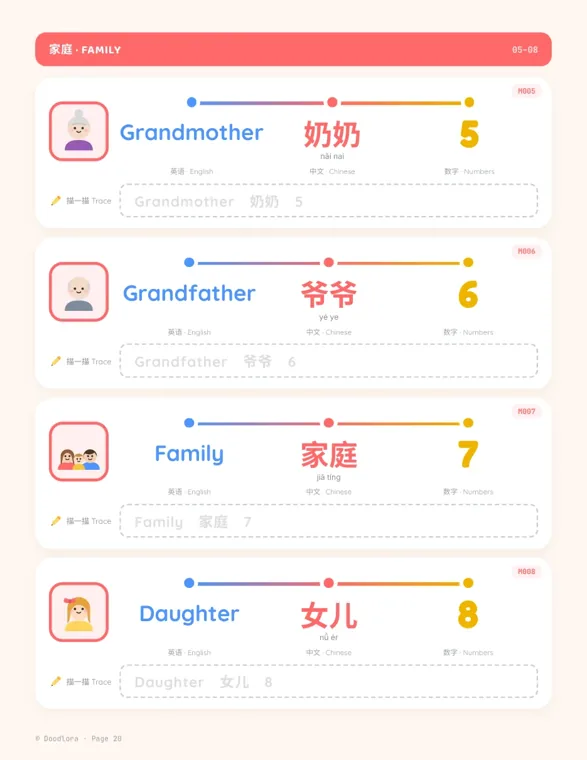
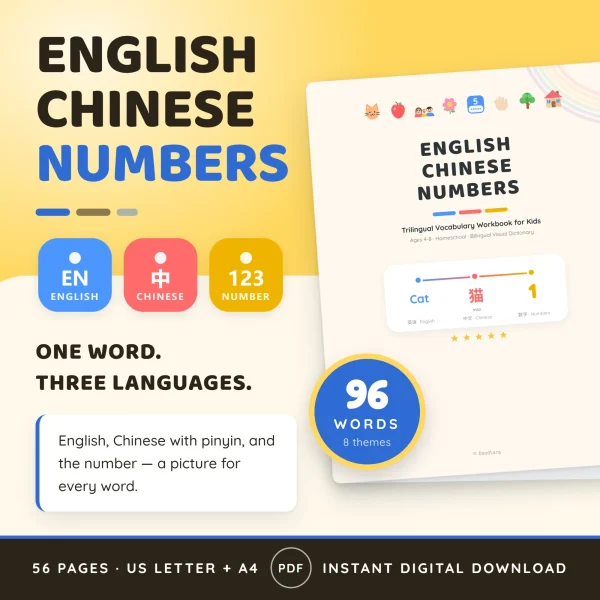
Children’s books often space pinyin one syllable at a time, as on page 20 of our 56-page English–Chinese vocabulary workbook. The official rule joins the syllables of a word (nǎinai, jiātíng), and many books published in China now space syllable by syllable anyway. Both are normal, so don’t let the spacing change of style worry you.
Where the tone mark goes
The mark goes on the vowel that carries the syllable, and a simple check finds it:
- If the syllable has an a or an e, the mark goes there: hǎo, xiè.
- In ou, the mark goes on the o: gǒu, dog.
- Otherwise, it goes on the second vowel: liù (six) and shuǐ (water).
When the mark lands on an i, it replaces the dot, as in yī. A syllable with no mark at all is neutral tone.
Tone changes that pinyin doesn’t show
Pinyin is usually written with each syllable’s own tone, even when people say it differently in a phrase. Dictionaries and flashcards print the base tone, so don’t correct them; just know these three changes.
- Two third tones in a row: the first one is said as a second tone. 你好 is written nǐ hǎo and said ní hǎo; 老鼠 lǎoshǔ, mouse, is said láoshǔ.
- 不 bù: before a fourth tone it’s said bú. 不是 bù shì, “is not,” becomes búshì.
- 一 yī: before a fourth tone it’s said yí (一定 yídìng, must), and before first, second and third tones it’s said yì (一天 yìtiān, one day). Counted on its own, at the end of a word, or used in a number like 十一, it stays yī.
Some textbooks write the changed tone for 一 and 不 to help beginners, so you’ll see both spellings in print.
How to read a pinyin chart
A pinyin chart lays out every syllable Mandarin uses in one grid. Initials run down the side, finals run across the top, and each filled cell is a syllable you can say. A blank cell means that pair doesn’t occur in Mandarin, which is why the grid has so many gaps.
Here’s a small corner of a typical chart:
| a | ai | ao | an | ang | |
|---|---|---|---|---|---|
| (no initial) | a | ai | ao | an | ang |
| b | ba | bai | bao | ban | bang |
| m | ma | mai | mao | man | mang |
| zh | zha | zhai | zhao | zhan | zhang |
Most charts leave the tone marks off, so each cell stands for up to four syllables: mā, má, mǎ and mà. The row with no initial at the top is where yi, wu and yu turn up, spelled with the y and w rule. The j, q and x rows have only i and ü columns filled, which is a quick reminder that ju means jü.
To practice with a chart, read across one row in a single tone, then read one cell in all four tones. If your chart is the clickable kind with audio, listen before you read; a printed chart can’t tell you whether your x sounds like sh or like “ks.” For a daily study plan you can slot ten minutes of chart reading into, see how to learn a new language.
How to type pinyin on a phone or computer
Pinyin is also how most learners type Chinese. You type the syllable without tone marks, and the keyboard offers a list of characters with that sound: type xiexie and pick 谢谢. Add the keyboard once:
- iPhone or iPad: Settings, then General, Keyboard, Keyboards, Add New Keyboard, and choose Chinese, Simplified, then Pinyin – QWERTY.
- Android: in Gboard, add the language Chinese (Simplified) and choose the Pinyin layout.
- Windows: under Time & language, add Chinese (Simplified, China); Microsoft Pinyin comes with it.
- Mac: under Keyboard, Input Sources, add Pinyin – Simplified.
Menu names shift a little between versions, but the language is always Chinese (Simplified) and the layout is always Pinyin. Most phones also accept v for ü, so type lv for 绿 lǜ and nv for 女 nǚ. If the keyboard offers the wrong character, the tone is usually what’s missing; pick from the longer list or type the whole word so it can guess from context.
Pinyin for kids and for parents who don’t read Chinese
For a child in Chinese school, or a parent helping with homework, pinyin is the bridge to the characters. A child who can read pinyin can sound out a new word alone, and a parent who can read it can check the sounds without reading the characters.
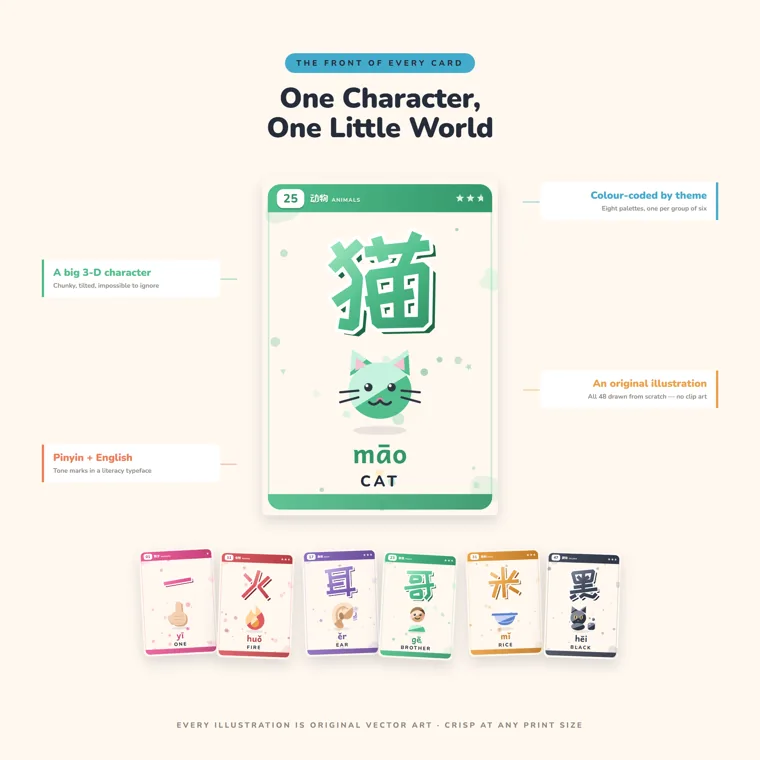
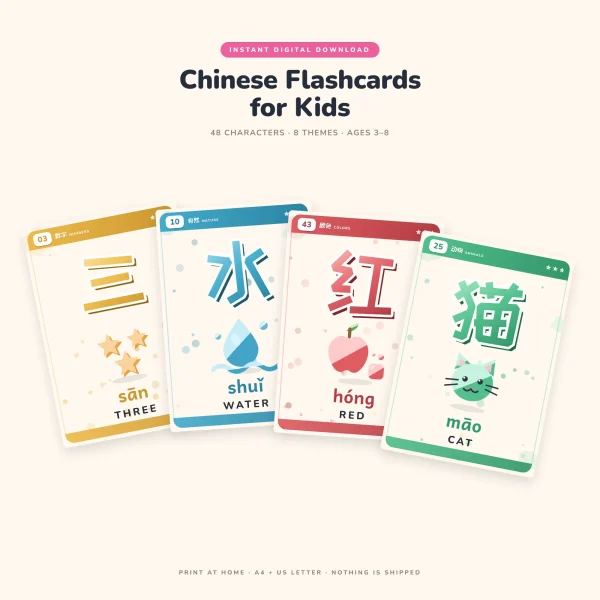
Our flashcards put the pinyin with tone marks under the picture on each card front, and the workbook prints it under the characters on its word pages. Watch for two things with children:
- Reading pinyin as English: x read as “z” and qu read as “kwoo” both come from English habits. Go over the misread letters above together before the first session.
- Leaning on the pinyin: once a child knows a card’s sound, cover the pinyin with a thumb and ask for the character alone.
Saying the sound from pinyin before writing a character also helps with handwriting practice, which our guide on how to write Chinese characters builds into its tracing routine. Both sets below come as US Letter and A4 PDFs, and the rest of our printables for home and classroom are in the Doodlora Studio shop.
Pinyin questions people ask
Is pinyin the same as Mandarin?
No. Mandarin is the spoken language, and pinyin is a way of spelling its sounds with Latin letters. Chinese is still written in characters, and pinyin is designed for Standard Chinese only, not for Cantonese or other varieties.
Do people in China use pinyin?
Yes, mostly for learning and typing. Children learn it alongside characters, it’s the main typing method in mainland China, and it appears on street signs and in names written for English readers. Adults rarely read whole texts in pinyin.
What’s the difference between pinyin and Wade–Giles?
Wade–Giles is an older romanization that pinyin replaced. It spells the same sounds differently, which is why a train station in Taiwan can have a Wade–Giles sign reading Taichung while the pinyin spelling is Táizhōng.
Printables from this article
Related articles
Chinese Learning Printables
How to Teach Kids Chinese: Pinyin, Characters, First Words
A home plan for parents teaching Mandarin to young children: what to do at each age, a 10-minute daily routine, the first words and characters, and how to tell it's sticking.
Chinese Learning Printables
How to Say Happy New Year in Chinese: Sayings & Replies
The Mandarin greeting syllable by syllable, which wish fits grandparents, coworkers and kids, what to say back, and the four-character sayings families use at Chinese New Year.
Chinese Learning Printables
Chinese Radicals: List of Common Radicals and the Kangxi 214
What a Chinese radical is, why the count is 214 in one list and 201 in another, a table of 29 common radicals with examples, and how to use them to look up characters.