How to Teach Kids Chinese: Pinyin, Characters, First Words
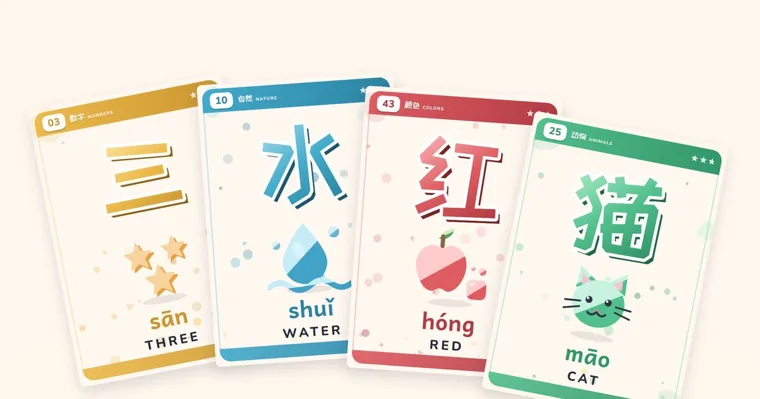
To teach kids Chinese at home, start with spoken words for the things in their day, keep it to about 10 minutes a day in two or three short bursts, and show characters as pictures to recognize long before you ask for any writing. You don’t have to speak Mandarin yourself. Pinyin with tone marks tells you how each word sounds, so you only need to stay one word ahead of your child. The sections below cover what fits each age, which words to teach first, the tools that help, and how to tell it’s sticking.
What age to start teaching kids Chinese
Any age works, but the activity changes as your child grows. A baby only needs to hear words, a preschooler can play matching games with characters, and a child who already reads English letters is ready for pinyin. The first two rows below follow the parent guide in our First 100 Words set. The rest is how we pace our own printables, which are marked ages 3 to 8 for the flashcards and 4 to 8 for the workbook.
| Age | What to do | Leave for later |
|---|---|---|
| Under 1 | Hold one picture 8 to 12 inches from the baby’s face, say the word slowly, and repeat the same few words for several days | Any questions or testing |
| 1 to 2 | Lay out two cards and ask “Where is the dog?” in Chinese, then let them point; name food and toys in Chinese at meals and bath time | Pinyin and characters |
| 3 to 4 | Picture cards with big characters, matching and hunting games, short songs | Writing |
| 5 to 7 | Pinyin once they know the English alphabet, tracing characters with few strokes | Long copying pages |
| 8 and up | Reading pinyin alone, writing characters in stroke order, short sentences | Nothing, just keep sessions short |
An older starter isn’t behind. An 8-year-old who reads English picks up pinyin fast, but they will read it like English at first, so x comes out as “z” and qu as “kwoo”. Go through the letters English speakers misread in our guide to what pinyin is before the first session, not after the habit sets in.
How many minutes a day to spend on Chinese with kids
About 10 minutes a day is enough for children under 8, as long as it happens most days. The parent guide in First 100 Words says two or three minutes at a time is plenty and to stop while it is still fun. Our flashcard how-to page suggests 5 cards a day, read through 3 times. Short and frequent beats one long Saturday lesson, because a 4-year-old forgets a word between weekends.
Here is how those 10 minutes can fit into an ordinary day:
| When | Minutes | What you do |
|---|---|---|
| Breakfast | 2 | Name what’s on the table in Chinese: water, milk, egg, rice |
| After school | 5 | One card game with the 5 cards of the day |
| Bedtime | 2 to 3 | A short song, or one last look at the day’s cards |
Keep 5 to 10 cards out at a time and swap them once a week, which is the rotation the parent guide recommends. Adults studying for themselves need more time, and how to learn a new language plans 20 to 45 minutes a day. If you want to learn Mandarin alongside your child, start there.
Pinyin or characters first for kids learning Chinese
For a child under 5, speaking comes first, then characters as whole pictures, and pinyin last. Pinyin is a tool, and at the start it’s mostly a tool for you. Mandarin-speaking families outside Taiwan use pinyin to link characters to words a child already says. Children there start pinyin in kindergarten, and it disappears from textbooks after primary school. So even native speakers treat it as a bridge, not the goal.
A 3-year-old who doesn’t read English yet has no use for a second alphabet whose letters sound different from the first. That same child can recognize 猫 (cat) the way they recognize a store logo, by its shape. Once your child reads English letters, add pinyin so they can sound out new words alone.
Tones are the part parents worry about most. Say each word as a whole, the same way every time, and stretch the tone a little: the high flat tone in māo, the falling tone in dà. Don’t drill tone numbers with children under 5; they copy what they hear.
Which Chinese words to teach kids first
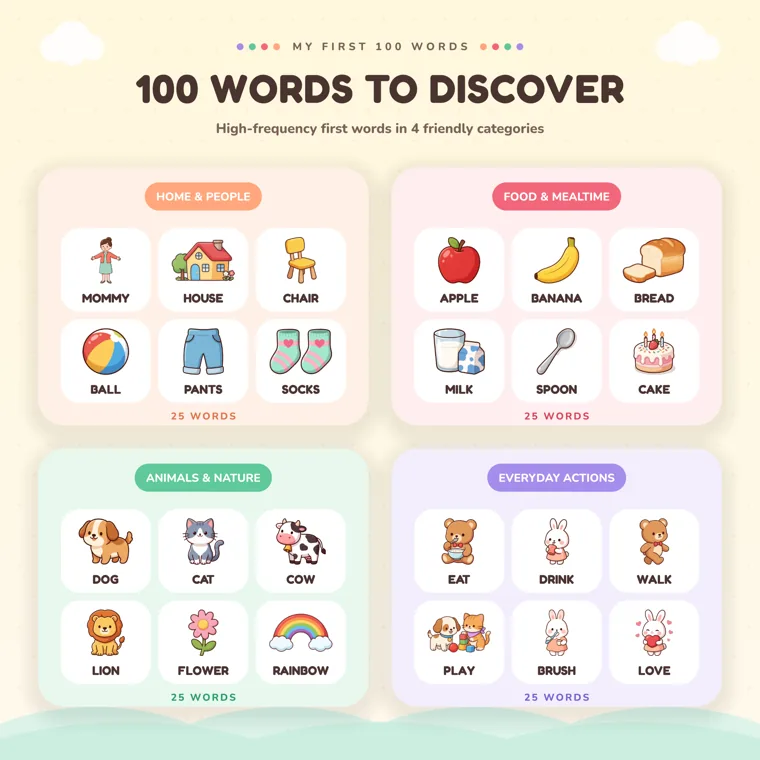
Teach the words your child would use on an ordinary day: family, food, animals, numbers, colors and a few actions. Our Chinese printables are built around the same groups. A word they can say at dinner tonight sticks better than one from a list.
| Chinese | Pinyin | English |
|---|---|---|
| 妈妈 | māma | mom |
| 爸爸 | bàba | dad |
| 奶奶 | nǎinai | grandma (Dad’s mother) |
| 爷爷 | yéye | grandpa (Dad’s father) |
| 水 | shuǐ | water |
| 猫 | māo | cat |
| 狗 | gǒu | dog |
| 一 二 三 | yī èr sān | one two three |
| 大 / 小 | dà / xiǎo | big / small |
| 红 | hóng | red |
Grandparent words are the first place families get it wrong. 奶奶 and 爷爷 mean Dad’s parents only. For Mom’s parents, say 外婆 (wàipó) and 外公 (wàigōng), or 姥姥 (lǎolao) and 姥爷 (lǎoye), depending on what your family uses.
When you start reading, pick characters with few strokes that still look like their meaning: 人 (person), 口 (mouth), 日 (sun), 月 (moon), 山 (mountain), 水 (water), 火 (fire) and 木 (tree). Stroke counts climb fast. 白 (white) has 5 strokes and 蓝 (blue) has 13, so 白 is the easier first color to read. Hello, thank you and sorry, with their tones marked, are in basic Chinese phrases with pinyin.
Tools for teaching Chinese at home: cards, tracing, songs
Picture cards do most of the work for children under 6, tracing comes in around 5, and songs and daily phrases fill the gaps between sessions. You don’t need all of them at once.
Picture flashcards and five card games
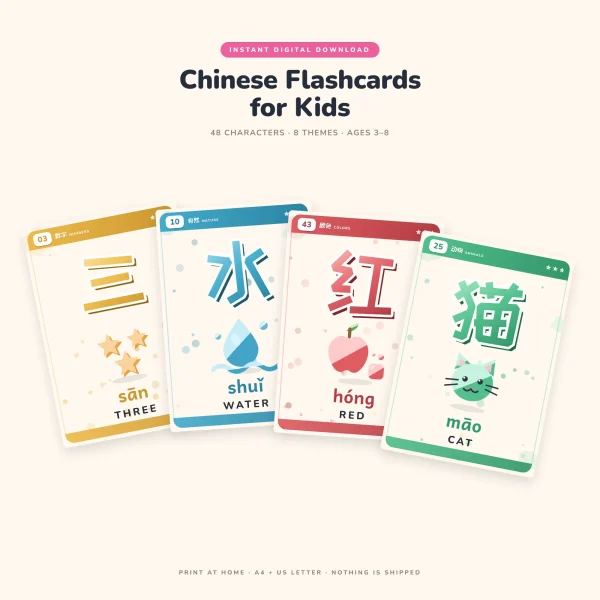
Our Chinese Character Flashcards come with a page of five games. Read the character, pinyin and English aloud. Match a character to an English word you say. Play memory with 6 cards face down. Draw a card and hunt the house for the real thing, like water or something red. Put two cards together to build a word such as 大人 (adult). Start with one theme of 6 cards and add the next only when those feel easy.
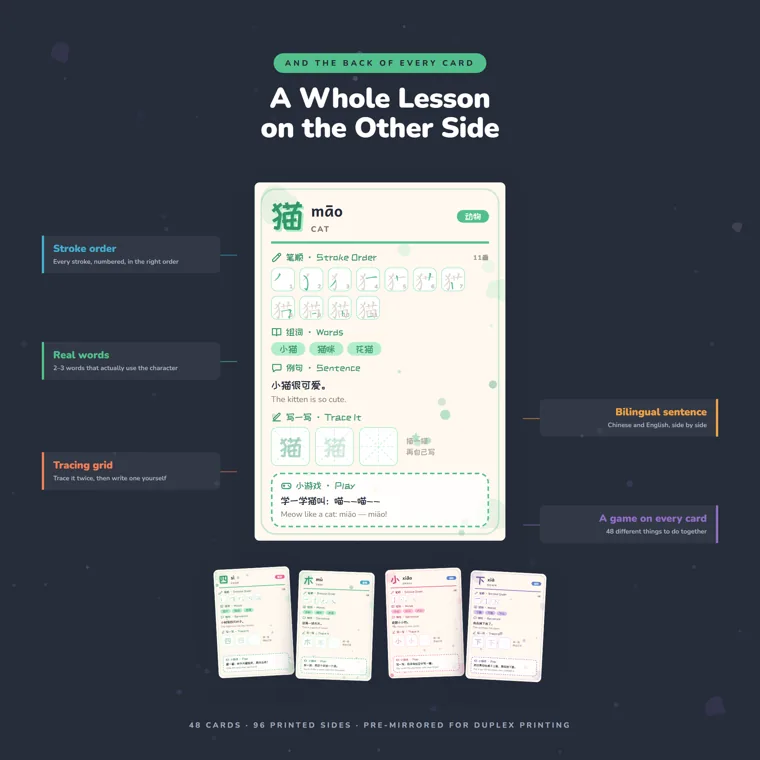
The card backs are written for the adult, which helps if you don’t read Chinese. Each one has the stroke order, two or three common words, a short sentence with an English line under it and a tracing row.
Tracing Chinese characters before writing
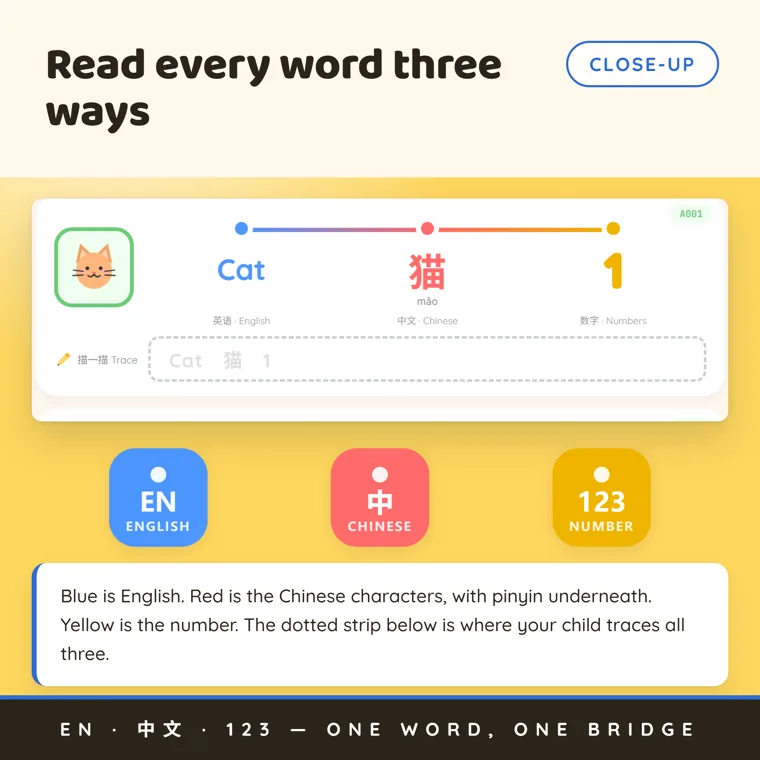
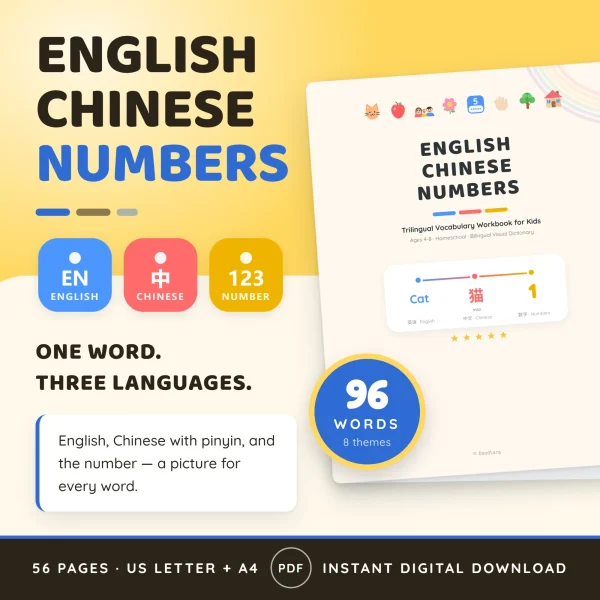
Tracing gives a 5- or 6-year-old the shape without the stress of a blank box. On the flashcard backs, your child traces the gray character, then writes one alone. Our English–Chinese Vocabulary Workbook puts 96 words in 8 themes of 12. Each entry has a dotted strip to trace the English, the characters and a number. Its theme pages print one rule before any writing: say all three out loud first.
Print tracing pages at 100% or Actual Size. A page shrunk to fit leaves the tracing boxes too small for a young hand. Stroke order matters once your child writes without a model. The rules are laid out one character at a time in how to write Chinese characters.
Songs and everyday phrases
A song gives your child tones and rhythm you might not get right on your own. Two Tigers (两只老虎, liǎng zhī lǎohǔ) is sung to the tune of Frère Jacques, so your child already knows the melody. Play one song all week rather than a new one each day.
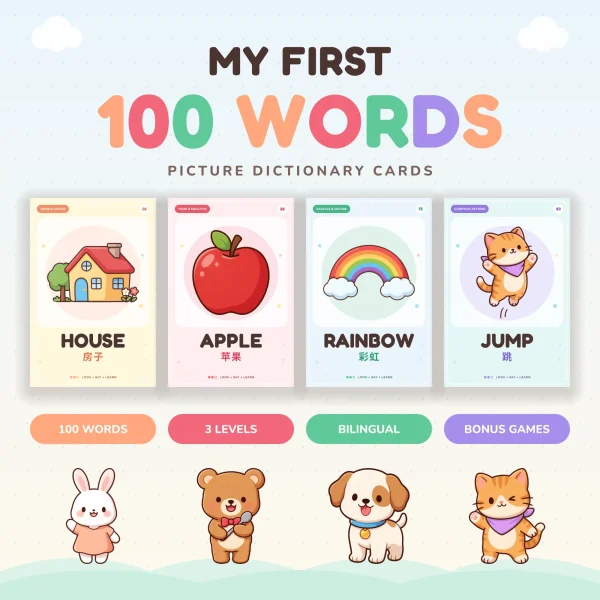
Daily phrases turn routines into practice. Say 吃 (chī, eat) at the table, 喝水 (hē shuǐ, drink water) when you pour a cup, 洗澡 (xǐzǎo, bath) at bath time and 睡觉 (shuìjiào, sleep) at bedtime. For babies and toddlers, First 100 Words has 100 words on three card levels. The first level shows only the English word, the second adds the Chinese and the third adds a sentence and a question. You can browse the rest of our Chinese learning sheets from the Doodlora Studio home page.
How to check your child’s Chinese progress
Check three things for each word: does your child understand it, say it, and use it? The progress chart in the First 100 Words parent guide uses exactly those three boxes, hear, say and use.
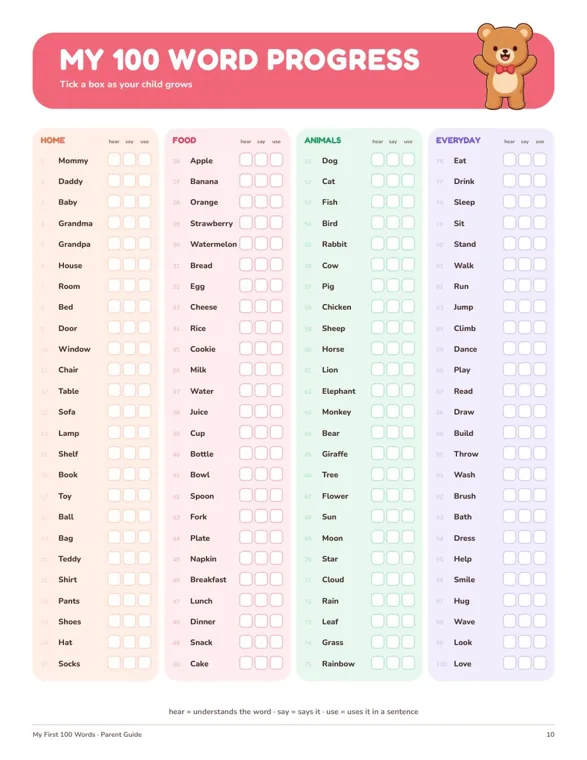
- Hear: lay out two cards and ask “猫在哪里?” (māo zài nǎlǐ, where is the cat?). A point to the right card counts.
- Say: hold up a card and wait 3 to 5 seconds before you help, the pause the parent guide asks for. If nothing comes, say the word yourself and smile.
- Use: listen for the word in a sentence, even a mixed one like “I want 水.”
For reading, cover the picture on a card with your hand and see if the character alone gets a name. Our flashcard set has a checklist page of all 48 characters to tick off as your child learns them. Once a week is often enough to check. Testing every day turns the cards into a quiz, and young children notice.
When teaching kids Chinese gets hard: common problems and fixes
Most families stall in one of three places: the child loses interest, the parent doubts their own pronunciation, or life gets busy for a week or two.
Your child refuses or gets bored
Stop the session while it’s still fun, even after one minute. Let your child pick the card, or let them be the teacher and quiz you; the parent guide suggests that from age 3. Swap a sit-down game for the house hunt, which gets them moving.
You’re not sure you’re saying it right
Check new words in a dictionary app that plays recorded audio, not a computer voice, and copy it before you teach the word. A tone you say wrong every day becomes your child’s tone. If a word is still hard for you, leave it for later and teach an easier one.
You missed a week or more
Go back to the last theme your child knew well rather than moving on. A quick win gets the routine going again. Keeping the current cards somewhere visible, like on the fridge, makes the next session easier to start.
Questions parents ask about teaching kids Chinese
Can I teach my child Chinese if I don’t speak it?
Yes, for first words, early characters and pinyin. Picture cards and tone-marked pinyin give you the sounds, and a dictionary app checks them. For real conversation your child needs to hear fluent speakers, so add a weekend Chinese school or a tutor once they have a few dozen words.
Should kids learn simplified or traditional Chinese characters?
Pick the set your family or local school uses. Mainland China and Singapore use simplified characters, and Taiwan and Hong Kong use traditional ones. Our printables are all in simplified Chinese.
Printables from this article
Related articles
Chinese Learning Printables
How to Say Happy New Year in Chinese: Sayings & Replies
The Mandarin greeting syllable by syllable, which wish fits grandparents, coworkers and kids, what to say back, and the four-character sayings families use at Chinese New Year.
Chinese Learning Printables
Chinese Radicals: List of Common Radicals and the Kangxi 214
What a Chinese radical is, why the count is 214 in one list and 201 in another, a table of 29 common radicals with examples, and how to use them to look up characters.
Chinese Learning Printables
What Is Pinyin? Tones, Rules and How to Read a Pinyin Chart
What pinyin is, how a syllable is built from an initial, a final and a tone, the spelling rules that trip learners up, and how to read a pinyin chart or type pinyin.