How to Write Chinese Characters: Stroke Order and Grid Paper
Chinese characters are written one stroke at a time, in an order that’s fixed for each character: top before bottom, left before right, horizontal before vertical, plus a few rules for boxes and centers.
Learners practice that order on tián zì gé (田字格), square grid paper split by a dashed cross. They trace a model first, then write the character without one.
The order isn’t a matter of taste. Mainland China sets the stroke order for 8,105 characters in a national standard, GF 0023-2020, issued in 2020 by the Ministry of Education and the State Language Commission. It replaced an earlier list from 1997.
Nobody memorizes 8,105 sequences, though. A handful of rules covers most of them, and you look up the rest as you meet them.
The Chinese stroke order rules, one character each
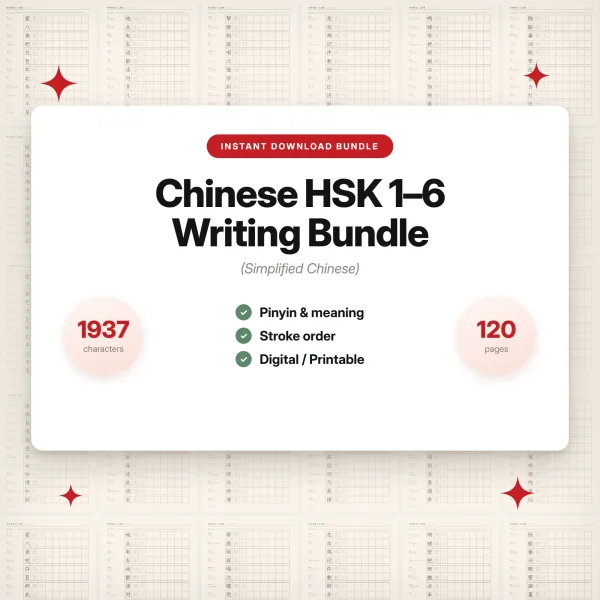
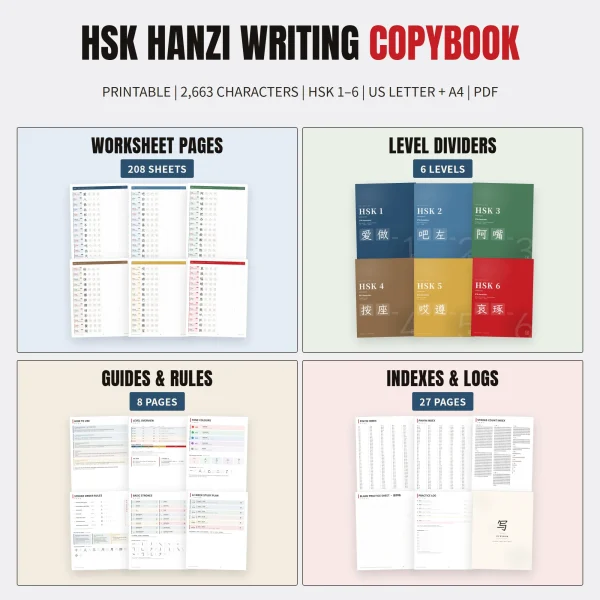
Beginner books split the rules a little differently. The stroke order page in our HSK Hanzi Copybook lists seven. The Chinese Character Writing Workbook adds an eighth for crossing strokes. Here are the seven, each with an example from those pages.
- Horizontal before vertical. 十 (shí, ten): the horizontal, then the vertical through it.
- Left-falling before right-falling. 人 (rén, person): the stroke that sweeps down to the left, then the one that sweeps down to the right.
- Top to bottom. 三 (sān, three): three horizontals, starting at the top.
- Left to right. 川 (chuān, river): the three strokes from left to right.
- Outside before inside. 月 (yuè, moon): the outer frame, then the two short strokes inside it.
- Close the frame last. 国 (guó, country): the left side and the top-right corner, then everything inside, then the bottom stroke that seals the box.
- Center before the two sides. 小 (xiǎo, small): the hooked middle stroke, then the left dot, then the right dot.
The workbook’s eighth rule covers crossings. When a horizontal crosses a left-falling stroke, the horizontal goes first, as in 大 (dà, big).
When two rules seem to pull in different directions, top to bottom wins. Chinese teachers put this in a short rhyme, which the workbook translates as “top to bottom leads; left to right follows.” So a character built as a top part over a bottom part gets its whole top part first.
The strokes the rules are talking about
The rules name stroke types, so it helps to know them on sight. The copybook’s basic strokes page teaches 16. The workbook splits them finer and shows 24.
Worksheets printed in China label strokes in Chinese. Two names turn up everywhere: héng, the horizontal, and shù, the vertical.
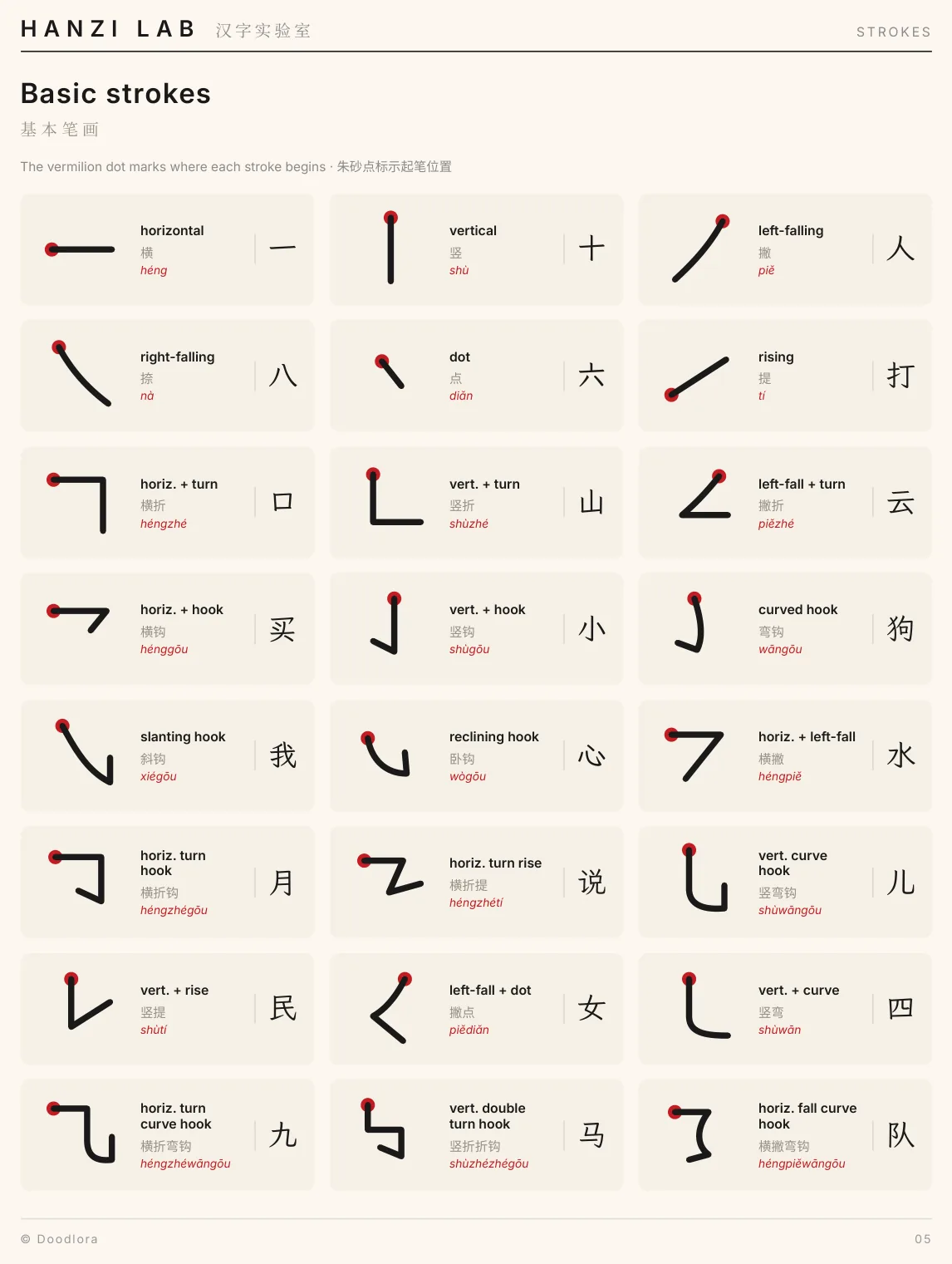
Calligraphers go further and split one type into several shapes. A vertical can stop with a pressed, rounded end, called the dewdrop vertical, or thin to a point, called the hanging-needle vertical.
For stroke order, those differences don’t matter. Both are verticals, and the rules treat them the same way.
Four of the rules, stroke by stroke
十 is the plainest case of horizontal before vertical. The horizontal goes down first, and the vertical comes second, straight through the middle of it.
If you wrote the vertical first, the result would look the same. The copybook gives two reasons to follow the order anyway: the proportions come out even, and each stroke ends near where the next one starts, so the hand doesn’t jump around.
人 shows the second rule. The left-falling stroke comes first, from the top down to the lower left. The right-falling stroke starts partway down the first one, not at its top, and sweeps down to the right.
三 is top to bottom in its plainest form. The top horizontal comes first, and the bottom one, written last, is also the longest.
小 puts the center rule ahead of left to right. The hooked middle stroke goes down first, and the two dots come after it, left then right.
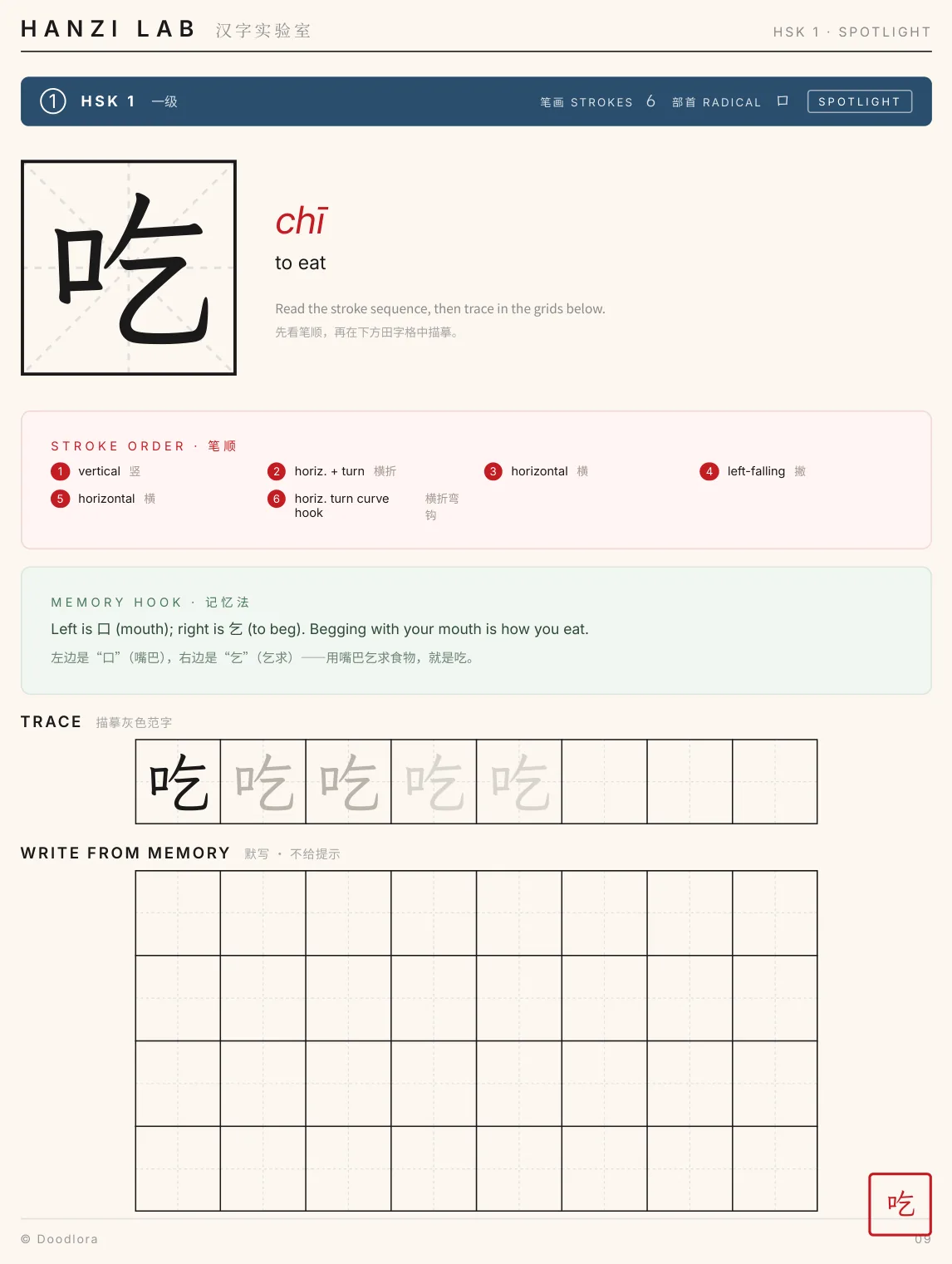
Practice books spell the order out stroke by stroke. Each level of the workbook opens with a page like this one for 吃 (chī, to eat).
Stroke order in bigger characters: one part at a time
Most characters are built from smaller pieces, and many of those pieces are characters in their own right. You finish the top piece before the bottom one, or the left piece before the right. Inside each piece, the same seven rules apply.
寺 (sì, temple) is 土 (tǔ, earth) sitting on 寸 (cùn, a traditional unit of length). 土 goes first: horizontal, vertical, horizontal. Then comes 寸: its horizontal, the long vertical with a hook, and the dot. That’s six strokes in all.
全 (quán, whole) puts a roof over 王 (wáng, king). The roof is 人 again, left-falling stroke first, and it goes on before anything underneath. Then 王: horizontal, horizontal, vertical, and the long bottom horizontal last, for six strokes.
音 (yīn, sound) stacks 立 (lì, to stand) on 日 (rì, sun). 立 comes first: dot, horizontal, dot, a short left-falling stroke, and a long horizontal.
日 uses the frame rules. The left vertical goes first, then the top and right side in one turning stroke, then the short horizontal inside. The bottom horizontal closes the box last, which makes nine strokes for the whole character.
Left-right characters work the same way sideways. 猫 (māo, cat) has 犭, a radical found in many animal names, on the left and 苗 (miáo, sprout) on the right. All three strokes of 犭 go down before 苗 begins.
Tián zì gé and mǐ zì gé: how Chinese grid paper works
Tián zì gé (田字格) means “field-character grid.” Each square has a solid border and a dashed cross that splits it into four, so it looks like 田 (tián, field).
Tián zì gé is the paper Chinese schoolchildren learn on. A 2023 guest post on Language Log, the University of Pennsylvania linguistics blog, names tián zì gé and mǐ zì gé as the two grids most used by elementary students in China.
The dashed lines are there for placement. The crossing marks the center of the square, and the four quarters let you see when one side of a character has grown too big. In 十, for example, the horizontal sits on the middle line and the vertical runs down the center.
Mǐ zì gé (米字格), the “rice-character grid,” adds two diagonals, so each square looks like 米 (mǐ, rice). The copybook’s note says the diagonals are there to line up the slanting strokes. Those are the left-falling and right-falling sweeps, which the cross alone doesn’t guide.
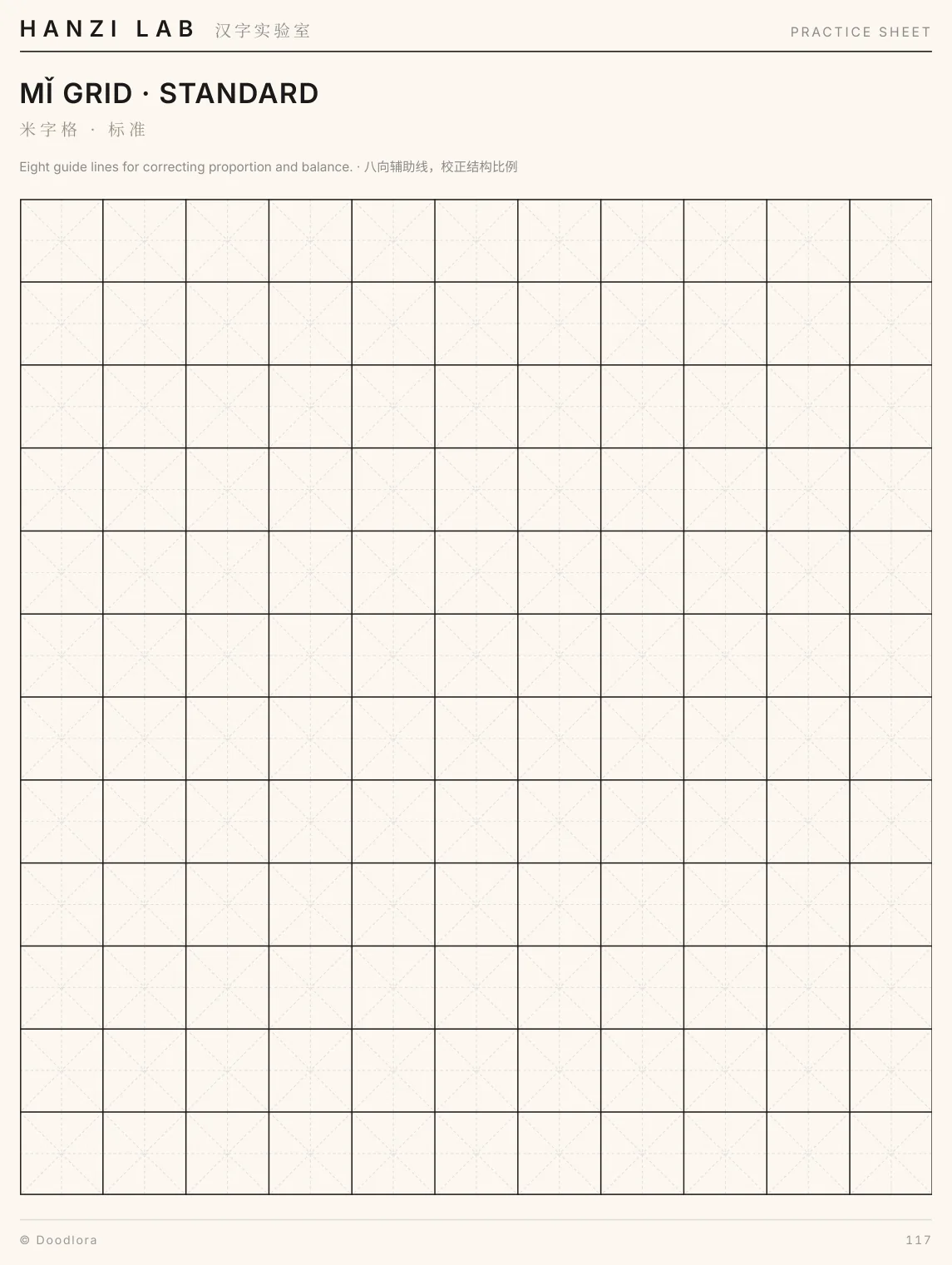
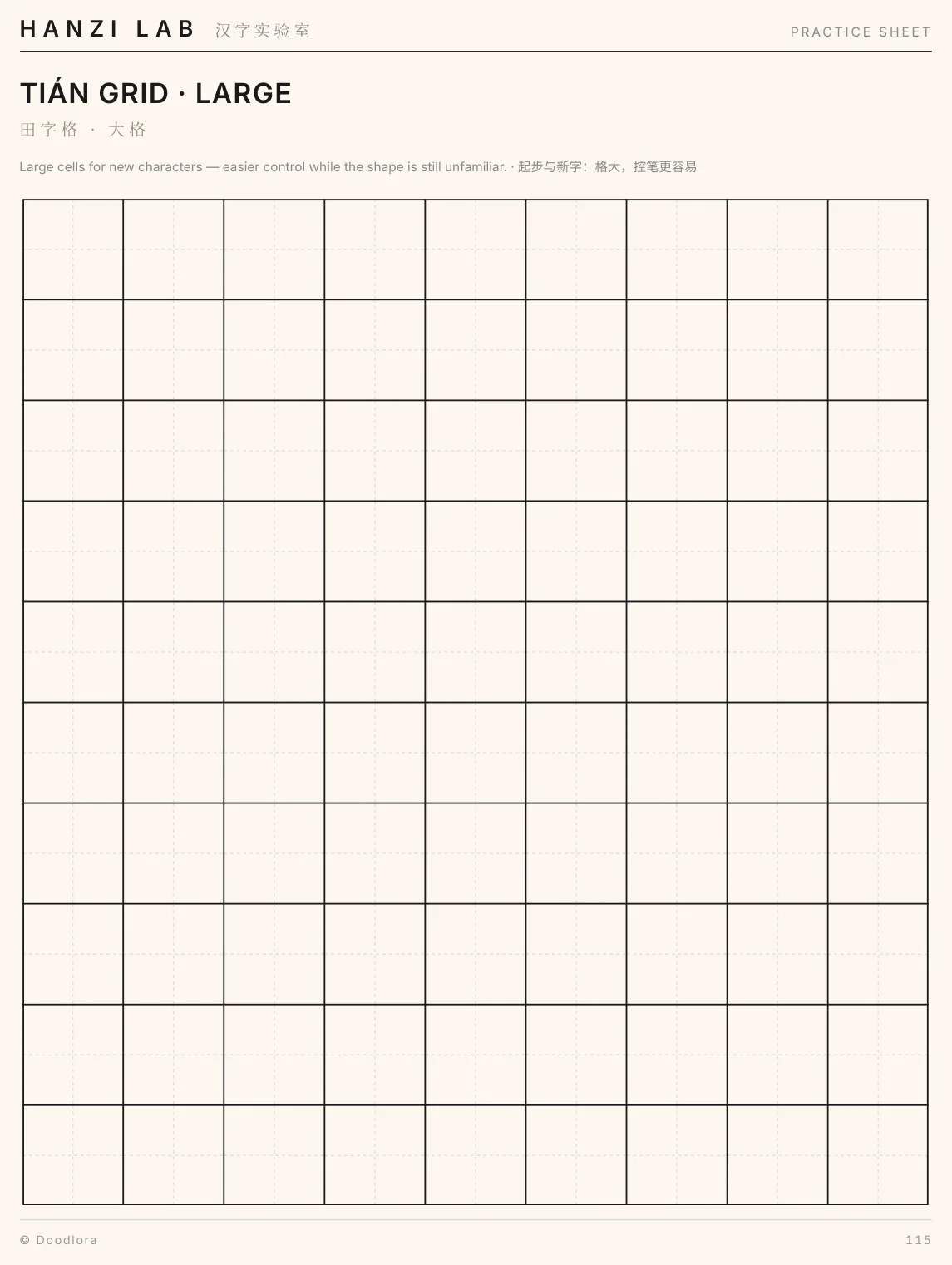
The workbook’s blank sheets suggest an order for using them. Large tián squares are for new characters, when the shape is unfamiliar and the extra room makes control easier.
Standard tián squares are for everyday practice. The mǐ grid is for fixing proportion and balance, and a plain grid with no guides tests whether the shape is really yours.
Our Chinese Character Writing Workbook has all five blank grids at the back: large and standard tián, mǐ, plain, and a small copying grid. Before them come 948 guided practice rows.
Print grid sheets at 100%. Fit to page shrinks the grid until the squares are no longer square, and the quarter lines stop meaning anything. Our guide to printing at actual size shows where the setting is and how to check the print.
How to practice writing characters: model, trace, then memory
Grid paper works best with a routine that takes the model away a little at a time. A practice row in the workbook starts with a solid model. Next come two pale gray copies to trace over, then six empty squares where you write from memory and compare against the model.
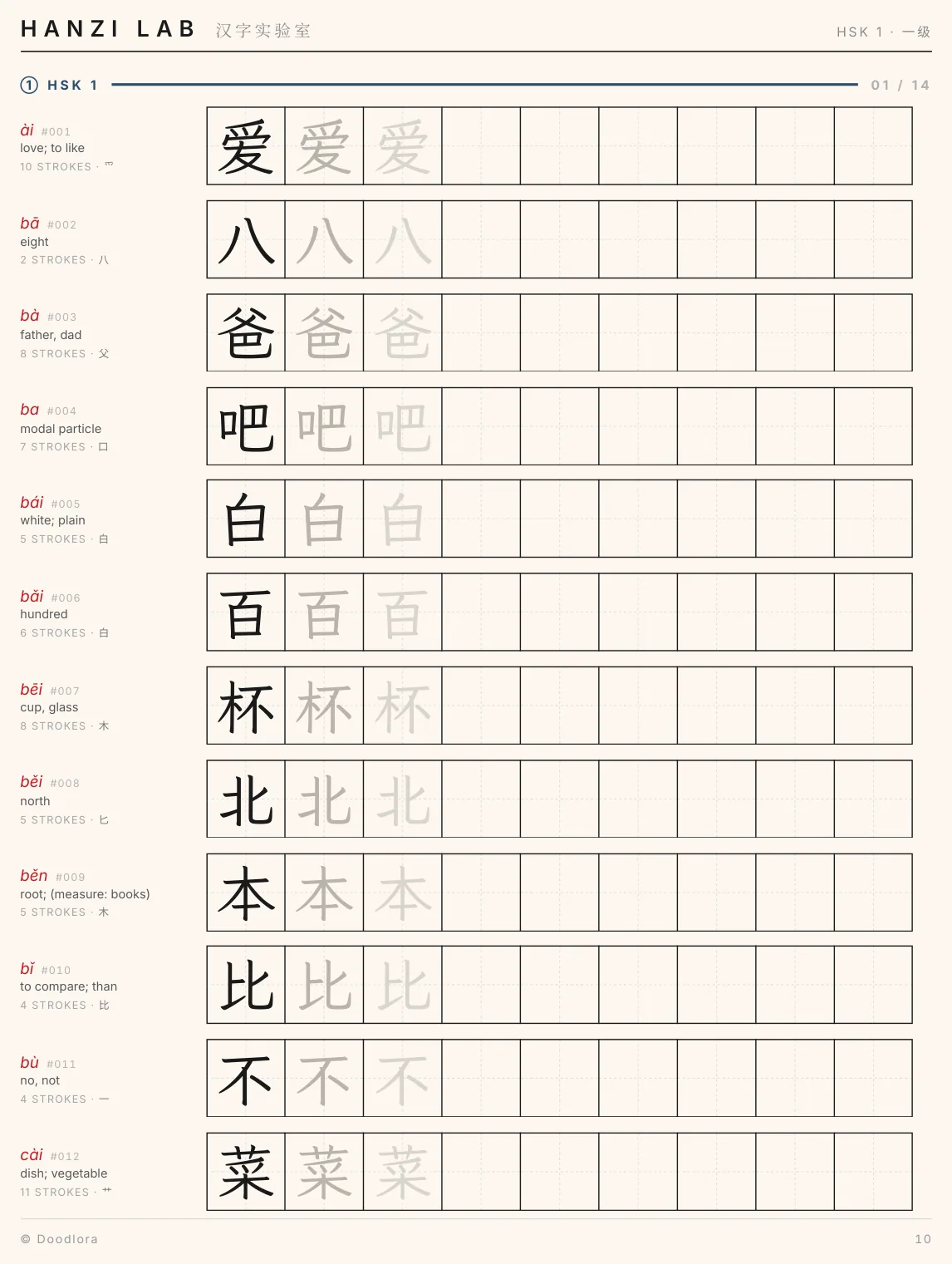
The HSK Hanzi Copybook uses the same idea with one more gray square: a model, three copies to trace, and six empty squares. That’s nine repetitions of each character, 13 characters to a sheet.
Say the character out loud from its pinyin before you write it. The copybook asks for that, and it asks you to check the stroke count once you’re done. Both books print the count beside every character, so a count that doesn’t match tells you a stroke went missing or got split in two.
Short sessions hold up better than long ones. The workbook’s plan is one page a day, about fifteen minutes:
- three minutes rewriting three of yesterday’s characters with the models covered,
- eight minutes on the new page, tracing twice and writing six,
- four minutes writing five characters from the pinyin index with the characters covered.
If you miss a day, the plan says not to catch up. Go straight to today’s page.
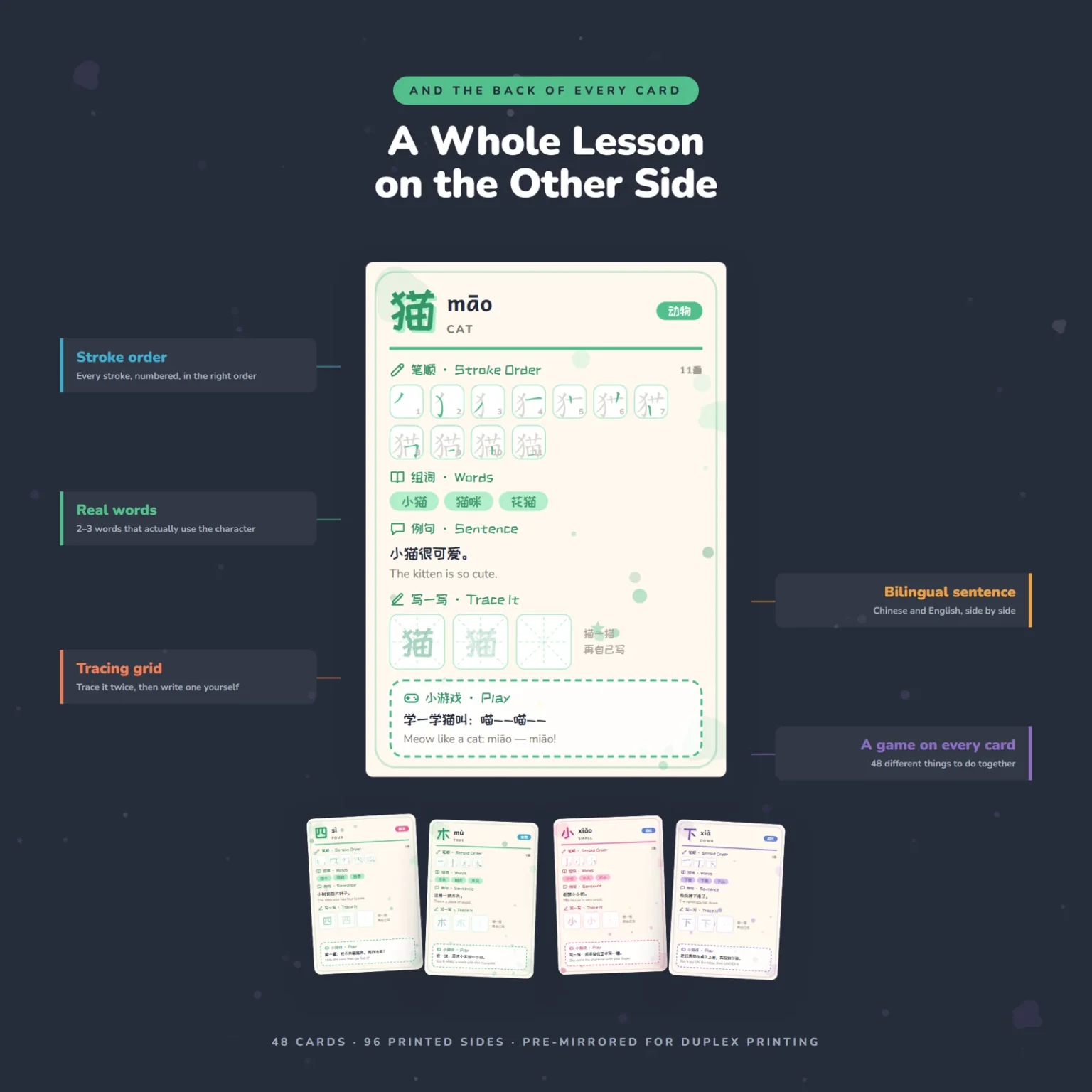
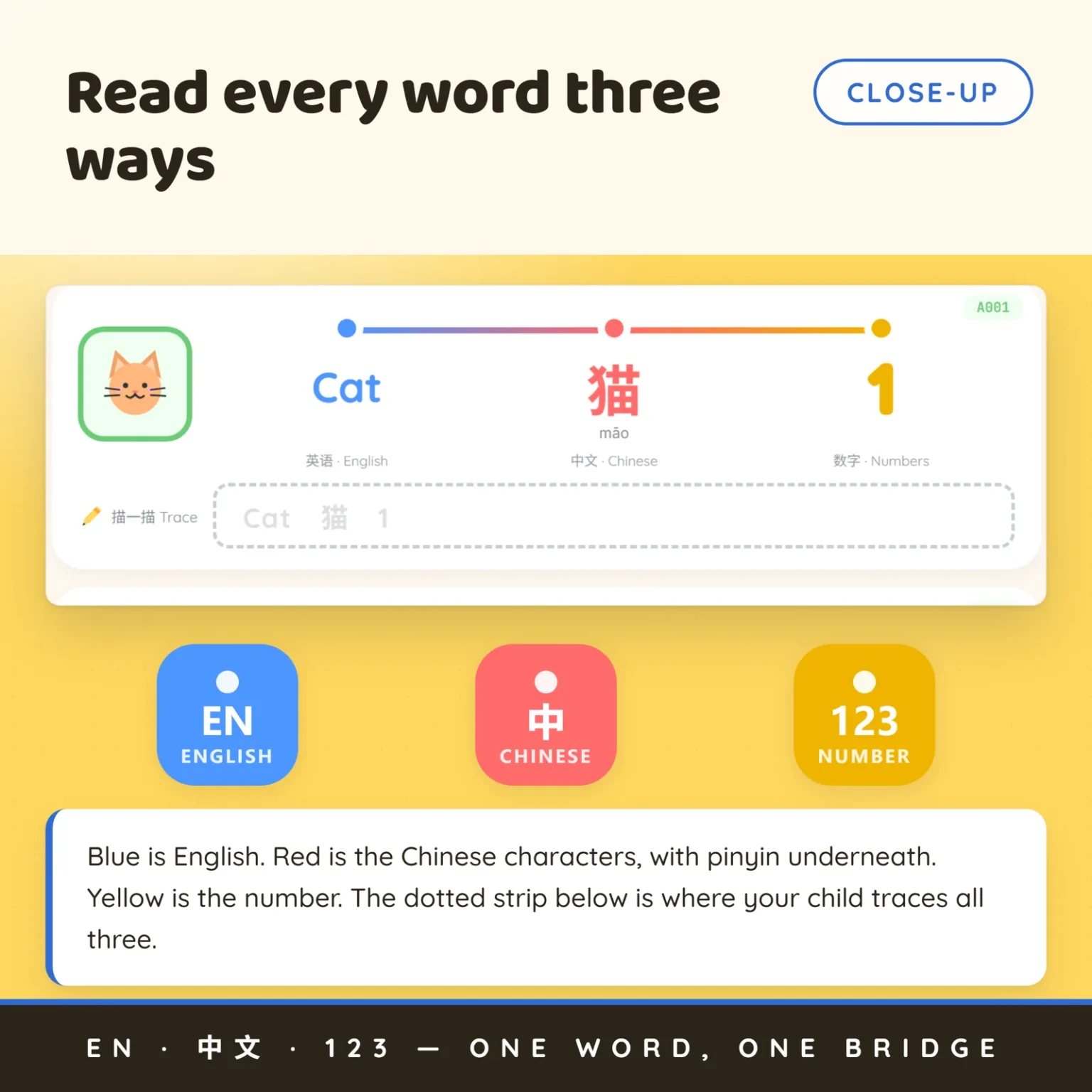
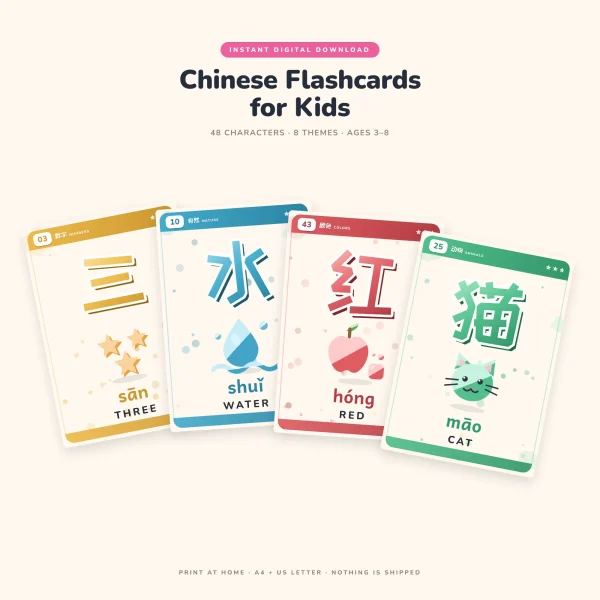
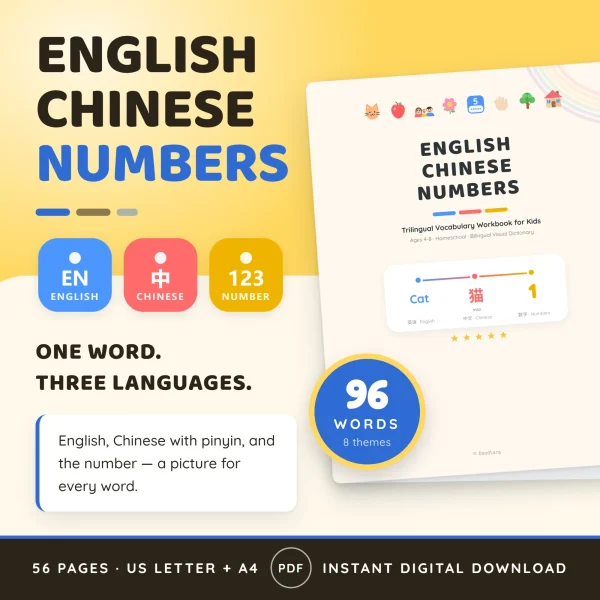
Young children usually start further back. The Chinese Character Flashcards number every stroke on the back of each card and end with a row where the child traces a gray character before writing one alone. The English–Chinese Vocabulary Workbook adds a dotted tracing strip under each word.
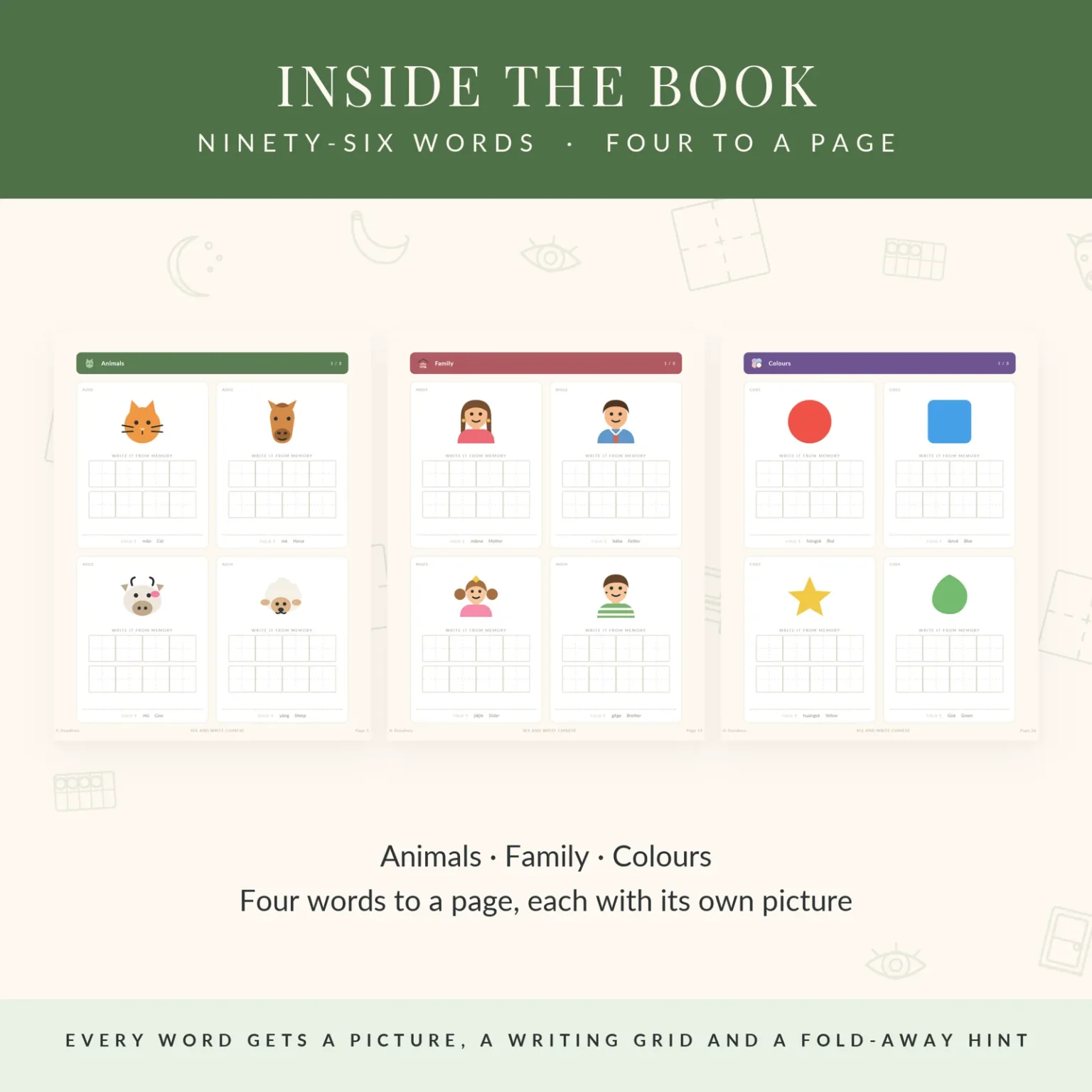
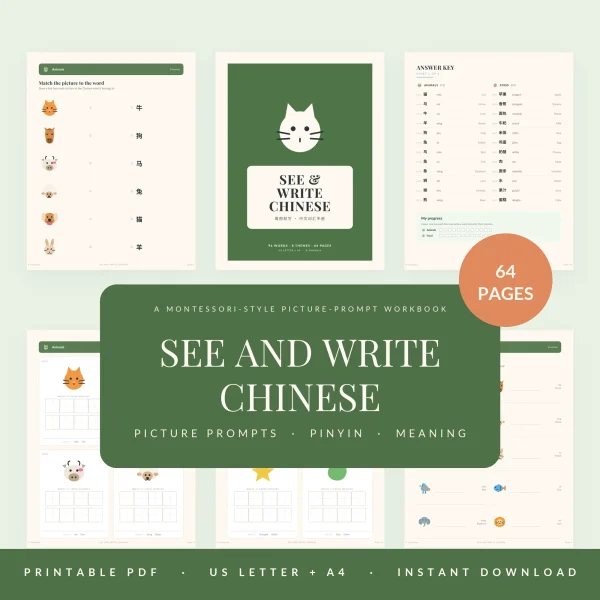
Once the words are familiar, the See and Write Chinese Vocabulary Workbook takes the model away completely. Each card shows only a picture, the child writes the word from memory, then folds the card to check.
The rest of the range is on the Chinese learning page.
Holding the pen for Chinese handwriting
Shaky strokes often come from the hand, not the order. Chinese pen handwriting teachers describe much the same hold.
The pen rests against the knuckle at the base of your index finger. Your index fingertip sits a little ahead of your thumb, since the thumb is shorter, with a small gap between the two.
Keep the index finger’s top joint straight or slightly arched. One teacher warns that when it folds inward, you’re pressing too hard, and the finger gets sore and stiff.
Hold the pen about the length of your index finger’s top segment above the tip. That keeps the tip in view instead of hidden under your fingers.
Let your ring and little fingers curl in next to the middle finger, leaving the palm hollow. Rest the side of your hand on the paper and keep it there. Don’t lift the wrist to write.
Put most of your forearm on the desk.
One teacher noticed their horizontals shaking when only the hand was on the desk and the arm hung off the edge. The push was coming from the shoulder. The other teacher’s setup is about two-thirds of the forearm on the desk, with the elbow just past the edge.
If you write right-handed, slide the paper to the right of your body instead of straight in front. One teacher lines up the paper’s left edge with the nose, so the writing hand doesn’t block your view and you don’t tilt your head to see.
All of this is for pencils and pens. Brush calligraphy uses a different grip.
Stroke order mistakes to check in your own writing
A few characters seem to break the rules above. Our workbook’s stroke order page lists several of them as the places where learners go wrong.
- 女 (nǚ, woman). The long horizontal comes last, after the two crossing sweeps.
- 方 (fāng, square). Dot, horizontal, then the turning stroke with a hook. The left-falling stroke goes last.
- 火 (huǒ, fire). The two short strokes at the top go first, a dot on the left and a short left-falling stroke on the right. The two long sweeps follow.
- 小. The middle stroke goes first, even though left to right would suggest the left dot.
- 忄, the heart radical on the left of characters such as 情 (qíng, feeling). In the mainland standard, both dots come before the vertical.
That last one is also where scripts part ways. Everything on this page uses simplified characters, the form used in mainland China and in all of our practice books. Taiwan’s Ministry of Education issues its own standard for traditional characters, and it writes the vertical of 忄 second, between the two dots.
The official orders match for most characters, but not for all of them. If your textbook uses traditional characters, follow its order.
For any character you haven’t written before, look it up before you practice it. An animated stroke order dictionary shows each stroke in sequence, and a minute there saves you a page of practice in the wrong order.
Printables from this article
Related articles
Chinese Learning Printables
How to Teach Kids Chinese: Pinyin, Characters, First Words
A home plan for parents teaching Mandarin to young children: what to do at each age, a 10-minute daily routine, the first words and characters, and how to tell it's sticking.
Chinese Learning Printables
How to Say Happy New Year in Chinese: Sayings & Replies
The Mandarin greeting syllable by syllable, which wish fits grandparents, coworkers and kids, what to say back, and the four-character sayings families use at Chinese New Year.
Chinese Learning Printables
Chinese Radicals: List of Common Radicals and the Kangxi 214
What a Chinese radical is, why the count is 214 in one list and 201 in another, a table of 29 common radicals with examples, and how to use them to look up characters.