Cheetah vs Leopard vs Jaguar: Spots, Build and Speed
The quickest way to settle cheetah vs leopard is to look at the face. A cheetah has a black “tear” streak running from the inner corner of each eye down to its mouth, and no leopard or jaguar has one. Next, look at the spots. A cheetah’s are solid round or oval dots, while a leopard’s and a jaguar’s are rosettes, broken rings of black around a patch of darker gold. The body is the third clue: a cheetah is slim and long-legged with a small head, built for sprinting, and a leopard is shorter-legged and muscular, built for stalking and climbing.
The jaguar is the one people mix up with the leopard, not the cheetah. Its rosettes are bigger and usually have a dot in the middle, and its body is heavier and stockier. It also lives only in the Americas, so a spotted cat filmed in Africa is never a jaguar. The rest of this page goes clue by clue, then puts all three cats in one table, with notes on speed, where each one lives, and the three animal prints that borrow their names.
Check the face first: tear streaks
The tear streaks are the single most reliable mark, because they are unique to the cheetah. Each one starts at the inside corner of the eye and runs down beside the nose to the mouth. Nobody is sure what they’re for. They may cut the sun’s glare, or they may make the cat’s expressions easier for other cheetahs to read.
A leopard’s face has spots too, and a jaguar’s head spots are solid, but neither cat has the two dark lines. That works even in a blurry photo or a quick moment on a nature show, as long as you can see the face.
A few other face details back it up:
- Head size. A cheetah’s head is small and streamlined for its body, with a short snout and eyes set high. A leopard has a broad head, and a jaguar’s is more square and blocky still.
- Ears. A cheetah’s ears are small, short and rounded, with black patches on the back.
- Whiskers. They are shorter, fewer and finer on a cheetah than on other cats, so the muzzle looks cleaner.
Spots vs rosettes: reading the coat
If the face is turned away, the coat tells you almost as much.
Cheetah: solid spots. An adult cheetah has about 2,000 evenly spaced black spots, each roughly 1.2 to 2 inches (3 to 5 cm) across. They’re filled in, not hollow. The chin, throat and belly are white with no markings, and every cheetah’s spot pattern is its own, the way a fingerprint is.
Leopard: rosettes. A leopard’s dark spots are grouped into rosettes, small clusters that form a ring or a broken rosebud shape. Compared with a jaguar’s, they’re smaller, more numerous and usually empty in the middle.
Jaguar: rosettes with a dot. A jaguar’s rosettes are larger, darker and fewer than a leopard’s, with thicker edges, and many have one or more small spots in the middle. On its head, neck and tail the jaguar’s spots are solid, so check the sides of the body, where the rosettes are clearest.
The tail is a useful last check:
- A cheetah’s tail is 24 to 31 inches (60 to 80 cm) long. The first two-thirds is spotted and the last third has four to six dark rings, ending in a bushy white tuft.
- A leopard’s tail is long, 26 to 40 inches (66 to 102 cm), with a white tip and spots that form incomplete bands toward the end.
- A jaguar’s tail is the shortest of any big cat, 17.7 to 29.5 inches (45 to 75 cm), and its spots can merge into bands and a black tip.
Black leopards and black jaguars still carry their rosettes under the dark fur, and they’re the cats usually called black panthers. Black cheetahs are rare; a few have been seen in Zambia and Zimbabwe.
Painting the spots is an easy way to make the coat rule stick with kids. Pick a big-cat project from these animal crafts for kids and have them dab solid dots for a cheetah and broken rings for a leopard.
Cheetah vs leopard vs jaguar: comparison table
Typical adult ranges, from Wikipedia’s species pages and the Smithsonian’s National Zoo.
| Cheetah | Leopard | Jaguar | |
|---|---|---|---|
| Face | Black tear streak from each eye to the mouth | No tear streaks | No tear streaks; solid spots on the head |
| Coat pattern | Solid round or oval spots | Rosettes with a plain center | Larger rosettes, often with a dot inside |
| Head | Small and streamlined, short snout | Broad | More square, with powerful jaws |
| Body | Slim, deep chest, long legs | Slender and muscular, fairly short legs | Compact and muscular, stocky legs |
| Weight | 46–143 lb (21–65 kg) | Males 68–159 lb (31–72 kg), females 45–95 lb (20.5–43 kg) | Usually 123–212 lb (56–96 kg) |
| Shoulder height | 26.4–37 in (67–94 cm) | Males 24–28 in (60–70 cm) | 22.4–31.9 in (57–81 cm) |
| Top speed | 58–65 mph | Over 36 mph | Not a chaser; ambushes from cover |
| How it hunts | Sprints down prey in the open | Stalks and ambushes, sometimes drags prey up a tree | Stalks and ambushes, often near water |
| Feet and claws | Blunt, partly retractable claws for grip at speed | Skilled climber, rests on branches | Strong swimmer; climbs, though less than cougars do |
| Most active | Daytime, mostly dawn to noon | Mostly dusk to dawn | Varies with its prey |
| Found in the wild | Eastern and southern Africa, parts of North Africa, central Iran | Africa and Asia | Southwestern U.S. to northern Argentina |
Two things jump out. The cheetah is the tallest of the three at the shoulder, yet often the lightest, because so much of it is leg. The jaguar sits lowest to the ground and weighs the most, and big males can reach about 348 pounds (158 kg).
Speed vs strength: why the bodies look so different
Each cat’s shape matches the way it catches food, and that’s the easiest way to remember which is which.
The cheetah runs. It’s the fastest land animal. The highest reliably measured speed is about 65 mph; the 71 mph figure you’ll still see quoted came from a faulty measurement. It can go from 0 to 60 mph in under 3 seconds, and one full-speed stride covers 13 to 23 feet (4 to 7 m). During a hunt it rarely uses all of that. Cheetahs wearing GPS collars averaged about 34 mph while hunting, saving the top burst to close the last straight stretch. The long tail works like a rudder through the prey’s zigzag turns.
The cheetah’s feet are built for grip, not for climbing or grabbing. Its claws are short, blunt and only partly retractable, and the Smithsonian’s National Zoo notes that a cheetah’s footprints show claw tips, more like a dog’s track than a typical cat’s.
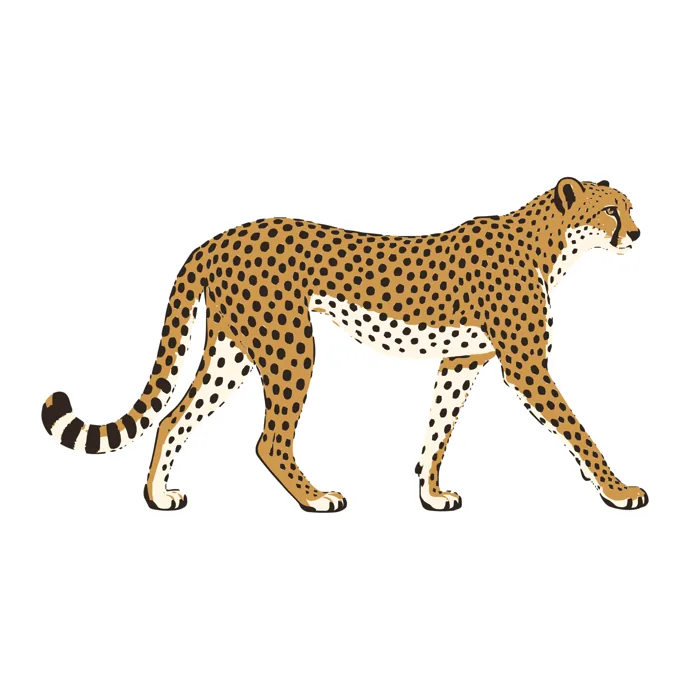
The leopard climbs. A leopard can run at over 36 mph, leap more than 20 feet (6 m) forward and jump about 10 feet (3 m) straight up. Its real skill is trees. Leopards rest on branches, come down headfirst, and sometimes haul a kill up into a tree. It hunts mostly at night, creeping as close as it can before it pounces.
The jaguar ambushes, often by water. A jaguar walks slowly along forest paths, listening, then rushes prey from cover. It’s a strong swimmer that hunts in water and has been recorded swimming at least 0.8 miles (1.3 km) between islands and shore. Its bite is the third strongest of any cat, after the tiger and the lion, and it often kills by biting through the skull.
Where cheetahs and leopards share ground in Africa, the leopard is the dominant one of the pair. Hunting by day helps cheetahs stay out of the way of leopards and lions, which do much of their hunting after dark.
Where each cat lives, and where two of them overlap
Location can answer the question before you even see the spots.
- Cheetahs live mostly in open country: savannas like the Serengeti and the Kalahari in eastern and southern Africa, and dry mountains in parts of North Africa. The only wild cheetahs left in Asia are a small, critically endangered population in central Iran. An African subspecies has also been introduced to India. Cheetahs seldom live in tropical forests.
- Leopards have the widest range of the three, across much of Africa and Asia, from rainforest to dry grassland and high mountains.
- Jaguars live only in the Americas, from the southwestern United States through Mexico and Central America to the Amazon and as far south as Paraguay and northern Argentina.
So the cheetah and the leopard can turn up in the same African park, and that’s where photos get mislabeled most. They also leave scent marks at some of the same spots; in a study in Namibia, cheetahs visited the shared sites at night and leopards in the morning, so they rarely met. The jaguar never meets either one in the wild, which makes “jaguar vs leopard” a question about photos and zoo visits, not about who shares a habitat.
Cheetah print, leopard print and jaguar print
The same rules work on fabric, phone cases and party decorations, and they matter if you’re the one making the pattern.
- Cheetah print is solid dots, fairly even in size and spacing, on a gold or tan ground.
- Leopard print is rosettes: small broken rings or C-shapes of black, empty in the middle.
- Jaguar print uses bigger, chunkier rosettes, often with a dot inside.
Product names aren’t always careful about this, so look at the shapes rather than the label before you buy fabric for a costume or a classroom bulletin board. If you’re drawing the pattern yourself, fill the shapes in for a cheetah and leave a gap in the ring for a leopard.

Teaching cheetah vs leopard to a class
The three-clue order (face, coat, body) gives kids a routine they can actually use on a new photo. One way to run it with a group of about 20 to 30 students takes 15 to 20 minutes:
- Show one close-up of each cat’s face. Ask what the cheetah has that the others don’t, and let students point to the tear streaks before you name them.
- Show a side view of each coat. Have students describe the spots in their own words, “filled in” or “like a ring,” before you give them the word rosette.
- Show full-body photos. Ask which cat looks built for running and which for climbing.
- Test them. Mix up six to ten photos, cheetahs and leopards from Africa plus a few jaguars, and have pairs sort them with a reason for each answer. Ask where each photo was taken, too; that rules out the jaguar fast.
Older students can copy the table above into a notebook with the cheetah column filled in, then complete the leopard and jaguar columns from their own photo sorting.
Cheetah, leopard and jaguar questions
Which is faster, a cheetah or a leopard?
The cheetah, by a long way. Its top speed is about 65 mph, and a leopard tops out a little over 36 mph. A leopard is the better climber and jumper.
Is a jaguar bigger than a leopard?
Yes, usually. Jaguars in most areas weigh 123 to 212 pounds, while male leopards typically weigh 68 to 159 pounds.
Can cheetahs roar?
No. Cheetahs purr, growl, hiss and make a bird-like chirp that the Smithsonian’s National Zoo says can be heard a mile away. The jaguar, by contrast, roars or grunts to call over long distances, a hoarse sound of five or six deep notes.
What is a king cheetah?
A king cheetah is a regular cheetah with a rare coat mutation. Its spots are large and blotchy, and three wide dark stripes run from the neck down the back. It was once described as a new species, but it’s a color form of the ordinary spotted cheetah.
Are cheetahs and leopards endangered?
Both are listed as Vulnerable on the IUCN Red List, and the jaguar is listed as Near Threatened. The Asiatic cheetah in Iran is critically endangered.
Using cheetah clipart in a report or poster
A school report or a poster on big cats needs two kinds of picture. Real photos do the teaching, because only a photo shows a true coat and face. Graphic art does the rest: the title, borders, a header for each section, or a sticker on the cover.
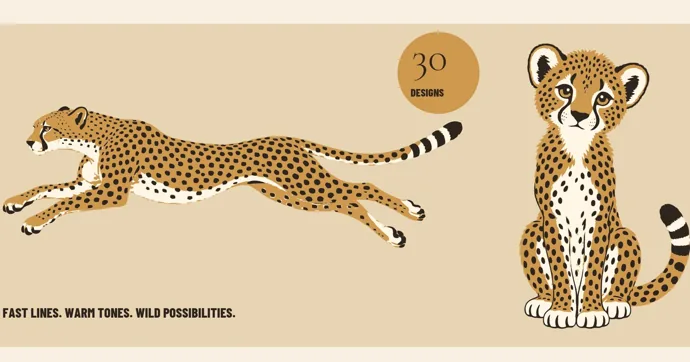
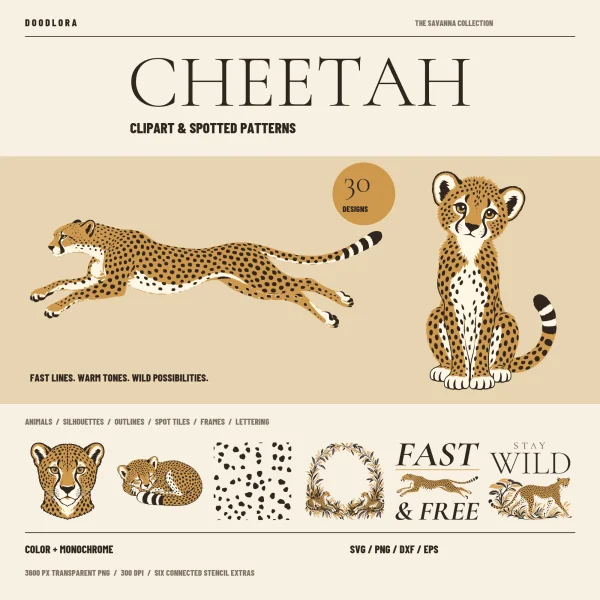
For the decorating side, our cheetah clipart set has 30 designs: 6 adult cheetahs, 6 cubs and family scenes, 4 silhouettes, 4 line drawings, 6 repeating spot tiles, 2 blank frames and 2 lettering designs (“Fast & Free” and “Stay Wild”). The cats are drawn with tear streaks, solid spots and ringed tails, so they won’t contradict the lesson, but they are illustrations, not a field guide. There are no leopards or jaguars in the set, so for a three-cat comparison poster, pair it with photos of the other two.
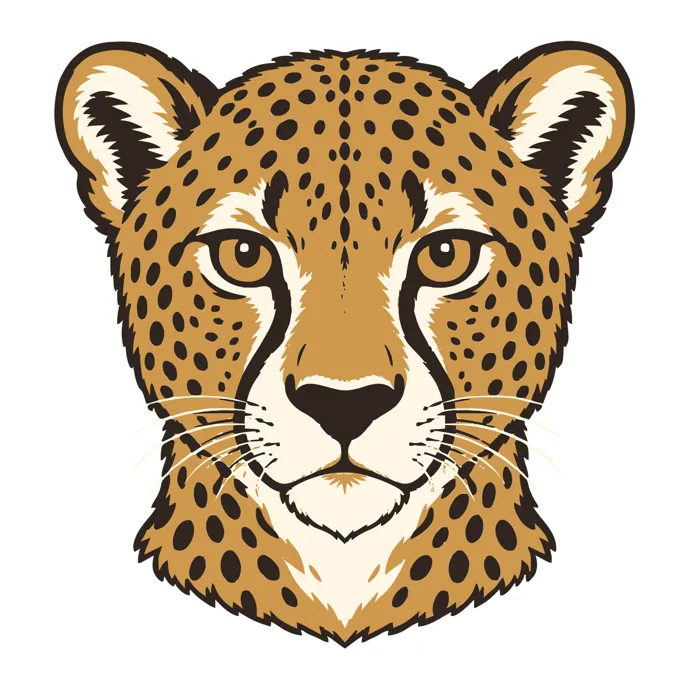
Every design comes in a warm savanna palette of ochre, ivory and dark brown, plus a monochrome version. The PNGs are transparent, 3600 × 3600 pixels with 300 dpi in the file data, which is 12 inches square, so scale them down to fit a Letter page on a home inkjet. The SVGs and DXF outlines are for design programs and cutting machines; set the final width after you import them, since the formats don’t open at one shared size. The six spot tiles repeat edge to edge when you place whole copies side by side, which makes them handy for a cheetah print border or background. If PNG, SVG and DXF are new to you, start with what clipart is and which file does what, then see how to use clipart for layout steps. Besides the personal license, a commercial license is offered for this set, with its terms listed on the product page.
For the report itself, a single line covers it: tear streaks and solid spots mean cheetah, rosettes mean leopard, and big rosettes with a dot inside, in the Americas, mean jaguar.
Printables from this article
Related articles
Clipart & SVG Cut Files
How to Draw a Truck: Easy Pickup, Big Rig and Cartoon
Split a pickup into three parts before you draw a single wheel: a bed, a cab and a hood. Keep the roof about 2.2 wheels tall and the bed rail level with the hood, and the truck looks right even before the details go on.
Clipart & SVG Cut Files
How to Draw a Train: Steam Engine, Cars and Tracks
Split the page into a 10-square grid, lay a long boiler tube across the middle, set a box cab at the back and a tall stack at the front, hang two big driving wheels under the cab end, then couple cars behind and run the rails to a vanishing point.
Clipart & SVG Cut Files
Hawk vs Falcon: Wings, Size, Hunting Style and Eagles
A falcon has long, narrow wings that taper to sharp points and flies on steady, quick wingbeats; a hawk has broader wings with rounded tips and either soars in slow circles or flaps hard and glides. Falcons kill with a notched beak and hawks with their talons, and eagles are the largest, heaviest-billed members of the hawk family.