Visual Schedule for Kids: Morning and Bedtime Routine Cards
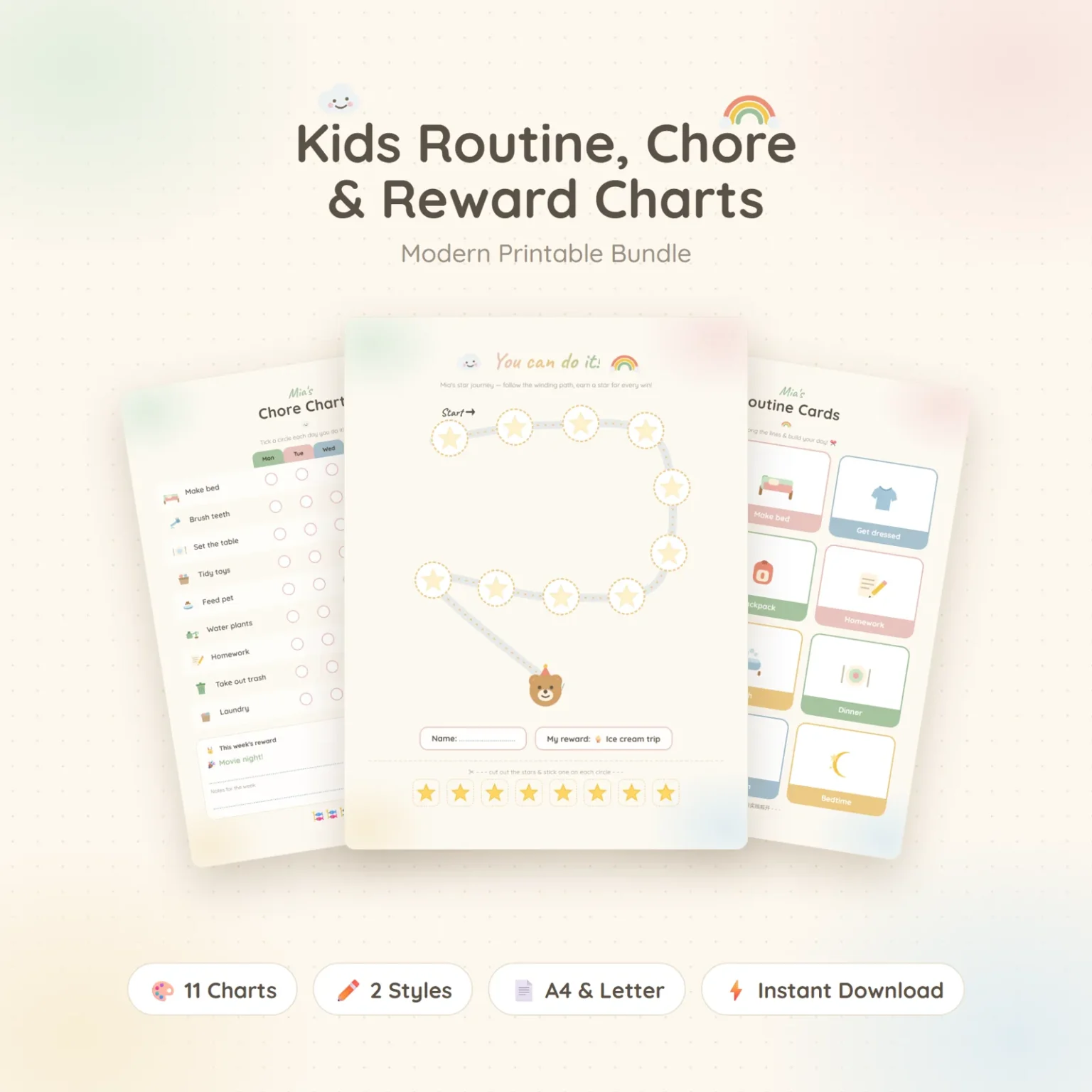
Pick one routine, line up a picture card for each step in the order your family does it, and hang the strip where that routine happens: that’s a working visual schedule for kids.
Your child moves each card, or ticks its circle on a chart, as the step gets done.
If the cards came from a printable set, compare them with your own routine before you cut a single one.
We went through our own routine files page by page, and the printed order isn’t always the order a family’s evening runs. On the US Letter copy of one page, the last step of the day is missing altogether.
Start a visual schedule with one stretch of your child’s day
Choose a stretch with a clear start and a clear finish. “Getting out the door for school” works. “Everything from waking up to dinner” doesn’t, because nobody can follow a board that long while hunting for a shoe.
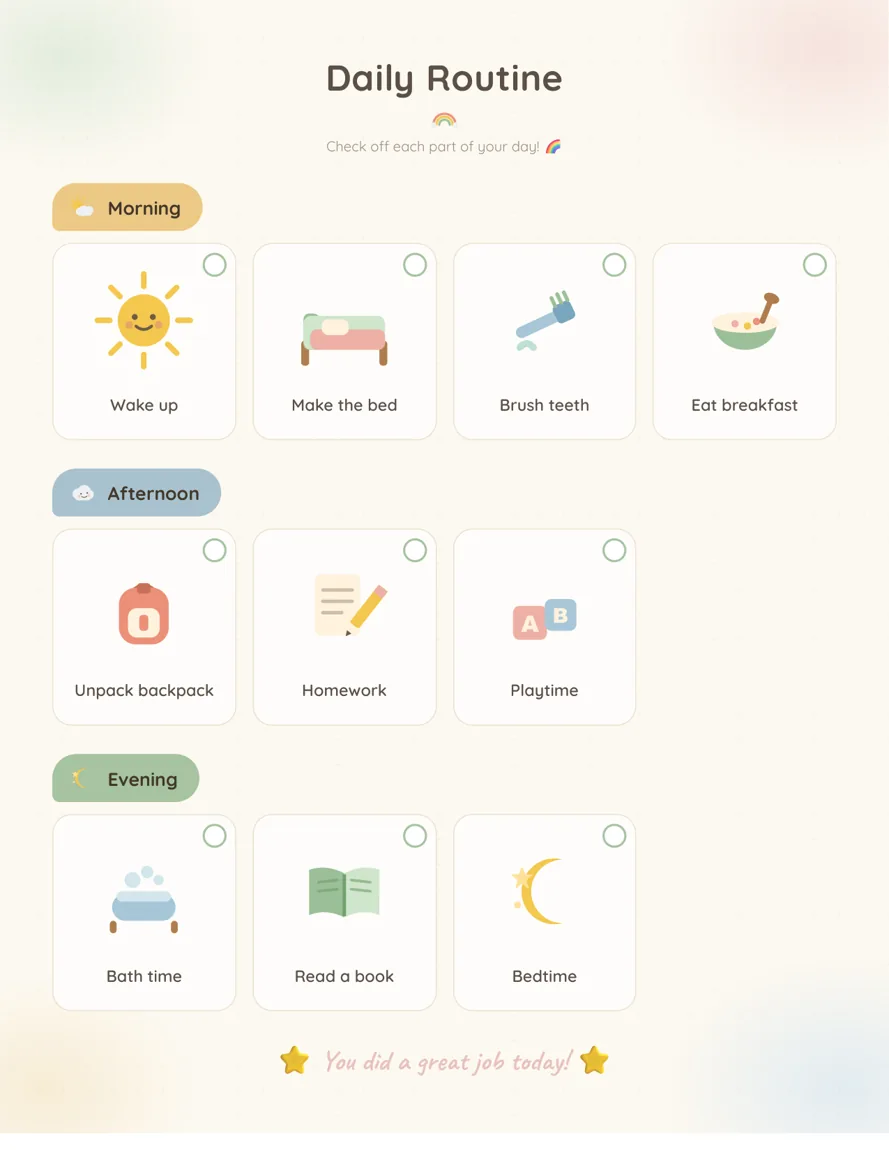
Our own daily routine page follows the same arrangement.
It holds ten pictures under three headings, four in the Morning, three in the Afternoon and three in the Evening, and every picture has a circle to tick.
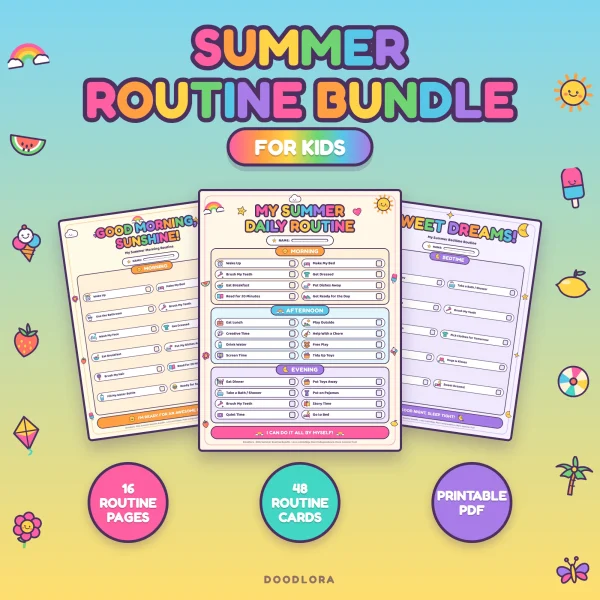
The summer routine set goes further and gives each part of the day its own sheet, with 12 morning tasks, 10 afternoon tasks and 10 at bedtime.
Before you pick any illustrations, write the stretch down on paper exactly the way it happens.
If breakfast comes before getting dressed in your house, keep it there. A neat printed chart isn’t a reason to reorder a routine that already works.
Then decide where it ends, because the last card tells your child when they’re done.
| Stretch | Cards from our 12-card set, in one family’s order | Where it ends |
|---|---|---|
| Leaving for school | Wake up, Make bed, Get dressed, Breakfast, Brush teeth, Backpack | At the door with the bag on |
| After school | Backpack, Homework, Play | When free play starts |
| Bedtime | Dinner, Bath, Brush teeth, Read, Bedtime | Lights out |
Those stretches run three to six cards, and the daily page itself never puts more than four pictures under one heading.
Longer lists do exist, like the 12-step summer morning page, but that’s a checklist to tick from top to bottom, not a strip of cards to move.
Matching printed routine cards and checklist pages to your routine
With your list written down, hold it against the printed pieces. There are two kinds.
Cards are cut apart and moved around. Checklist pages keep every step in one unchanging order and give you a circle to tick.
Pick cards if the order changes from day to day, say, swimming on Wednesdays and no homework on Fridays. Pick a page if every school morning runs the same way.
Putting the 12 routine cards in your own order
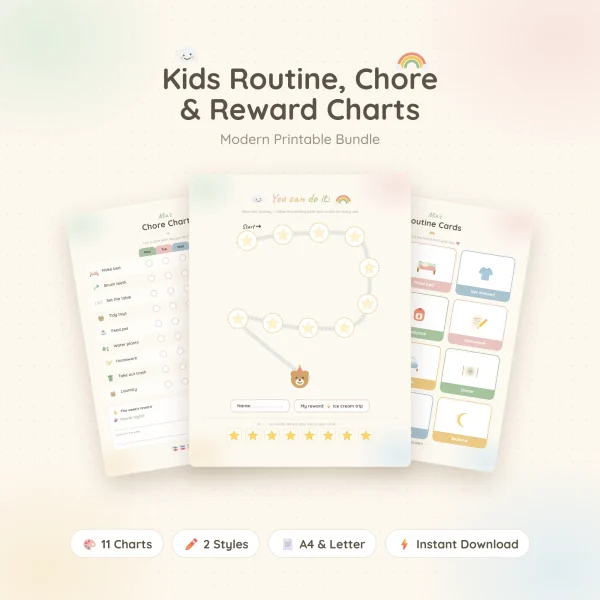
Our Picture Visual Schedule & Reward Charts set has two card pages, and they hold the same 12 cards. One page has dashed cutting lines, the other thick colored frames.
That’s 12 steps in two looks, not 24 different steps.
The printed order is Wake up, Make bed, Get dressed, Breakfast, Backpack, Homework, Play, Bath, Dinner, Read, Brush teeth and Bedtime.
It isn’t a day’s order. Dinner sits after Bath, and Brush teeth comes after Read, so cut first and arrange after.
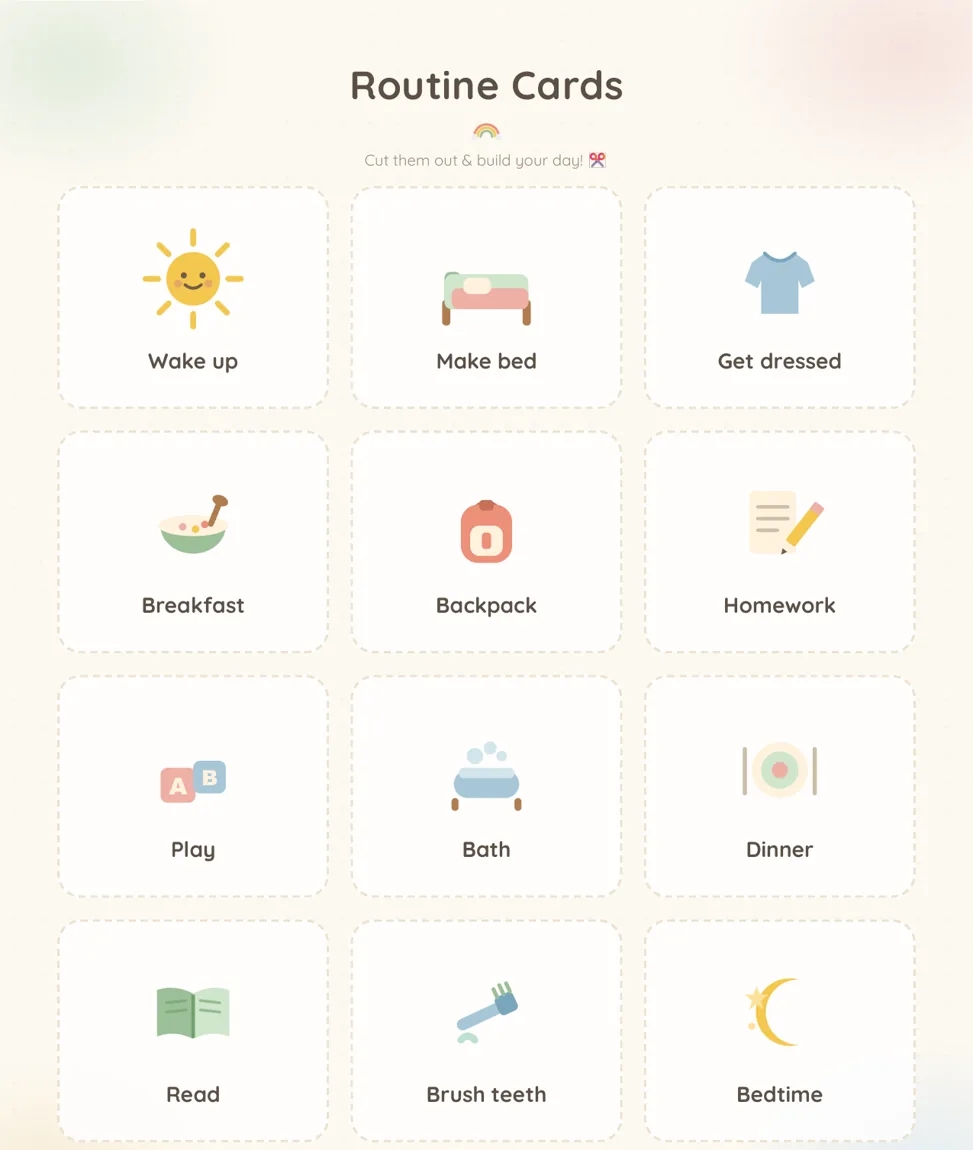
The cards don’t use quite the same names as the daily routine page, either.
The cards include Get dressed and Dinner, which the daily page leaves out. The daily page says Unpack backpack, while the card just says Backpack, so one card can mean packing the bag in the morning or emptying it after school.
Say which one you mean the first few times you point at it.
Brush teeth turns up twice on most days, morning and night, but each page prints it once. Cut both card pages and you’ll have two of every card, or print the dashed page a second time.
On the US Letter file, the measurement comes to about 2.4 by 2 inches (6 by 5 cm) per card.
Five cards stacked in a column come to about 9.7 inches (24.7 cm), which fits the long side of a Letter sheet. Five in a row run about 11.9 inches (30.2 cm), longer than the sheet itself, so a five-card strip fits a sheet best as a column.
Our chart of printing papers moves anything that gets handled or reused up to cardstock. A routine card gets picked up every morning, so it qualifies.
Print them in color if your printer allows it. The print page in our summer set puts it plainly: color is how a child who can’t read yet tells the pages apart.
If the soft colors come out gray or faint, check for draft mode, toner saving and low ink, the three causes we go through for coloring pages that print gray.
Two checklist pages to fix before you use them
The My Day page lists the routine from top to bottom, one step per row.
On the US Letter file, that list stops at Read a book. Bedtime is missing completely, and a blank band sits at the bottom of the page where that row would go.
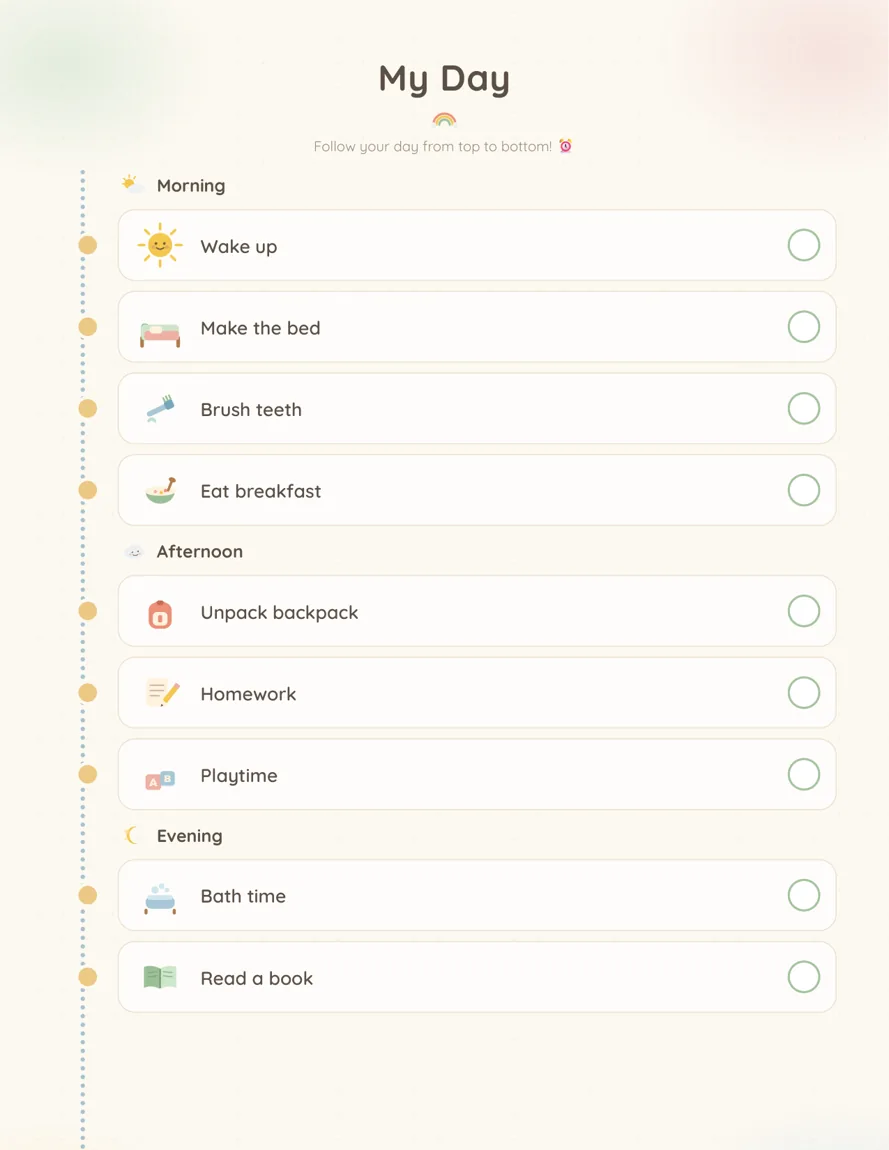
The A4 file of the same page has all ten rows, and so does the daily routine page in both sizes.
We don’t know why the Letter version lost its last row.
A4 runs about three quarters of an inch (18 mm) taller than Letter, as our Letter vs A4 page shows side by side, so the shorter page probably squeezed the row out, but the files never say so.
If you print on Letter, write Bedtime into that blank band before you laminate.
The My Jobs page has the opposite problem. It sorts nine chores into three printed columns, and the sorting is fixed.
Morning gets Make bed, Tidy toys and Homework. After School gets Brush teeth, Feed pet and Take out trash. Bedtime gets Set the table, Water plants and Laundry.
Few families set the table at bedtime.
Use the Daily Jobs checklist from the same set instead, which lists the same nine jobs with no times attached, or cross out a job and write it into the right column.
Every Doodlora Studio routine set built on these 11 charts repeats both quirks, from the watercolor version to the farm, space and ocean ones.
A step with no printed card
Sooner or later a routine needs a step the cards don’t have.
The 12-card set has no blank cards, and none for appointments, outings or school subjects.
Don’t substitute a picture that only sort of fits, like the Play card for a trip to the playground. Make a card the same size, draw or paste a picture of the actual thing, and print the word underneath.
If you build that picture from clipart, our guide to using clipart in a printable covers sizing it for a small card.
The summer set solves the problem with a much bigger collection. It has 48 cards, eight to a page, each about 3.7 by 1.9 inches (9.4 by 4.9 cm).
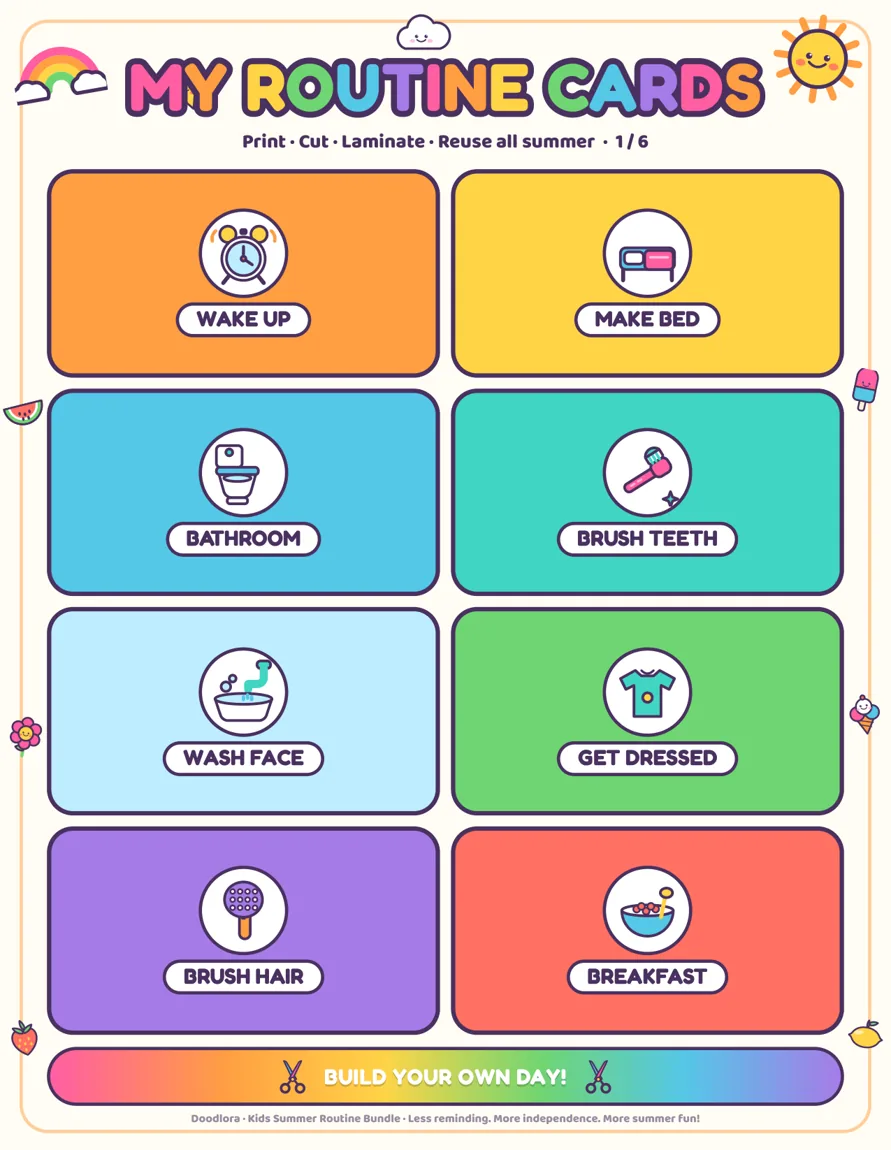
Bathroom, Wash Face, Brush Hair, Pack Bag, Get Ready, Shower and Pajamas are all in there, plus separate Help Mom and Help Dad cards.
Its routine pages include a blank My Routine sheet as well, with seven write-in lines each for morning, afternoon and evening.
Where the schedule goes and how a step counts as done
Once the cards are in order, the strip needs a location and a rule for what “done” looks like.
Hang it where the routine happens.
A board on the bedroom door won’t help a child who’s pulling on shoes in the hallway. If the routine moves from room to room, tape a small copy of the last few cards near the last step.
Decide what each card asks for.
Brush teeth means the brushing is finished, not that the toothbrush got picked up. Read can mean picking a book and reading it together.
A single Read card can stay on the strip while your child chooses which book, so the card fixes the task without fixing every detail of it.
Then choose one way to mark a step as done, and keep it for the whole routine.
You can flip the card face down, slide it into an envelope labeled Done, or tick its circle. On a chart, slip the page into a clear sheet protector and tick with a dry-erase marker, as the printing instructions in our summer set suggest.
The same notes suggest hook-and-loop dots on the back of laminated cards, so your child can rebuild the day themselves.
Show the strip on a calm afternoon, not five minutes before the bus.
Read the cards together, practice moving one, then point at the next.
If your child finishes breakfast but flips the Backpack card instead, fix it together: “Breakfast is done. This is the breakfast card.” Getting the card right isn’t a competition with points.
Keeping reward charts separate from the schedule
A ticked card is easy to turn into a star. Keep those two jobs on separate sheets.
The schedule answers “What’s next?” A reward chart counts something you’ve chosen to notice.
Doodlora Studio sets print them apart. The daily routine page closes with “You did a great job today!” and nothing to count, while the three reward charts each count to ten.
There’s a winding star path, a 10-box sticker grid that asks what your child gets after all 10, and a star meter that climbs from 1 to 10 toward a reward written at the top. The path and the grid come with stars to cut out and stick on.
The routine tracker is the one page that combines the two, and it needs a decision before you use it.
It puts ten routines against Monday to Sunday, which is 70 circles, and prints “A full week of routines = a special treat!” across the bottom.
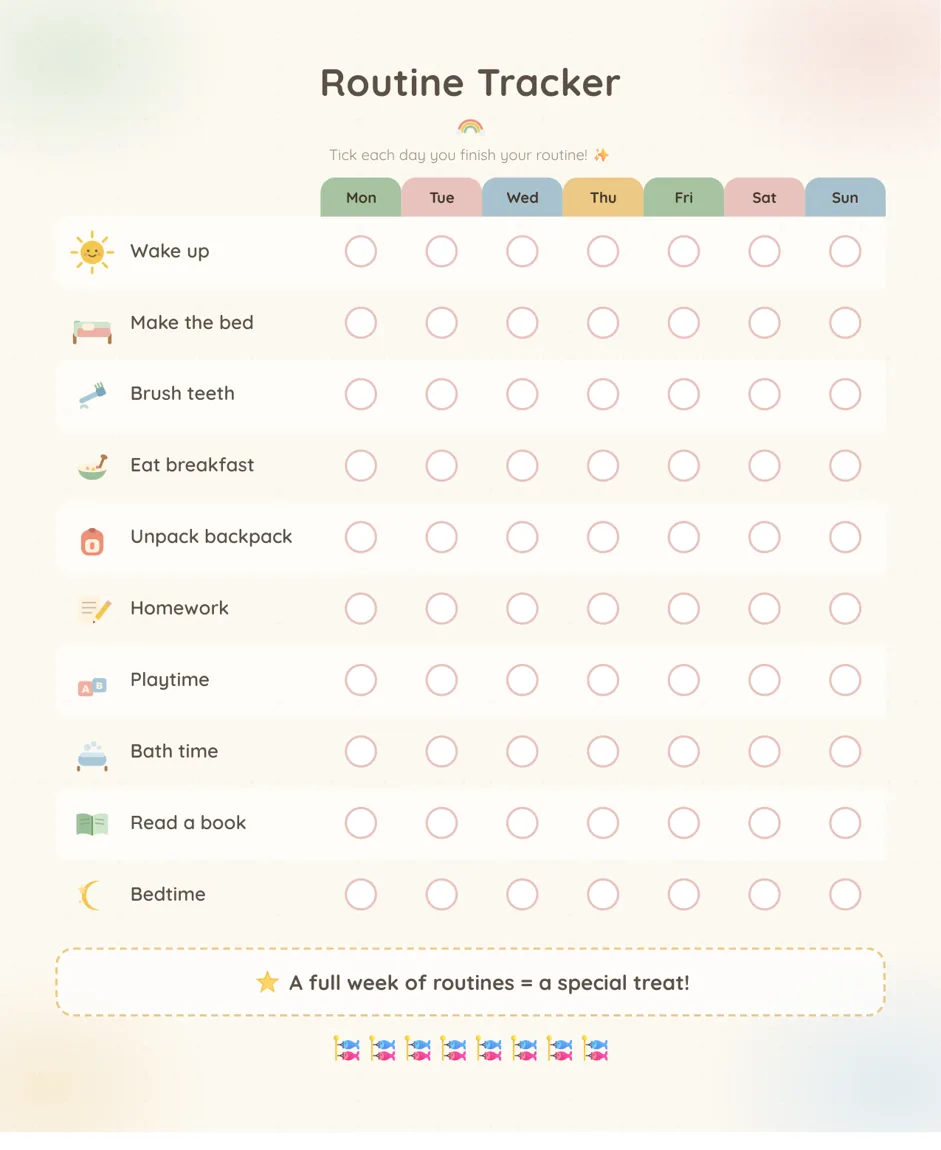
Decide before Monday what one empty circle means. If a single missed Bath cancels the treat, the whole week’s chart has turned into a test.
When you do use a reward chart, name the one action it records, like “backpack on its hook after school,” rather than “being good.”
The schedule stays up whether a star was earned or not, because it still has to say what comes next.
The same three reward charts come in our watercolor, farm, space and ocean themes too; they’re all in the reward and chore charts section.
When a child skips a card, misreads a picture or the day changes
Nothing in a file can tell you how one particular child reads a picture, so give the strip a few days and watch what happens with it.
If your child jumps from the first card to the fifth, the strip is too long. Take two cards off.
If they ask what the same card means every morning, the picture isn’t doing its job. Swap in a clearer drawing, or photographs of their own toothbrush and backpack.
A card that hides several actions can be split, but only as far as your child needs. Backpack might become lunch box, water bottle and folder for one child, while a sibling manages fine with the single card.
Print one test page before you cut a whole set, and look at it from where your child will stand.
Lamination is optional. A paper strip is fine while you’re still working out what belongs on it. Before you laminate everything, seal one test card and check that your dry-erase marker wipes off it cleanly.
When the day itself changes, change the strip in front of your child.
If there’s no bath tonight, take the Bath card off before the routine starts. A card for something that won’t happen leaves the evening’s strip impossible to finish.
For a night at the grandparents’ house, pack a shorter strip with the same familiar cards.
And when a step keeps stalling, check the room itself before blaming the illustration. If the backpack is still in the car, a better drawing of a backpack won’t put it in reach.
Printables from this article
Related articles
Reward & Chore Charts
Morning Routine for Kids: School-Day Steps and Times by Age
How to set a wake-up time from the time you leave, which steps a school morning needs and how long each takes, how it changes from preschool to age 12, and fixes for the usual hold-ups.
Reward & Chore Charts
Bedtime Routine for Kids: Steps, Times and a Chart by Age
How to set a bedtime from your child's wake-up time, which steps go in the routine and how long each takes, how it changes from toddlers to age 12, and how to get back on track after the holidays.
Reward & Chore Charts
Age Appropriate Chores: Chores for Kids by Age, 2 to Teens
Chores for kids by age, from toddlers carrying napkins to teens clearing snow, with how to teach each job, how to check it, and what to do when it comes back half done.