Morning Routine for Kids: School-Day Steps and Times by Age
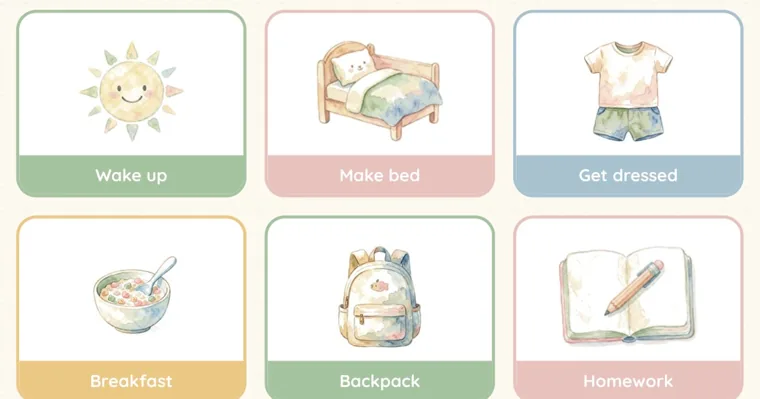
A morning routine for kids is the same short list of steps, in the same order, between waking up and walking out the door. On a school day most families need five or six: get up and use the bathroom, get dressed, eat breakfast, brush teeth, then shoes, coat and backpack. Set the wake-up time by counting back from when you have to leave, and plan on 45 to 60 minutes for a child in the early grades.
The rest of this guide fills in the numbers. It covers the sleep that has to fit before that alarm, how long each step tends to take, what a 4-year-old can do alone compared with a 10-year-old, which jobs move to the night before, and the fixes for a child who stalls in pajamas or a shoe that has gone missing. Those minute counts are our planning numbers, so check them against a week of real mornings.
How early to wake kids up for school
Start from the time you leave the house, because that’s the one fixed point. Take off the length of your routine and you have the wake-up time. Then check it against sleep, since the alarm only works if bedtime leaves enough hours before it.
The hour ranges come from the 2016 consensus recommendations of the American Academy of Sleep Medicine, which the American Academy of Pediatrics backs on its HealthyChildren.org site. Each range is total sleep across a whole day, so a preschooler who still naps gets to count that nap.
| Age | AASM recommendation per 24 hours | Example routine length | Leave at 7:30 a.m., wake at |
|---|---|---|---|
| 3 to 5 years | 10 to 13 hours, naps included | 60 minutes | 6:30 a.m. |
| 6 to 12 years | 9 to 12 hours | 50 minutes | 6:40 a.m. |
| 13 to 18 years | 8 to 10 hours | 40 minutes | 6:50 a.m. |
The last two columns are one example, not a target. If the wake-up time leaves fewer hours than the bottom of the range, move bedtime earlier rather than squeezing the morning. Our bedtime routine for kids guide works the same numbers from the other end, from wake-up time back to lights-out.
On the same page, the AAP advises one waking time for weekdays and weekends alike. A child who sleeps two hours later on Saturday and Sunday meets Monday’s alarm at what feels like the middle of the night, so keep weekend mornings within reach of the school-day time.
The steps of a school morning routine and how long each takes
Keep the order fixed, even on days when one step changes. A child who knows that breakfast always comes after getting dressed has less to negotiate about. Our minute counts assume a 6- to 8-year-old who needs a reminder or two. A preschooler needs more time, and a 10-year-old less.
| Step | Minutes | What usually slows it down |
|---|---|---|
| Wake up, use the bathroom, wash hands and face | 5 to 10 | Lying in bed after the alarm |
| Get dressed | 5 to 10 | Choosing clothes, arguing about the weather |
| Breakfast | 15 to 20 | A screen at the table, waiting for food |
| Brush teeth and hair | 5 | Being left until shoes are already on |
| Shoes, coat and backpack | 5 | A missing shoe, a form nobody signed |
| Spare time before leaving | 5 to 10 | Nothing, this is the time that absorbs a spilled bowl |
That adds up to 40 to 60 minutes. Mornings with a shower, a packed lunch made from scratch or a younger sibling to dress need more.
Get dressed before breakfast
We’d put getting dressed before the table. Once a child sits down to eat in pajamas, dressing becomes the step that happens while everyone else is putting shoes on. A dish towel over the lap handles drips on school clothes. If making the bed is on your list, it fits between the bathroom and getting dressed, and for a young child pulling the blanket up is enough.
Teeth before or after breakfast
Families do this both ways, and either works if it stays the same every day. Brushing straight after breakfast keeps the sink step in one place; brushing first gets it done before the rush. Printed charts don’t always match your choice. Both of our routine chart sets print Brush teeth before Eat breakfast on the Daily Routine page, so if you brush afterward, check the circles out of order or tell your child that page reads differently.
Keep ten minutes spare
A routine timed to the minute falls apart the first time someone spills milk. The spare minutes at the end are for exactly that. On mornings when nothing goes wrong, they become free time before the door, for drawing, a book or a game, which also gives a dawdler a reason to finish. If you use a TV show as the reward for being ready, switch it on only once shoes and backpack are by the door.
A morning routine by age: preschool, early grades and older kids
The steps barely change between 4 and 12. What changes is how many of them the child does alone and how the list is shown.
Preschoolers, ages 3 to 5
Four or five picture steps are enough. Your child can use the toilet, wash hands, pick between two outfits you’ve laid out and pull on pants and a top, while you handle breakfast, hair, buttons and most of the shoe work. Allow a full hour.
A 4-year-old doesn’t read a clock, so “five more minutes” means nothing. A kitchen timer they can watch, or a song that ends when breakfast is over, does the job of a clock. For coats, the flip method lets small children do it alone: lay the coat on the floor, hood toward the child’s feet, push both arms into the sleeves and flip it over the head.
Ages 6 to 8
Most children this age can do every step themselves with a nudge. The reminders move from your voice to the wall, with a picture and a word for each step, so you can point at the chart instead of repeating the list. Let them pour their own cereal and clear their bowl. Practice new skills such as tying laces on a weekend afternoon, not at 7:25 on a Tuesday.
Ages 9 to 12
An older child can run the routine on their own: an alarm clock of their own, a written list if they still want one, a bag packed the night before and a simple breakfast they make themselves. Your job shrinks to one check at the door for lunch, homework and the right shoes. Showers are the usual time sink at this age. A morning shower adds 10 to 15 minutes, so if mornings are tight, move it to the evening.
Two or more children and one bathroom
Stagger the wake-ups by 10 minutes and give the bathroom a fixed order, so nobody bangs on the door. Each child gets a separate chart. A shared one turns into an argument about who checked off whose step.
What to do the night before
Anything that doesn’t depend on the morning can move to the evening, and every job you move takes a decision out of the rushed half hour.
- Clothes: the whole outfit, socks included, checked against tomorrow’s forecast.
- Backpack: homework, library books and signed forms inside, bag by the door.
- Shoes and coat: in one fixed spot, a basket or a hook by the door.
- Food: lunch made or at least decided, breakfast decided.
- Special days: gym clothes, an instrument or show-and-tell on the right day, written on a calendar the child can see.
Do these before the bedtime routine starts, not after lights-out, when nobody wants to hunt for a permission slip. If you want a night-before list for yourself too, the parents’ version sits in morning routine ideas.
Turning the morning routine into a picture chart
A chart lets a child see what comes next without asking, and it lets you point instead of talking. A child who can’t read yet simply follows the pictures.
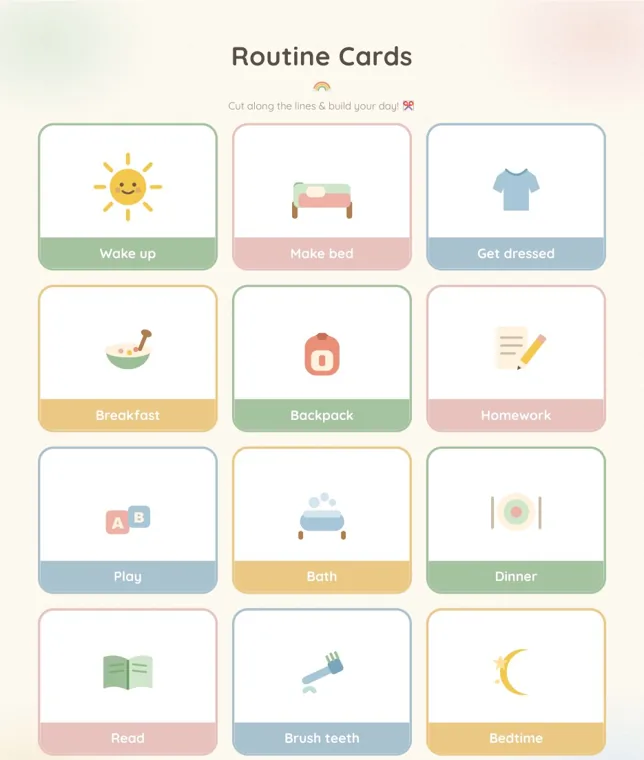
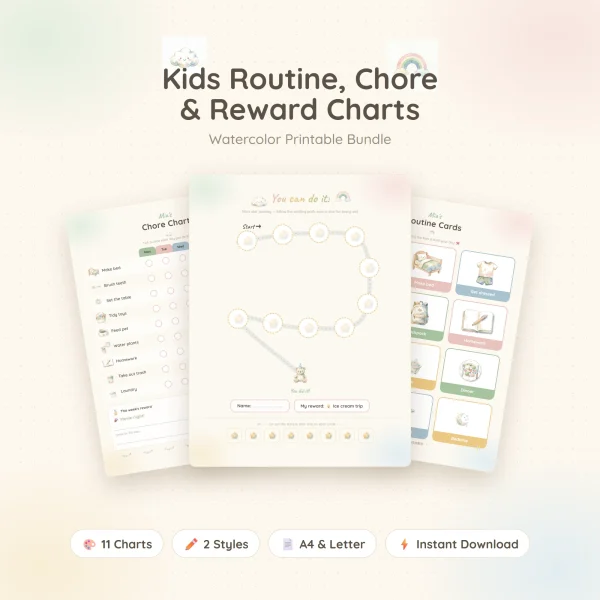
The picture visual schedule set we sell includes a page of 12 routine cards with colored frames, cut along the solid lines. Half of them fit a school morning: the sun for Wake up, the bed, the T-shirt for Get dressed, the cereal bowl, the toothbrush and the backpack. Put them in your own order on a strip by the bathroom or the front door. For where to hang the strip and how a child marks a step done, see visual schedule for kids.
The page has no card for the bathroom, washing up, shoes or a coat. Draw those on index cards cut to the same size, so the strip reads as one set.
If you’d rather tick a page than move cards, the Daily Routine page works as a single-sheet checklist. In the watercolor routine and reward charts it starts with a Morning row of four tiles, each with a circle to check.
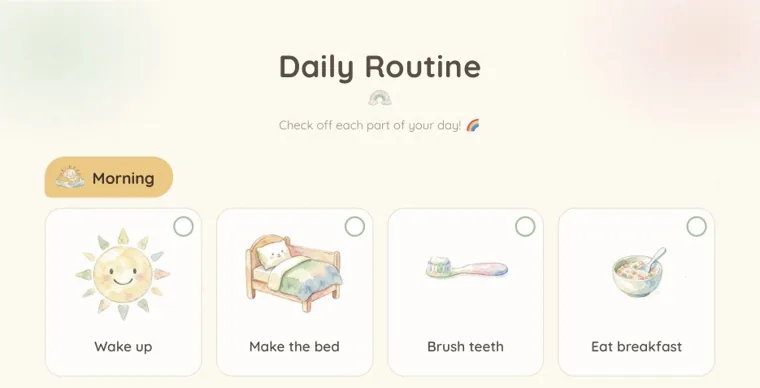
Those four tiles are Wake up, Make the bed, Brush teeth and Eat breakfast. Get dressed isn’t there, and neither are shoes or the backpack; the only backpack tile is Unpack backpack, under Afternoon. Write the missing morning steps in the margin beside the row before you laminate the page or slide it into a sheet protector.
When the morning stalls
Most stuck mornings come down to a handful of problems, and each has a fix you can set up ahead of time.
Dawdling at every step
Swap repeated reminders for one signal the child can see or hear. A timer on the counter works, or a short playlist where each song is one step, dressed by the end of the second song. Comment on the step that got done rather than the ones still waiting. If you end up dressing a 7-year-old every time they stall, stalling becomes the way to get help, so step back to pointing at the chart.
Arguments over clothes
Settle the outfit the night before, from two choices that suit the weather. In the morning the decision is already made, and the argument has nothing to attach to. If a child changes their mind every day, the rule is simple: whatever was laid out is what gets worn.
The missing shoe
Give shoes one home, by the door, and put them there when the child comes in after school, not when you’re leaving the next morning. The same goes for the backpack and coat. The spare ten minutes at the end of the routine are what saves you on the morning one still disappears.
A child who won’t get out of bed
First check the wake-up time against the sleep table above. If bedtime leaves fewer hours than the range, the fix is in the evening, not the morning. The AAP suggests exposing children to bright light when it’s time to get up, so open the curtains and turn on the lights. A five-minute warning before the real wake-up helps a slow riser too.
Mornings that only go wrong on school days
If the routine runs fine on Saturdays and falls apart every weekday, the problem may be about school rather than the steps. Ask your child about it at a calm time, after school or at bedtime, and talk to the teacher if it keeps up.
Rewarding a smooth morning
A reward chart can help for the first few weeks of a new routine, as long as it counts one thing the child controls. “Ready by 7:25 with shoes on” can be counted. “A good morning” can’t.
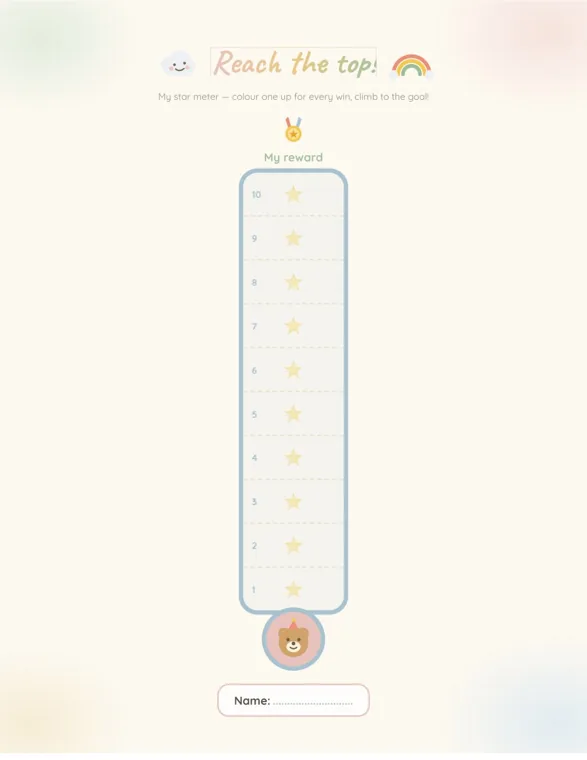
On the picture set’s star meter, ten numbered boxes climb from 1 to 10 under a My reward label, with a Name line at the bottom; the watercolor set has the same chart. At one box per school morning, ten boxes are two weeks. Keep the reward chart separate from the routine chart, so the steps don’t turn into things a child does only for stars. To pick the reward and plan when the chart comes down, read how to use a behavior chart first.
Getting the morning routine back after winter break
Two weeks of late mornings move a child’s wake-up time, and the first school day pays for it. Start four or five days before school.
Move the wake-up time earlier in steps
Set the alarm 15 minutes earlier each day, or every other day, until it reaches the school-day time. Bedtime has to move with it, and our bedtime guide covers that side.
Do a full rehearsal the day before school
On the last day of the break, run the whole morning at the real times: alarm, dressed, breakfast, teeth, shoes and out the door to the car or the bus stop. Anything that’s gone missing over the holidays, a lunch box, a winter hat or a library book, turns up the day before rather than at 7:25.
Give the first week extra slack
Add ten minutes to the spare time for the first week back, and lay out everything the night before, even for older kids who usually manage alone. If a new activity changes some mornings, such as an early club or a different drop-off, update the cards or the chart now so the routine on the wall matches the one you actually run.
Printables from this article

Related articles
Reward & Chore Charts
Bedtime Routine for Kids: Steps, Times and a Chart by Age
How to set a bedtime from your child's wake-up time, which steps go in the routine and how long each takes, how it changes from toddlers to age 12, and how to get back on track after the holidays.
Reward & Chore Charts
Age Appropriate Chores: Chores for Kids by Age, 2 to Teens
Chores for kids by age, from toddlers carrying napkins to teens clearing snow, with how to teach each job, how to check it, and what to do when it comes back half done.
Reward & Chore Charts
How to Use a Behavior Chart: Reward System for Kids by Age
A step-by-step plan for setting up a behavior chart at home, from picking one to three goals and wording them for your child to choosing rewards and phasing the chart out.