Potty Training Tips: When to Start and How to Use a Chart
Start potty training when your child shows the readiness signs, not on a particular birthday. According to the American Academy of Pediatrics (AAP), children generally show signs of bladder and bowel control between 18 and 24 months, the average age to begin in the United States is between 2 and 3, and most children are trained by 4. Once you start, the tips that matter most are simple: a potty chair in the same place every day, regular sits at the same times, calm words for accidents, and nights left for later.
This guide follows that order. It covers the readiness signs, what to set up before the first day, how the first few days usually go, how to use a sticker chart without turning it into a bribe, nighttime, outings and child care, and the setbacks that come after a good start. Anything about pain, constipation, infection or a sudden change belongs with your child’s pediatrician, and the last section lists those.
Signs your child is ready to start potty training
Readiness is about what your child can do, so watch for the signs before you pick a start date. The AAP lists these signs that a child may be developmentally ready:
- stays dry for at least 2 hours at a time during the day, or wakes up dry from naps
- shows signs of a coming pee or poop, like grunting, freezing or squatting
- can follow simple instructions
- can walk to and from the bathroom and help undress
- dislikes wet diapers and wants to be changed
- asks to use the toilet or potty chair
- asks to wear “big-kid” underwear
A child doesn’t need every sign on the list. Two things do have to be in place, though: your child has to notice the body’s signal, and has to be able to get pants down and back up. A child who can’t yet do the second part will have accidents however good the routine is.
When to wait a little longer
Some weeks are a poor time to begin even if your child is ready. The AAP suggests delaying when the family has just moved or is about to, when a baby is expected or has just arrived, or during a major illness, a death or another family crisis. Starting a new child-care program belongs on the same list, since the AAP names a change in child care as a common reason trained children slip back.
When to start potty training: the ages most children train
Most children in the U.S. start between 2 and 3 years old, and most are trained by 4. Toilet training often comes up at the 18-month, 2-year, 2½-year and 3-year well-child visits, so those checkups are a good time to ask your pediatrician about your own child.
Two things about timing surprise many parents. Skills arrive unevenly: a child may pee in the potty easily and take several more months to poop there. Day and night are also separate. Staying dry during the day comes first, and staying dry at night often comes months or even years later. Plan for daytime training first and treat nights as a different project.
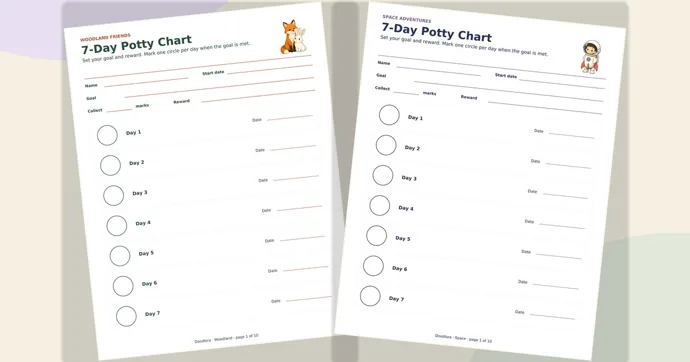
Pick a start date in a calm stretch with no trips or visitors, and plan the first week around home. A one-week potty training chart with a single daily goal, like a sit right after waking up, gives that first week a clear finish line; the chart section below explains how to set it up.
Getting ready before the first day
A little setup the week before makes the first days much calmer. Here is what to have in place:
- A potty chair. It’s a child-sized seat with a removable bowl underneath. Your child’s feet should reach the floor. Keep it in the same spot every day.
- A step stool for the big toilet, for later. Most children tell you when they want to move up from the potty chair, and a stool lets them brace their feet.
- Underwear. The AAP suggests switching to big-kid underwear once training starts. Some parents use cloth training pants, which are thicker and protect clothes a little better.
- Your family’s words. Pick the words you’ll use for body parts, pee and poop, and avoid negative ones like dirty, naughty or stinky.
- A book or two about using the potty, read in the days before you start.
- Spare clothes and a small cleanup kit near the potty for the first week.
Let your child see you use the toilet and wash your hands afterward. Seeing the whole routine done by someone else makes it far less strange.
A picture of each step
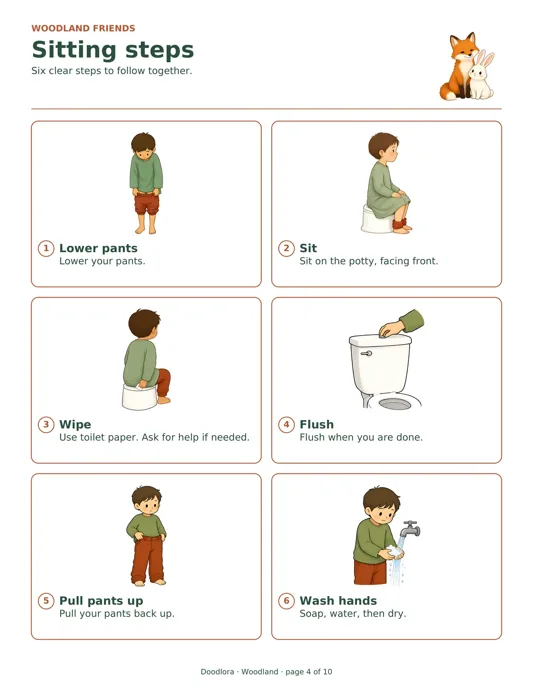
Toddlers can’t read a list of steps, but they can follow pictures. Our potty training chart set includes a sitting steps poster and a standing steps poster, each with six numbered pictures and one short line under each. The sitting order is lower pants, sit facing front, wipe, flush, pull pants up, then wash hands with soap and water. Tape it low on the wall beside the potty, where a seated toddler can see it, not up near the mirror.
Tell every caregiver the same plan
Grandparents, a sitter and the child-care room should all use the same words, the same times and the same reaction to accidents. The AAP stresses consistency across caregivers, and a child who gets a different routine in each place has to relearn it every time. A short note with your family’s words and your sit times saves a lot of confusion.
How to potty train: the first few days
The first days are about building a routine and noticing signals, not about a perfect record. Expect accidents, keep your voice calm, and let your child do as much of the work as possible.
Sit at the same times every day
Seat your child on the potty first thing in the morning, every morning. Add sits after meals and before bed, since those are times many children need to go. Keep each sit short and relaxed, with a book if that helps. If nothing happens, that’s fine. Pants go back up and you try again at the next usual time.
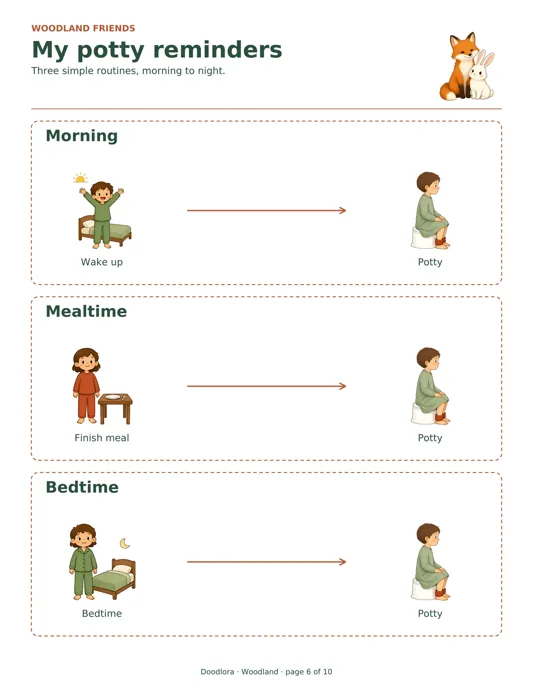
Our potty chart set has a reminders page with three strips, wake up then potty, finish meal then potty, and bedtime then potty. An adult cuts the strips apart, and you can tape each one where that moment happens: by the bed, by the table, by the bathroom door.
Learn your child’s signals
Most children show a poop is coming by grunting, squatting or going still, and some turn red in the face. When you see it, say briefly that this means a poop is on the way, and head to the potty together. If your child tells you about a wet diaper or wet pants, praise them for using their words. The AAP notes that children often take longer to notice the need to pee than the need to poop, so pee accidents tend to last longer.
Let your child take charge
The AAP describes training as your child taking over their own toileting, and suggests handing over as much of it as you can. Let your child pull pants down and up, choose the book and flush. Flushing matters more than it seems. Some children are afraid the toilet will flush part of them away, or pull them in, and doing the flushing themselves gives them control. If your child is scared, let them flush after they’ve climbed off.
Teach wiping and handwashing from the start
Show girls how to spread their legs and wipe from front to back, which keeps germs from the bottom away from the vagina and bladder. Boys can start by sitting to pee and stand once they’re better at it; the standing steps poster in our set swaps “sit” for “face the toilet” and makes wiping “if needed”. Every visit ends with handwashing, for boys and girls alike.
When accidents happen
Accidents are part of learning, so react to them the same calm way each time. Say what happened in plain words, remind your child that pee and poop go in the potty, and have them help with the cleanup. The AAP describes helping clean up as a predictable, non-punishing consequence. Avoid scolding and punishment. The AAP notes that power struggles, begging and punishing all keep children from taking charge of their own toileting.
Daytime accidents can go on for months after training looks finished, even at 3 or 4, and usually taper off by about six months after training. Accidents that are frequent at age 3 and aren’t getting fewer are worth raising with your pediatrician.
How to use a sticker chart for potty training
A chart can help a toddler see progress, but use it with care. The AAP’s own advice leans two ways. One page suggests a hug, praise and perhaps a small tangible reward when a child makes progress, and lists stickers on a chart as a way to support a child who has slipped back. Another warns that treats and punishments distract children from the real goal, which is mastering the skill. A chart that works sits between the two: it records what your child did, the sticker itself is most of the reward, and your specific praise (“You felt it coming and told me!”) does the rest.
Chart the try, not the result
Put on the chart a step your child controls, and move to the next one only when it’s routine:
- Sat on the potty after waking up.
- Peed in the potty.
- Told you before going.
- Pulled pants down and up without help.
- Washed hands after.
Keep dry nights off the chart. Night dryness depends on the bladder maturing, not on effort, so a chart for it would mostly record misses your child can’t help.
Choosing how many spaces
Charts come in two shapes, and each fits a different goal. A day chart gives one mark for any day the goal is met. A count chart gives one sticker for every success, so it fills faster.
| What you’re tracking | Chart that fits | Why |
|---|---|---|
| Morning sit, every day for a week | 7-day potty chart | One circle per day, finished in a week |
| A habit that’s still shaky | 14-day or 30-day potty chart | A longer span, with days that don’t count left empty |
| Every pee in the potty | 10-space sticker chart | Fills in a day or two, so the end stays in sight |
| Telling you before going | 20-space sticker chart | For a child who already manages the first steps |
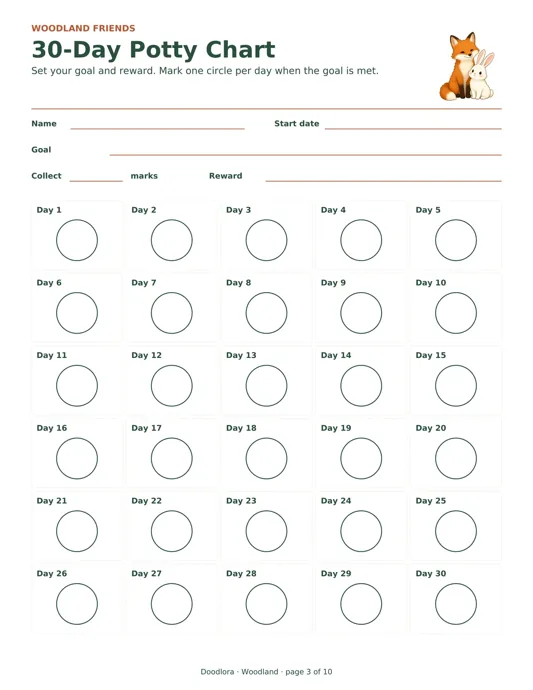
Start with a short chart, so the reward stays in sight for a toddler. The 7-day, 14-day and 30-day pages are in our potty training chart set. Each has lines for name, start date, goal, the number of marks to collect and the reward, with one circle per day. The grown-up guide in that set calls the days “just a span, not a deadline”, so a day without a mark is simply left blank.
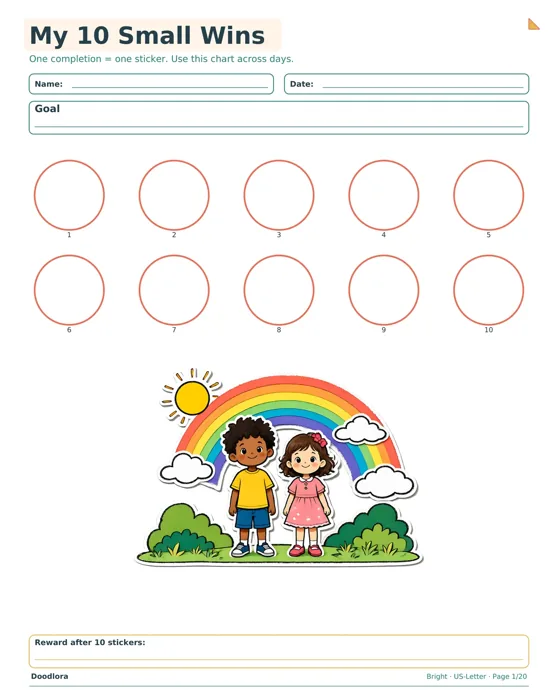
For counting every success, the sticker chart set has charts with 10, 20 or 30 one-inch circles, one sticker per completion. The 10-space My 10 Small Wins page is the one to start a toddler on.
Stickers and rewards
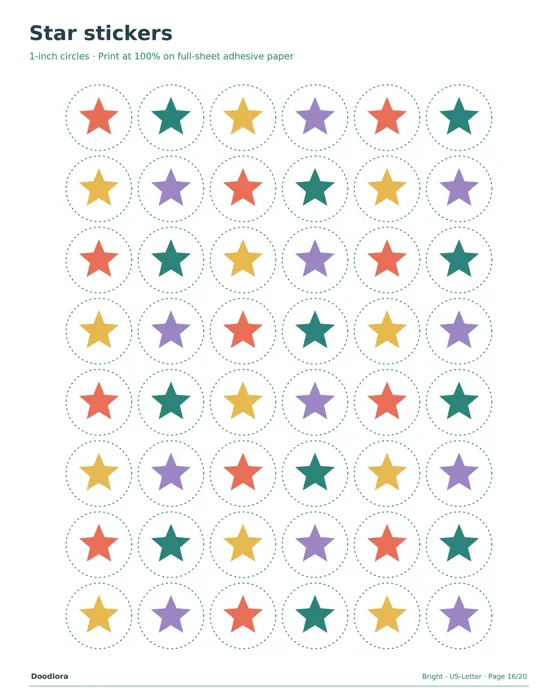
The potty chart pages don’t come with stickers, so mark the circles with a crayon, a stamp or stickers you already have. The sticker chart set includes three sheets of 48 one-inch circles each (stars, smiley faces and a mix of both). Print them at 100% on full-sheet adhesive paper, not precut labels, and have an adult cut them out. A toddler choosing which star goes on is half the fun.
Keep the reward at the end of the chart small and not food: a book, a song, bubbles, building blocks or drawing together. Those are the six pictures on the reward menu page in our potty chart set, plus a blank box for your own idea. Agree on the reward before you start and write it on the chart, so your child knows what the row of circles leads to.
Once the step is routine, retire the chart instead of raising the price. Phasing a potty chart out works the same way as with any reward chart, and the last step of how to use a behavior chart walks through it.
Nighttime and naps
Leave nights alone until days are going well. Bladder control at night usually comes much later than in the daytime, often months or even years after daytime training is done. The AAP notes that 40% of children in the U.S. still wet the bed after they’re fully trained during the day, that bedwetting stays common through age 5, and that it usually doesn’t need medical treatment until age 8 to 10. Many children under 6 simply aren’t able to stay dry at night yet.
For most toddlers and preschoolers, the AAP suggests downplaying night training:
- Keep your child in training pants or a diaper at night for as long as they’re comfortable in them.
- Put a waterproof cover under the sheet to protect the mattress.
- Make a potty sit part of the bedtime routine, together with pajamas and before the story, as in our bedtime routine for kids.
- Respond calmly to a wet night. Don’t blame your child, and set a no-teasing rule for siblings.
- If your child is waking up and using the potty at night on their own, let them.
Children who have been dry at night for a while often have wet nights again during training. The AAP’s advice is to go back to training pants at night and try again later. If your child has been fully trained for six months or more and suddenly starts wetting the bed, talk with your pediatrician.
Outings, travel and child care
Being away from home is where the routine is easiest to lose. A few habits help:
- Have your child try the potty before you leave, and again when you arrive somewhere new.
- Pack a change of clothes, a bag for wet ones and wipes. Accidents on outings are normal in the early weeks.
- Show your child the bathroom in each new place. If an automatic flush scares your toddler, cover the sensor with a sticky note until they’re off the seat.
- Keep the same words and the same calm reaction you use at home.
Watch for holding. The AAP notes that some children, older ones especially, hold back their poop away from home because they dislike public toilets, and holding back is a common cause of constipation. If your child goes days without pooping, or poops are hard or painful, call your pediatrician rather than pushing harder on training.
For child care and preschool, talk with the caregivers before your child starts going in underwear. Ask how they handle bathroom times, tell them your child’s words for pee and poop, and agree on what happens after an accident. A copy of the steps poster or the reminder strips can go with your child, so the pictures are the same in both places. Keep the sticker chart at home, where you can see it every day.
A child who copes better with pictures may need more than the bathroom steps: a visual schedule for kids lays out the whole morning, potty included, as a row of cards.
When potty training goes backward
Regression is common and usually short. A child who had been doing well suddenly has lots of accidents, stops using the potty or asks for diapers again. The AAP’s first step is to have the pediatrician check that the cause isn’t physical, because regression sometimes signals an infection, constipation or another problem that needs treatment.
Once physical causes are ruled out, look for a change in your child’s life. The AAP lists these common causes:
- a new sitter, or starting child care or preschool
- a pregnancy or a new baby in the family
- a serious illness in the child or someone in the family
- a death
- parents’ conflict or divorce
- a recent or upcoming move
Then work through it. Tell your child you’ve noticed the change and ask about it in simple words. Fix what you can: time alone with you away from a new baby, a talk with the child-care staff, familiar things around the potty in a new home. Keep the potty easy to reach, sit your child on it at the usual times, and support them with hugs, praise and stickers on a chart.
Most regressions pass in a few days or weeks. If one lasts a month or more, the AAP suggests asking whether your child was really ready for full daytime training. Putting the potty away for a while is fine if it’s a clear relief to your child.
When to call your child’s pediatrician
Some problems need a doctor, not a new tactic. Call your child’s pediatrician if you notice:
- pain, burning or straining when your child pees
- cloudy or pink pee, or blood on the underwear or toilet paper
- hard, dry or painful poops, or days of holding back
- frequent daytime accidents at age 3 or older that aren’t getting fewer
- bedwetting that starts suddenly after six months or more of being fully trained
- a regression with no clear reason
- any other worry before, during or after training
The AAP’s advice is to talk with your child’s doctor whenever a concern comes up. Often it’s minor and quickly sorted out, and if your child needs other care, the pediatrician can refer you.
Printable potty charts and sticker charts
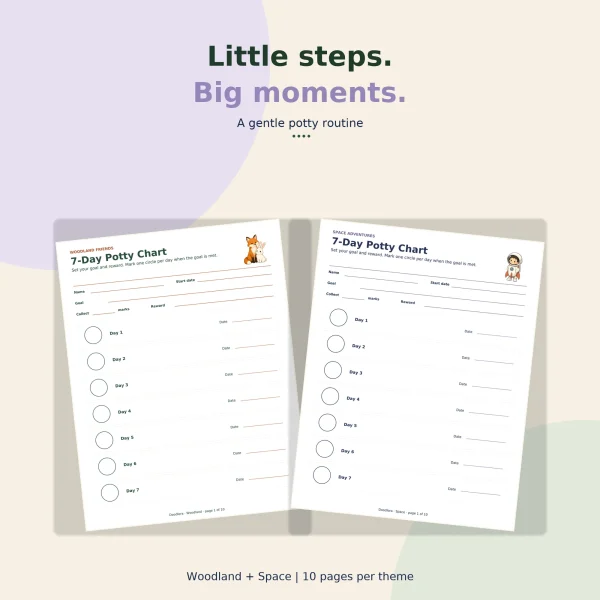
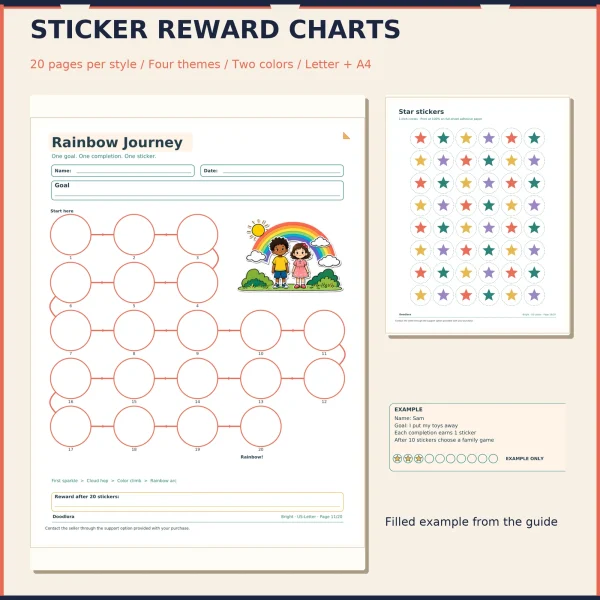
Our two printable sets cover the pieces above. The potty training chart set comes in two themes, Woodland Friends with a fox and a rabbit and Space with a small astronaut, and each theme has the same ten pages: 7-day, 14-day and 30-day charts, the sitting and standing steps posters, the reminders page, a First / Then board, a reward menu, an I Did It! certificate and a one-page grown-up guide. The sticker chart set has 20 pages, with 10, 20 and 30-space charts, four 20-space picture trails, weekly job charts, a reward menu and the three sticker sheets.
Both sets print on US Letter or A4. The PDFs can’t be typed into, so write names and goals by hand, or open the Canva template link included with each set to add them before printing. You’ll find both sets, along with other reward charts, in our reward charts shop.
Printables from this article
Related articles
Reward & Chore Charts
Morning Routine for Kids: School-Day Steps and Times by Age
How to set a wake-up time from the time you leave, which steps a school morning needs and how long each takes, how it changes from preschool to age 12, and fixes for the usual hold-ups.
Reward & Chore Charts
Bedtime Routine for Kids: Steps, Times and a Chart by Age
How to set a bedtime from your child's wake-up time, which steps go in the routine and how long each takes, how it changes from toddlers to age 12, and how to get back on track after the holidays.
Reward & Chore Charts
Age Appropriate Chores: Chores for Kids by Age, 2 to Teens
Chores for kids by age, from toddlers carrying napkins to teens clearing snow, with how to teach each job, how to check it, and what to do when it comes back half done.