 1 / 6
See and Write Chinese Vocabulary Workbook
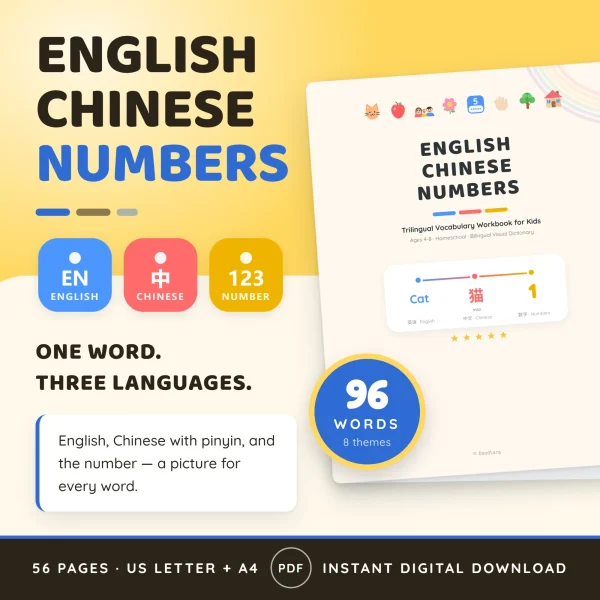
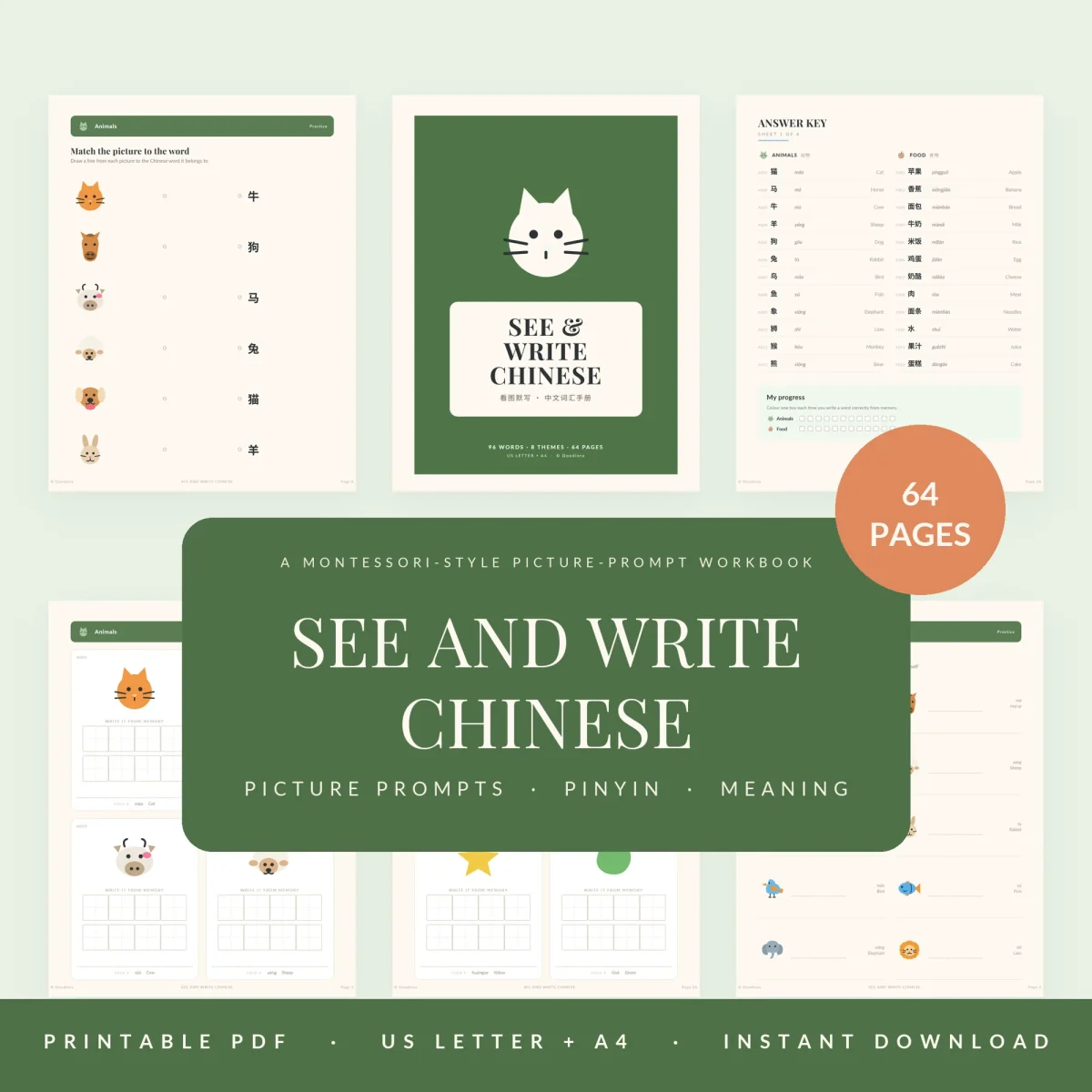
Ninety-six everyday words in simplified Chinese, from 猫 cat to 手机 phone, each prompted by a picture instead of a printed character. The learner writes the word from memory, then folds the card to check the pinyin and English.
$4.99
Buy any 3 or more printables and save 20% at checkout.
- Download right after payment — link works for 30 days, up to 5 downloads
- Files arrive as a ZIP with your license PDF inside
- Secure checkout by Stripe · Refund policy
See and Write Chinese is a vocabulary workbook built around recall. The Chinese characters are not printed on the practice cards at all. Each card shows a picture, two rows of four writing boxes with dashed center guides, and a dashed fold line at the bottom. The pinyin and the English meaning sit below that line, so the answer stays hidden until the word has been written.
Eight themes, seven pages each
The 96 words are split into animals, food, family, colors, numbers, body, nature and everyday things, 12 words in each. A theme opens with a title page, then three pages of cards, four words to a page.
Three practice pages follow. The matching page has six pictures and six Chinese words to join with a line. The fill-in page shows a picture with only its pinyin and English, and the child writes the characters on the line. The review page lists all 12 words as a checklist, gives four larger boxes with diagonal guides for the characters that gave the most trouble, and leaves a few lines for using one of the words in a sentence.
The words themselves
Most are the words a child meets first: numbers from zero to ten plus 百 for hundred, twelve colors in their full 红色 form, family words like 妈妈 and 爷爷, and body words like 头 and 牙齿. 53 of the 96 are two-character words, and a word like 苹果 píngguǒ fits twice in each row of four boxes. The pictures are flat and simple, a red circle for 红色 and a small house for 房子, so the attention stays on remembering the word.
Who it suits
Since nothing on the cards can be traced, the book works best once a learner has already met these words, in class, from flashcards or at home, and needs to practice pulling them back out of memory. The study guide suggests 10 to 15 words a day, the same set again the next day, and once more a week later. A child meeting characters for the first time will get more from a tracing book first.
Printing
Print at 100% or Actual Size so the boxes stay square. Printing single-sided keeps the answer key at the back out of view while a child works. Plain copy paper is fine for pencil.
Questions
- Simplified or traditional characters?
- Simplified. Every word in the book, including the answer key, is in simplified characters.
- Is pinyin included?
- Yes, with tone marks. It sits under the fold line on every card, next to each picture on the fill-in pages, and beside every word in the answer key.