History Trivia Questions and Answers, From Easy to Hard
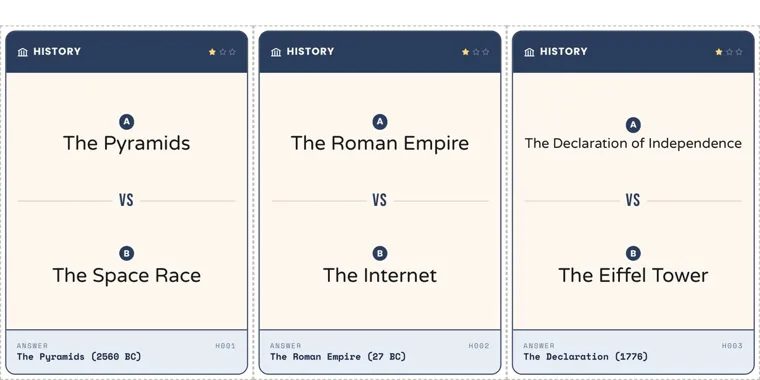
These 61 history trivia questions come with their answers and are sorted into rounds, so you can pick the ones that suit whoever’s at the table. You’ll find an easy round for kids, three rounds of American history from Jamestown to the Montgomery bus boycott, world history, a Christmas and New Year’s round, a hard round, and five true-or-false myths. Each date and name in the answers matches Wikipedia’s entry for that event.
The question most likely to start an argument is one everybody thinks they know. Congress adopted the Declaration of Independence on July 4, 1776, but most of the delegates signed it on August 2. Myths like that one get their own round at the end. First comes a plan for Thanksgiving, Christmas Eve or New Year’s Eve, with scoring rules for dates and a tie-break that fits a history quiz.
How to run a history trivia game at a holiday gathering
A history quiz needs one host who reads and keeps score, plus at least two players. Pick the rounds by who’s coming, because a table of grandparents who studied Pearl Harbor in school and a table of ten-year-olds who just learned about Jamestown want very different questions, and the wrong round loses half the room fast. Treat the player counts and times below as starting points, then adjust after the first round.
| Gathering | Players | Rounds to use | About how long | Format |
|---|---|---|---|---|
| Thanksgiving, after the meal | 6 to 14, mixed ages | Easy round, one American era, myths | 30 to 40 minutes | Teams of 3 or 4, one answer sheet each |
| Christmas Eve or a visit with grandparents | 4 to 8 | Christmas round, then one era each generation picks | 20 to 30 minutes | Everyone answers out loud |
| New Year’s Eve with adults | 6 to 12 | American eras, world history, hard round | 45 to 60 minutes | Pairs, written answers, final wager before midnight |
| A kids’ table, ages about 8 to 12 | 2 to 6 | Easy round as multiple choice | 10 to 15 minutes | One adult reads, kids answer |
Older relatives often know the 20th century best, since they lived through part of it. If they’re the core of your group, our trivia for seniors list sorts 36 questions by decade, from Disneyland and Sputnik through the 1970s, and they make a strong second half.
Let the trailing team pick the next era
After each round, the team in last place chooses which section comes next. That keeps the score close, because a team that’s behind will usually pick the era it knows best, and it also settles the usual fight between the Civil War buff who wants the hard questions and the kid who only wants the easy ones.
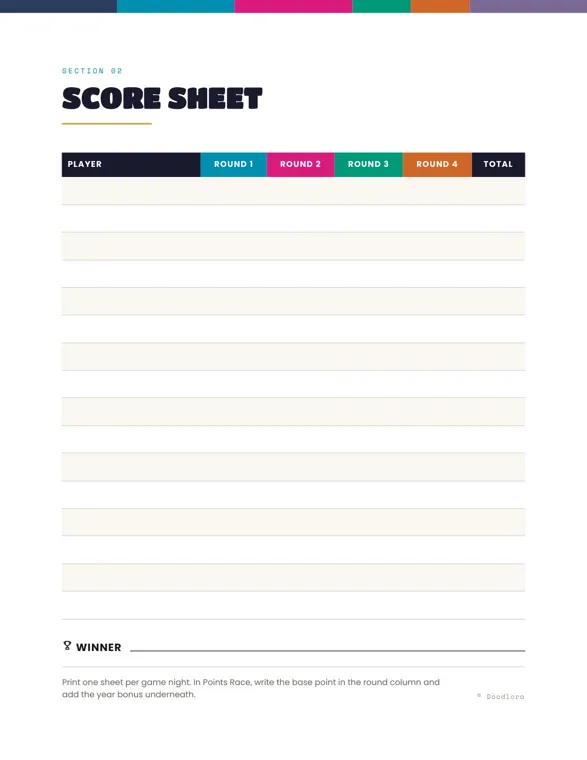
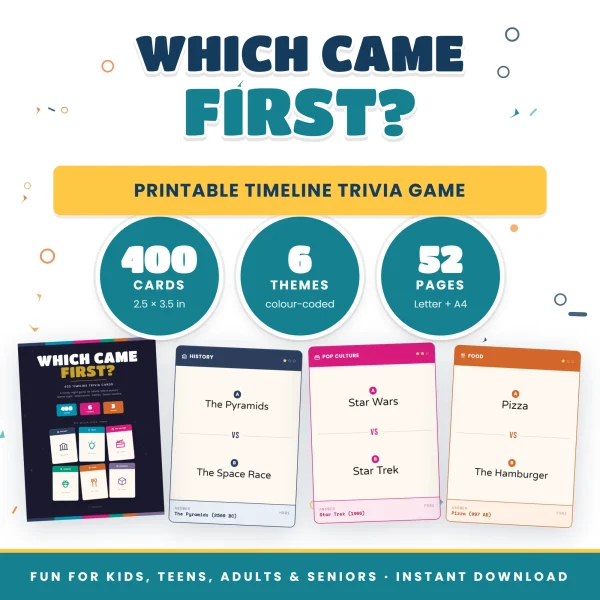
Four rounds suit most evenings. That’s also how many round columns fit on the score sheet in our timeline trivia cards, so one printed page covers the whole night.
Scoring dates, names and spelling
Give one point for each right answer, and decide the house rules for dates before the first question. Dates cause most of the disputes in a history quiz. Our suggestion: two points for the exact year, one point if a written answer lands within ten years. For names, a last name is enough and spelling doesn’t count, so “Gutenburg” still scores.
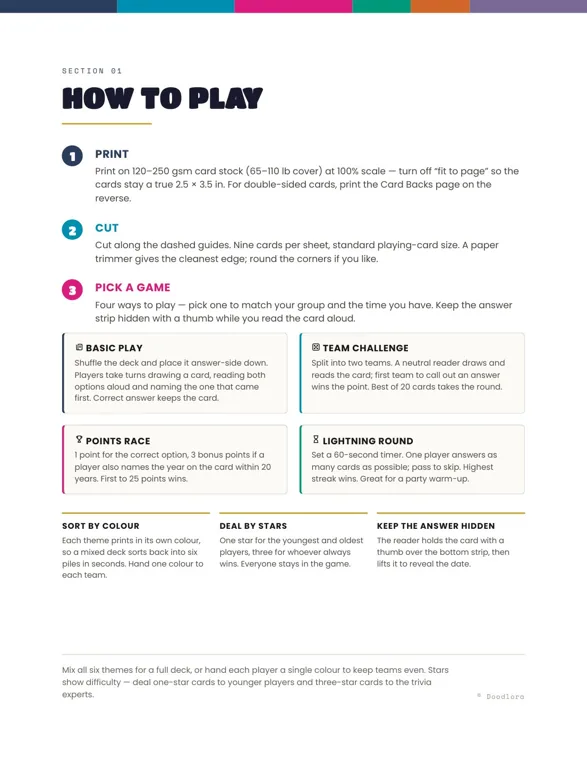
The Points Race game in our Which Came First? timeline trivia cards uses a looser version of that rule. A player earns 1 point for picking the earlier event and 3 bonus points for naming its year within 20 years, and the first to 25 points wins. Those wide margins suit kids and anyone who’s rusty on dates.
The final wager and tie-breaks
Before the last question of the night, each team writes down how many of its points it wants to bet. A right answer adds the bet, and a wrong one takes it away. Use a hard-round question for this, read it once, slowly, and give every team 30 seconds to write its answer before anybody says a word, so nobody can copy a rival’s guess.
For a tie, read four events from the lists below and ask each team to write them in order, earliest first. Try Jamestown, the Boston Tea Party, the Louisiana Purchase and the California gold rush (1607, 1773, 1803, 1848). The team with the most events in the right place wins. If that’s still level, go to sudden death with the hard round, one question at a time.
Making history trivia work for kids
Turn any question into multiple choice by adding two wrong answers, and make one of them plainly silly for kids under 8. Kids’ answers can count double, which stops an adult on the team from taking over. Don’t make kids write, either, since saying the answer is faster. A real penny on the table makes question 6 easy to picture, and a dollar bill helps with Washington.
Battles and assassinations fill the later sections, so check them first if young children are playing. Apart from the Titanic, the easy round sticks to presidents, landmarks, famous documents and firsts.
Easy history trivia questions for kids
These ten suit kids of about 8 to 12 as written, and younger ones as multiple choice. They’re also a gentle warm-up for adults.
- Who was the first president of the United States? Answer: George Washington, who served from 1789 to 1797.
- Which document, adopted on July 4, 1776, announced that the 13 colonies were breaking away from Britain? Answer: The Declaration of Independence.
- Which country’s people gave the Statue of Liberty to the United States? Answer: France. The tablet on the statue calls it a gift from the people of the Republic of France.
- Which two brothers made the first powered airplane flight in 1903? Answer: Orville and Wilbur Wright, on December 17, 1903, at Kill Devil Hills, about four miles south of Kitty Hawk, North Carolina.
- Who was the first person to walk on the Moon? Answer: Neil Armstrong, commander of Apollo 11. He and Buzz Aldrin landed on July 20, 1969.
- Which president’s face is on the penny? Answer: Abraham Lincoln. He has been on the one-cent coin since 1909, the 100th anniversary of his birth.
- The ancient Egyptians built most of their pyramids as tombs for whom? Answer: Their pharaohs, and the pharaohs’ wives.
- Which famous ship sank on its very first voyage in April 1912 after hitting an iceberg? Answer: The Titanic, which went down on April 15, 1912, on its way from Southampton, England, to New York City.
- How many stars are on the American flag, and what do they stand for? Answer: 50 stars, one for each state.
- Name one of the four presidents carved into Mount Rushmore. Answer: George Washington, Thomas Jefferson, Theodore Roosevelt or Abraham Lincoln.
American history trivia questions
The three rounds below run in order, from the first English settlers to the 1950s. Each one is about the right length for a single round.
Colonies and the Revolution
- What was the first permanent English settlement in the Americas, founded in 1607? Answer: Jamestown, in the Colony of Virginia. Plymouth is the usual wrong guess, but it came 13 years later.
- In December 1773, colonists dumped chests of tea into which harbor to protest a British tax? Answer: Boston Harbor, on December 16, 1773, in the Boston Tea Party.
- Who wrote most of the Declaration of Independence? Answer: Thomas Jefferson. He wrote the draft between June 11 and June 28, 1776, and Congress edited it.
- The Battles of Lexington and Concord, on April 19, 1775, were the first major fighting of which war? Answer: The American Revolutionary War.
- Whose army spent the hard winter of 1777 to 1778 camped at Valley Forge, Pennsylvania? Answer: George Washington’s Continental Army, from December 19, 1777, to June 19, 1778.
- Which British general surrendered at Yorktown, Virginia, in October 1781? Answer: Charles Cornwallis. The surrender papers were signed on October 19, 1781.
- In which city did the Constitutional Convention meet in 1787? Answer: Philadelphia, at the Pennsylvania State House, now called Independence Hall.
- What’s the name for the first ten amendments to the Constitution? Answer: The Bill of Rights, ratified on December 15, 1791.
A growing country and the Civil War
- In 1803, the United States bought a huge territory west of the Mississippi from France. What do we call that deal? Answer: The Louisiana Purchase.
- Which two explorers led the Corps of Discovery west from Camp Dubois, Illinois, in May 1804? Answer: Meriwether Lewis and William Clark.
- Francis Scott Key wrote the words of which song after watching the British bombard Fort McHenry in 1814? Answer: “The Star-Spangled Banner,” which became the national anthem in 1931.
- Gold found at Sutter’s Mill in January 1848 set off which rush? Answer: The California gold rush. The find came on January 24, 1848, near Coloma on the American River.
- Which fort near Charleston, South Carolina, was bombarded in April 1861 at the start of the Civil War? Answer: Fort Sumter. The bombardment began on April 12, 1861.
- Which speech, given on November 19, 1863, begins “Four score and seven years ago”? Answer: Abraham Lincoln’s Gettysburg Address.
- Where in Virginia did Robert E. Lee surrender to Ulysses S. Grant on April 9, 1865? Answer: Appomattox Court House.
- Where was the golden spike tapped to finish the first transcontinental railroad on May 10, 1869? Answer: Promontory Summit, in what was then Utah Territory.
The 20th century
- The 19th Amendment, which took effect in August 1920, gave women what right? Answer: The right to vote. Tennessee became the 36th state to approve it, on August 18, 1920.
- What nickname was given to October 29, 1929, the worst day of the Wall Street crash? Answer: Black Tuesday. Some 16 million shares changed hands on the New York Stock Exchange that day.
- Which president is the only one to serve more than two terms? Answer: Franklin D. Roosevelt, who won four.
- Which naval base in Hawaii did Japan attack on December 7, 1941? Answer: Pearl Harbor, on the island of Oahu.
- What was the code name for the Allied invasion of Normandy that began on June 6, 1944? Answer: Operation Overlord. The landings on June 6 itself are better known as D-Day.
- In which city was Rosa Parks arrested in December 1955 for refusing to give up her bus seat? Answer: Montgomery, Alabama. Her arrest started the Montgomery bus boycott.
- Which amendment ended national Prohibition in December 1933? Answer: The 21st Amendment, ratified on December 5, 1933.
A printable which-came-first round to warm up the table
A spoken quiz needs a host with a list, but a deck of cards lets people play while dessert comes out. Our Which Came First? deck runs to 400 cards, and its History theme fills pages 6 to 14 of the PDF with 80 of them. Each card names two things, and players say which came first. The date sits in a strip at the bottom, so the reader keeps a thumb over it.
The quickest way to use it before a quiz is the Lightning Round from the rules page. Set a 60-second timer, let one player answer as many cards as possible, and allow passes. Hand out History cards only, and eight players can each take a turn in under ten minutes.
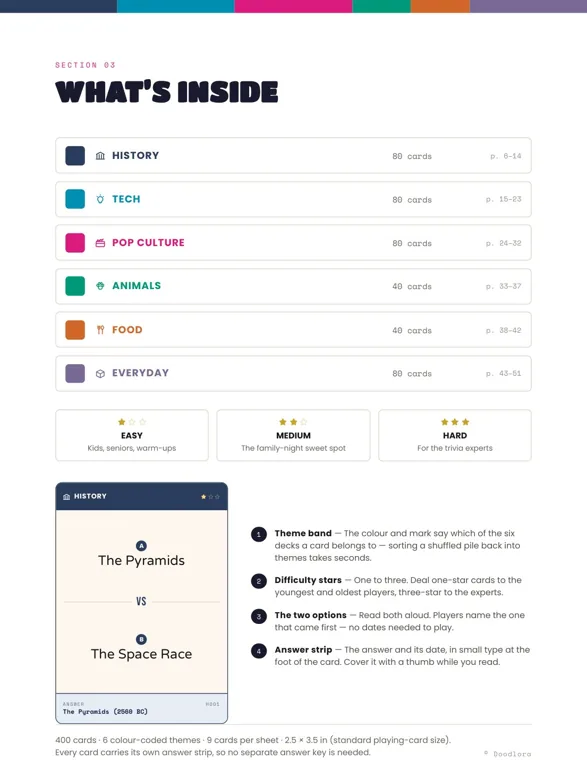
Know what’s in the History deck before you rely on it. Its first sheet is mostly wars, empires and landmarks, but from the second sheet on, inventions and firsts take over, like the telephone against the light bulb or the first X-ray against the first ultrasound. That makes it a partner for the American history rounds above, not a replacement.
A few “first” cards can start a debate of their own, such as the one that dates the first computer to 1946, so it’s worth saying up front that the year on the strip is the house answer for the night. The cards come out at 2.5 by 3.5 inches, standard playing-card size, only when you print at 100% scale.
World history trivia questions
World history works best after a round or two of American history, once the table has warmed up. The first five questions are ancient and medieval, and the next six run from Columbus to 1994.
Ancient and medieval world
- Which of the Seven Wonders of the Ancient World is still largely standing? Answer: The Great Pyramid of Giza, which is also the oldest of the seven.
- Which Roman leader was killed on the Ides of March, 44 BC? Answer: Julius Caesar, stabbed by a group of senators on March 15, 44 BC.
- Which English king put his seal on the Magna Carta at Runnymede in 1215? Answer: King John, on June 15, 1215.
- In 1206, a Mongol leader named Temüjin took a new title. What was it? Answer: Genghis Khan.
- Which German goldsmith invented the movable-type printing press around 1440? Answer: Johannes Gutenberg.
The modern world
- Christopher Columbus sailed west in 1492 for which two monarchs? Answer: Queen Isabella I and King Ferdinand II of Spain, known as the Catholic Monarchs.
- Which Paris fortress and prison did revolutionaries storm on July 14, 1789? Answer: The Bastille.
- Which French emperor was beaten at the Battle of Waterloo on June 18, 1815? Answer: Napoleon. Waterloo is in what is now Belgium.
- Whose assassination in Sarajevo on June 28, 1914, led to World War I? Answer: Archduke Franz Ferdinand of Austria, shot along with his wife, Sophie, by Gavrilo Princip.
- In what year did the Berlin Wall fall? Answer: 1989, on the night of November 9.
- Who became South Africa’s first Black president in 1994? Answer: Nelson Mandela, who served until 1999.
Christmas and New Year’s history trivia
These six fit the weeks from Christmas Eve to New Year’s Day. For the November table, our Thanksgiving trivia list covers the Plymouth feast, how the holiday got its Thursday, and football, in 52 questions.
- On which night did George Washington lead his army across the Delaware River before attacking Trenton? Answer: Christmas night, December 25 to 26, 1776.
- In what year did Congress first make Christmas a national holiday? Answer: 1870. The law of June 28, 1870, created four holidays: New Year’s Day, Independence Day, Thanksgiving and Christmas. At first it covered only federal workers in Washington, D.C.
- In which year did soldiers on the Western Front of World War I hold the unofficial Christmas truce? Answer: 1914.
- Which president lit the first National Christmas Tree on Christmas Eve, 1923? Answer: Calvin Coolidge, who pressed a button at the foot of the tree and didn’t make a speech.
- In what year did the first ball drop in Times Square on New Year’s Eve? Answer: 1907, on December 31, to welcome 1908.
- On Christmas Eve 1968, the Apollo 8 crew read from which book while orbiting the Moon? Answer: The Book of Genesis. They read its first ten verses in a TV broadcast.
If the quiz is building up to midnight, our New Year’s Eve games plan runs from 7 p.m. to midnight, with an early countdown for kids who won’t stay up.
Hard history trivia questions
Save these for the final wager or for a sudden-death tie-break. Most of the table won’t know them, which is the point.
- Which president served only 31 days? Answer: William Henry Harrison, in 1841. He was also the first president to die in office.
- Which state was the first to ratify the Constitution? Answer: Delaware, on December 7, 1787, which is why it’s nicknamed “The First State.”
- In which city was George Washington first sworn in as president? Answer: New York City, on the balcony of Federal Hall, on April 30, 1789. Philadelphia and Washington, D.C., are the usual wrong guesses.
- Which treaty, signed on September 3, 1783, officially ended the American Revolutionary War? Answer: The Treaty of Paris.
- Who was the first president to serve two nonconsecutive terms? Answer: Grover Cleveland, the 22nd and 24th president. Donald Trump, the 45th and 47th, is the second.
- Constantinople fell to the Ottoman Empire on May 29, 1453. Which empire’s capital was it? Answer: The Byzantine Empire.
History myths: a true-or-false round
All five of these show up on popular trivia lists, and none of them holds up. Read each one as a statement, ask for a show of hands on who believes it, and only then give the real answer, because the arguments that follow are half the fun of this round. It’s a good closer over pie.
- True or false: the delegates signed the Declaration of Independence on July 4, 1776. Answer: False. Congress adopted it on July 4, but most delegates signed it on August 2, 1776.
- True or false: Paul Revere rode through the night shouting “The British are coming!” Answer: False. The ride depended on secrecy, and most colonists still thought of themselves as British. Eyewitnesses and Revere’s own account give his warning as “The Regulars are coming out.”
- True or false: Napoleon was famously short. Answer: Mostly false. His height is estimated at 5 feet 2 inches in old French units, which comes to about 168 cm (1.68 meters), or about 5 feet 6 inches. That was average height for his time.
- True or false: educated people in the Middle Ages believed the Earth was flat. Answer: False. Medieval scholars accepted that the Earth was round, and historians call the flat-Earth story a modern misconception.
- True or false: George Washington had wooden teeth. Answer: False. His false teeth were made of metal, ivory, bone, animal teeth and human teeth.
Once the history rounds run out, our movie trivia questions make an easy switch for the same crowd. If you’d rather skip the quiz entirely, the 15 games in our family game night ideas work with preschoolers, school-age kids and teens at one table.
Printables from this article
Related articles
Printable Party Games
How to Plan a Baby Shower: Timeline, Food & 2-Hour Schedule
A baby shower plan from the first talk with the parents-to-be to the last gift: timing, guest list, budget, venue, a two-hour schedule, safe food and backup plans.
Printable Party Games
How to Plan a Bridal Shower: Timeline, Budget and Schedule
A host's plan for a bridal shower, from the first talk with the bride and co-hosts to the guest list, invitations, a timed party schedule, the gift opening and what to do when something slips.
Printable Party Games
35th Birthday Ideas: Party, Trip, Theme and Gift Ideas
Ways to celebrate turning 35, sorted by how many people the birthday star wants around, with group size, time, prep and the snag to plan for in each.