History of Cowboys: Vaqueros, Rodeo Events and Cowboy Facts
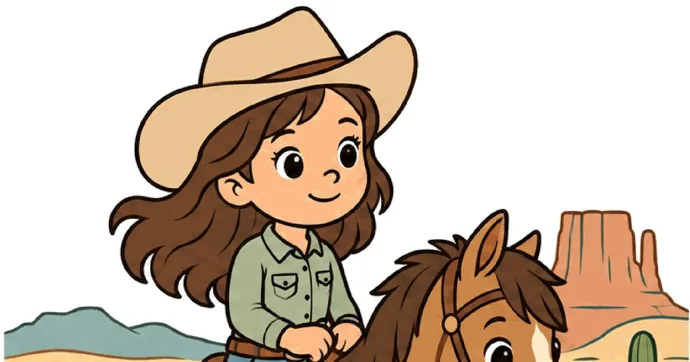
The American cowboy started as the vaquero, the Mexican cattle worker whose skills, gear and words grew out of ranching traditions Spanish settlers brought to the Americas. Vaqueros were herding cattle in northern Mexico in the 1590s, long before English-speaking settlers reached Texas. The cowboy most people picture came later, on the Texas cattle drives that ran from 1865 to the mid-1890s, and the men on those drives were Mexican, Black, Native American and white.
Below is a timeline, then the vaquero roots, who rode the trails, what a day on a drive looked like, why barbed wire and railroads ended it, and how rodeo and its events grew out of ranch work. The last part covers teaching it with coloring pages, age by age.
Cowboy history timeline, from Spanish cattle to the first rodeos
Most dates below come from the Texas Parks and Wildlife Department (TPWD) teaching unit “Vaqueros and Cowboys,” the National Park Service, and Wikipedia’s articles on the cowboy and the rodeo.
| When | What happened |
|---|---|
| 1500s | Spanish settlers bring cattle and horses to what is now Mexico and Florida |
| 1590s | Vaqueros are herding cattle in northern Mexico (TPWD) |
| 1598 | Juan de Oñate’s expedition crosses the Rio Grande into New Mexico with 7,000 head of cattle |
| 1821 | English-speaking settlers begin arriving in Texas |
| 1866 | Charles Goodnight and Oliver Loving set out on June 6 with about 2,000 cattle; Goodnight is credited with the first chuck wagon the same year |
| 1867 | Abilene, Kansas, becomes a cattle shipping point and loads over 36,000 head that year |
| 1869 | First recorded rodeo competition, in Deer Trail, Colorado |
| 1871 | Peak year on the Chisholm Trail (TPWD) |
| 1874 | Joseph Glidden gets his patent for modern barbed wire |
| 1883 | A roping contest in Pecos, Texas, on July 4, often called the first official rodeo |
| 1886–1887 | A harsh winter kills hundreds of thousands of cattle across the Northwest |
| 1888 | Prescott, Arizona, charges admission and awards trophies, a claim to the first professional rodeo |
| Mid-1890s | Railroads and barbed wire end the long Texas drives (TPWD) |
The dates double as a quiz round for older kids. Our history trivia questions add more American history rounds, sorted from easy to hard.
Vaqueros: the Spanish and Mexican roots of the cowboy
The cowboy’s job came from Spain, where cattle ranchers worked big herds on horseback over dry, open country. In the 16th century Spanish settlers brought that system, along with horses and domestic cattle, to the Americas. In New Spain, which later became Mexico and the American Southwest, the tradition turned into the vaquero of northern Mexico.
The word itself tells the story. Vaquero comes from the Spanish vaca, “cow,” plus -ero, “worker,” so a vaquero is a cow worker. According to Wikipedia, the English word cowboy derives from vaquero, and buckaroo is generally believed to be an anglicized version of the same word.
The first vaqueros worked mission herds
The Spanish missions trained Native Americans to tend their herds, and those riders were among the first vaqueros. The ranch owners, by contrast, were mostly of Spanish descent. TPWD notes that vaqueros were rounding up longhorn cattle in the Texas brush country since the late 1500s. One of their main routes ran between south Texas and Mexico City, and the ranches sat mostly on missions and presidios.
The longhorns came from that Spanish stock too. TPWD describes them as descendants of cattle the Spaniards turned loose in south Texas, with a horn spread that could reach up to 8 feet.
Words and gear the cowboy borrowed from the vaquero
Much of the cowboy’s kit, and the English names for it, came straight from vaquero Spanish:
- Lasso comes from lazo, the vaquero’s rope for catching cattle.
- Chaps comes from chaparreras, the leather leg covers vaqueros made from cattle hides to protect against mesquite and prickly pear.
- Rodeo comes from rodear, “to go around,” the Spanish word for a roundup.
- Branding and recorded brands came north with Spanish ranching. When Texas belonged to Spain, brands were written into ledger books in San Antonio.
The wide hat had a job as well. TPWD links the word sombrero to sombra, “shade,” because a vaquero spent all day under the south Texas sun.
Who the cowboys were: Mexican, Black and Native American riders
Movies made the cowboy look like one kind of man, and the records say otherwise. Wikipedia points out that cowboys ranked low in the social order, so nobody kept firm figures on who they were. The estimates that exist come from census records and historians, and they vary.
Mexican vaqueros on the Texas ranges
Census records suggest cowboys of Mexican descent averaged about 15% of the total, with more of them in Texas and the Southwest. Some estimates go higher. TPWD cites photographer Kendall Nelson’s estimate that about one out of every three working cowboys in the mid-1800s was a vaquero. On the King Ranch in south Texas, the vaqueros still carry their own name, Kineños.
Black cowboys on the cattle trails
The National Park Service lesson “Engaging with Cowpoke History” states that one out of every four cowboys was African American. Wikipedia’s census-based figure is about 15% overall, rising to about 25% on the trail drives out of Texas and falling to very few in the Northwest. Many Black cowboys, including Nat Love and Bose Ikard, had been enslaved, and herding cattle in the West was a way to earn wages away from the discrimination of the South.
Bose Ikard rode with Goodnight and Loving on the trail that carries their names. The Park Service credits him with tracking and wrangling the cattle and with guarding Goodnight’s cash. Bill Pickett, born in Texas in 1870, became a Wild West show star and invented bulldogging, now called steer wrestling. Some venues still banned him because of his skin color.
Native American cowboys
Native Americans were part of cowboy history from its first chapter, as the trained riders who worked the mission herds. Wikipedia notes that Mexicans and American Indians already living in the region worked as cowboys during the cattle boom. After 1890, some Indian boarding schools taught ranching skills. Many Native Americans still own cattle or work as cowboys near reservations, and Indian rodeo has its own associations.
Cowgirls and women ranchers
Ranchers rarely hired women to drive cattle, but women were on the land. The Park Service notes that a small number of Black and Latina women owned and managed ranches, and that Mary Fields, born enslaved in Tennessee, later moved to Montana. Women showed up in force once rodeo arrived, which is covered further down.
Hollywood cowboys versus working cowboys
Western films often showed cowboys fighting Native Americans. According to Wikipedia, most armed conflicts actually involved Native people and U.S. Army cavalry units, while cattle drives usually paid a toll of ten cents a head to cross Native land. TPWD adds that plenty of cowboys and vaqueros never owned a gun. The ones who had guns kept them for emergencies or hunting supper.
Cattle drives: the trails north from Texas, 1866 to the mid-1890s
The long drives happened because Texas had cattle and the rest of the country wanted beef. After the Civil War, longhorns that were cheap in Texas could sell for much more up north, if someone walked them to a railroad. TPWD estimates that from 1865 to the mid-1890s, vaqueros and cowboys brought about 5 million longhorns north.
The first drives and the railheads in Kansas
The first big push, in 1866, aimed for the railhead at Sedalia, Missouri. Farmers in eastern Kansas, afraid the longhorns would spread cattle fever and trample crops, threatened the drovers, and the herds were sold cheaply. In 1867 a shipping yard opened at Abilene, Kansas, west of farm country. Later trails led to Wichita and Dodge City, which shipped 500,000 head by 1877.
The Chisholm Trail and the Goodnight-Loving Trail
Two trails come up in almost every account:
- Chisholm Trail. Named for Jesse Chisholm, who marked the route, it ran about 1,000 miles from Texas through Indian Territory, now Oklahoma, to Kansas. TPWD puts its peak in 1871 and says it was nearly out of use by the mid-1880s.
- Goodnight-Loving Trail. Charles Goodnight and Oliver Loving left on June 6, 1866, with about 2,000 cattle, heading west and then north through New Mexico toward Colorado. One stretch crossed about 100 miles of desert, according to the Park Service.
Who rode with a trail herd
A herd of about 3,000 cattle needed a surprisingly small crew. TPWD puts it at 12 to 15 men, and Wikipedia says at least 10, with about three horses for each rider. The jobs split like this:
- Trail boss: in charge of everything, which TPWD compares to the captain of a ship.
- Cook: drove the chuck wagon, cooked, and often handled medical care, which made him one of the most respected people in camp.
- Wrangler: looked after the remuda, the herd of spare horses, and was often the youngest rider.
- Drovers: rode set positions around the herd to keep it moving.
Herds mixed cattle from several ranches, so each animal got a second “road brand” marking it as part of that drive.
A cowboy’s day on a cattle drive
A drive usually set off in spring, when new grass could feed the herd along the way and there was time to reach the north before winter. Each morning started with rounding up the cattle that had wandered overnight.
The pace stayed slow on purpose. Cattle could cover 25 miles in a day, but they lost so much weight that they were hard to sell, so most herds made about 15 miles a day with rests to graze at midday and at night. At that speed, the trip from a home ranch to a railhead took as long as two months.
The work never fully stopped. Riders took shifts to watch the herd 24 hours a day, guiding it by day and guarding it at night against stampedes and thieves. TPWD calls stampedes the biggest steady danger, since a gust of wind, a flash of lightning or the sun on a canteen could set longhorns running. Drovers would get ahead of a running herd and turn it into a tightening circle until it slowed.
Night guards often sang to the cattle. TPWD notes that the singing cowboy was real, and that the songs helped keep a nervous herd calm.
The pay was low. Wikipedia puts the average at about a dollar a day plus food. Many cowboys started young, and some were hired at 12 or 13 once they could handle the work.
How barbed wire and railroads ended the long cattle drives
The long drives lasted only about 20 years, and two inventions ended them. Barbed wire let ranchers fence their land, and railroads brought the market to Texas instead of making Texas walk to the market.
Joseph Glidden received his patent for modern barbed wire in 1874, and fencing spread across Texas and then the northern plains. By 1884 interstate railroads were established in Texas, according to TPWD, so drives to Kansas were no longer needed. Meatpacking plants were also being built closer to ranch country.
The weather finished the open range in the north. During the winter of 1886–1887, overgrazed ranges ran out of forage and hundreds of thousands of cattle died across the Northwest. By the 1890s, the Park Service notes, ranchers were choosing barbed-wire fences over hiring cowboys to watch the herds.
Cowboys didn’t disappear. Ranches multiplied across the West, the work became more settled, and smaller drives to local railheads continued into the 1940s, until trucks took over.
How rodeo began: from ranch roundups to the arena
Rodeo started as cowboys and vaqueros showing off their work skills. In the 1820s and 1830s, informal contests in the western United States and northern Mexico pitted riders against each other at roping and riding. TPWD describes the charreada as the vaquero’s equivalent of the cowboy’s rodeo, an event first developed in Mexico, and charros still compete in charreadas.
After the Civil War, the contests got organized:
- 1869: Deer Trail, Colorado, holds the first recorded rodeo competition.
- 1883: a July 4 roping argument in Pecos, Texas, turns into a public contest often called the first official rodeo.
- 1888: Prescott, Arizona, charges admission and gives trophies, its claim to the first professional rodeo.
As the drives ended, Wild West shows and rodeos gave cowboys a new way to earn a living. Bill Pickett toured with his bulldogging act, and many early rodeo champions, such as Nat Love, were African American. Women competed too: Prairie Rose Henderson rode at Cheyenne in 1901, and by 1920 women were competing in rough stock events, relay races and trick riding. In 1908, Hawaiian cowboys, called paniolo, won the steer roping championship at Cheyenne Frontier Days.
Rodeo events and the ranch jobs behind them
Professional rodeo events fall into two groups. Timed events race the clock, and rough stock events judge a ride on a bucking horse or bull. Some events are based on real ranch practice and others are modern inventions, so the roping events are the easiest ones to connect to the history above.
| Rodeo event | What happens | Worth knowing |
|---|---|---|
| Tie-down roping | A rider ropes a running calf, dismounts, and ties three of its feet together | Based on roping calves for branding or medical care; the oldest timed event |
| Breakaway roping | The rope breaks free from the saddle once the calf is caught, and the calf runs on without being tied | Mostly entered by women and by boys under 12 in the United States |
| Team roping | One rider ropes the steer’s horns and a partner ropes its two hind legs | The only event where men and women compete together |
| Steer wrestling | The rider jumps from a running horse onto a steer and wrestles it down by the horns | Bill Pickett’s bulldogging; probably the most dangerous event for the rider |
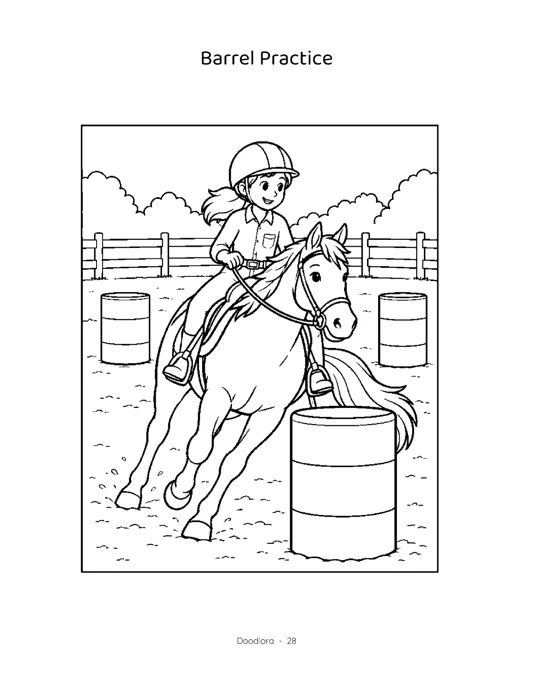
| Barrel racing | Horse and rider run a cloverleaf pattern around the barrels without knocking any over | A women’s event in professional, college and high school rodeo |
| Saddle bronc riding | The rider stays on a bucking horse using a special saddle with no horn and a single lead rope | Most broncs are not wild horses but spoiled riding horses or horses bred to buck |
| Bareback bronc riding | The rider holds only a rigging strapped around a bucking horse | The same rough stock skill, with no saddle |
| Bull riding | The rider stays on a bucking bull, while bullfighters distract the bull if the rider falls | Uses skills like bareback riding but carries more danger |
High school and college rodeos sometimes add goat tying and pole bending. Some local rodeos also run steer riding for children, generally ages 8 to 14, as a training event for bronc and bull riding.
Rodeo also draws opposition from animal rights and some animal welfare groups, who argue some events are cruel, and some states and cities restrict or ban certain events, while the Professional Rodeo Cowboys Association requires a veterinarian at every rodeo, padded flank straps and horn protection for steers.
Cowboy facts for kids
These short cowboy facts work as warm-up questions or fact cards. Each one comes from the sources above.
- The word cowboy comes from the Spanish vaquero, “cow worker.”
- Vaqueros were herding cattle in northern Mexico in the 1590s, more than 250 years before the big Texas drives.
- About one in four cowboys on the Texas trail drives was Black, according to the National Park Service and census estimates.
- A crew of 12 to 15 riders could move a herd of about 3,000 cattle.
- A herd walked about 15 miles a day, so a drive to Kansas could take two months.
- Longhorn horns could spread up to 8 feet across.
- Cowboys sang to their cattle at night to keep them calm.
- Some cowboys were hired at 12 or 13 years old and earned about a dollar a day.
- The chuck wagon is credited to rancher Charles Goodnight in 1866.
- Hawaii has its own cowboys, the paniolo, a word that likely comes from español.
- The U.S. Senate first named the fourth Saturday of July the National Day of the American Cowboy in 2005.
Teaching cowboy history with coloring pages, by age
Younger kids listen better with a crayon moving, and older kids can label a page with dates and new words. The cowboy pages we sell are cartoon ranch scenes, not portraits of real historical riders. Pair them with real photographs, such as the Library of Congress pictures used in the Park Service lesson, so kids don’t take the cartoons as history.
Each of the three sets below has 30 designs plus a cover. Each comes in black-and-white pages for coloring and matching color reference pages, with both US Letter and A4 PDFs. A teacher may print them for a single class under the personal license that comes with each set.
Ages 3 to 5: horses, hats and boots
Keep it to one idea and about 10 to 15 minutes, by our planning estimate. Preschoolers do best with a single big object, so start with the western coloring pages, the simplest of the three sets. Most of its 30 pictures hold one thing drawn large, such as boots, a horseshoe, a pony or a covered wagon.
While they color, name one thing a cowboy needed and why. The hat gave shade, the boots fit in stirrups, and the horse did the walking. For more ranch-themed ideas at this age, our farm activities for preschool are grouped by setting.
Ages 6 to 8: a cowboy’s day and the words he borrowed
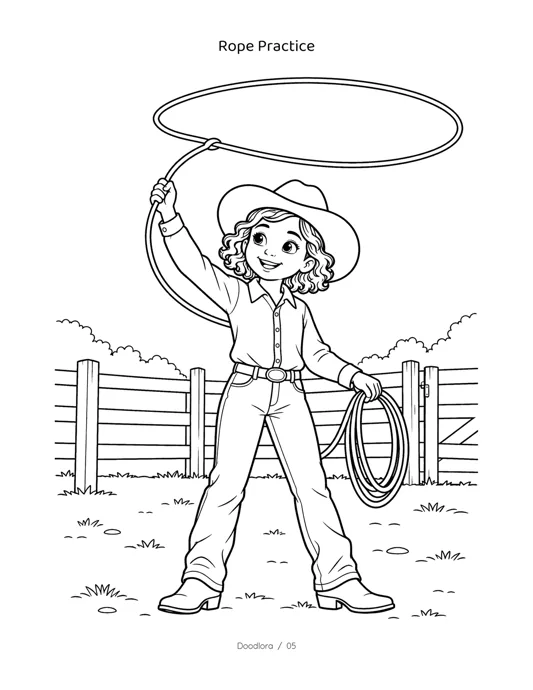
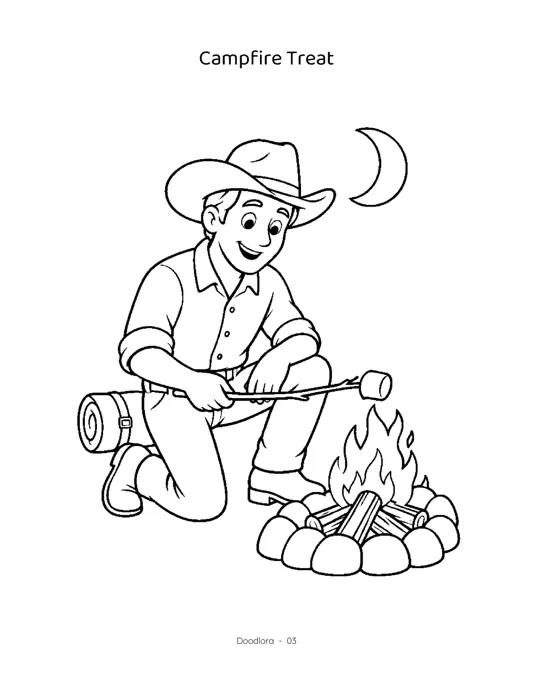
Plan on 20 to 30 minutes. The cowboy coloring pages follow ranch life scene by scene: a trail ride, lasso practice, a campfire, horse grooming, a trail rest and a ranch gear rack. Pick three or four and ask kids to put them in the order of a cowboy’s day.
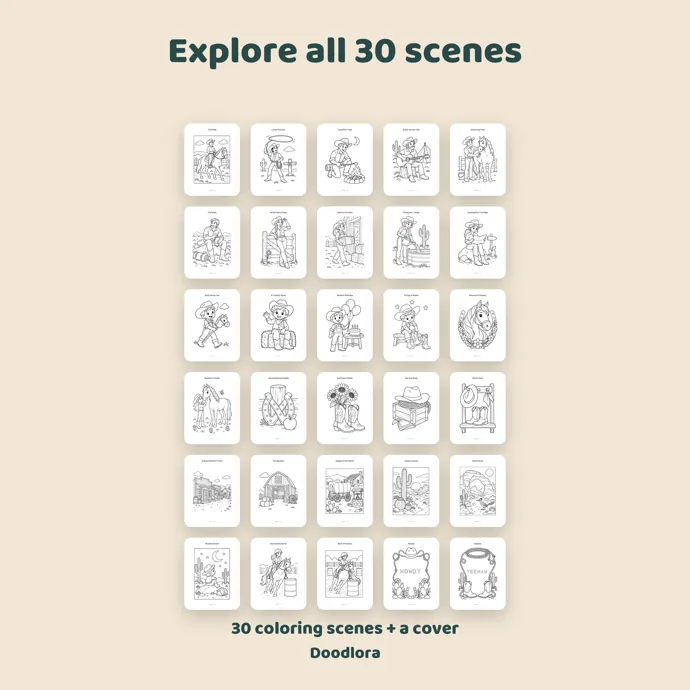
This age is ready for the vocabulary list. Write lasso, chaps and rodeo on the board, put the Spanish word next to each one, and let kids hunt for a lasso on their pages. One catch is worth knowing: the scene titles are printed in the artwork, so read them aloud for kids who can’t read yet.
Ages 9 to 11: the timeline and the people on it
Older kids can handle a 45-minute lesson with the timeline table above. Give each student or pair one date and one coloring page that fits it, such as a roping page for the vaquero roots or a barrel page for rodeo. Then line the class up in date order and have each pair explain its date in one sentence.
The cowgirl coloring pages work well here because the same girl appears on most of the designs, riding, roping, camping and barrel racing. That makes a good opening for the cowgirls and the women rodeo riders of the early 1900s. Add a short research card on Bose Ikard, Bill Pickett or Mary Fields so the lesson names real people.
Printing the cowboy pages for a class
Print one test page first at Actual Size or 100%, on the paper size that matches the PDF you picked. For a class of crayon users, plain printer paper is fine. Our guide to printing coloring pages covers settings and paper by supply. If you’re deciding between crayons, markers and colored pencils, our coloring tips compare them age by age.
Printables from this article
Related articles
Printable Coloring Pages
Is a Tomato a Fruit? Is Corn a Vegetable? Cucumbers Too
A tomato is a fruit in botany because it grows from the flower and holds the seeds, and a vegetable in the kitchen; the Supreme Court took the kitchen side in Nix v. Hedden in 1893, for the tariff only.
Printable Coloring Pages
How to Draw Food: Cute Fruit, Desserts and Snacks
Every cute food starts as a plain shape. Ink one bold outline, add the single detail that names it, color it warm with a white shine spot, and put a face on last if you want one.
Printable Coloring Pages
Types of Sushi: Nigiri vs Sashimi, Rolls and Sushi for Kids
Sushi is vinegared rice plus a topping or filling, and the shape gives each type its name: nigiri, maki, uramaki, temaki, gunkan, chirashi, inari and oshizushi. Sashimi is sliced fish with no rice. Here's how to spot each one, what to order first and which pieces have no raw fish.