Types of Sushi: Nigiri vs Sashimi, Rolls and Sushi for Kids
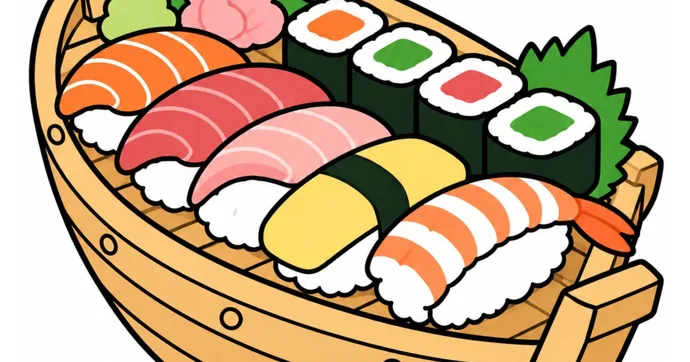
Sushi is vinegared rice paired with something else, and the “something else” doesn’t have to be raw fish. The name of each type tells you the shape: nigiri is a hand-pressed mound of rice with a topping draped over it, maki is a roll cut into rounds, temaki is a cone you hold in your hand, and chirashi is a bowl. Sashimi shows up on every sushi menu, yet it isn’t sushi at all, because it’s sliced fish served with no rice.
Find the name on the menu in the left column, then read across to see what will arrive and whether it contains raw fish.
| Name on the menu | What arrives | Easiest way to recognize it | Raw fish? |
|---|---|---|---|
| Nigiri | An oval of rice with one topping laid over it | One slice on one small rice mound, sometimes tied with a strip of nori | Usually, but tamago (sweet omelet) is a cooked topping |
| Hosomaki | Thin roll, about 1 inch across, cut into rounds | Nori outside, one filling in the middle | Depends on the filling; cucumber (kappa maki) has none |
| Futomaki | Thick roll, about 2 to 2½ inches across | Nori outside, several colorful fillings | Often vegetarian or cooked |
| Uramaki | Inside-out roll | Rice on the outside, nori hidden inside | Depends; a California roll has none |
| Temaki | Hand roll shaped like a cone | Open end spilling filling, eaten with fingers | Depends on the filling |
| Gunkan | “Warship” piece | A band of nori wrapped around rice, holding loose toppings like roe | Usually |
| Chirashi | A bowl of rice with toppings scattered over it | No rolling or pressing at all | Usually |
| Inari | A pouch of fried tofu filled with rice | Golden-brown pocket, no fish in sight | No |
| Oshizushi | Pressed block cut into pieces | Neat rectangles from a wooden mold | No; the fish is cooked or cured |
| Sashimi | Sliced fish, no rice | Slices fanned on a plate, often with garnish | Yes, and it isn’t sushi |
Ordering sushi for the first time: the shapes on almost every menu
A first order works best if it covers two or three shapes, so you learn what you like. A common starting plate is a couple of nigiri, one roll and a hand roll. If you’re teaching the names to kids before a restaurant visit, our sushi coloring pages have a picture for most of these shapes, and the last section of this guide lists which page shows which. All of the types below are listed on the Japan National Tourism Organization’s sushi guide or in the Wikipedia sushi article, and the sizes come from the same sources.
Nigiri
Nigiri is the classic sushi shape: a small oblong of rice pressed by hand, with a topping called the neta draped over it and usually a dab of wasabi in between. Salmon and tuna are the most common toppings. Some toppings, such as tamago (sweet egg), eel, octopus and squid, get tied to the rice with a thin strip of nori so they don’t slide off.
This style became popular in Edo, the old name for Tokyo, in the 1820s and 1830s. A chef named Hanaya Yohei is often credited with inventing or perfecting it in 1824, and the rice balls of that era were about three times the size of today’s.
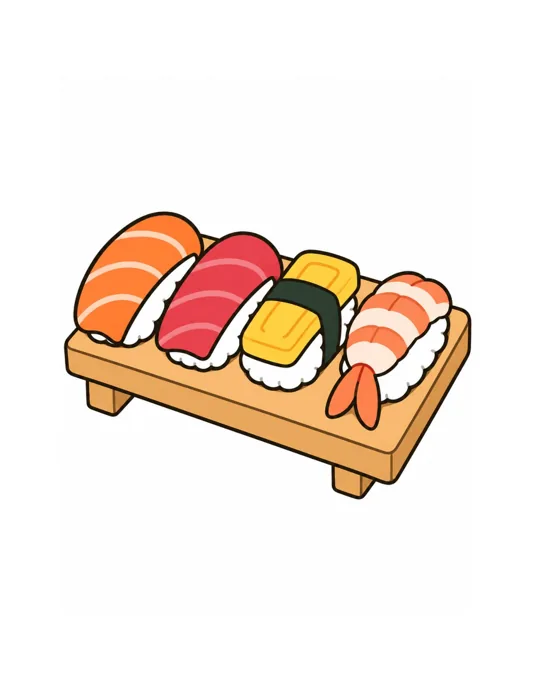
How to spot it: one piece, one topping, and you can see the rice underneath. If there’s no rice, it’s sashimi.
Maki rolls: hosomaki and futomaki
Maki (makizushi) means “rolled sushi.” The rice and fillings go onto a sheet of nori, and a bamboo mat called a makisu rolls them into a cylinder that gets cut into six or eight pieces. A thin roll, hosomaki, is about 1 inch (2.5 cm) across and usually holds one filling, such as tuna, cucumber or pickled plum paste. A thick roll, futomaki, runs about 2 to 2½ inches (5 to 6 cm) and holds several fillings chosen for color and taste.
Two thin rolls have their own names. Kappa maki is cucumber, named after the kappa, a water imp from Japanese folklore that loves cucumbers. Tekkamaki is raw tuna.
How to spot it: dark green nori on the outside, and you see the fillings in the cut face of each round.
Uramaki, the inside-out roll (and the California roll)
Uramaki flips a maki roll so the rice is on the outside and the nori wraps the filling inside. The outer rice is sometimes rolled in sesame seeds or fish roe. Japan’s tourism board calls the California roll, an inside-out roll that’s “nearly unknown in Japan,” a reversed makizushi, and Wikipedia notes uramaki is uncommon in Japan, partly because rice on the outside is hard to eat with your fingers.
The California roll usually holds imitation crab, avocado and cucumber. The original recipe called for real cooked crab. Many of the multi-filling rolls on US menus, such as spicy tuna and tempura rolls, grew out of this style and out of futomaki.
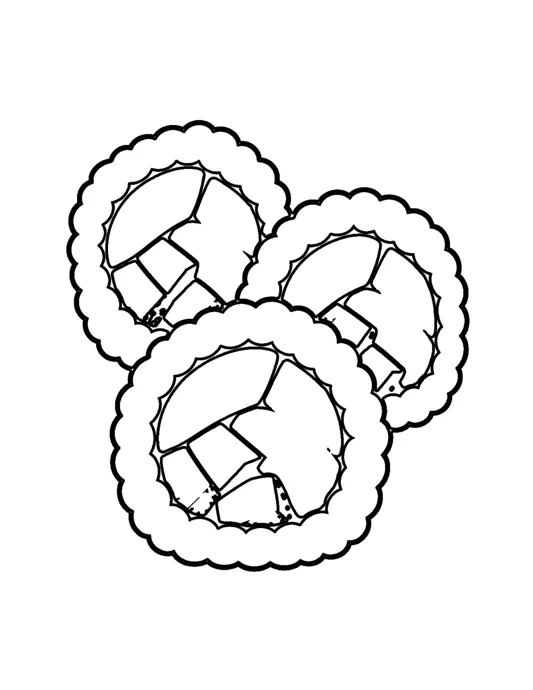
How to spot it: white rice outside, often speckled with seeds or orange roe. If the outside is dark green, it’s regular maki.
Temaki (hand roll)
Temaki is a cone of nori about 4 inches (10 cm) long, closed at the narrow end with the filling spilling out of the wide end. It’s too awkward for chopsticks, so you eat it with your fingers. Eat it right away, too. The nori soaks up moisture from the filling and gets chewy fast, which is why takeout hand rolls often come with the nori sealed in plastic film until you’re ready.
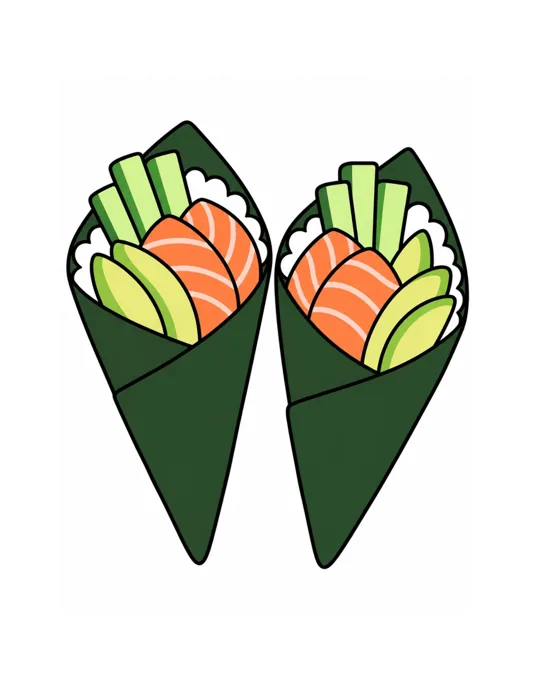
How to spot it: a cone, not a round. Order one per person, since it doesn’t share well.
Gunkan (warship sushi)
Gunkan maki is a type of nigiri with a strip of nori wrapped around the rice, so the piece becomes a little container. It holds toppings too loose to stay on a plain nigiri: fish roe, sea urchin, chopped scallops, natto, or sweet corn with mayonnaise. Wikipedia dates its invention to 1941, at the Ginza Kyubey restaurant in Tokyo.
How to spot it: an oval cup of nori with the topping piled on top, like a small boat. That shape gives it the “warship” name.
Chirashi (scattered sushi)
Chirashi skips the shaping. You get a bowl of sushi rice with fish and vegetable garnishes arranged or scattered across the top. The JNTO guide notes chirashi works well for sharing among a few people. In Japan, families traditionally eat it on Hinamatsuri, the Girls’ Day festival in March, and on Children’s Day in May.
Oshizushi (pressed sushi)
Oshizushi, also called hako-zushi or “box sushi,” comes from the Kansai region and is an Osaka specialty. The toppings go into the bottom of a wooden mold, rice goes on top, and the lid presses it all into a firm block that’s cut into bite-size rectangles. Battera, made with mackerel, is the best-known version. In oshizushi every ingredient is cooked or cured, and raw fish is never used.
Sashimi: on the menu, but not sushi
Sashimi is thinly sliced raw fish (or occasionally meat) served without rice. Japan’s tourism board says it plainly: sashimi is often served at sushi restaurants but isn’t sushi. A sashimi plate shows the fish on its own, so it’s the order for someone who wants to taste the fish, not the rice.
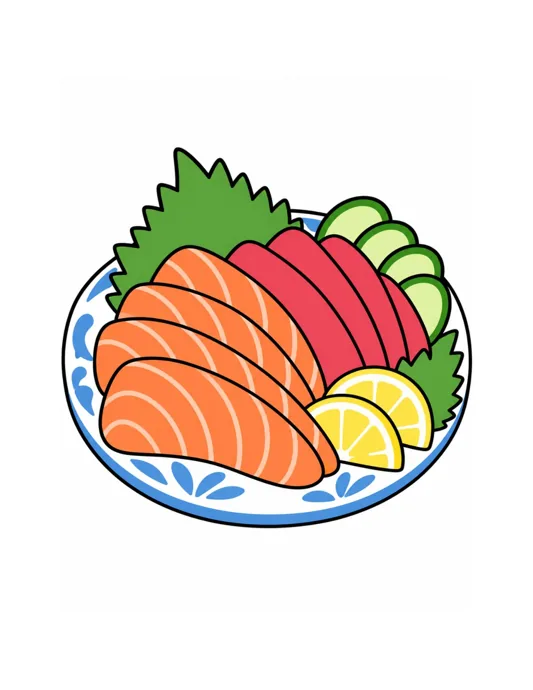
Nigiri vs. sashimi: if a slice of salmon is sitting on rice, it’s salmon nigiri. If it’s sitting on a plate with a leaf or shredded radish and no rice, it’s salmon sashimi.
Sushi for kids and anyone skipping raw fish
Plenty of sushi has no raw fish at all, which matters if you’re ordering for a child, someone pregnant, or anyone who simply doesn’t want it. The FDA lists pregnant women, children, older adults and people with weakened immune systems as groups who should avoid raw or undercooked fish or shellfish, including the raw seafood in some sushi. Ask the restaurant when you aren’t sure whether a topping is cooked.
Cooked picks
- Tamago nigiri: a block of sweet, layered omelet (tamagoyaki) tied onto rice with a nori strip. It’s the easiest cooked nigiri to spot because it’s bright yellow.
- California roll: imitation crab, avocado and cucumber, with no raw fish in the classic version. Read the menu line anyway, because restaurants build their rolls differently.
- Tempura roll: a roll with fried shrimp tempura inside, or a whole roll battered and fried.
- Oshizushi: pressed, with cooked or cured toppings only.
Vegetable picks
- Kappa maki: cucumber in a thin nori roll. It’s traditionally eaten to clear the palate between raw fish and other foods.
- Inari: a pouch of fried tofu, usually filled with just sushi rice. Wikipedia notes it’s named after the Shinto god Inari, whose fox messengers are said to love fried tofu. The pouches are usually rectangular in the Kanto region and triangular in Kansai.
- Avocado roll, futomaki and umeshiso maki: avocado is one of the plant fillings used in sushi rolls, futomaki is often made vegetarian with cucumber, gourd or bamboo shoot, and umeshiso maki holds pickled plum paste and perilla leaf.
- Corn gunkan: sweet corn with mayonnaise in a nori cup, one of the softer gunkan toppings.
Where to take kids for a first try
A conveyor-belt restaurant (kaiten-zushi) is the easiest place to start with children. Plates ride past the seats, everyone grabs what looks interesting, and the JNTO guide calls it a great introduction to sushi and fun for kids. Plate colors mark different prices. The one rule children need to know before you sit down: you may take any plate off the belt, but you never put a plate back.
How to eat sushi without a misstep
Sushi etiquette is short, and most of it comes from the JNTO guide:
- Dip the topping, not the rice. Turn a nigiri so the fish side touches the soy sauce. Rice dunked in soy sauce soaks up too much and can fall apart.
- Fingers are fine. Chopsticks are the usual choice, but eating sushi by hand is perfectly acceptable, even at higher-end restaurants. Hand rolls are always finger food.
- Ginger goes between pieces. The pickled ginger (gari) cleans your palate between orders. Don’t pile it on top of the sushi.
- Watch the chopsticks. Don’t pass food from one pair of chopsticks to another, and don’t stand chopsticks upright in a bowl. Lay them across the bowl or on a chopstick rest.
- At a counter, order piece by piece. At a traditional sushi counter, each nigiri is formed after you order it and served right away. Asking for omakase hands every choice over to the counter.
Kids who are practicing table manners in general can pick these up quickly; our manners for kids guide has the everyday ones.
Learning the sushi types with coloring pages
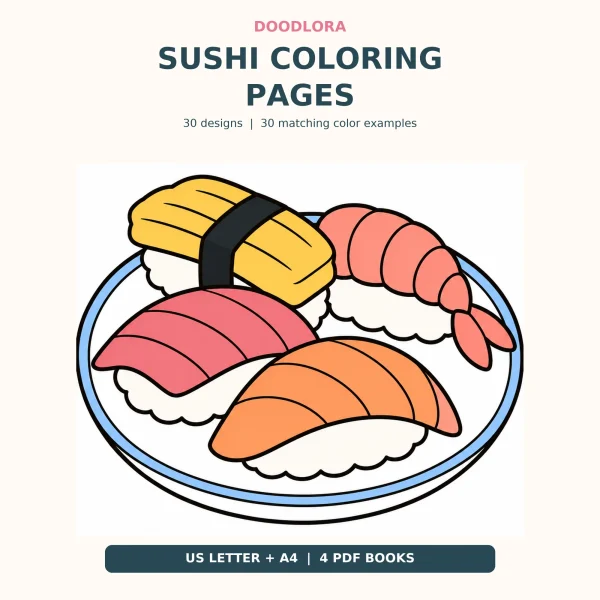
A coloring page makes a handy flash card for the names, as long as you treat it as a picture of the shape and not a field guide. The sushi book has 30 designs, drawn once as black outlines and once fully colored, with both versions sized for US Letter and for A4. Each book has 31 pages, a cover and then the 30 designs in order, so design 1 in the line art matches design 1 in the color guide.
Here’s how the pages line up with the types above:
| Type | Pages in the book | What’s drawn |
|---|---|---|
| Nigiri | 2 to 5 | Plates and a wooden stand of salmon, tuna, tamago and shrimp nigiri |
| Maki | 6, 7 and 9 | Nori-wrapped rolls, including a row of thin cucumber rolls on a stand |
| Inside-out roll | 8 | Rolls with the rice on the outside |
| Gunkan | 10 and 11 | Nori cups topped with roe, cucumber cubes, diced salmon and soybeans |
| Temaki | 12 and 13 | Hand rolls, one standing in a wooden holder |
| Sashimi | 14 and 15 | Fanned slices on a dish and on a board, with no rice |
| Sushi boats, bento and the conveyor belt | 16 to 21 | Mixed platters, two bento box pages and plates riding a belt |
The book has no chirashi bowl, inari pouch or oshizushi block, so those three are good ones for kids to draw themselves from the descriptions above. Pages 30 and 31 label six ingredients in big letters: SALMON, TUNA, TAMAGO, CUCUMBER, AVOCADO and NORI.
A simple way to use it with a class or at the table:
- Print the line art for the kids and keep the color guide on a tablet or one printed copy for reference. Print at Actual Size on white paper, one page per sheet, as the printing note in the download says. If the outlines come out gray or the edges get clipped, see how to print coloring pages.
- After a child colors a page, have them write the type name under it (nigiri, maki, temaki) and circle “raw” or “cooked” based on the table near the top of this guide.
- Line up a nigiri page and a sashimi page side by side and ask what’s missing from the second one. The answer, rice, is the whole difference.
The book is sold under a personal license: printing at home is covered, and so is a teacher making copies for a class they teach. Markers work well on the big, closed shapes; our coloring with markers tips cover keeping the colors from bleeding.
Once the names stick, a sushi menu reads like a list of shapes: pressed, rolled, coned or scattered. Pick one of each on your next visit and you’ll know which shape is yours.
Printables from this article
Related articles
Printable Coloring Pages
Is a Tomato a Fruit? Is Corn a Vegetable? Cucumbers Too
A tomato is a fruit in botany because it grows from the flower and holds the seeds, and a vegetable in the kitchen; the Supreme Court took the kitchen side in Nix v. Hedden in 1893, for the tariff only.
Printable Coloring Pages
How to Draw Food: Cute Fruit, Desserts and Snacks
Every cute food starts as a plain shape. Ink one bold outline, add the single detail that names it, color it warm with a white shine spot, and put a face on last if you want one.
Printable Coloring Pages
What Is STEM? Meaning, STEM Activities and Careers
STEM stands for science, technology, engineering and mathematics, a label the National Science Foundation adopted in 2001 for four subjects that work best when taught together. Here is what each letter covers, how STEAM differs, one hands-on activity per age group, the jobs behind the letters and five women whose work shaped them.