Funny Games to Play With Friends, Family and Big Groups

The funny games to play are the ones where someone has to fail in public: a grown adult hopping on one leg to pull on a sock, a teammate drawing “Monday” with no letters allowed, a whole circle counting to 15 and tripping over “fizzbuzz.” Pick by head count first. Two or three people need head-to-head games, a table of six suits word and drawing rounds, and a crowd of 15 needs circle and team games.
Each game below lists how many can play, what to set out, how a round runs and how it ends. The times are planning estimates, not rules.
| Game | Players | Best for | A round takes | You need |
|---|---|---|---|---|
| Fill-in-the-blank story | 2 or more | Kids who can name a noun, adults | About 5 minutes | One story with blanks |
| Emoji guessing race | 2 or more | Mixed ages | 10 to 15 minutes a round | Printed puzzle pages, pencils |
| One Leg Sock face-off | 2 or more | Teens and adults | 1 minute a turn | A pair of socks |
| Spin and Walk | 2 or more | Anyone steady on their feet | 1 minute a turn | Tape line on the floor |
| Forbidden words | 4 to 10, in two teams | Readers, teens, adults | 1 minute a turn | Word cards, a timer |
| No-letters drawing | 4 or more, in teams | Mixed ages | 1 minute a turn | Paper, markers, word slips |
| Psychiatrist | 5 or more | Teens and adults | 10 minutes or so | Nothing |
| Fizz buzz | 4 or more | Kids who know their 3s and 5s, adults | 5 minutes | Nothing |
| Zip zap boing | 8 or more | Everyone who can stand | 5 to 10 minutes | Floor space |
| Squeak piggy squeak | 8 or more | Kids, family parties | 10 minutes | Blindfold, cushion, chairs |
| Wrap the Mummy | Teams of 3 or 4 | Kids and adults | 1 minute | Toilet paper |
| Shake It Out | 2 or more, one at a time | Kids and adults | 1 minute a turn | Tissue box, string, ping pong balls |
| Straw Conveyor | Teams of 4 or more | Teens and adults | 1 minute | Straws, a tissue |
| Hat Catch | 2 or more, one at a time | Kids and adults | 1 minute a turn | Balloon, bucket hat or bowl |
Funny games to play with two or three people
With two or three players, nobody can hide in a team, so the laugh comes from watching one person attempt something slightly ridiculous. These four need no board and no more than one person waiting at a time.
Fill-in-the-blank story
A fill-in-the-blank story works for two players or more and takes about five minutes a story. Mad Libs, the word game Leonard Stern and Roger Price invented in 1953, is the published version. One player holds a short story with key words blanked out, and each blank is labeled with a type, such as noun, verb, number, celebrity, exclamation or part of the body.
The holder asks the others for a word of each type without reading out the sentence around it. When every blank is filled, the holder reads the whole story aloud. To write your own, take a five-sentence story about someone at the table and blank out eight words.
Younger players stall on “adjective.” Ask for “a describing word, like slimy or enormous” instead.
Emoji guessing race
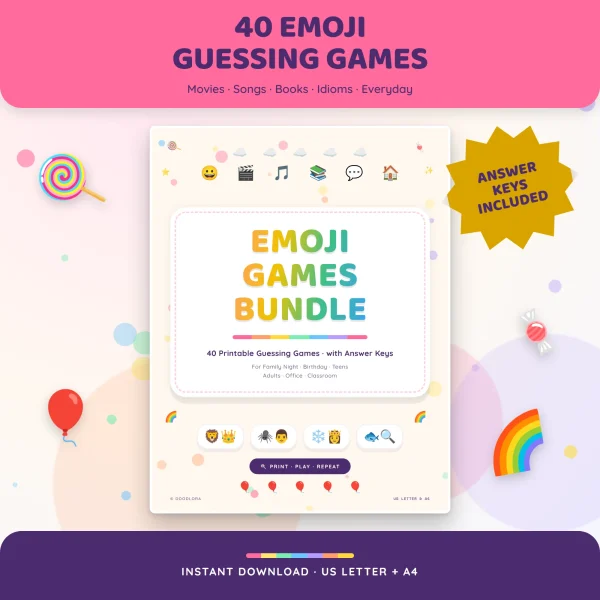
Emoji puzzles are a quiet kind of funny: the groan arrives when a player finally sees that a caterpillar and an apple stand for a picture book. Two players can race each other, or a bigger group can split into teams. Set out one puzzle page per player, pencils, and 10 to 15 minutes for a round.
Our emoji guessing games have 40 puzzles across five rounds: movies, songs, books, idioms and everyday life. Each page shows the emoji, a line for the guess and a one-line hint. Players say their guess out loud, write it on the line, and score one point for each right answer. Most points wins the round.
The trap is the answer. Each page prints it in a strip along the bottom, so a fast reader at the table sees it before thinking. Fold that strip back before you hand the pages out, and keep the answer key from the back of the pack with whoever checks.
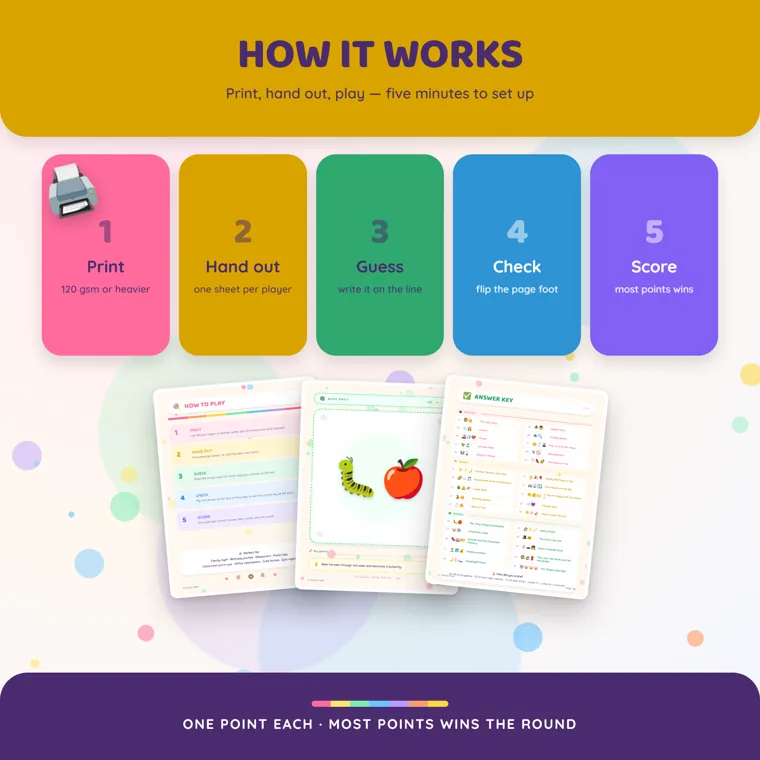
For the biggest laughs, play the idioms round. “Raining cats and dogs” and “kill two birds with one stone” look strange spelled out in pictures, and players read them literally before they get it. We use the emoji pages a different way in our family game night ideas, as a teens-versus-parents round.
One Leg Sock face-off
One Leg Sock is a one-minute challenge from our one-minute party games deck, and it turns two people into a comedy act. Each player needs a pair of socks. Stand on one leg and pull a sock onto the raised foot, then the second sock. That foot must not touch the floor at any point.
One sock on inside the minute scores 1 point, and both socks score 2. Play best of three. Let players hold the back of a chair if your floor is slippery, because a sideways hop on a polished floor ends with someone on the ground.
Spin and Walk
Spin and Walk needs nothing but floor space and a straight line. Lay a strip of tape about 10 feet (3 meters) long. The player spins around ten times on the spot, then walks the line without stepping off it. Finishing on the line scores 1 point.
The funniest part is the first two steps, so have everyone else stand along the sides. Move the coffee table first and keep the line away from stairs and glass. A dizzy adult can easily fall over sideways.
Funny games for a table of 4 to 8 friends
A table of four to eight people can split into two teams, and team games give the quiet guests a teammate to lean on. These four run seated or close to it, which suits a dinner party or a living room after the meal.
Forbidden words
The Taboo board game sets the rules for this one. It’s played with an even number of players, from four to ten, seated so the two teams alternate around the circle. On each turn, one player is the “giver” and tries to get teammates to guess a word without saying it or any of five forbidden words printed under it.
For “baseball,” the forbidden words might be sport, game, pastime, hitter and pitcher. The giver can’t say part of a forbidden word (“base”) or a form of it (“marry” when “marriage” is out). Gestures, sounds and drawings are off limits. A player on the other team listens as the censor and calls out any slip.
Each turn lasts one minute. The team scores a point for every word guessed and takes a penalty point for every forbidden word spoken. To make cards at home, write a target word at the top of an index card and five obvious clue words under it.
Settle the part-of-a-word rule before the first turn. Every argument at the table comes from it.
No-letters drawing
No-letters drawing borrows its rules from Pictionary. Split into two to four teams, with paper and markers for each team and word slips in a bowl. The drawer reads a slip for no more than five seconds, then draws. The drawing can’t include numbers or letters, and the drawer can’t speak, point or gesture.
The team has one minute to guess. A right answer scores a point, and the turn passes to the next team. Play until each player has drawn twice. Abstract words such as “Monday” or “borrow” get the best laughs, because drawers end up with arrows and confused stick figures.
Some drawers sneak in a letter. Agree before you start that a drawn letter loses the point. For the same idea without paper, our guide to charades for kids covers the acting version and how to make it work with young players.
Psychiatrist
Psychiatrist is a party game in which everyone except one player shares the same made-up problem. The “psychiatrist” sits in the middle of the circle and has to guess the problem by asking indirect questions. We’d play it with at least five people, because the laughter comes from different patients answering the same odd condition in different ways.
Send the psychiatrist out of the room while the patients agree on a problem, such as being afraid of the dark or believing they’re a famous movie star. The psychiatrist comes back and questions each patient in turn: “Do you prefer daytime or nighttime?” rather than “Is it about light?” If a patient answers in a way that doesn’t fit the problem, the others shout “Psychiatrist!” and that patient swaps seats with the first person who shouted.
The round ends when the psychiatrist names the problem. Pick a problem that changes everyday answers, or the round stalls. “Thinks they’re a cat” plays better than “is afraid of spiders.”
Fizz buzz
Fizz buzz is a counting game that gets funny fast. Players sit in a circle and count up in turn, saying “fizz” for any number divisible by three, “buzz” for any number divisible by five, and “fizzbuzz” for numbers divisible by both. The count runs 1, 2, fizz, 4, buzz, fizz, 7 and on. A player who hesitates or gets it wrong is out.
The last player in wins. Once the group gets past 30 without a slip, swap the 5 rule for 7, a variation some groups play. For kids who are still learning their times tables, let everyone stay in and just restart the count.
For a longer seated night, our party games for adults add bluffing and dinner-table games such as Fictionary and Botticelli.
Funny games for a big group of 10 or more
With ten or more people, the best funny games keep most of the room watching one or two players, or put everyone on a team at once. These six need a cleared floor, and three of them come from the one-minute deck.
Zip zap boing
Zip zap boing is a circle game that drama groups often use as a warm-up. Its rules vary from place to place, and the version below is the one the UK Scout Association uses. Everyone stands in a circle about 6 feet (2 meters) apart. Clasp your hands with your index fingers pointing and say “zip” to pass the play to the person next to you. Say “zap” to pass it to anyone who isn’t next to you.
“Boing” is a star jump that sends the play back to the person who just passed it to you. Anyone who stalls or uses the wrong word is out, and the game ends when two players are left. Speed is what makes it funny, so the person who started should push the pace once everyone has the three words.
Squeak piggy squeak
Squeak piggy squeak is an old parlor game, popular in Victorian times, built on blind man’s buff. One player is the “farmer,” blindfolded and holding a cushion. Everyone else sits in a circle of chairs. Spin the farmer around three times, then the farmer finds a lap, puts the cushion on it without touching the person with their hands, and sits down.
The farmer says “Squeak, piggy, squeak,” and the seated player squeaks. If the farmer guesses who it is, that player becomes the next farmer. If not, the farmer goes again, and everyone switches chairs before the next spin.
Watch the sizes. An adult sitting on a small child’s lap is a bad idea even with a cushion. In mixed groups, use the variation where the farmer points instead of sitting, and the person pointed at squeals.
Wrap the Mummy
Wrap the Mummy is a team card from the one-minute deck, and it’s the minute most guests will want a photo of. Each team of three or four needs three rolls of toilet paper. Pick one player to be the mummy and wrap them from head to toe in 60 seconds, leaving the eyes and nose clear.
A mummy wrapped with nothing hanging loose at the buzzer scores 1 point. Run every team at once for a bigger laugh. Have a bin bag ready, because three rolls a team turns into a lot of loose paper.
Shake It Out
Shake It Out is our pick for the loudest minute in the deck. Tie an empty tissue box around the player’s waist with string, with the opening at the back, and drop in 10 ping pong balls. The player has one minute to shake and jump until the box is empty.
All 10 balls out scores 1 point. The balls go everywhere, so give the player a clear patch of floor and appoint two kids as ball collectors before the next turn.
Straw Conveyor and Hat Catch
Two more cards suit a crowd. In Straw Conveyor, each team member holds a drinking straw in their mouth. Tear a tissue into squares. The first player picks one up by sucking through the straw and passes it to the next player’s straw with no hands. Three squares passed in a minute scores 1 point, and six squares score 2.
Hat Catch is a solo turn for the whole room to watch. The player puts a bucket hat or a small bowl on their head, throws a balloon up and catches it in the hat without touching the balloon with their hands. Three catches score 1 point and six catch 2.
How to run a round of one-minute challenges
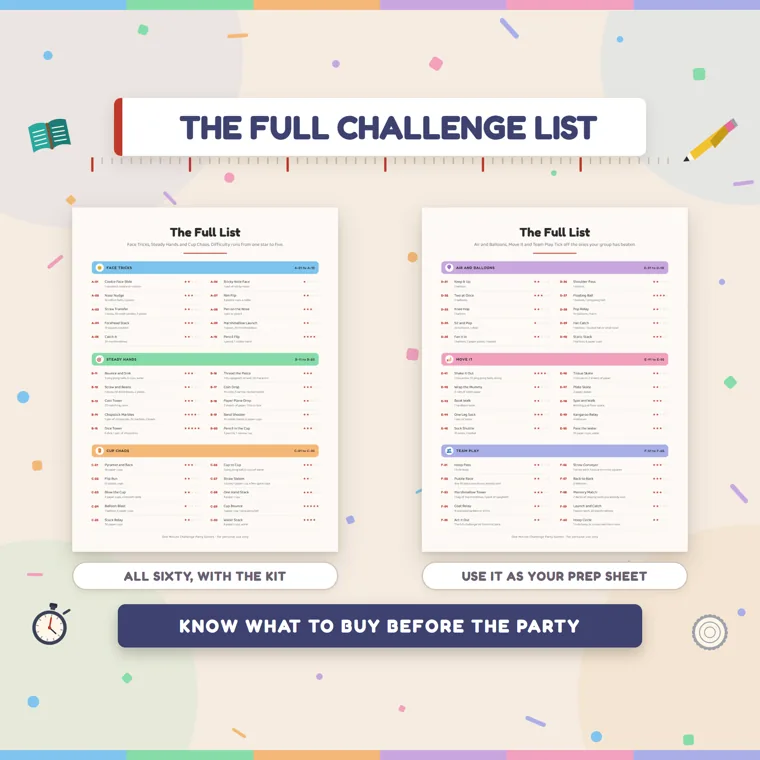
One-minute challenges work as a full party game, not only as single stunts. The deck we’ve been quoting has 60 challenge cards in six groups (face tricks, steady hands, cup chaos, air and balloons, move it, and team play), plus six blank cards for challenges your family invents.
The round is simple. Shuffle the deck and place it face down. The first player draws a card, reads it aloud and gathers what it lists. One person keeps time with a phone, everyone counts down the last ten seconds, and the points go on the score sheet. Pass the deck to the left and play until the deck runs out or everyone has had five turns.
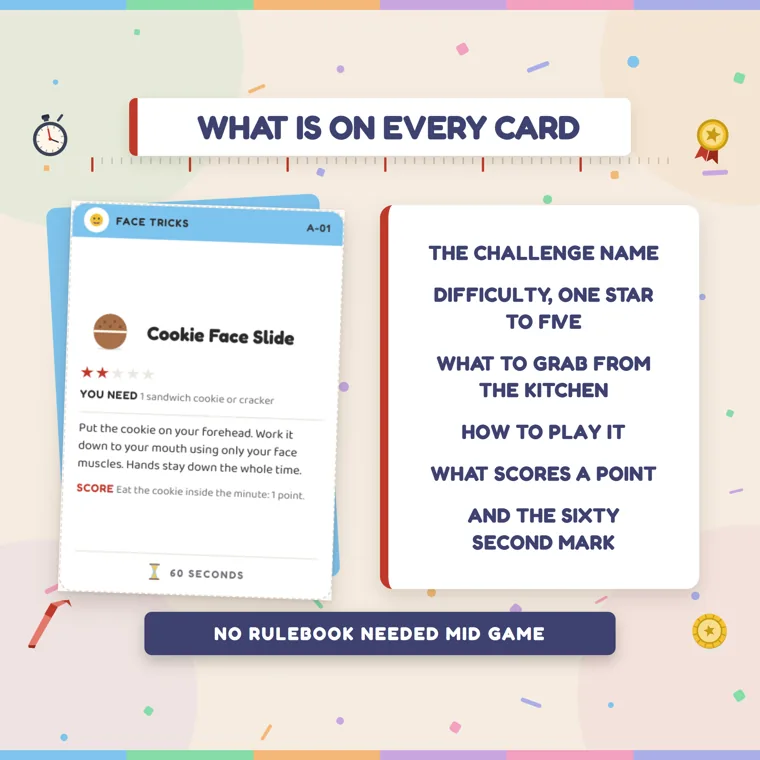
Most cards score 1 point, and beating the harder target on the same card scores 2. The deck’s own guide puts the sweet spot at six players and says twenty still works. For a solo game, two to eight players works best. For a crowd, split into teams of three or four and play the team cards together.
With players under eight, let them stand closer, use bigger targets and count a near miss as a hit. A failed card goes back into the deck, which is half the fun: someone else gets to fail at the same thing. Our one-minute party game ideas cover the cup and table challenges and the supply list in more depth.
Funny games with food in your mouth: chubby bunny and the marshmallow cards
Chubby bunny turns up on many lists of funny games, and it’s the one to leave out. Players put marshmallows into their mouths one at a time and try to say “chubby bunny” after each one, and the player who fits the most wins. Wikipedia’s article on the game records at least three people who died by choking on marshmallows, one of them a 12-year-old at a school event in 1999.
The same caution applies to any game that puts food at the back of the throat. Three cards in our one-minute deck have a partner toss or launch marshmallows into a player’s open mouth: Catch It, Marshmallow Launch and Launch and Catch. We’d take those three out when young children are playing, and with older players, swallow each marshmallow before catching the next. The other 57 cards are funny enough without them.
If your crowd likes brain teasers more than physical stunts, our guide to riddles for adults shows how to run a riddle round. The printed riddle cards it covers include a 60-second speed round where anyone may shout an answer, which gets the same rush with nothing in anyone’s mouth. More games for every age are on the Doodlora home page.
Printables from this article
Related articles
Printable Party Games
New Year’s Eve Party Ideas: Themes, Food & a Night at Home
Choose the kind of New Year's Eve party first, then pick a theme, a timeline that ends where your guests will, food that can sit out for hours, and a countdown that fits the youngest person in the room.
Printable Party Games
Christmas Pajama Party Ideas: Invitation, Food & Games
Pick the kind of Christmas pajama party first, then send an invitation that says pajamas and pickup time, plan food and a simple timeline for that group, and end with bedtime, breakfast or a thank-you card.
Printable Party Games
Western Party Ideas: Cowboy Theme Food, Games and Decor
Pick the western party that fits your crowd first: a 90-minute cowpoke birthday for preschoolers, a two-hour cowgirl or rodeo party for older kids, an evening barbecue and line dance for adults, or a western day at school. Each plan below covers guests, timing, decor, food, games and how to wrap up.