What Is STEM? Meaning, STEM Activities and Careers
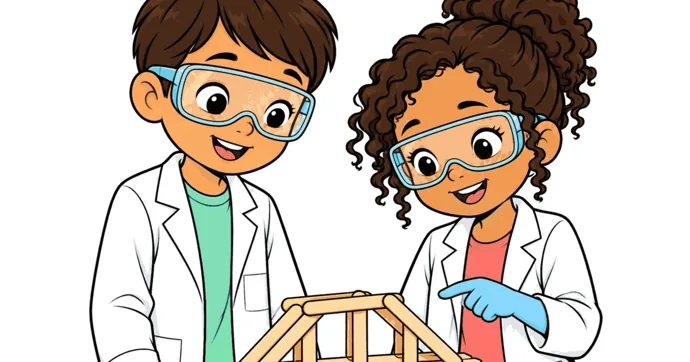
STEM stands for science, technology, engineering and mathematics. It is an umbrella term for four subjects that share the same habits: ask a question, test an idea, measure what happened and use the numbers to decide what to try next. The acronym took hold in the United States in 2001, when the National Science Foundation adopted it in place of an older ordering, SMET. When a school says it “does STEM,” it usually means kids work on problems that pull in two or more of those subjects at once instead of meeting each one in a separate lesson.
If you only need the short version for a child, try this: science asks how the world works, technology is the tools we make, engineering is designing something that solves a problem, and math is the counting and measuring that holds the other three together.
What does STEM stand for? The four letters
Each letter is a whole field, and each one shows up in a child’s day long before anyone calls it STEM.
| Letter | Stands for | What it covers | Where a kid already meets it |
|---|---|---|---|
| S | Science | Biology, chemistry, physics, earth and space science | Watching a seed sprout, noticing that ice melts on a sunny step |
| T | Technology | Tools people build, from pencils and levers to computers and code | Using a tablet, a calculator or a kitchen timer |
| E | Engineering | Designing, building and improving something that solves a problem | Building a block tower that stays up, fixing a paper airplane that dives |
| M | Mathematics | Numbers, measurement, shapes, patterns and data | Counting, comparing heights, splitting snacks fairly |
The letters overlap on purpose. A child who builds a ramp (engineering), rolls a car down it (science), times the run on a phone (technology) and compares three runs (math) has done all four in ten minutes. When a child wants more hands-on experiments like that one, our science activities for kids are sorted by age.
Which subjects count as STEM?
There is no single agreed list, and this trips up parents reading school or college pages. Wikipedia notes that the disagreement is mostly about the social sciences. In the United States, the National Science Foundation counts psychology, economics, sociology and anthropology as STEM, while the United Kingdom groups the social sciences with the arts and humanities instead. For a young child the debate doesn’t matter, but if you are comparing “STEM programs,” read what each one actually includes.
Where the term STEM came from
Educators were already using the acronym in the early 1990s. A mentoring program in New York State’s Capital District used “STEM” as early as November 1991, and a teacher-education group at the University of Massachusetts Amherst, founded in 1998, put it in its name. Before that, the National Science Foundation had used SMET, short for science, mathematics, engineering and technology.
The switch came in 2001. Wikipedia credits Peter Faletra, then running teacher and scientist workforce programs at the federal Office of Science, with urging the change, and Rita Colwell and other NSF administrators with adopting it. In the United States the term then spread through debates about schooling and about the shortage of people trained for high-tech jobs, along with a concern that the four subjects were being taught in isolation.
The idea is not only American. UNESCO runs STEM education programs worldwide and treats girls’ and women’s access to STEM as one of its main concerns, which is where the women in STEM section below starts.
STEM vs STEAM: what the A adds
STEAM adds the arts to STEM, so lessons use drawing, design, music or storytelling alongside science, technology, engineering and math to push kids toward creative, imaginative solutions. In practice the difference is often one step: a STEAM version of a bridge challenge might ask kids to sketch and color their design before building it, or to design the bridge to look good as well as hold weight.
You will also see other variations, such as STEMM (adding medicine) or STREAM (adding arts plus reading or robotics, depending on the program). Ask the school which letters it means before you assume.
STEM activities by age, one for each letter
Pick the age row first, then the activity. Each one works at a kitchen table or on a classroom floor, and none needs a kit.
| Age | Activity | Mostly | People | Time | You need |
|---|---|---|---|---|---|
| 3 to 5 | Tallest tower that stands alone | Engineering, math | 1 to 4 kids | 15 to 20 min | Blocks or paper cups, a ruler or a piece of string |
| 5 to 7 | Program a grown-up robot | Technology, math | 2 to 6 kids, 1 adult “robot” | 20 min | Masking tape, arrow cards, a small toy as the goal |
| 8 to 10 | One-sheet paper bridge | Engineering, math | 2 to 4 per team | 30 to 40 min | Copy paper, two stacks of books, pennies, a pencil and chart |
| 11 to 14 | Two-week temperature graph | Science, math, technology | 1 kid or a class | 5 min a day for 14 days | An outdoor thermometer, a notebook, graph paper or a spreadsheet |
Ages 3 to 5: the tallest tower that stands alone
Give each child the same pile of blocks or paper cups and one rule: the tower has to stand by itself while you count to five, with no hands touching it. Small groups of two to four work well, either building one tower together or one each. Let them build, fall down and rebuild for about 15 minutes.
End by measuring. Preschoolers don’t need inches, so cut a piece of string the height of each finished tower and lay the strings side by side on the floor. Ask which base was wider on the tallest tower. That one question turns a pile of blocks into an engineering lesson.
The common snag is the “no hands” rule. Agree on it before anyone starts, or every tower will be held up at the moment you measure.
Ages 5 to 7: program a grown-up robot
This is coding without a screen. Tape a grid of six or so large squares on the floor and put a toy at one end. An adult stands at the start and becomes the robot, who can only follow cards: forward one square, turn left, turn right. Two to six kids lay the cards in a row as their program, then read them out while the robot moves exactly as told.
When the robot walks into a wall, that is a bug. Kids fix the program and run it again, which is the same loop a software developer works in. A round takes three or four minutes, so plan about 20 minutes for every child to write one program.
The pitfall is left and right. When the robot faces the kids, its left is their right, and the program goes wrong in a way that feels unfair. Have the robot face the same direction as the kids at the start, or let that confusion become the lesson for older ones.
Ages 8 to 10: the one-sheet paper bridge
Set two equal stacks of books about 8 inches apart. Each team of two to four gets one sheet of copy paper and has to make a bridge across the gap that holds as many pennies as possible. They can fold, roll or pleat the paper, but they can’t tape it to the books. If any cutting is needed, use child-safety scissors.
Give 15 minutes to design and build, then test. Add pennies one at a time to the middle of the bridge and record the count when it touches the table. Decide before testing what counts as failure, because “it’s only bending” arguments eat the rest of the session.
Finish with a class chart: team, bridge shape, pennies held. Kids usually discover that a pleated, accordion-folded sheet holds far more than a flat one, and the chart lets them see it instead of being told.
Ages 11 to 14: a two-week temperature graph
Hang an outdoor thermometer in the shade and read it at the same time every day for 14 days. Each reading takes five minutes, including writing it down. One child can do this alone, or a class can take turns.
At the end, put the numbers into a line graph, on graph paper or in a free spreadsheet. Ask what the warmest and coolest days had in common, and whether a cloudy day changed the reading. That is real meteorology: collecting data, plotting it and looking for a pattern.
The trap is reading the thermometer at different times. A 7 a.m. reading and a 3 p.m. reading on the same day can be far apart, so the graph shows the clock, not the weather. Pick one time and keep it.
Running STEM stations in a classroom
For a class of about 24, split into six groups of four and run two or three of the activities above as stations for 10 to 12 minutes each. Give every group four jobs that rotate at each station: builder, tester, recorder and reporter. Rotating jobs matters, because otherwise the same confident kids build every time while others only watch.
Close with a two-minute report from each group: what they tried, what failed and what they’d change. That last question is the heart of STEM, and it is easy to skip when the bell is close.
In late November, the same station setup works with the turkey and fall-themed challenges in our Thanksgiving STEM activities.
Using STEM coloring pages alongside the activities
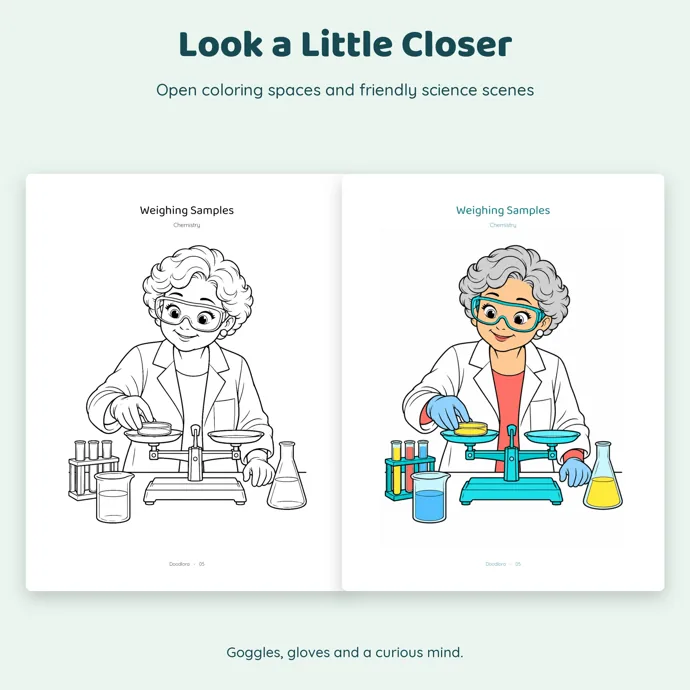
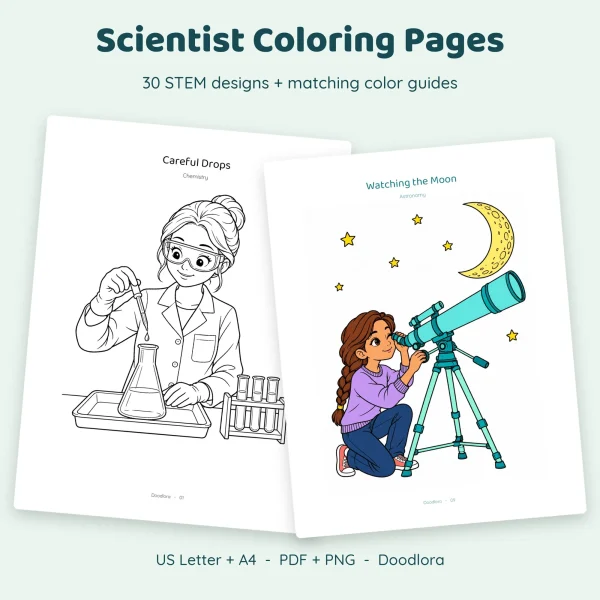
Coloring pages are a quiet way to start or end a STEM session, and they give a child a picture to point at when you talk about what scientists do. Our STEM coloring book has 30 designs plus a cover, and each page prints the name of its field under the title, so a child can see which kind of science they are coloring.
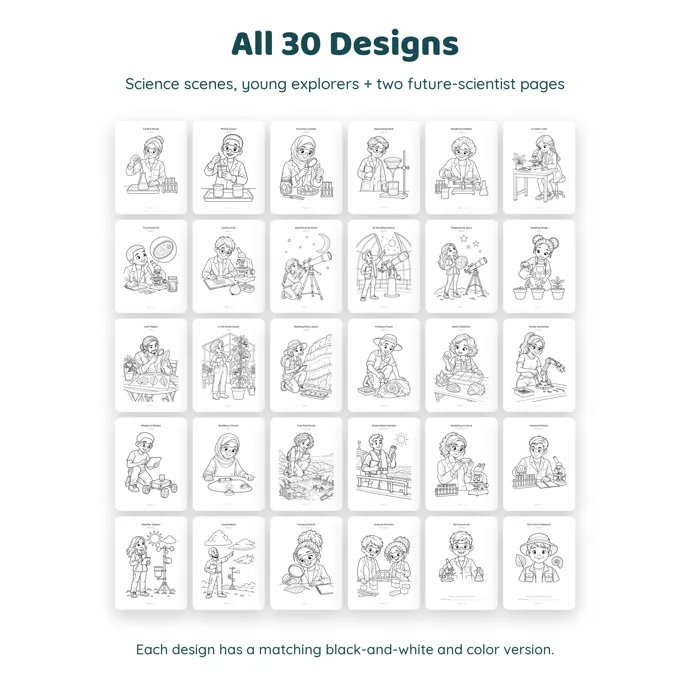
The 30 designs split by field like this:
| Field | Pages | What’s drawn |
|---|---|---|
| Chemistry | 01 to 05 | Dropping liquid into a flask, mixing colors, crystals, filtering sand, weighing a sample |
| Microscopy | 06 to 08 | A microscope at a desk, pond life in a bubble, sketching cells beside an onion |
| Astronomy | 09 to 11 | A telescope under the moon, an observatory dome, a star chart |
| Botany | 12 to 14 | Watering seedlings, comparing leaf shapes, a tomato plant in a greenhouse |
| Geology | 15 to 17 | Rock layers in a cliff, uncovering a fossil, sorting rocks |
| Robotics | 18 to 20 | A robot arm, a wheeled rover steered from a tablet, a battery and bulb circuit |
| Oceanography | 21 to 22 | A tide pool, a water sample on a boat |
| Medical research | 23 to 24 | A culture dish beside a microscope, notes beside test tubes |
| Meteorology | 25 to 26 | A weather station, a person pointing at clouds |
| Young scientists and Future Me | 27 to 30 | Kids with a magnifier, two kids building a craft-stick bridge, and two “what will you discover?” pages |
The people on the pages are drawn characters, not portraits of real scientists. They include girls and boys, adults of different ages and kids of different backgrounds, which helps when you want a child to picture themselves in the job.
Two ways to use them with the activities above:
- Before an activity, hand out the page that matches it. The craft-stick bridge page (28) goes with the paper bridge challenge, and the weather station page (25) goes with the temperature graph. Ask the child to find every tool in the picture.
- After an activity, have the child color the matching page while you ask what they found. It works as a calm wind-down when a group is still excited.
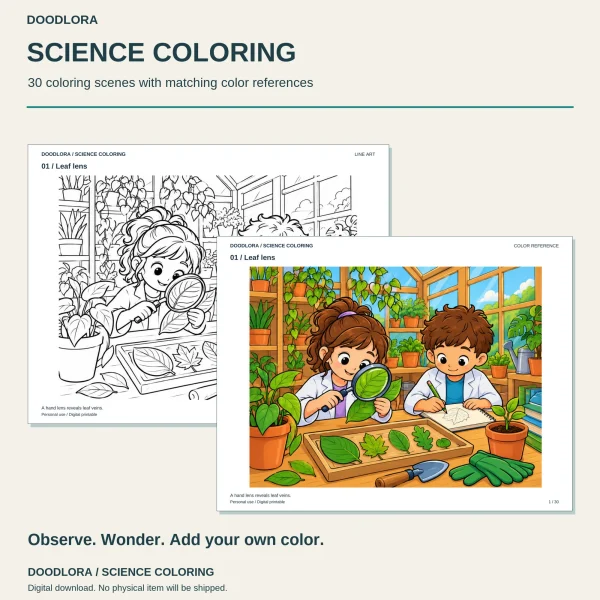
If your child is younger or likes simple machines, our science coloring pages take a different approach. Every one of the 30 landscape pages shows the same two cartoon kids with one idea, such as a magnet, a prism or a pulley, and prints one plain sentence about it under the picture.
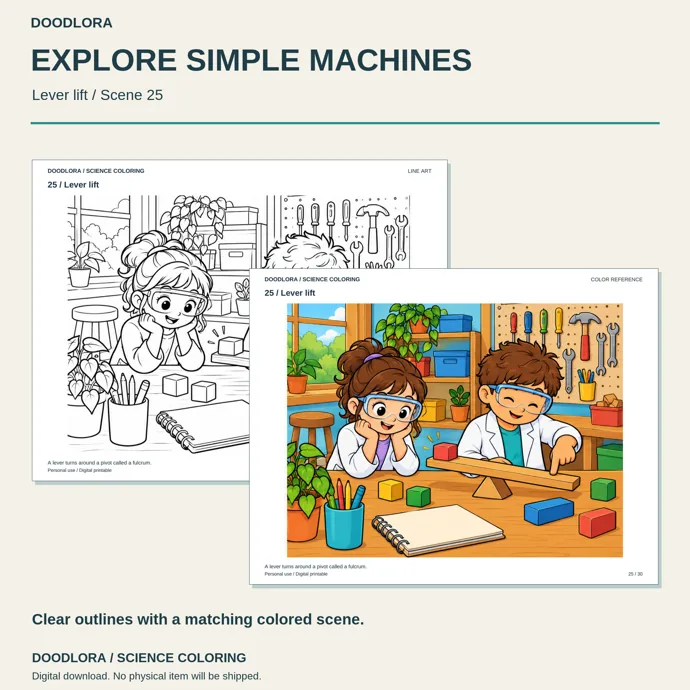
Scene 25 pairs neatly with a hands-on lever: a ruler balanced on a pencil, with coins on each end. Pages 25 to 30 cover the lever, pulley, ramp, gears, wheel and axle and a sound page, so you can run a simple machines week with one page a day.
STEM careers: the jobs behind the letters
STEM careers are jobs that use science, technology, engineering or math every day. Because there is no single official list, a “STEM career” on one website might include doctors and psychologists and on another might not. Here is a practical way to explain them to a child, sorted by letter.
| Letter | Example jobs | What a child might see them do |
|---|---|---|
| Science | Chemist, biologist, geologist, astronomer, meteorologist, oceanographer, medical researcher | Test samples, study fossils, track storms, look through telescopes |
| Technology | Software developer, cybersecurity specialist, IT technician, data analyst | Write code, fix computers, keep accounts safe |
| Engineering | Civil engineer, mechanical engineer, robotics engineer, environmental engineer | Design bridges and roads, build robots, plan clean water systems |
| Math | Statistician, actuary, accountant, math teacher | Turn numbers into decisions, predict risks, teach |
Many STEM careers mix letters. A robotics engineer writes code, a meteorologist runs computer models, and a medical researcher depends on statistics.
Talking about STEM careers with kids
Start from what a child already likes, not from a job title. A child who collects rocks is doing a geologist’s work; one who takes apart old flashlights is thinking like an engineer. Name the job after you name the interest: “People who study rocks for their whole job are called geologists.”
The last two pages of our STEM coloring book are built for this conversation. Each one shows a kid ready for science work, with the line “Color your future. What will you discover?” and a blank that starts “I want to study.”
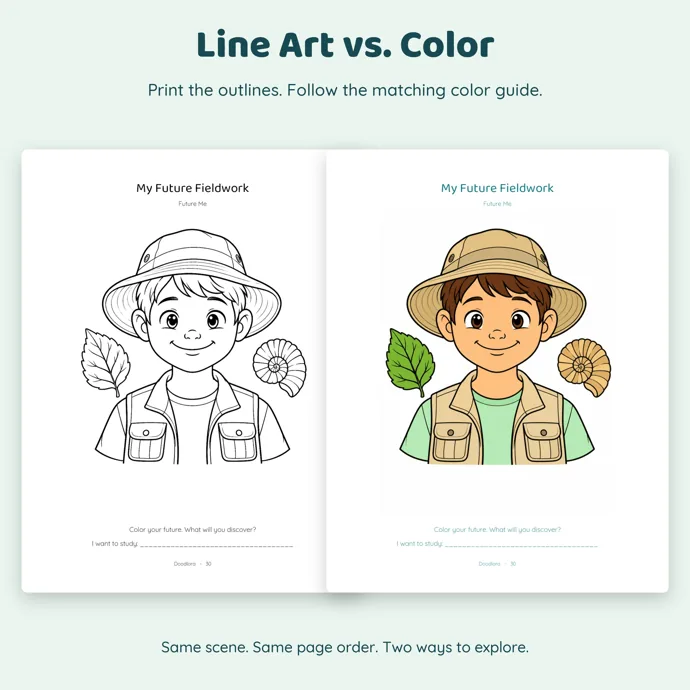
Let the child fill in the blank however they like. “Sharks” and “volcanoes” are fine answers; the point is linking a curiosity to a field. If they write something you don’t know, look up together what that kind of scientist is called.
Women in STEM: five people to know
Women have shaped every one of the four STEM fields, yet UNESCO notes that girls and women are still under-represented in STEM education and, as a result, in STEM careers, held back by biases, social norms and expectations. Learning names and stories is one small way to change what kids picture when they hear “scientist.” The five below come from different centuries and all four letters. Dates are from Wikipedia.
| Name | Years | Field | Known for |
|---|---|---|---|
| Ada Lovelace | 1815 to 1852 | Math, technology | Saw that Charles Babbage’s planned Analytical Engine could do more than calculate; often called the first computer programmer |
| Marie Curie | 1867 to 1934 | Science | Shared the 1903 Nobel Prize in Physics and won the 1911 Nobel Prize in Chemistry for discovering radium and polonium |
| Grace Hopper | 1906 to 1992 | Technology, math | U.S. Navy rear admiral and computer pioneer whose FLOW-MATIC language strongly influenced COBOL |
| Katherine Johnson | 1918 to 2020 | Math | NASA mathematician whose orbital calculations were critical to the first U.S. crewed spaceflights |
| Mae Jemison | born 1956 | Engineering, science | Engineer and physician; first African-American woman in space, aboard Endeavour in 1992 |
Ada Lovelace (1815 to 1852)
Ada Lovelace was an English mathematician and writer. Her best-known work was on Charles Babbage’s proposed Analytical Engine, a mechanical general-purpose computer that was never finished. Lovelace was the first to recognize that the machine could be used for more than pure calculation, which is why she is often considered the first computer programmer. For kids, her story shows that technology starts as an idea on paper.
Marie Curie (1867 to 1934)
Marie Curie was a Polish and naturalized-French physicist and chemist. She shared the 1903 Nobel Prize in Physics with her husband, Pierre Curie, for research on radioactivity, then won the 1911 Nobel Prize in Chemistry for discovering the elements radium and polonium. Pair her with the chemistry pages (01 to 05) of the coloring book and talk about what an element is.
Grace Hopper (1906 to 1992)
Grace Hopper earned a Ph.D. in mathematics from Yale, taught at Vassar College and joined the U.S. Navy Reserve during World War II. In 1944 she began programming the Harvard Mark I computer. Hopper developed the theory of programming languages that work on different machines and built FLOW-MATIC, which strongly influenced COBOL. The grown-up robot game above is a good lead-in: Hopper’s big idea was making instructions easier for people to write.
Katherine Johnson (1918 to 2020)
Katherine Johnson was an American mathematician who worked at NASA and its predecessor, NACA, for 33 years. She calculated trajectories, launch windows and emergency return paths for Project Mercury flights, including those of Alan Shepard and John Glenn, and worked on paths for the Apollo missions to the Moon. She received the Presidential Medal of Freedom in 2015, and her story was told in the 2016 film Hidden Figures. Her work is a strong answer for any child who asks what math is for.
Mae Jemison (born 1956)
Mae Jemison earned degrees in chemical engineering and in African and African-American studies from Stanford University, then a medical degree from Cornell. She worked as a Peace Corps medical officer in Liberia and Sierra Leone before joining NASA’s astronaut corps in 1987. In September 1992 she flew aboard Space Shuttle Endeavour on the STS-47 mission, becoming the first African-American woman to travel into space. Pair her with the astronomy pages (09 to 11).
Turning these stories into an activity
For ages 7 and up, give each child or pair one name from the table. They read a short library or encyclopedia entry, color a coloring page from the matching field and tell the group three things: what the person studied, one problem they solved and which STEM letter fits best. Plan about 30 minutes. The last question has no single right answer, and that’s the useful part, because most of these careers used two or three letters at once.
Keep the focus on the work, not on “firsts” alone. A child who learns that John Glenn asked for Katherine Johnson to check the computer’s numbers before he would fly remembers it far better than a list of awards.
Printables from this article
Related articles
Printable Coloring Pages
Is a Tomato a Fruit? Is Corn a Vegetable? Cucumbers Too
A tomato is a fruit in botany because it grows from the flower and holds the seeds, and a vegetable in the kitchen; the Supreme Court took the kitchen side in Nix v. Hedden in 1893, for the tariff only.
Printable Coloring Pages
How to Draw Food: Cute Fruit, Desserts and Snacks
Every cute food starts as a plain shape. Ink one bold outline, add the single detail that names it, color it warm with a white shine spot, and put a face on last if you want one.
Printable Coloring Pages
Types of Sushi: Nigiri vs Sashimi, Rolls and Sushi for Kids
Sushi is vinegared rice plus a topping or filling, and the shape gives each type its name: nigiri, maki, uramaki, temaki, gunkan, chirashi, inari and oshizushi. Sashimi is sliced fish with no rice. Here's how to spot each one, what to order first and which pieces have no raw fish.