 1 / 6
STEM Coloring Pages: 30 Science Scenes in Chemistry, Astronomy, Botany, Geology, Robotics and Weather
Thirty pages that move through ten areas of science, from a chemistry bench and a microscope to an observatory dome, a fossil dig, a robot arm, a tide pool and a weather station, with a different person at work on nearly every page. The last two pages ask a child to color their future self and write what they want to study, and a full color guide comes with the book.
$3.99
Buy any 3 or more printables and save 20% at checkout.
- Download right after payment — link works for 30 days, up to 5 downloads
- Files arrive as a ZIP with your license PDF inside
- Secure checkout by Stripe · Refund policy
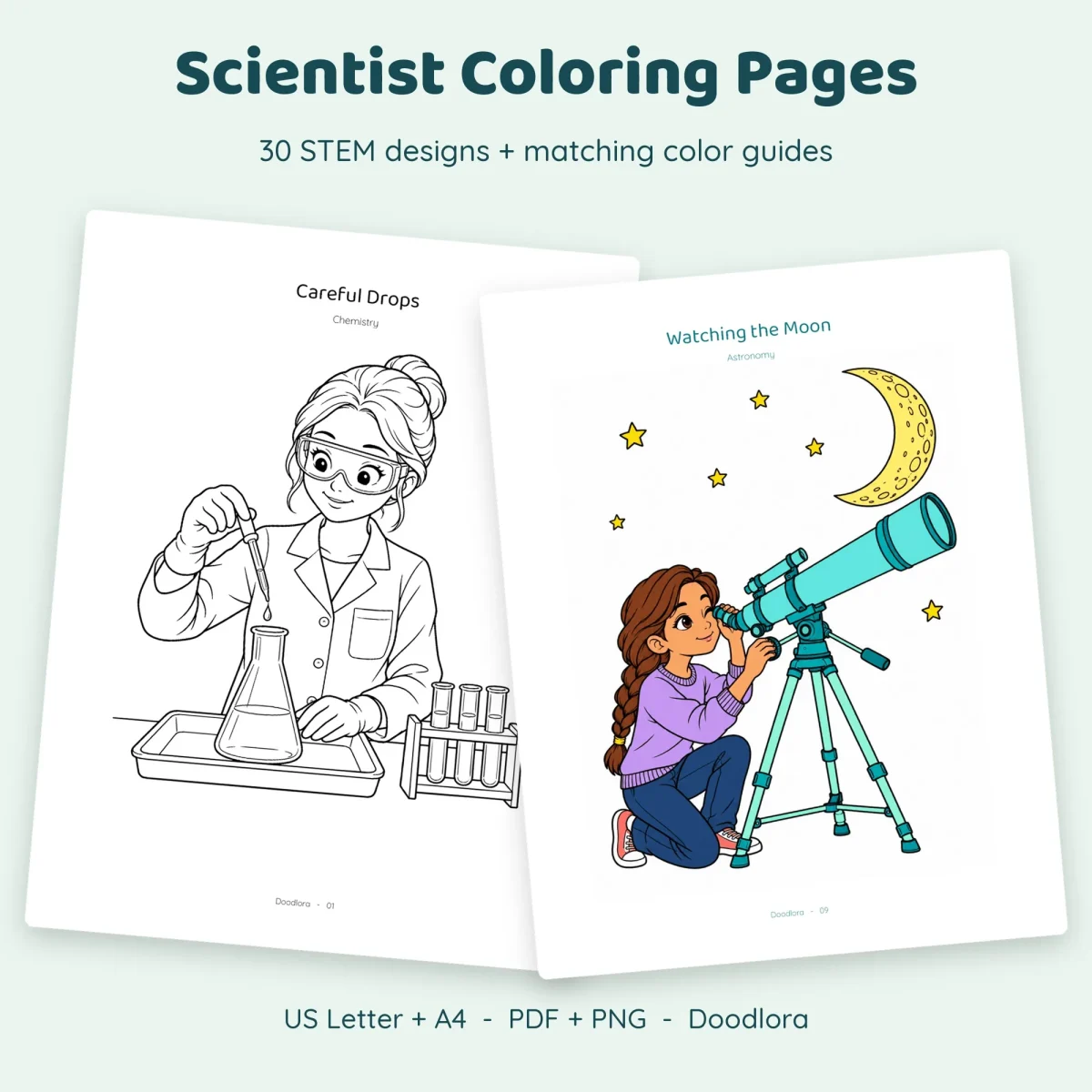
A science coloring book arranged by field rather than by experiment. Each of the 30 pages carries a short title and, under it, the branch of science it belongs to (Chemistry, Microscopy, Astronomy and so on), so the book doubles as a picture tour of what scientists in different areas actually do all day. The drawings are cartoon style with clean, medium-weight outlines and mostly white backgrounds.
Field by field
- Chemistry (01 to 05): squeezing a dropper into a flask, stirring a beaker, looking at crystals through a magnifier, filtering sand through a funnel on a stand, and weighing a dish on a balance.
- Microscopy (06 to 08): a girl at a microscope, a boy with a bubble showing a single-celled pond creature, and a student sketching cells next to an onion.
- Astronomy (09 to 11): a telescope under a crescent moon, an open observatory dome, and a girl holding a round star chart.
- Botany (12 to 14): watering seedlings in three pots, comparing leaf shapes on a sheet, and tending a tomato plant in a greenhouse.
- Geology (15 to 17): sketching rock layers in a cliff, brushing dirt off an ammonite fossil, and sorting stones into a tray.
- Robotics and circuits (18 to 20): tightening a bolt on a robot arm, steering a wheeled rover from a tablet, and a battery, switch and bulb wired into a loop.
- Ocean, medicine and weather (21 to 26): a starfish and crab in a tide pool, a water sample on a boat, a petri dish beside a microscope, notes next to test tubes, a weather station with a rain gauge, and a man pointing at the clouds.
- Young scientists and Future Me (27 to 30): a girl with a magnifier and a leaf, two kids building a bridge from craft sticks and blocks, then the two write-in pages from the FAQ.
Who is in the pictures
Almost every page has a different person: kids, teens and a few grown-ups, including a gray-haired woman at the balance and a bearded man reading the clouds, with a range of skin tones and hair, and girls in a hijab on pages 03 and 20. No page shows a famous real scientist, so children can picture themselves in any of the jobs.
Printing and coloring
Print the Letter PDF on 8.5 x 11 in paper or the A4 PDF on A4, portrait, at Actual Size. Glassware, telescopes and robot parts are drawn as large clear shapes, good for crayons or colored pencils on ordinary printer paper; try markers on one sheet first. The color guide uses teal, yellow and coral for the equipment if a child wants a model to follow. The pictures show activities to color, not instructions for experiments, so any real lab work needs a grown-up alongside.
Questions
- Which science fields are covered, and how many pages each?
- Chemistry 5 (pages 01 to 05), microscopy 3, astronomy 3, botany 3, geology 3, robotics and circuits 3, oceanography 2, medical research 2, meteorology 2, then two Young Scientists pages and the two Future Me pages. The field name is printed in small type under each title.
- What goes on the two Future Me pages?
- Page 29 shows a smiling kid in goggles and a lab coat holding a microscope and a flask, and page 30 a kid in a bucket hat and field vest between a leaf and a spiral shell. Under each picture are the line Color your future. What will you discover? and a blank line that starts I want to study:, for a child to fill in.