Wedding Planning Checklist: Timeline and Day-Of Checklist
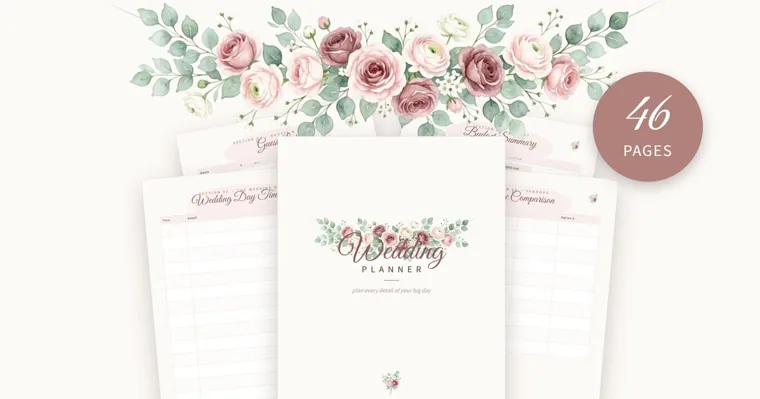
A wedding planning checklist works best as a timeline. Settle the budget, a rough guest count, the date and the venue first, then book the vendors whose calendars fill early. Invitations, flowers and attire come in the middle months, and the last eight weeks are mostly confirming details, collecting replies and handing jobs to other people.
The list below runs from 12 or more months out to the weeks after the wedding, with who usually handles each task and the step that tends to slip at that stage.
The month markers are an order of work, not deadlines anyone will hold you to. Your venue and vendor contracts set the real dates, so copy those onto your own calendar as soon as you sign. If the wedding is less than a year away, the last section shows how to squeeze the early blocks together.
| When | Main jobs | Who usually leads |
|---|---|---|
| 12+ months before | Budget, guest list draft, possible dates, venue, planner if you want one | The couple, plus anyone contributing money |
| 10 to 8 months before | Photographer, caterer, band or DJ, officiant, attire shopping, save-the-dates | The couple |
| 6 to 4 months before | Invitations, florist, hair and makeup, registry, honeymoon, cake, menu tasting, rings, transport, rehearsal dinner | The couple; the rehearsal dinner host |
| 2 months before | Mail invitations, confirm vendors, finish the timeline, write vows, final fitting | The couple |
| 1 month before | Marriage license, final headcount, seating chart, vendor balances | The couple |
| Wedding week | Timeline to everyone, payments and tips, emergency kit, rehearsal | The couple and a day-of point person |
| Day before and day of | Drop-off at the venue, rings and license, clean-up crew | The point person and wedding party |
| After the wedding | Rentals, gifts, thank-you notes, name-change paperwork | The couple, with help the morning after |
12 or more months before: budget, guest count, date and venue
These four go first because each one limits the next. The budget caps how many people you can host, the guest count decides which venues fit, and the venue’s open dates decide your wedding date. Work on them in that order, even though the venue is the fun part.
- Set a total budget and agree on who is contributing.
- Draft the guest list, even a rough one with a number at the bottom.
- Pick two or three possible dates, so one booked weekend doesn’t stall everything.
- Tour, choose and book the venue.
- Decide on a general style or theme.
- Book a wedding planner, if you’re hiring one.
Who: the two of you, plus anyone putting money in. Parents who contribute often expect a say in the guest list too, so it’s easier to talk about both at the same sitting than to find out after the venue is booked.
Easy to miss: what the venue price actually covers. Tables, chairs, in-house catering, parking, an end time for music and a backup space for rain all change which other vendors you’ll need. Ask before you sign, not after.
If the wedding fund comes out of monthly pay, the section on annual and irregular costs in our guide to making a monthly budget works for it: divide the amount you still need by the months you have left.
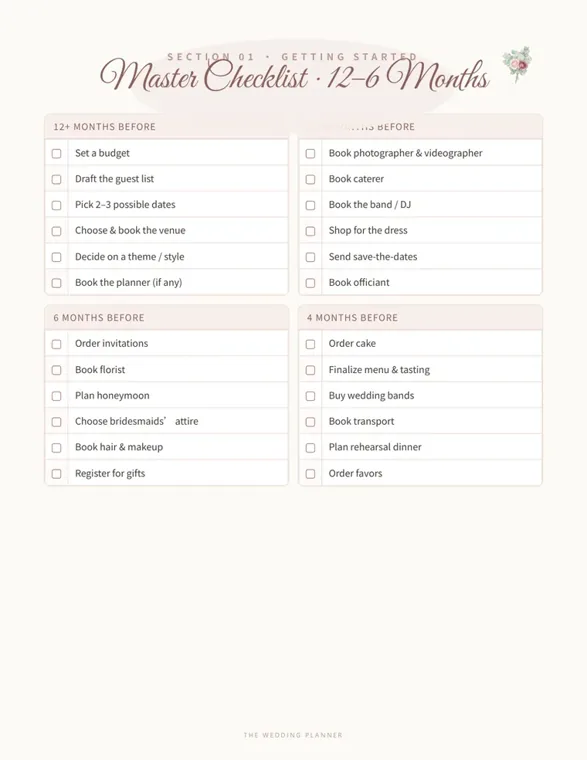
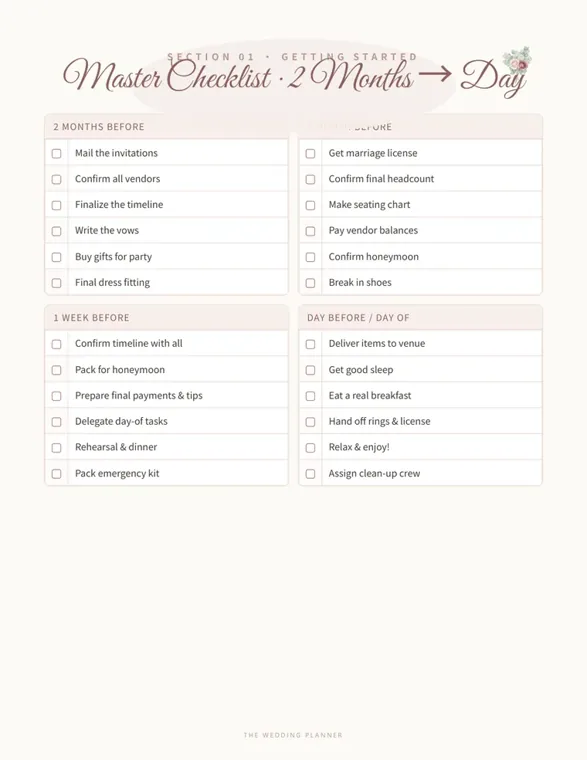
Our printable wedding planner splits this timeline across two master checklist pages, pages 10 and 11. Page 9 is a blank key dates grid with rows from 12+ months down to the day before, which is the place to turn “8 months before” into an actual date on your calendar.
10 to 8 months before: the vendors who book up early
Once the venue and date are fixed, the next bookings are the people who can only work one wedding per day. A photographer or band who is free on your date this month may not be free next month.
- Book the photographer and videographer.
- Book a caterer, if the venue doesn’t include one.
- Book the band or DJ.
- Book the officiant.
- Start shopping for the dress or suit.
- Send save-the-dates.
Who: the couple. Splitting the bookings between you works well, as long as both of you read each contract before it’s signed.
Easy to miss: save-the-dates are a promise. Anyone who gets one expects an invitation, so send them only to people you’re sure about. Guests traveling from out of town are the ones who need this early notice most.
Dress shopping starts here too, even though the final fitting is two months out, because a made-to-order dress can take months to arrive before alterations even begin.
Ask every vendor the same few questions before paying a deposit: are you free on our date, what’s included in the price, what is the deposit and payment schedule, what’s the cancellation policy, do you have insurance, and can we see full examples of your work rather than highlights.
Write each deposit and balance due date down the day you sign. Contracts scatter those dates across different months, and a balance due a few weeks before the wedding is easy to forget.
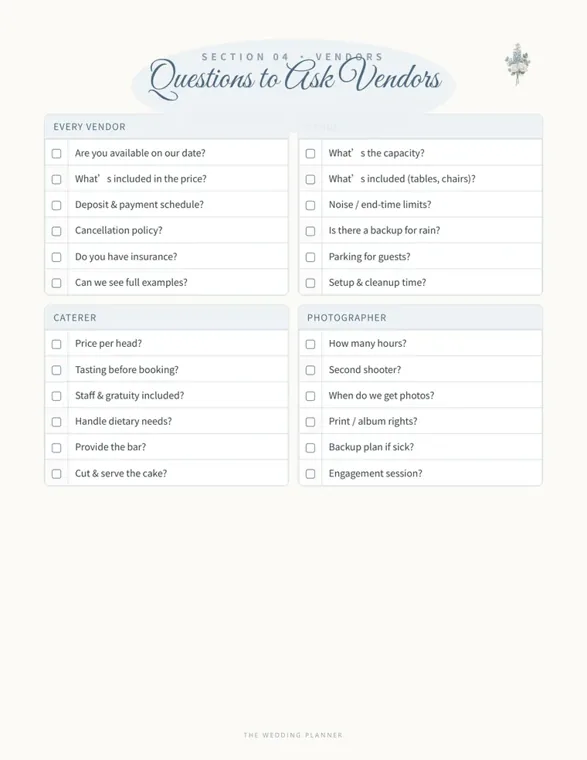
If you’d like to keep all of this on paper in a binder, the planner below has those vendor questions on page 30, comparison pages for three venues, caterers, photographers and florists, and a payment schedule page with columns for deposit, balance due and due date.
If you want the save-the-date and the invitation to match, choose the invitation design now rather than at six months. Our lemon wedding invitation suite has a save the date, invitation and reply card in the same watercolor style, edited in an offline editor and printed at home.
6 to 4 months before: invitations, flowers and the remaining bookings
The middle months fill in everything that depends on the venue, the date and the look you settled on earlier. The planner’s master checklist splits them into two lists.
At 6 months:
- Order invitations.
- Book the florist.
- Plan the honeymoon.
- Choose the bridesmaids’ attire.
- Book hair and makeup.
- Register for gifts.
At 4 months:
- Order the cake.
- Finalize the menu and go to the tasting.
- Buy wedding bands.
- Book transportation.
- Plan the rehearsal dinner.
- Order favors.
Who: mostly the couple. Whoever is hosting the rehearsal dinner should hear the date now. If a friend or relative is throwing a bridal shower, it often falls in these months; the host plans it, and you mainly need to hand over the guest list.
Easy to miss: the RSVP date on the reply card. Your caterer will want a final headcount before the wedding, so set the reply deadline early enough to leave a week or two for chasing people who never answer. Before buying stamps, take one fully assembled invitation to the post office and have it weighed. A square, thick or lumpy envelope can need more postage than a standard letter.
Two smaller traps sit in this block. Book honeymoon flights in the name on the ID you’ll travel with, even if one of you plans to change names after the wedding. And count how many people need hair and makeup before you book: everyone gets a time slot, so a long list means an early start on the wedding morning.
2 months before: invitations out and vendors confirmed
From here on, the work changes from booking to confirming. Most of what’s left is checking that everyone you hired has the same plan you do.
- Mail the invitations.
- Confirm every vendor: date, arrival time, and who will meet them at the venue.
- Finish the wedding day timeline.
- Write your vows.
- Buy gifts for the wedding party.
- Have the final dress fitting.
Who: the couple, with the venue coordinator and photographer helping on the timeline.
Easy to miss: the family photo list. Write out each grouping by name, such as “both sets of parents” or “grandparents with the couple,” and tell those relatives when to stay put after the ceremony. Otherwise the photographer waits while someone hunts for an uncle at the bar. A do-not-play list for the DJ or band is worth writing now too, while you still have the time to think about it.
The planner’s wedding day timeline page has three columns: time, detail and who. Filling in the “who” column for every line is what turns a schedule into something a friend can run while you’re getting dressed.
1 month before: marriage license, headcount and seating chart
This month has the one task with legal rules attached, and it’s easy to get the timing wrong.
- Get the marriage license.
- Confirm the final headcount with the caterer.
- Make the seating chart.
- Pay vendor balances that are due.
- Confirm the honeymoon bookings.
- Break in your wedding shoes.
Who: the couple. In many counties both of you have to apply in person with ID.
Easy to miss: the license window. Each state sets its own rules, and many have a waiting period before the license can be used, an expiration date after it’s issued, or both. Look up your county clerk’s page this month and pick an application date that lands inside both limits. The seating chart has its own trap: it can’t be finished until replies are in, so chase late replies before you start moving names around, and check that every yes also has a meal choice.
The wedding week checklist
The wedding week is when the couple stops being the people who handle everything. A day-of point person takes over: a hired coordinator, or a dependable friend who knows the timeline.
- Send the final timeline to every vendor and the wedding party.
- Pack for the honeymoon.
- Put final payments and tips in envelopes labeled by vendor.
- Hand day-of jobs to named people.
- Go to the rehearsal and rehearsal dinner.
- Pack an emergency kit.
Who: the couple, then the point person.
Easy to miss: jobs that belong to “someone.” On the day, nobody remembers that “someone” was supposed to take the gifts home. Write one name beside each job: greeting and directing vendors, holding the rings and license, giving out final payments, keeping the timeline, collecting your personal items, taking gifts and cards home, returning rentals and leading clean-up.
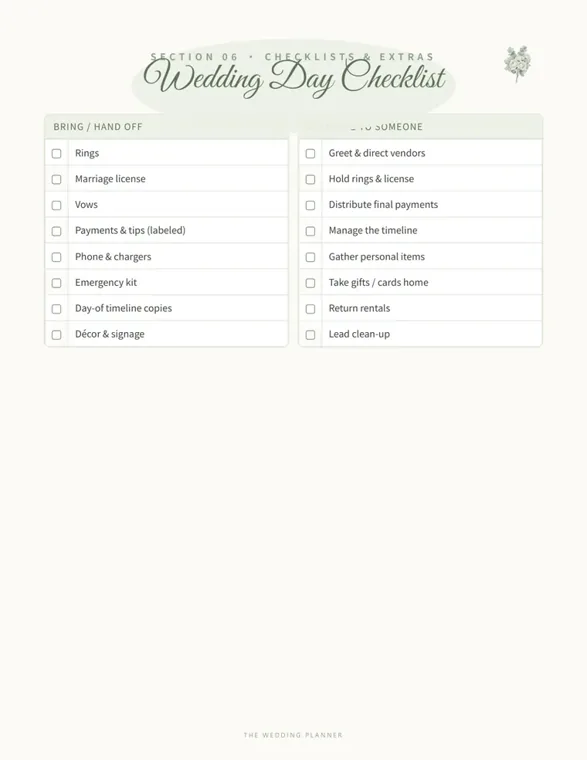
The emergency kit doesn’t need to be big. Safety pins, a small sewing kit, stain remover, pain reliever, snacks, water, flat shoes and a phone charger cover most of what goes wrong; the planner’s emergency kit list has a fuller version split into beauty and repair, and health and comfort.
The day before and the wedding day
The day before is for dropping things off and then getting out of the way.
- Deliver decorations, signs and favors to the venue.
- Hand the rings and marriage license to the person holding them.
- Get some sleep.
- Eat a real breakfast.
- Make sure the clean-up crew knows they’re the clean-up crew.
Who: the point person and the wedding party; the couple’s job is to show up.
Easy to miss: venue drop-off times and the signed license. Many venues only allow drop-off during set hours, so ask when you confirm the timeline. After the ceremony, the license has to be signed and returned to the county office that issued it. Find out who does that, whether it’s your officiant or one of you, and by when.
After the wedding: rentals, gifts and thank-you notes
The planner’s master checklist stops at the wedding day, but a few jobs come after it. The gift and thank-you tracker and the delegate list cover most of them.
- Return rentals on the date in the rental agreement.
- Bring home gifts, cards and anything left at the venue.
- Log each gift as you open it, then write the thank-you notes.
- Order certified copies of the marriage certificate if either of you is changing names.
- Pay any final invoices.
Who: the couple, with a family member or friend handling the morning-after returns.
Easy to miss: which card came with which gift. Cards get separated from boxes fast, so tape each card to its gift or write it down as you open it. The tracker in our planner has four columns, from, gift, received and thanked, so nobody’s thank-you depends on memory. For a name change, the Social Security office, the DMV and the passport office each have their own process and each will ask for proof, which is why one certified copy is rarely enough.
Planning a wedding in less than 12 months
A shorter engagement still follows the same order; the blocks just overlap. Do the 12-month and 8-month jobs in the first month or two: budget, guest count, venue, then the photographer, officiant and music right behind it. Those are the bookings that run out first.
Leave invitations on their normal schedule if you can, because they go in the mail about two months ahead. If that isn’t possible, send save-the-dates or a quick message to the guest list as soon as the venue is booked, so people can hold the date while the printed invitations catch up.
Printables from this article

Related articles
Printable Planners
How to Meal Plan: Meal Planning and Prep for Beginners
A step-by-step weekly meal planning method for beginners, from reading the calendar to the grocery list, safe leftovers, simple meal prep and busy-night backups.
Printable Planners
Budget Categories: Fixed, Variable and Easy-to-Miss Costs
Budget categories for singles, families and irregular earners, with what goes in each one, first-month estimates and the yearly costs that slip through.
Printable Planners
How to Use a Planner: Daily Plan, Weekly Review & Ideas
A step-by-step way to set up a paper or printable planner, use it for a few minutes a day, review each week and get back on track after skipped days.