Types of Owls: Owl Species in North America and the World
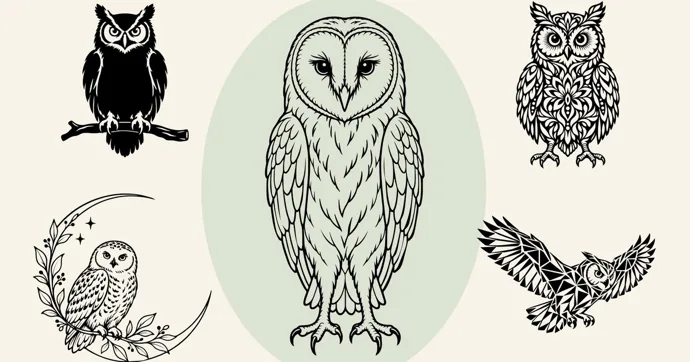
There are about 220 to 225 types of owls in the world, split into two families: the barn owls and the much larger family of “true” or typical owls. Nineteen of those species breed in the United States and Canada. The great horned owl is the most widespread of them, living everywhere from deep forest to city parks. To work out which owl you saw or heard, check five things in this order: size, ear tufts, face shape, eye color and the call.
Below, the North American owls are grouped by where you’d run into them, from backyard trees to open grassland and northern forest. Each one gets its size, range and best identification clue. After that come the giants and the famous owls of other continents, a table of calls, owl facts, the answer to what a group of owls is called, and what to do if you find an owl that’s hurt.
The 19 types of owls in the US and Canada at a glance
Lengths are bill to tail. Most owl females are bigger than males, so treat every size as a range.
| Owl | Length | Where it lives | Quickest clue |
|---|---|---|---|
| Great horned owl | 17–25 in | Almost everywhere: forest, desert, suburbs, city parks | Big ear tufts, yellow eyes, deep hoots |
| Barred owl | 16–25 in | Eastern forests, now spread into the Northwest | No tufts, dark eyes, “who cooks for you” |
| Barn owl | Up to 20 in tall | Farmland, open country, barns and silos | White heart-shaped face, dark eyes |
| Spotted owl | About 17 in | Old-growth forest in the West | Like a barred owl but spotted and barred below |
| Great gray owl | 24–33 in | Northern and mountain conifer forest | Huge gray face, yellow eyes, white “bow tie” |
| Snowy owl | About 21–25 in (males) | Arctic tundra; some come south in winter | Mostly white, yellow eyes, out by day |
| Long-eared owl | 12–16 in | Dense trees next to open ground | Tall tufts set close together, orange eyes |
| Short-eared owl | 13–17 in | Grassland, marsh, open country | Yellow eyes in black rings, floppy flight |
| Burrowing owl | 7–11 in | Open dry land with low plants | Long legs, lives in old burrows, out by day |
| Northern hawk owl | About 14–18 in | Far northern forest | Black-bordered white face, active by day |
| Eastern screech-owl | 6½–10 in | Woodlands and towns in eastern North America | Ear tufts, yellow eyes, gray or rusty |
| Western screech-owl | About 9 in | Woods near water in the West | Small tufts, whistles that speed up |
| Whiskered screech-owl | Small | Mountains of southeast Arizona and southwest New Mexico | Tufts and yellow eyes; very local |
| Flammulated owl | About 6 in | Western North America; migratory | Tiny tufts, dark eyes |
| Northern saw-whet owl | 7–9 in | Dense forest, often near water | No tufts, white Y between yellow eyes |
| Boreal owl | 8–11 in | Northern conifer forest (taiga) | White-spotted crown, yellow eyes |
| Northern pygmy-owl | 6–7 in | Western forest | Long tail, black “false eyes” on the back of the head |
| Ferruginous pygmy-owl | About 6 in | Southwest US border country into the tropics | Stocky, big feet |
| Elf owl | 5–6 in | Southwest deserts, nests in saguaro cactus holes | Sparrow-sized, puppy-like chatter |
That count of 19 comes from the Owl Research Institute’s identification guide. Some guides list 39 “North American” owls, but that wider count includes Mexico and Central America. If you came for an owl project rather than a field ID, the torn-paper owl in our bird crafts guide is a good first one.
How to tell owls apart: size, tufts, face, eyes and call
Size. Compare the owl with birds you already know. A northern saw-whet owl is about the size of an American robin, a burrowing owl is a little bigger than a robin, and an elf owl is about the size of a sparrow. The great horned owl stands about 20 inches tall with a 48-inch wingspan.
Ear tufts. The “horns” or “ears” are just feathers, and about half of the world’s owls have them. Great horned, long-eared and screech-owls show tufts. Barn, barred, spotted, great gray, snowy, saw-whet and burrowing owls have round heads with none. A few owls can lay their tufts flat, so a round head isn’t proof on its own.
Face. A barn owl’s white, heart-shaped face is unlike any other owl in North America. The great gray owl has the largest facial disc of any bird of prey, with dark rings inside it. The long-eared owl’s dark eye patches run up and down, and the short-eared owl’s run sideways.
Eye color. Most owls here have yellow eyes. The useful exceptions are the dark-eyed ones: barn owl, barred owl and flammulated owl. Long-eared owls usually have orange eyes. At night a flashlight won’t tell you much, so this clue works best on a daytime roost.
Call. You’re far more likely to hear an owl than see one. Washington’s wildlife department says as much, and its call descriptions are the core of the table further down.
Time of day and habitat. An owl hunting in daylight narrows the list fast: burrowing, short-eared, snowy, northern hawk owl and northern pygmy-owl are the usual suspects. An owl standing on the ground beside a burrow in dry grassland is almost certainly a burrowing owl.
Big owls you might hear near home
These four are the large owls of woods, farms and parks. The great horned owl and the barred owl are the two you’re most likely to hear hooting from a backyard.
Great horned owl
The great horned owl is the most widespread owl in North America. It shows up in dense forest, open woodland, clear-cuts, desert, golf courses, cemeteries and city parks. It’s 17 to 25 inches long and heavily built, with a barrel-shaped body.
- Looks: Mottled brown above, pale below with dark crosswise bars, a white throat patch and big ear tufts. The tufts are why some people call it the cat owl.
- Eyes: Large and yellow.
- Call: Four or five deep hoots in a rhythm often written as “who’s awake, me too.” Listen in the early evening and before dawn.
- Watch for: Crows and jays mobbing a perched owl, diving at it and calling. That racket is often how a daytime great horned owl gets found.
Barred owl
A barred owl is about as big as a great horned owl, 16 to 25 inches long, but it has a round head with no tufts. Its eyes are dark brown and can look black from a distance.
- Looks: Gray-brown with crosswise bars across the throat and upper chest and up-and-down streaks on the belly.
- Where: Native to eastern North America. It has spread west through Canada and reached the Pacific Northwest. In Washington it was first recorded in 1972, and there it now crowds out the spotted owl.
- Call: “Who cooks for you, who cooks for you-all,” ending on a falling note.
Barn owl
The barn owl is the owl found across more of the world than any other. In North America the white, heart-shaped face and dark eyes make it easy to name if you get a look.
- Size: Long legs make it up to 20 inches tall, with a 39-inch wingspan.
- Looks: Golden-buff back, very pale underparts, no ear tufts.
- Where: Farmland and open country. It got its name from nesting in barns, silos and sheds, and it hunts mostly rats and other rodents.
- Call: Not a hoot. It gives a long, raspy, hissing scream that sounds like canvas being ripped.
Spotted owl
The spotted owl lives in old-growth forest in western North America, from British Columbia to Mexico. It averages about 17 inches long with a 45-inch wingspan. It looks like a smaller barred owl, so check the belly: a barred owl is streaked there, while a spotted owl has a mix of spots and bars. The northern spotted owl is listed as threatened, and habitat loss and competition from barred owls are the pressures on it.
Small owls in backyard trees and woodlots
Small owls are easy to miss because they’re tiny, stay still and hide in cavities or dense branches. Most of them nest in tree holes, often old woodpecker holes.
Eastern screech-owl
This is the small eared owl of eastern North America, from Canada to Mexico. It’s 6½ to 10 inches long, stocky and short-tailed, with yellow eyes and ear tufts. It comes in two colors, gray or rusty red, and the rusty birds are more common in the south. It handles towns and suburbs better than most owls, though it’s strictly nocturnal and rarely noticed. Its call is a descending, whinny-like trill that some compare to a miniature horse.
Western screech-owl
The western screech-owl replaces the eastern one in the West. It averages about 9 inches long, dark brown or gray with small ear tufts. It likes woods near water and nests in tree cavities or nest boxes. To hide, it stretches tall and pulls its wings in tight until it looks like a dead stub on a branch. The call is a slow run of short, mellow whistles that speeds up and drops slightly at the end.
Northern saw-whet owl
The saw-whet is 7 to 9 inches long, about the size of a robin, and one of the smallest owls in North America. It has a round head with no tufts, yellow eyes, a white Y between the eyes and brown streaks down a pale chest. In winter it moves from higher ground down into valleys. The call is a steady whistled toot, about two per second, which some people say sounds like a saw being sharpened on a whetstone.
Northern pygmy-owl
At 6 to 7 inches including its long tail, the pygmy-owl gets mistaken for just another small brown bird. It hunts in daylight and sometimes turns up near winter bird feeders, hunting the small birds there. The best mark is on the back of the head: two black patches that look like eyes. Its call is a soft, hollow toot, about one every two seconds.
Elf owl
The elf owl is the smallest owl in the world by weight. It’s 5 to 6 inches long and weighs about 1.4 ounces on average. It breeds in the desert Southwest, in California, Arizona, New Mexico and Texas, and often nests in old woodpecker holes in saguaro cactus. Look for pale yellow eyes with thin white eyebrows. It eats mainly insects and calls at dusk and before dawn with a high whinny or chuckle that sounds a little like a puppy.
Owls of open country: grassland, desert and tundra
These owls live where there are few trees, and several hunt in daylight. That makes them the easiest owls to actually see.
Burrowing owl
The burrowing owl stands on long gray legs, longer than any other owl’s. It’s 7 to 11 inches long, a little bigger than a robin, brown with white spots above, and it has no tufts but bold white eyebrows.
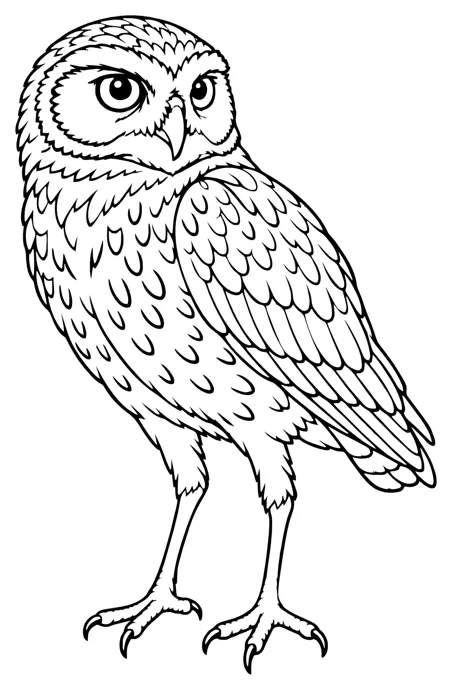
- Where: Grassland, rangeland, farm country and desert, anywhere open and dry with low plants. It rarely digs its own burrow. It moves into old burrows made by prairie dogs, ground squirrels, badgers or foxes.
- When: Often out during the day, but it hunts most at dawn and dusk.
- Clue: An owl standing on the ground by a hole, bobbing its head when it’s bothered.
Short-eared owl
The short-eared owl is a medium owl of grassland and marsh, 13 to 17 inches long with a 33- to 43-inch wingspan. Its tufts are so short you usually can’t see them. The yellow-orange eyes sit in black rings that look like heavy mascara, inside a pale facial disc. It hunts over open ground in daylight with a loose, floppy wingbeat that’s often called moth-like or bat-like.
Long-eared owl
The long-eared owl is the short-eared owl’s look-alike from the woods. It’s slim, 12 to 16 inches long, with tall tufts set close to the middle of the head and usually orange eyes. It roosts and nests in dense stands of trees, often several owls to one roost, and hunts over open ground nearby. To tell the two apart, look at the dark around the eyes: up-and-down on the long-eared, sideways on the short-eared. The long-eared is also streaked all the way down its belly, while the short-eared’s streaks stop at the chest.
Snowy owl
The snowy owl is the only owl that’s mostly white, and in North America it’s the heaviest owl. Males run about 21 to 25 inches long. Adult males are close to pure white, while females and young birds are speckled and barred with brown. It has bright yellow eyes and no visible tufts.
Snowy owls breed on the Arctic tundra. They wander widely, and in some winters large numbers move south, some as far as the northern US. Unlike most owls, a snowy owl is often active in daylight.
Northern forest owls: the great gray, boreal and hawk owl
These three live mostly in Canada, Alaska and northern or mountain forests. Seeing one in the lower 48 usually means a trip north or into the mountains.
Great gray owl
By length, the great gray owl is the largest owl in the world: 24 to 33 inches, with a wingspan that can top 5 feet. Most of that is fluffy feathers, and it weighs far less than an eagle-owl. It has a huge round gray face with no tufts, yellow eyes inside dark rings, a white “bow tie” under the bill and the longest tail of any owl. It breeds from Alaska across Canada and south in the mountains to northern California, Idaho, western Montana, Wyoming and northeastern Minnesota, usually in conifer forest near meadows or bogs. Its call is a slow series of very deep “who” notes.
Boreal owl
The boreal owl is a small owl of the northern conifer forest, 8 to 11 inches long, with females larger than males. Look for yellow eyes and an olive-brown crown covered in small white spots. It’s active at night in hard-to-reach forest, so it’s rarely seen. It looks like a saw-whet owl, but the saw-whet is smaller and has no spotted forehead.
Northern hawk owl
The northern hawk owl is one of the few owls that’s often active in the daytime. It’s 14 to 18 inches long, with a white face framed in black, yellow eyes and a yellow bill. It stays in the far north most years and sometimes moves south in numbers.
Rare and local owls of the Southwest and mountain West
Flammulated owl. About 6 inches long with a 14-inch wingspan, it looks like a western screech-owl at a quarter of the weight. Its tufts are barely visible, its eyes are dark and its voice is different. It’s a migratory owl of western North America.
Whiskered screech-owl. It’s a small eared owl with yellow eyes. In the US it lives only in the mountains of southeastern Arizona and southwestern New Mexico, and its range runs south through Mexico to Nicaragua.
Ferruginous pygmy-owl. About 6 inches long and stocky, with oversized feet and talons. It reaches the US only in the Southwest, including south-central Arizona, and it’s one of the most common owls in Central and South America.
Types of owls around the world
Owls are found in all regions of the Earth except the polar ice caps and some remote islands. A few North American owls, like the barn owl, great gray owl, snowy owl, long-eared owl and short-eared owl, also live in Europe or Asia. These are some of the best-known owls of other continents.
Eurasian eagle-owl
The Eurasian eagle-owl is one of the two largest owls in the world. It’s 22 to 30 inches long with a wingspan of 4 feet 4 inches to 6 feet 2 inches. Its orange eyes and big ear tufts are distinctive, set on a body mottled in tawny and blackish brown. It lives across Europe and Asia, mostly in mountains and rocky country near woodland edges, and occasionally in city parks.
Blakiston’s fish owl
Blakiston’s fish owl ties the eagle-owl for the title of largest owl, and on average it’s a little heavier. It’s 24 to 28 inches long with a wingspan of up to 6 feet 3 inches. Its ear tufts are broad and ragged and hang to the side instead of standing up. It lives along rivers in old forest in the Russian Far East, China and Japan, where it needs water that doesn’t freeze in winter to catch fish.
Tawny owl
The tawny owl is the common woodland owl of Europe, 15 to 18 inches long, with a big round head, no tufts and dark brown eyes. Its back is either brown or gray. It nests in tree holes and stays on one territory all year. Its ears are set at different heights, which helps it pinpoint prey by sound.
Little owl
The little owl is about 8½ inches long, with a flat-topped head, a stern frowning face, yellow eyes and white eyebrows. It lives across Europe, North Africa and Asia east to Korea, in farmland, woodland edges, steppe and semi-desert. It’s also called the owl of Athena. Its scientific name, Athene noctua, honors the Greek goddess Athena, whose symbol of wisdom was an owl.
The smallest and largest owls side by side
| Smallest | Largest | |
|---|---|---|
| Species | Elf owl | Eurasian eagle-owl and Blakiston’s fish owl (great gray owl is longest) |
| Length | About 5¼ in | Eurasian eagle-owl females up to 30 in |
| Weight | As little as 1 oz | Up to about 9¼ lb |
| Wingspan | About 10½ in | Up to about 6 ft 3 in |
| Where | US Southwest and Mexico | Eurasia; Russian Far East and Japan |
Owl calls: which owl did you hear?
If you heard it at night and never saw it, start here. The descriptions come from Washington’s wildlife department and the species accounts listed under the table.
| What you heard | Likely owl |
|---|---|
| Four or five deep hoots, “who’s awake, me too” | Great horned owl |
| “Who cooks for you, who cooks for you-all,” falling at the end | Barred owl |
| Long raspy hiss-scream, like canvas ripping | Barn owl |
| Short whistles speeding up like a bouncing ball | Western screech-owl |
| A descending, horse-like whinny or trill | Eastern screech-owl |
| Steady whistled toots, about two a second | Northern saw-whet owl |
| One soft hollow toot every two seconds | Northern pygmy-owl |
| Slow series of very deep “who” notes | Great gray owl |
| Scratchy barks, “waowk, waowk,” over a field | Short-eared owl |
| High puppy-like whinny or chuckle in the desert | Elf owl |
Young great horned owls beg with a high, scratchy screech well into summer. It sounds a lot like a barn owl but is usually shorter and less raspy, so don’t log a barn owl from one scream.
Owl facts worth knowing
- Heads, not eyes, do the turning. An owl’s eyes are fixed in its skull, so it turns its whole head, up to about 270 degrees either way. It can’t spin all the way around. Owls have 14 neck bones, twice as many as people.
- They’re farsighted. An owl can’t focus on anything very close to its eyes, so it feels prey at close range with hairlike feathers on the bill and feet.
- Silent flight. Soft, comb-edged flight feathers muffle the sound of the wings, so prey doesn’t hear the owl coming.
- Lopsided ears. In many owls, one ear opening sits higher than the other. The tiny difference in when a sound reaches each ear lets the owl pinpoint prey in the dark.
- Females are usually bigger than males.
- Pellets. Owls swallow prey whole and cough up the fur and bones in a pellet, from ½ inch to 4 inches long. Fresh pellets and white droppings under a tree are a good sign an owl roosts above.
What is a group of owls called?
A group of owls is called a parliament. It comes from the old English “terms of venery,” the traditional collective names for animals, and you’ll mostly see it in word lists and trivia. In real life you rarely see a group at all, because most owls live alone. The exceptions are the burrowing owl, which is sociable, and the long-eared owl, which often shares a roost with others of its kind.
How to find owls without bothering them, and what to do about an injured owl
During the day, scan dense trees, especially conifers, for an owl-shaped lump. Look for white droppings on branches and pellets on the ground. Listen for crows or jays scolding something in a tree. At dusk, stay quiet and listen. Washington’s wildlife department asks people not to disturb owls during the late-winter to spring nesting season.
- Injured owl: Contact a wildlife rehabilitation facility right away. Your state or local wildlife office keeps a list of rehabilitators and can tell you who serves your area. Don’t try to keep or care for it yourself. Owls are federally protected, and only licensed rehabilitators may legally transport and keep them.
- An owl swooping at you: Attacks are rare, and an owl will often hoot repeatedly first to warn people away from a nest. Wave your arms, protect your head and face, leave the area, and report it to your state wildlife agency or the land manager.
- Owl pellets in class: A few people have caught Salmonella from handling owl pellets at school. Wash hands after any pellet activity.
Using owl clipart for owl reports, ID cards and crafts
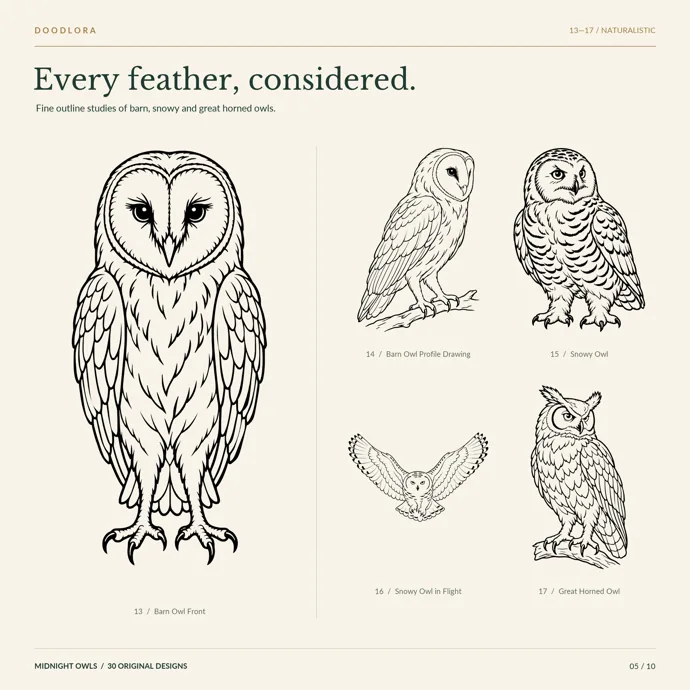
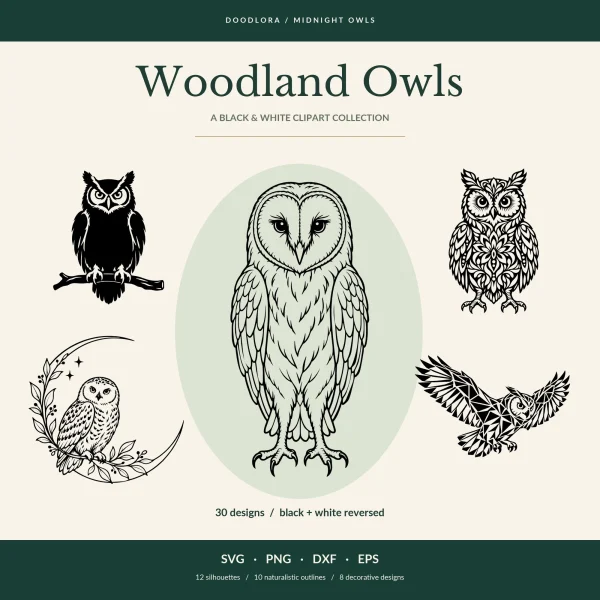
For a school report, a nature journal or a set of owl ID cards, our black and white owl clipart has 30 owl designs. Ten of them, designs 13 to 22, are line drawings of named species: two barn owls, two snowy owls, a great horned owl, a long-eared owl, a tawny owl, a burrowing owl, a little owl and a Eurasian eagle-owl head. Every design comes in a black version and a white version for dark paper.
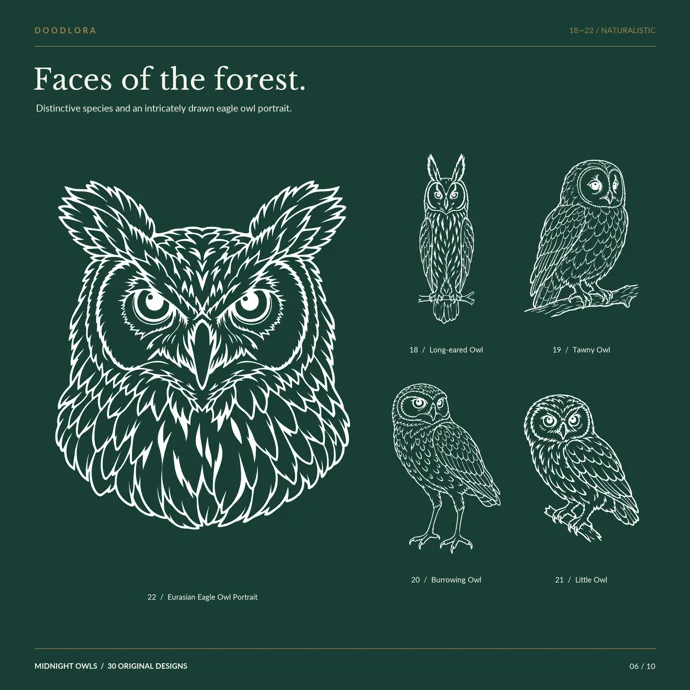
These are decorative drawings, so pair each one with the facts above instead of using the art to identify a bird. The tawny owl drawing is a good example: it gives the bird pale eyes with dark pupils, while a real tawny owl’s eyes are dark brown.
A simple ID card that works for a class:
- Print one species drawing per card and color it from a photo in a field guide.
- Under the drawing, write four lines from this guide: length, where it lives, eye color and the call.
- Add a check box for “heard it” and one for “saw it” so the cards double as a backyard log.
- Sort the deck into “has ear tufts” and “no ear tufts” as a first quiz.
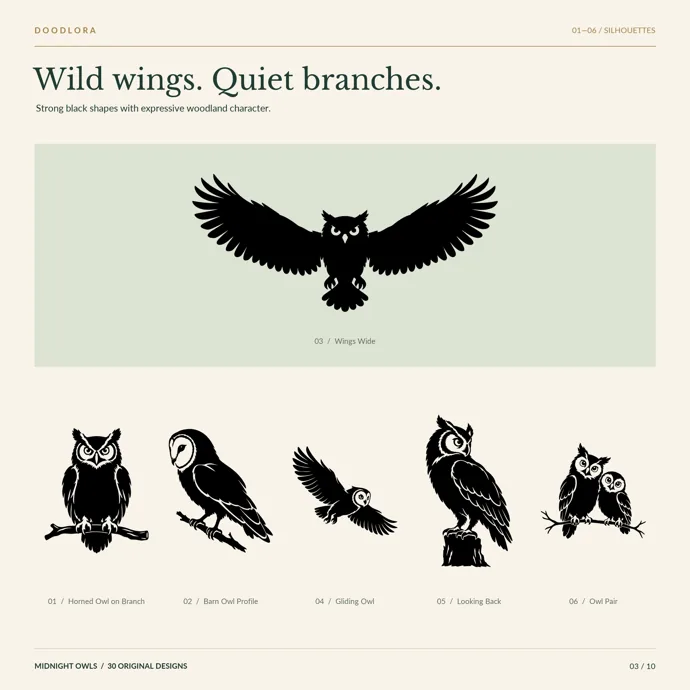
The first 12 designs are bold silhouettes with the eyes and feathers cut out as thin lines, which suit stickers, shirts and cut projects on a cutting machine. The fine line drawings have many small separate pieces, so cut a test piece first. This set also has a commercial license tier; the terms are on the product page.
For more hands-on projects with woodland animals, see our animal crafts guide. If you’re new to working with clipart files, how to use clipart covers the basics.
Printables from this article
Related articles
Clipart & SVG Cut Files
How to Draw a Truck: Easy Pickup, Big Rig and Cartoon
Split a pickup into three parts before you draw a single wheel: a bed, a cab and a hood. Keep the roof about 2.2 wheels tall and the bed rail level with the hood, and the truck looks right even before the details go on.
Clipart & SVG Cut Files
How to Draw a Train: Steam Engine, Cars and Tracks
Split the page into a 10-square grid, lay a long boiler tube across the middle, set a box cab at the back and a tall stack at the front, hang two big driving wheels under the cab end, then couple cars behind and run the rails to a vanishing point.
Clipart & SVG Cut Files
Hawk vs Falcon: Wings, Size, Hunting Style and Eagles
A falcon has long, narrow wings that taper to sharp points and flies on steady, quick wingbeats; a hawk has broader wings with rounded tips and either soars in slow circles or flaps hard and glides. Falcons kill with a notched beak and hawks with their talons, and eagles are the largest, heaviest-billed members of the hawk family.