Solar System Project Ideas: Make a Model or Scale Model
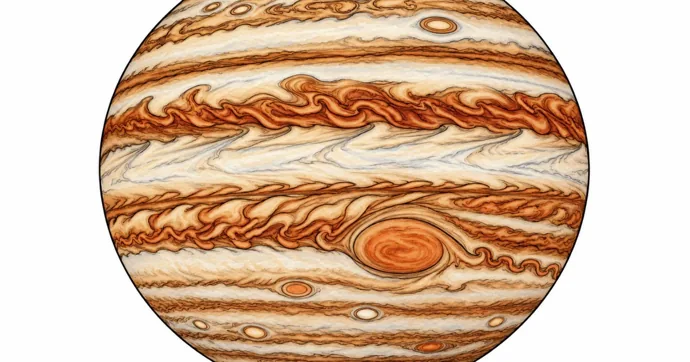
The best solar system project for a child depends on one question: does the teacher want the planets in order, or to scale? Most school projects only need the eight planets in the right order with Jupiter clearly the biggest. A kindergartner can do that on a paper plate in about 30 minutes. A 4th grader can build a hanging foam ball model over two evenings. A true scale model is a different job, because in NASA’s numbers Neptune is about 30 times farther from the Sun than Earth.
Read the assignment sheet before buying anything. If it says “to scale,” use the distance or size projects for grades 5 to 8 below. The grades and times in this list are our rough guide for one child working with an adult nearby, not measured results.
| Project | Best grades | Hands-on time | Main supplies | Shows |
|---|---|---|---|---|
| Paper plate solar system | K–2 | 30–40 min | Paper plate, paper circles, glue stick | Order |
| Planet order trail and garland | K–2 | 30 min | Printed trail page, string, tape | Order and names |
| Play dough planet lineup | K–1 | 15–20 min | Play dough, paper strip, marker | Order and size ranking |
| Hanging foam ball mobile | 3–5 | 2 sessions, about 90 min total | Foam balls, paint, skewers, fishing line, hoop | Order in 3D |
| Shoebox solar system | 3–5 | 60–90 min, plus drying | Shoebox, black paint, thread, small planets | Order in a scene |
| Orbit poster | 3–5 | 60–90 min | Poster board, string, pencil, markers | Orbits and the asteroid belt |
| Planet book from coloring pages | 3–6 | Several 30-minute sittings | Planet coloring pages, cardstock, stapler | One fact page per planet |
| One-planet report board | 3–6 | 2–3 evenings | Trifold board, printed pages, glue stick | One planet in depth |
| Folded paper strip | 3–6 | Under 30 min | About 3 feet of receipt paper, markers | Distances to scale |
| Hallway distance model | 4–8 | 30–45 min | Tape measure, index cards, tape | Distances to scale |
| Paper circle size model | 5–8 | About 60 min | Compass, colored paper, chalk, string | Sizes to scale |
| Same-scale calculation | 6–8 | About 45 min | Calculator, NASA numbers below | Why one model can’t do both |
Planet order and sizes to check before building any solar system model
Every project below rests on the same short list of facts, and most graded mistakes come from them. Counting outward from the Sun, the planets run Mercury, Venus, Earth, Mars, Jupiter, Saturn, Uranus, Neptune. The main asteroid belt sits between Mars and Jupiter, so the four small rocky planets come first and the four giants after the belt.
Pluto is not the ninth planet. NASA calls it “a dwarf planet located in a distant region of our solar system beyond Neptune known as the Kuiper Belt,” and says it was reclassified in 2006. If the project includes Pluto, place it past Neptune and label it “dwarf planet.”
The table below uses NASA’s Planetary Fact Sheet. To get the size column, we divided each diameter by Earth’s diameter, 7,926.2 miles (12,756 km). To get the distance column, we divided each distance by Earth’s 149.6 million km, which makes Earth’s distance equal to 1. Astronomers call that unit an AU.
| Planet | Diameter (km) | Width if Earth = 1 | Distance from Sun (million km) | Distance if Earth = 1 (AU) |
|---|---|---|---|---|
| Mercury | 4,879 | 0.38 | 57.9 | 0.39 |
| Venus | 12,104 | 0.95 | 108.2 | 0.72 |
| Earth | 12,756 | 1.00 | 149.6 | 1.00 |
| Mars | 6,792 | 0.53 | 228.0 | 1.52 |
| Jupiter | 142,984 | 11.21 | 778.5 | 5.20 |
| Saturn | 120,536 | 9.45 | 1,432.0 | 9.57 |
| Uranus | 51,118 | 4.01 | 2,867.0 | 19.16 |
| Neptune | 49,528 | 3.88 | 4,515.0 | 30.18 |
| Pluto (dwarf planet) | 2,376 | 0.19 | 5,906.4 | 39.48 |
Three size facts trip kids up most often. Jupiter is the biggest, wider than Saturn even though Saturn’s rings make it look larger. Uranus is a little wider than Neptune. Venus is nearly Earth’s size, while Mars is only about half as wide. For a kid-friendly tour of what each planet is like, our space facts for kids goes through them one at a time.
Solar system projects for kindergarten to 2nd grade
At this age, the goal is the order and one or two size facts. Cut the circles yourself before the child sits down, so their job is coloring, gluing and saying the names. Stop when the eight planets are in place and named.
Paper plate solar system
Color the middle of a large paper plate yellow for the Sun, then draw eight rings around it with a crayon. Hand the child eight paper circles you cut ahead of time, with the Jupiter circle clearly the biggest and Saturn’s a little smaller. They glue one planet on each ring, starting with Mercury closest to the Sun, and you write the names under them. Plan on 30 to 40 minutes.
Kids often give Saturn the biggest circle because of its rings. Cut the rings as a separate paper band that goes around a smaller Saturn, and Jupiter stays the largest.
Planet order trail and garland
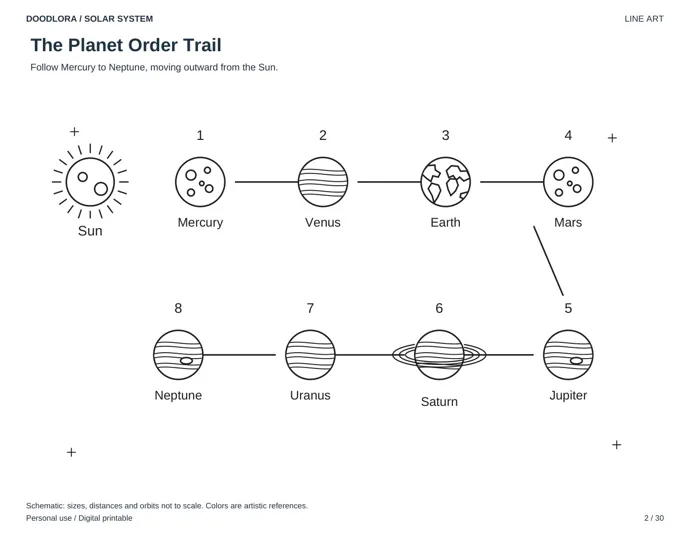
Print page 2 of our solar system coloring pages, “The Planet Order Trail.” It shows the Sun and the eight planets as simple outlined circles, numbered 1 to 8 and joined by a line. The child colors each one, and you cut the nine circles out. Tape them along a piece of string in number order, Sun first, and hang it where the child can read the names. It takes about 30 minutes.
Every planet on this page is drawn the same size, and the footer says sizes are not to scale. Tell the child the page shows order only. Then ask them to point to the planet that’s really the biggest.
Play dough planet lineup
Draw a line on a long strip of paper and mark the Sun at one end. The child rolls eight balls of play dough and lays them along the line in order. Give them one rule: Jupiter is the biggest ball, Saturn is next, and Mercury is the smallest. Plan on 15 to 20 minutes, and end by having them say the order back while touching each ball.
Soft dough balls roll into each other. Press each one gently onto the paper so it flattens a little on the bottom and stays put.
3D solar system models for grades 3 to 5
The classic three-dimensional project is a set of foam balls painted and hung in order. Third to fifth graders can do the painting, the labeling and most of the planning. An adult handles anything sharp: pushing skewers into foam, threading needles, and cutting foam. Both projects here take two sessions, because paint needs to dry overnight.
Hanging foam ball mobile
You need nine foam balls for the Sun and eight planets, water-based acrylic or tempera paint, wooden skewers, fishing line, and an embroidery hoop or two dowels tied in a cross. An adult pushes a skewer into each ball so the child can hold it like a lollipop while painting. Stand the skewers in a cup to dry overnight.
On day two, an adult pulls out the skewers and threads fishing line through each ball with a large needle. Tie the Sun in the center of the hoop. Hang the planets around it in order, with Mercury nearest and Neptune at the outer edge. Saturn’s ring can be cut from the flat rim of a paper plate and slipped over the ball. Glue it with tacky craft glue. The two sessions take about 90 minutes in total.
Solvent-based spray paint can eat into foam, so stick to water-based paint. Foam ball packs don’t come in scale sizes either. Use the largest ball for the Sun, the next for Jupiter, then Saturn, and keep Uranus and Neptune nearly the same. Write “sizes and distances not to scale” on the label so a grader doesn’t count it as an error. If foam needs cutting, an adult does it with a serrated knife.
Shoebox solar system
Stand a shoebox on one long side, open end toward the child, and have them paint the inside black. Once it’s dry, glue a yellow paper half-circle to one inside wall for the Sun. An adult pokes small holes in the box’s top with a pushpin. Then hang small paper or foam planets on thread through the holes, taping each thread on top. Plan on 60 to 90 minutes, plus drying.
A shoebox is too short for eight planets in a straight line. Hang them in a slight zigzag at different heights, so each one can be seen from the front. Put a paper key on the outside of the box listing the order.
Flat solar system posters and paper projects for grades 3 to 6
Paper projects are easier to carry to school and often score just as well. They also leave room for facts, which many rubrics ask for. These three move from the whole system to one planet.
Orbit poster
Pin a piece of string at the center of a poster board, tie a pencil to it, and draw the orbits as circles, lengthening the string each time. Add the Sun in the middle and one planet on each orbit. Draw the asteroid belt as a band of dots between Mars and Jupiter. If the teacher wants Pluto, add it past Neptune as a dwarf planet. Plan on 60 to 90 minutes.
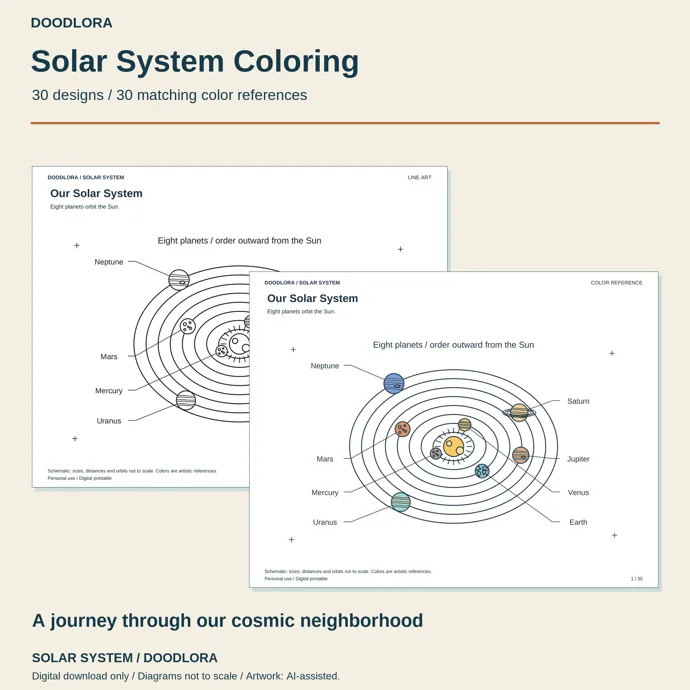
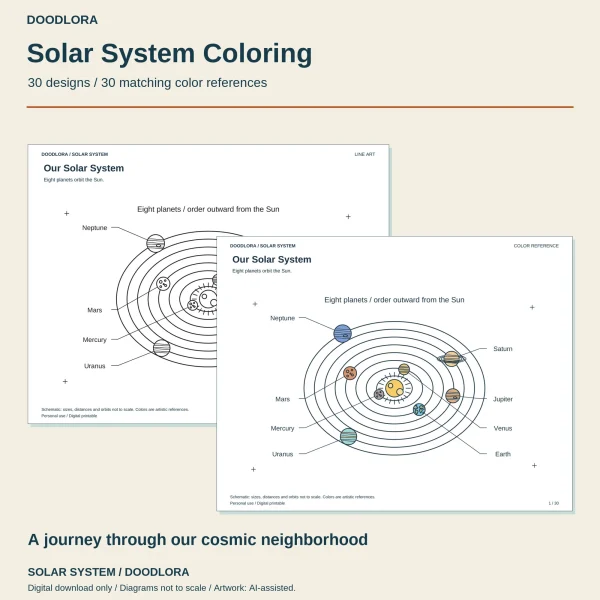
Evenly spaced orbits are fine for a poster, but they don’t show real distances. Add a small note saying the orbits are not to scale. Page 1 of our solar system set is a good model for this layout. The planets sit on evenly spaced orbits with labels, and its footer reads “sizes, distances and orbits not to scale.”
Planet book from coloring pages
A planet book gives each world its own page, which suits a child who likes to color slowly. Our planet coloring pages include a whole-globe drawing for each planet. Those are pages 1 (Mercury), 5 (Venus), 8 (Earth), 12 (Mars), 16 (Jupiter), 20 (Saturn), 24 (Uranus) and 27 (Neptune). The child colors one globe per sitting and writes three facts on the back. Then they staple the pages between two sheets of cardstock in planet order.
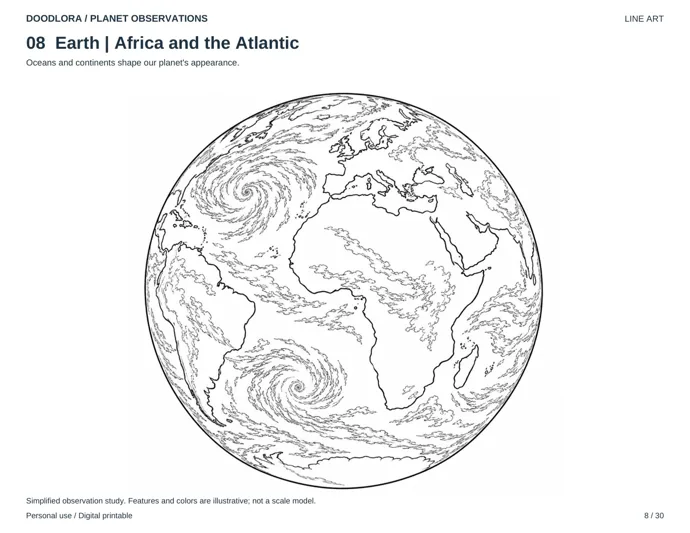
All eight globes print at roughly the same size. The set’s start-here file warns that “sizes are not comparable between pages,” so don’t cut them out and line them up as a size model. Instead, copy the “Width if Earth = 1” number from the table above onto each page. These drawings have a lot of fine line work, so the set suits older kids who enjoy detailed coloring.
One-planet report board
Some teachers assign one planet instead of all eight. Fold a trifold board into three panels. The left panel shows where the planet sits in the order and how wide it is next to Earth. The middle has a big colored picture, and the right panel holds three or four facts and one spacecraft that visited. Plan on two or three evenings.
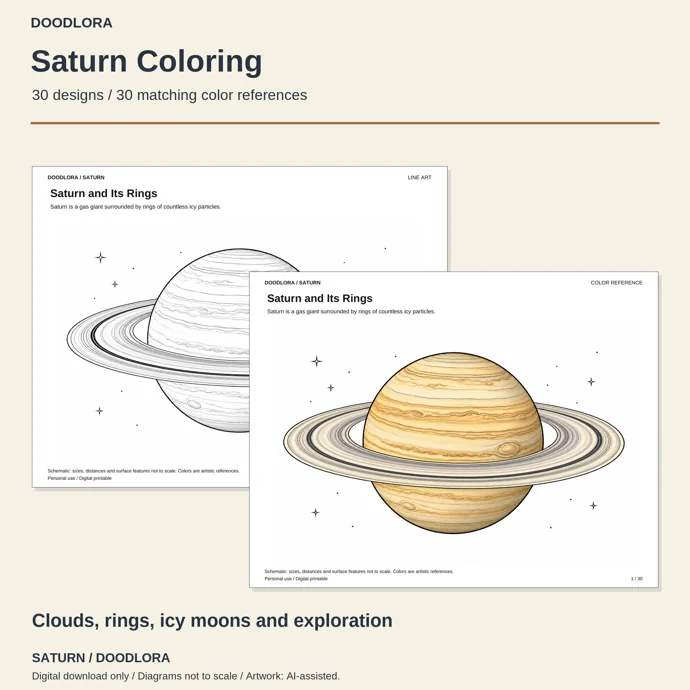
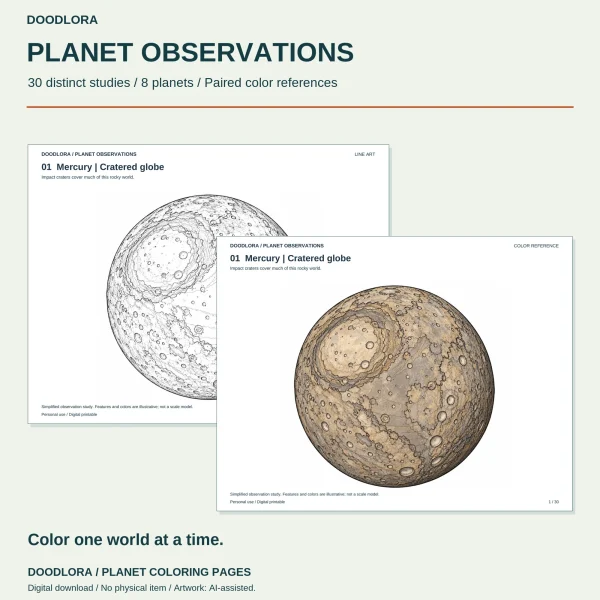
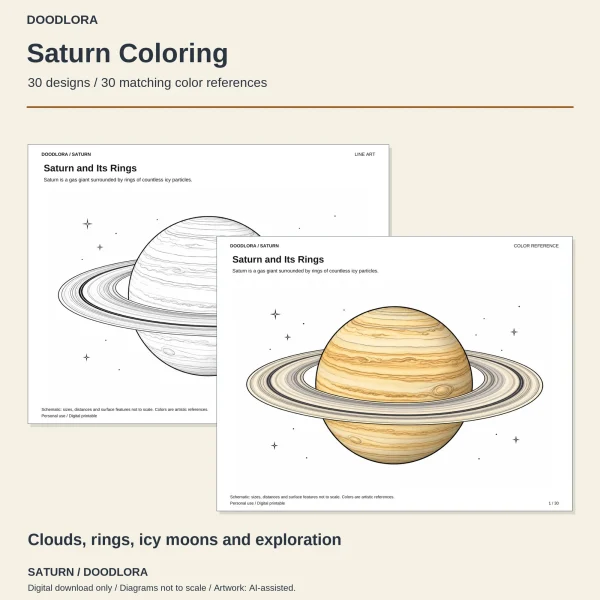
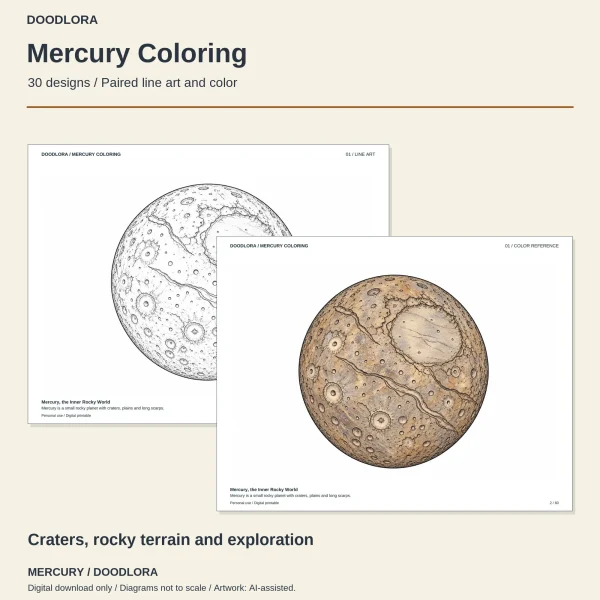
For Saturn, our Saturn coloring pages give you the center picture and the side panels. For the center, use page 1, the ringed planet among stars. For the side panels, page 7 names the ring regions and the gap between them, and page 23 shows the Cassini spacecraft at Saturn. For Mercury, our Mercury coloring pages start with the cratered globe. Design 13 is a cutaway of ice in a polar crater that sunlight never reaches. If your child draws Saturn freehand for the center panel, our guide on how to draw Saturn walks through the rings.
Kids tend to copy every caption they find. Pick three facts the child can explain out loud, because many teachers ask a question at the presentation.
Solar system distance models: a paper strip and a hallway
A distance model answers the question kids rarely expect: why are the inner planets so crowded together? These two projects use NASA’s distances, and both work for a whole class. Neither one shows planet sizes. On the same scale, the planets would be specks.
Folded paper strip
This one comes from NASA JPL’s “Solar System Scroll” lesson, which lists it at under 30 minutes. You need a strip of receipt paper or toilet paper about 3 feet long and some markers. Label one end Sun and the other end Pluto, and let the child guess where the planets go in pencil. Then fold to find the real spots:
- Fold the strip in half and mark the crease Uranus.
- Fold the Sun end to the Uranus mark. The new crease, a quarter of the way along, is Saturn.
- Fold the Pluto end to the Uranus mark. That crease, three quarters along, is Neptune.
- Fold the Sun end to the Saturn mark. The crease is Jupiter.
- Fold the Sun end to the Jupiter mark. That crease is the asteroid belt.
- Fold the Sun end to the asteroid belt mark. That crease is Mars.
- Squeeze Earth, Venus and Mercury between Mars and the Sun.
We checked the folds against NASA’s distances, using Pluto’s 5,906.4 million km as the whole strip. The Uranus fold lands at 2,953 million km against NASA’s 2,867. Saturn lands at 1,477 against 1,432, and Neptune at 4,430 against 4,515. The Mars fold is the loosest. It lands at about 185 million km, while NASA gives 228, so nudge Mars a little past its crease.
Hallway distance model
Use one foot for each AU, and the whole planet lineup fits in a 31-foot hallway. Tape a Sun card at one end, then measure from the Sun to each planet using the “Distance if Earth = 1” column. That gives Mercury about 4.6 inches out, Venus 8.7 inches, Earth 12 inches and Mars 18.3 inches. Jupiter goes at 5.2 feet, Saturn at 9.6 feet, Uranus at 19.2 feet and Neptune at 30.2 feet. Pluto would need another 9 feet beyond Neptune.
On a playground or a long sidewalk, use one yard per AU and the same column. Earth goes 1 yard from the Sun, Jupiter about 5.2 yards and Neptune about 30.2 yards. The project takes 30 to 45 minutes.
The common mistake is measuring each planet from the one before it, which adds up small errors. Measure every planet from the Sun card. Walk the line at the end: the first four planets fit within two feet, and Neptune is all the way down the hall.
Solar system scale models for grades 5 to 8
Middle school assignments often say “to scale,” and that usually means sizes or distances, not both. Ask the teacher which one, then pick one of these. The second project explains why you can’t fit both in one room.
Paper circle size model
Let Earth be 1 inch wide, and each planet’s width in inches is the “Width if Earth = 1” number in the table. Mercury is 0.38 inch, Mars 0.53 inch, Venus 0.95 inch and Earth 1 inch. Uranus is 4.01 inches, Neptune 3.88 inches, Saturn 9.45 inches and Jupiter 11.21 inches. Draw each one with a compass on colored paper, cut it out and label it. Plan on about an hour.
The Sun is the showstopper. NASA’s Sun fact sheet gives its radius as 109.2 times Earth’s, so on this scale the Sun is about 109 inches across, a little over 9 feet. Draw it on a driveway with sidewalk chalk tied to a 54.5-inch string. The string sets the radius, which is half the width, and the same goes for a compass. Kids who set the full width as the radius end up with circles twice as big as they should be.
Same-scale calculation
This one is a math project that makes a strong presentation. Start with Earth as a 1-inch ball. One AU is 149.6 million km, and Earth is 12,756 km wide, so Earth’s orbit is about 11,728 Earth-widths from the Sun. At 1 inch per Earth-width, that’s 11,728 inches, or about 977 feet. The Sun would be a ball about 109 inches across, roughly 9 feet.
Multiply 977 feet by Neptune’s 30.18 AU, and Neptune lands about 29,500 feet away. That’s about 5.6 miles, for a planet just under 4 inches wide. Students can show the result on a town map with the Sun at the school. Plan on about 45 minutes, and end by asking the class why every model on the classroom shelf says “not to scale.” That question also checks whether they’ve understood the project.
Getting a solar system project to school in one piece
A model that falls apart on the bus loses more points than a small mistake in the order. Each type of project needs a different kind of care on the way to school. Finish the night before, and do one last check of labels and order.
For hanging models, tape every fishing line to the hoop before you lift it, and carry it in a box. Shoebox models travel best with plastic wrap over the opening, so the planets don’t swing loose. Roll posters with the picture facing out, which keeps the corners from curling back.
Before it leaves the house, check five things. Are the planets in order from the Sun? Is Jupiter bigger than Saturn? If Pluto is included, is it marked “dwarf planet”? Is the asteroid belt between Mars and Jupiter? Does the label say whether sizes and distances are to scale? Those five catch most of the marks teachers take off.
Younger kids who want more space play after the project is done can try our space activities for preschoolers, with games, hunts and a moon diary. Our personal license covers a child’s project at home, and it also lets a teacher print the pages for their own students. The pages can’t be resold or posted online. Every project above also works with plain paper and the NASA table.
Printables from this article
Related articles
Printable Coloring Pages
Safari Animals: Big Five and a List of 25 African Animals
The Big Five are lion, leopard, elephant, rhino and buffalo. Here they are with 20 more African safari animals, sorted by where you look for them, with what each eats and how easy it is to see.
Printable Coloring Pages
Santa’s Reindeer Names: How Many, Origins and Facts
Dasher, Dancer, Prancer, Vixen, Comet, Cupid, Donner and Blitzen come from an 1823 poem, and the last two started out as Dunder and Blixem. Here's what each name means, how the team grew to nine, a name-card activity for kids and what real reindeer are like.
Printable Coloring Pages
Food Holidays: National Food Days by Month for Kids
A month-by-month list of American food holidays with the date rule for each one, such as January 23 for National Pie Day or the first Friday of June for National Donut Day, plus simple ways to mark them at home and in a classroom.