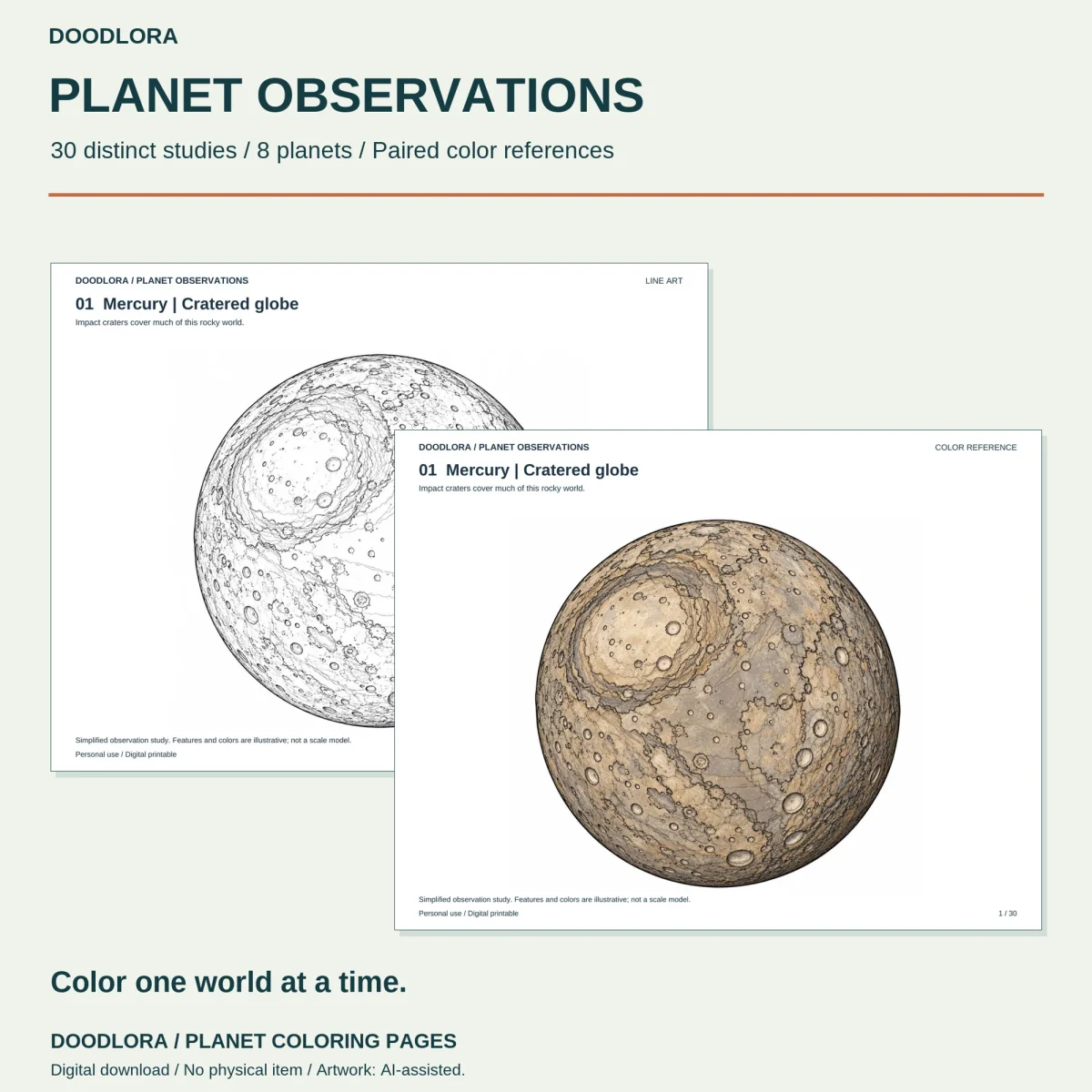
 1 / 6
Planet Coloring Pages: 30 Close-Up Studies from Mercury’s Craters to Neptune’s Storms
Thirty finely lined studies of the eight planets, where one page might hold a whole globe and the next a single crater field, canyon or storm. Every line drawing has a numbered color version to work from.
$3.99
Buy any 3 or more printables and save 20% at checkout.
- Download right after payment — link works for 30 days, up to 5 downloads
- Files arrive as a ZIP with your license PDF inside
- Secure checkout by Stripe · Refund policy
Thirty landscape planet coloring pages make up this set, each looking at a single planet, sometimes the whole globe and sometimes one small part of it. They’re drawn with thin outlines, packed crater fields and swirling cloud bands for anyone who enjoys a lot of line work. Nothing has a face, and there are no cartoon rockets.
How the 30 pages split across the planets
- Mercury, 4 pages: the cratered globe, a crater landscape, bright rays spraying out of one crater, and long cliffs crossing a plain
- Venus, 3 pages: a cloud-wrapped globe, a thin crescent, and a full page of sweeping cloud patterns
- Earth, 4 pages: Africa and the Atlantic, the Americas, Asia and Australia, and Antarctica seen from over the South Pole
- Mars, 4 pages: the red globe, the Olympus Mons shield volcano, Valles Marineris canyon country, and the layered polar ice
- Jupiter, 4 pages: the belted globe, the Great Red Spot, a cloud-band close-up, and the ring of eight cyclones around the north pole
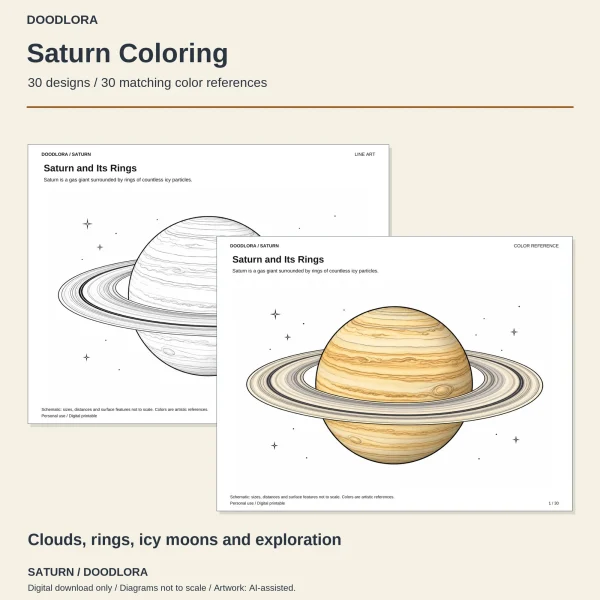
- Saturn, 4 pages: a wide ring view, the rings almost edge-on, the Cassini Division, and the six-sided storm at the north pole
- Uranus, 3 pages: the planet tipped on its side inside its rings, quiet cloud bands, and its narrow dark rings
- Neptune, 4 pages: a pale blue globe, a dark storm, high bright clouds, and faint rings with brighter arcs
Seven pages add a magnified circle or box beside the main drawing, such as the icy chunks inside Saturn’s rings on pages 20 and 22.
Words on the page
Above each drawing is the planet’s name, a title for the view and one plain sentence about it, for example that Saturn’s rings are made mostly of icy particles. A small line at the bottom says the drawing is simplified and not a scale model, so treat the shapes and colors as artwork, not as measurements.
Working from the color references
The color PDF follows the same numbering, so page 17 in one file is the Great Red Spot in the other. A few are worth checking before you start. Page 06, the Venus crescent, is mostly an empty outline, and the reference fills nearly all of it with black. Mercury is done in tans and browns, Uranus in pale blue-green and Neptune in a soft blue. You don’t have to follow any of it.
Print the line-art file on its own, at Actual Size in landscape. The A4 files hold the identical 30 designs, so choose by the paper in your printer.
Questions
- Are the planets drawn to scale?
- No. Each page carries a small note that it is a simplified study with illustrative features and colors, not a scale model, and the start-here file adds that sizes can't be compared from one page to the next.
- Do the pages show the planets in order or orbiting the Sun?
- No. Each page looks at one planet on its own. There is no Sun, orbit path or row of planets anywhere in the set.