Santa’s Reindeer Names: How Many, Origins and Facts
Santa’s reindeer are Dasher, Dancer, Prancer, Vixen, Comet, Cupid, Donner and Blitzen. Those eight names come from the poem “A Visit from St. Nicholas,” better known by its first line, “‘Twas the Night Before Christmas,” which first appeared in a newspaper in Troy, New York, on December 23, 1823. A ninth reindeer joined the team in a 1939 story, which is why many families count nine. The last two names have also changed: the first printing called them Dunder and Blixem.
Below is what each name means and an easy way to remember the order, how the spelling of the last pair shifted, every count of the team from one reindeer to ten, a name-card activity for kids, and what real reindeer are like, from their antlers to their clicking feet.
The eight reindeer names, in the poem’s order
Santa calls the reindeer by name in two lines of the poem, four names to a line. Learning them as those two lines is the easiest way to keep the order, and it’s the order most quizzes expect. If you’re running a holiday quiz, our Christmas trivia questions include reindeer questions; decide before you start whether you’ll accept eight or nine.
| Line | Name | What the word means |
|---|---|---|
| 1 | Dasher | someone who dashes, or moves fast |
| 1 | Dancer | someone who dances |
| 1 | Prancer | someone who prances, with high, springy steps |
| 1 | Vixen | a female fox |
| 2 | Comet | a comet streaking across the night sky |
| 2 | Cupid | the Roman god of love |
| 2 | Donner | thunder (Donder in Dutch, Donner in German) |
| 2 | Blitzen | lightning, from the German word Blitz |
Three things help kids keep them straight. The first line has three names that rhyme, Dasher, Dancer and Prancer, then Vixen. The second line starts with two C names, Comet and Cupid. The last pair means thunder and lightning, so kids can remember them as the stormy ones at the back of the team.
One snag comes up with older picture books and recordings. Some say Donder instead of Donner, and a few say Blixem. Neither one is a mistake. They are older spellings of the same reindeer, and the next section explains where they came from.
How the reindeer names Dunder and Blixem became Donner and Blitzen
The 1823 newspaper printing named the last two reindeer Dunder and Blixem, from an old Dutch oath meaning “thunder and lightning.” Here are the two lines as they first appeared in the Troy Sentinel, from the public-domain text:
“Now! Dasher, now! Dancer, now! Prancer, and Vixen,
“On! Comet, on! Cupid, on! Dunder and Blixem;
The names then shifted over about a century:
- 1823: The poem appears without an author’s name, with Dunder and Blixem.
- 1825: The editor of an almanac reprints it and changes Blixem to Blixen.
- 1837: The poem is first credited in print to Clement Clarke Moore, a New York professor.
- 1844: Moore includes it in a book of his own poems, with the pair spelled Donder and Blitzen: “On, Comet! on, Cupid! on, Donder and Blitzen!”
- Early 1900s: The German spelling Donner starts to replace Donder, long after Moore’s death, and Donner and Blitzen become the standard names.
Who wrote the poem is still argued over. Moore claimed it, but the family of Major Henry Livingston Jr., a New Yorker with Dutch roots, has long said he wrote it first. No printing with Livingston’s name has ever been found, and scholars disagree about the word analysis on both sides. For a family reading, “the poem usually credited to Clement Clarke Moore” covers it.
How many reindeer does Santa have?
In the poem, Santa has eight reindeer, and that is still the number in most Christmas stories. The answer kids usually give is nine, because a reindeer with a glowing red nose often leads the team at the front.
Rudolph the Red-Nosed Reindeer was created in 1939 by Robert L. May, a writer at the Montgomery Ward department stores in Chicago, as a booklet the stores gave away to children. Montgomery Ward handed out 2.4 million copies that first year. May also considered calling the reindeer Rollo or Reginald. In 1949, the song by Johnny Marks, sung by Gene Autry, made the ninth reindeer part of almost every telling.
The team hasn’t always been eight or nine. Here are the counts kids may run into:
- One reindeer: An 1821 illustrated poem printed in New York, “Old Santeclaus with Much Delight,” shows Santa’s sleigh pulled by a single reindeer with no name. It’s the earliest known mention of a reindeer pulling Santa’s sleigh.
- Eight reindeer: The 1823 poem, with every reindeer named.
- Ten reindeer: L. Frank Baum, the author of The Wonderful Wizard of Oz, gave Santa ten reindeer in his 1902 book The Life and Adventures of Santa Claus. None of the names match the poem: Flossie and Glossie, Racer and Pacer, Reckless and Speckless, Fearless and Peerless, and Ready and Steady.
- Nine reindeer: The eight from the poem plus the one from the 1939 booklet.
For a quiz or a classroom question, accept both eight and nine, and give a bonus point to anyone who knows that the poem has eight.
Do Santa’s reindeer have personalities?
The poem gives the reindeer names and nothing else. Santa whistles, shouts and calls them by name, and the team flies “more rapid than eagles,” but none of the eight gets a description. The personalities you’ll find in lists online, such as Dasher being the fastest or Vixen the mischievous one, were added much later by different writers, and no two lists agree.
That leaves room for kids to make up their own. Give each child one name and ask for one trait that fits the word: Comet might be the one who never stops moving, Cupid might carry the cards and letters, and Blitzen might be the loudest. Ten minutes is enough for a table of four to invent all eight. The only rule worth keeping is the order, so the story still matches the poem when you read it aloud.
A name-card activity for learning all eight
This works for ages 4 to 8 at home or at a class party, and it takes about 20 to 30 minutes. You need one printed sheet per child, crayons or markers, a pencil, and scissors for the grown-up or an older child.
Our reindeer coloring pages set has a page that fits this well. Page 6 is a sheet of eight small reindeer, each standing on its own card with an empty label box underneath, four cards in the top row and four in the bottom row. That layout matches the poem’s two lines of four names.
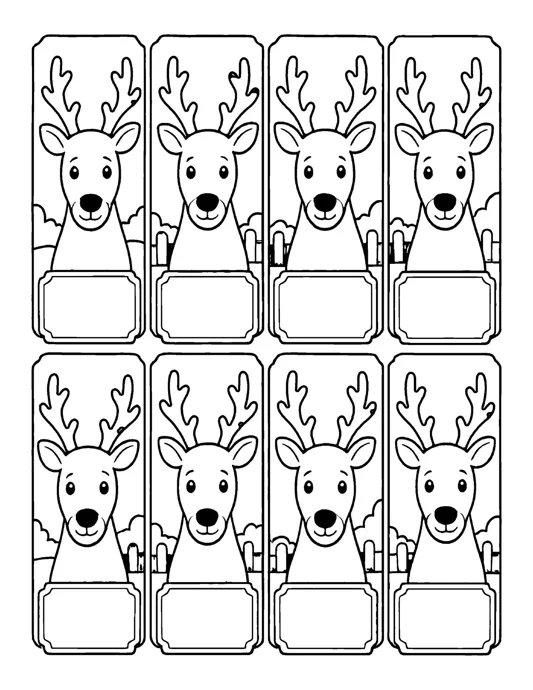
- Read the two lines aloud. Read the reindeer lines from the poem slowly, twice, and let kids say the names with you the second time.
- Write the names. The top row gets Dasher, Dancer, Prancer and Vixen, and the bottom row gets Comet, Cupid, Donner and Blitzen. The label boxes are small, so for children still learning to write, pencil each name in lightly and let them trace it.
- Color each reindeer differently. All eight reindeer are drawn alike, so a different antler color, nose color or background for each one is what tells them apart later.
- Cut the cards apart and play. Shuffle the eight cards, then race to lay them back in poem order. For a second round, turn them face down and take turns naming the hidden card before flipping it.
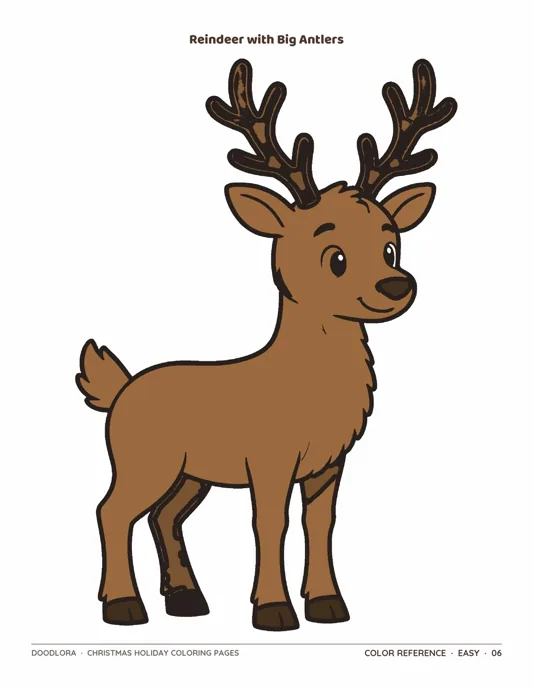
Print at Actual Size or 100%, and try one page first, as the instructions in the download say. Very young children often do better with one big reindeer than with eight small ones. Our easy Christmas coloring pages set has a single large reindeer on page 6 with bold, simple outlines. A preschooler can color it and name it after a favorite from the list.
If the children are coloring rather than writing, our coloring tips compare crayons, markers and colored pencils by age.
When kids ask whether the reindeer are real
Questions like “Are the reindeer real?” or “Can reindeer fly?” usually come right after the names. You don’t need a yes or a no. In the poem, the reindeer fly up to the house-top with the sleigh. Reindeer also live in real herds in the far north, and kids are often delighted to hear that those reindeer walk, run and swim farther than almost any other land animal. That turns the question toward something they can learn more about.
If the bigger question comes up, the one about Santa himself, our guide to Christmas traditions walks through a gentle way to answer it. Start from Saint Nicholas, who really lived and gave gifts in secret, and let older children join in keeping the surprise for the little ones.
Real reindeer facts for kids
Reindeer and caribou are the same species, Rangifer tarandus. In North America, wild herds are usually called caribou and domesticated ones are called reindeer. Reindeer are the only deer that people have herded and partly domesticated on a large scale. They live all the way around the Arctic, on the tundra and in the northern forests.
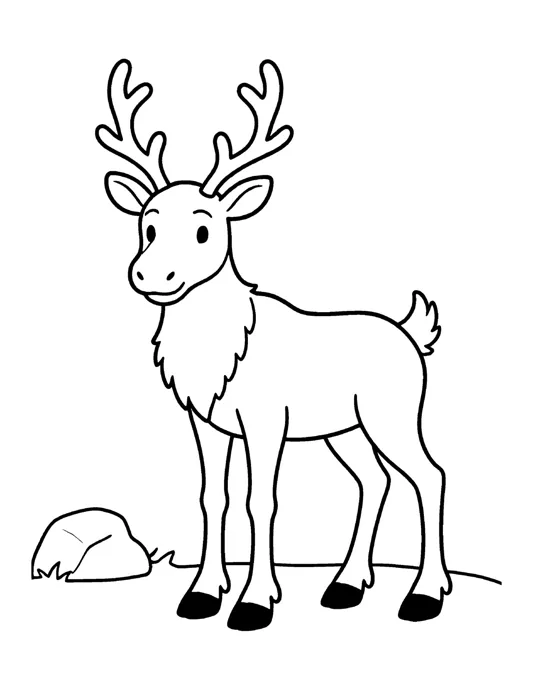
Both males and females grow antlers
Reindeer are the only deer species in which both sexes have antlers. Mature bulls grow the largest and most complex sets. Bulls usually shed their antlers shortly after the fall mating season, while cows can keep theirs until spring. So a real reindeer still wearing a full set of antlers in late December is often a female.
Their bodies are built for cold
A reindeer’s hairs are hollow, which traps body heat and also helps the animal float. The hooves are large and spread apart, so they work like snowshoes on snow and soft tundra and like paddles in water. Reindeer also make a clicking sound as they walk, which comes from tendons sliding over a bone in the foot.
Big animals that travel far
Caribou stand up to about 47 inches (120 cm) at the shoulder and weigh from about 121 to 700 pounds (55 to 318 kg), depending on the subspecies. In some groups, males are twice as big as females. They travel farther than any other land mammal, more than 3,100 miles (5,000 km) in a year, and the Animal Diversity Web lists top speeds of about 50 miles (80 km) an hour.
What they eat in winter
Reindeer eat lichen, moss, grasses, sedges and the leaves of low shrubs. In winter, they smell food buried under the snow and dig down to it with their front hooves. Lichen is an important winter food, though they don’t eat it alone.
Calves can run on their first day
Calves are born in May or June and weigh about 7 to 26 pounds (3 to 12 kg) at birth. A calf can follow its mother within an hour and can outrun a person when it’s just one day old.
Where to find the big herds
In Alaska, more than half a million caribou from four herds migrate through the central Brooks Range, moving north for the summer and south of the mountains for the winter, according to the National Park Service at Gates of the Arctic.
Printables from this article

Related articles
Printable Coloring Pages
Safari Animals: Big Five and a List of 25 African Animals
The Big Five are lion, leopard, elephant, rhino and buffalo. Here they are with 20 more African safari animals, sorted by where you look for them, with what each eats and how easy it is to see.
Printable Coloring Pages
Food Holidays: National Food Days by Month for Kids
A month-by-month list of American food holidays with the date rule for each one, such as January 23 for National Pie Day or the first Friday of June for National Donut Day, plus simple ways to mark them at home and in a classroom.
Printable Coloring Pages
How Is Chocolate Made? Bean to Bar, Step by Step
Chocolate starts as the seeds inside a cacao pod. Farmers ferment the beans for up to a week and dry them in the sun; a factory then roasts them, cracks off the shells, grinds the nibs into chocolate liquor, mixes in sugar and sometimes milk, and conches, tempers and molds the result.