How Long Do Flies Live? House Fly Life Cycle and Facts
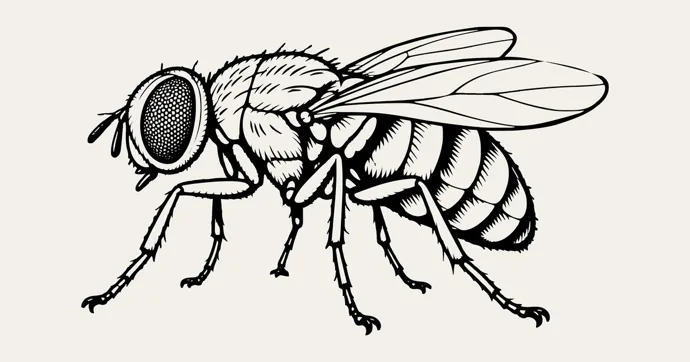
An adult house fly usually lives for two to four weeks. That is the figure Wikipedia’s Housefly entry gives, and it adds that adults can also hibernate through winter, which is how a few of them show up again in spring. The whole cycle from egg to adult is much shorter than most people expect: seven to ten days in warm conditions, and up to two months when it is cold or food is poor.
So a fly buzzing at your window is not living a long life, but it may be one of many. A single female can lay up to 500 eggs in her lifetime, in several batches of roughly 75 to 150. Short lives and fast turnover are the reason a few flies in late summer can turn into a lot of flies within a couple of weeks.
How long each stage of the house fly life cycle lasts
House flies go through complete metamorphosis: egg, larva, pupa and adult. Warmth drives every stage. Wikipedia puts it plainly for the larvae, “the warmer the temperature, the faster they grow,” and the same pattern holds for the pupae.
| Stage | What it looks like | How long it lasts |
|---|---|---|
| Egg | White, about 1/16 inch (1.2 mm) long, laid in batches | Hatches within a day |
| Larva (maggot) | Legless, cream-colored, blunt at the back, pointed at the head | Fast in warm, moist material; 30 days or more in cool conditions |
| Pupa | A hard, cylindrical case about 5/16 inch (8 mm) long | 2 to 6 days at 95°F (35°C); 20 days or more at 57°F (14°C) |
| Adult | Under 3/8 inch long, four dark stripes on the back of the thorax | Usually 2 to 4 weeks |
Eggs: laid where the larvae can eat
The female lays her eggs in warm, moist, rotting material. UC IPM, the University of California’s pest management program, lists manure, garbage, lawn clippings, decaying fruits and vegetables, and soil mixed with any of these. The spot matters because the larvae never travel far. They hatch within a day and feed right where they were laid.
Larvae: three growth stages, then a move
Maggots pass through three larval stages, growing larger at each one. Young larvae avoid light and burrow down into the material, which is why you rarely see them. At the end of the third stage they do the opposite and crawl out to find a drier, cooler spot to pupate. Blow fly larvae do the same thing, and UC IPM notes that this is why people sometimes see maggots crawling out of an outdoor trash can that held unbagged kitchen waste.
Pupae: the stage that shows temperature best
The last larval skin hardens into a shell called a puparium, and the pupa changes inside it. This stage is the clearest example of how heat sets the clock. At 95°F (35°C), pupae finish in two to six days. At 57°F (14°C), the same stage can take 20 days or more.
Adults: no more growing
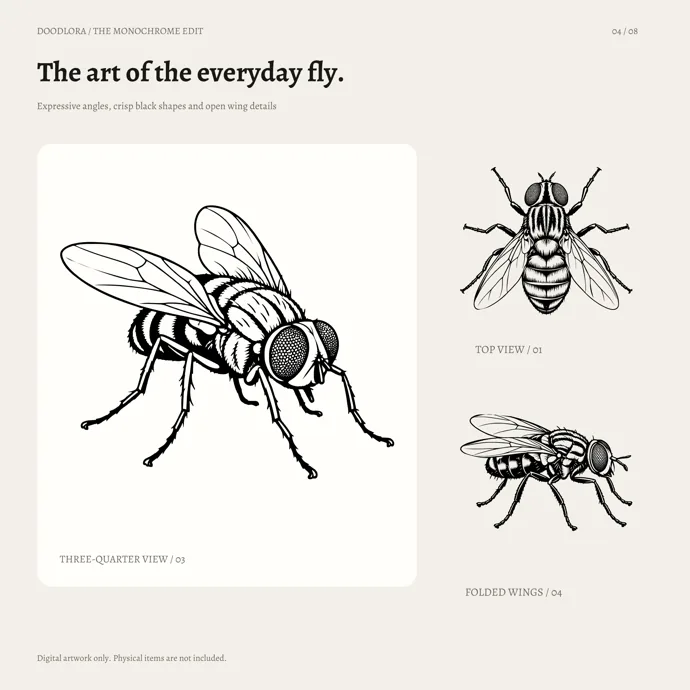
The new fly pops the end off the puparium and climbs out. Fluid pumps into the veins of its folded wings so they spread, dry and harden before it can fly. From then on it does not grow at all. Wikipedia makes a point worth repeating to kids: a small fly is not a young fly. It is a fly that got too little food as a larva. If you want that fact on a classroom chart, the realistic adults in our fly clipart are drawn large enough to label the head, thorax, wings and legs.
Fly facts kids usually ask about
These come up as soon as a class or a family starts talking about flies. Each one is from Wikipedia’s Housefly entry or the UC IPM Pest Notes on flies.
- They cannot bite. House flies have sponging mouthparts. They turn solid food into liquid with their saliva and then soak it up.
- They are small and striped. An adult is under 3/8 inch long, with four dark stripes running down the back of the thorax.
- They travel. House flies can fly several kilometers (a few miles) from the place where they hatched.
- They are busiest in summer. UC IPM notes that house fly numbers are highest in the hot summer months, which fits how fast warm weather moves them through the cycle.
- They come back after winter. Adults can hibernate and wake up when spring warms, then look for a place to lay eggs.
How long do other common flies live?
“Fly” covers thousands of species, so the answer changes with the fly. These two are the ones most people meet at home.
Fruit flies
The fruit fly most studied in labs, Drosophila melanogaster, lives about 50 days from egg to death at 77°F (25°C). Its development speeds up and slows down with temperature even more visibly than the house fly’s:
| Temperature | Egg to adult |
|---|---|
| 82°F (28°C) | 7 days, the shortest |
| 77°F (25°C) | About 8 1/2 days |
| 64°F (18°C) | 19 days |
| 54°F (12°C) | More than 50 days |
| 86°F (30°C) | 11 days, because heat stresses them |
At 77°F, the eggs hatch in 12 to 15 hours, the larvae feed for about four days, and the change inside the puparium takes about four more. Females lay around 400 eggs, about five at a time, into rotting fruit or similar soft, decaying material. That last detail explains the cloud of tiny flies that appears around an overripe banana.
Blow flies
Blow flies are the shiny ones, metallic green or blue, often with a coppery tint. Under ideal temperatures they can go from egg to adult in as little as seven days, the same as a house fly. In towns and cities their most common breeding site is human food waste, along with pet waste.
Why flies get into your home
Almost every fly inside a building came in from outside, according to UC IPM. They are drawn by food and by places to lay eggs, and they find gaps around windows and doors. The adults are the annoying part, but the larvae are where the numbers come from, so the useful work is cutting off breeding spots.
Flies are also a hygiene problem, not only a nuisance. UC IPM notes that house flies can pick up disease agents while feeding on animal feces or kitchen waste and then deposit them on human food.
How to keep flies down without chemicals
The steps below come from UC IPM’s guidance for homes, which says that in most home situations sanitation and screens should be enough. They work by breaking the life cycle: no wet waste, no larvae.
- Fix the entry points. Seal cracks around windows and doors, and keep screens well fitted.
- Bag the wet trash. Put kitchen waste and pet feces into plastic bags and seal them before they go into the outdoor bin.
- Use bins with tight lids. Keep them as far from the door as you practically can.
- Empty the bins every week. Put garbage out for pickup at least once a week even when the can is not full. UC IPM warns that garbage left longer than a week is likely to produce blow flies.
- Wash the cans. Rinse outdoor garbage cans with soap and water from time to time so leftover residue does not feed larvae.
- Clear the yard. Pick up dog feces, rotting fruit and other organic waste outdoors at least once a week.
Since fruit flies lay eggs in rotting fruit, the same habit applies indoors: do not leave overripe fruit or peels sitting out on the counter.
Using fly clipart for a life cycle lesson
Flies make a good science topic because the cycle is short enough to understand in one lesson, and the temperature numbers turn into an easy chart. Clipart helps with the visuals. Keep one limit in mind: these are illustrations, not a field guide. Several designs are cartoons, and the drawings are not meant for telling one fly species from another, so use a reference such as the UC IPM page if students need to identify a real fly.
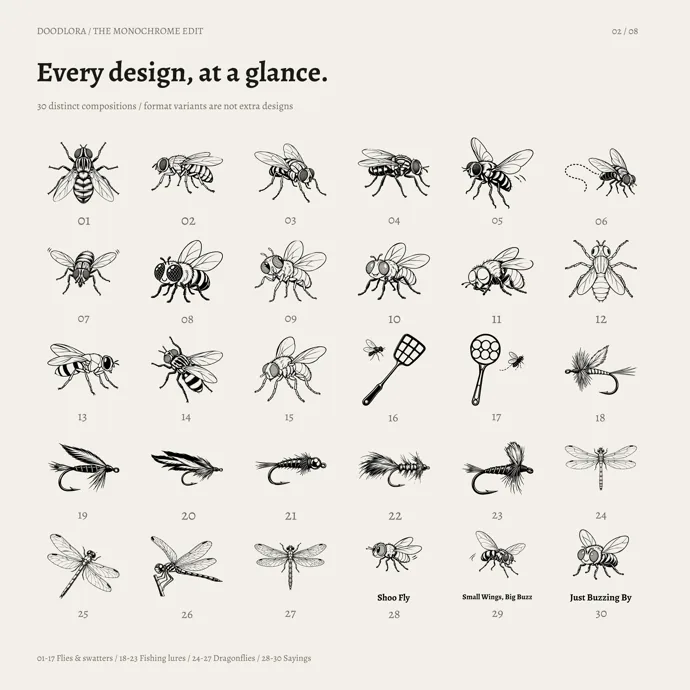
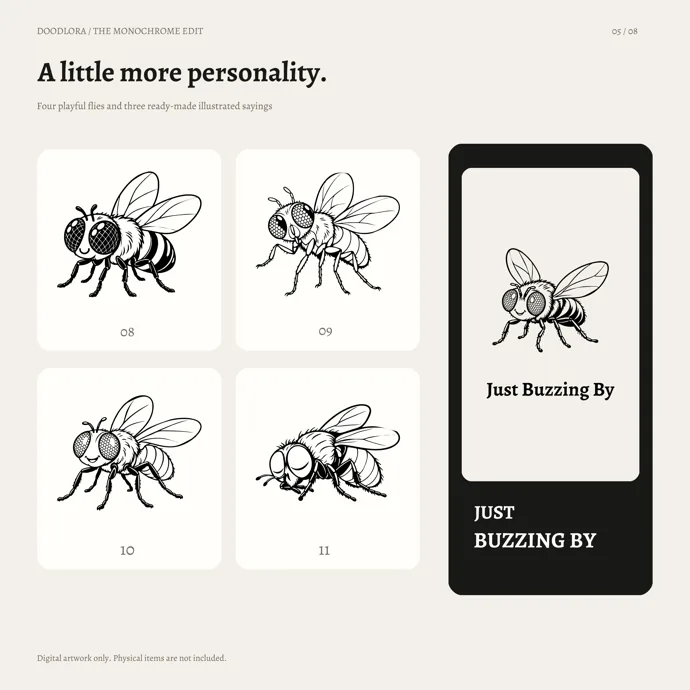
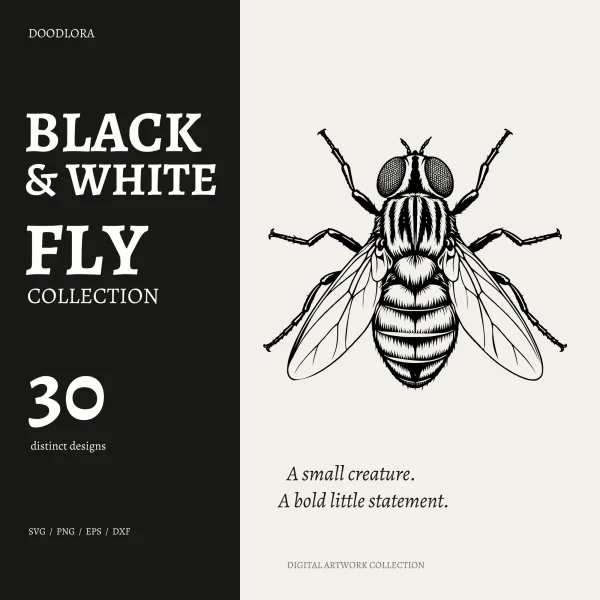
Our fly clipart set has 30 black ink designs. Designs 01 to 15 are flies (realistic studies, flying poses, cartoon flies and lighter outline drawings), 16 and 17 add a fly swatter, 18 to 23 are fishing lures tied to look like flies, 24 to 27 are dragonflies, and 28 to 30 pair a fly with a short saying. Every design comes as SVG, PNG, EPS and DXF. One thing to know before you plan a life cycle chart: the set shows adult flies only, so students draw the egg, larva and pupa themselves.
Ages 5 to 7: four-box life cycle wheel
- Group size: the whole class, each child working on a personal sheet, with a teacher or helper per table of five or six.
- Time: 25 to 30 minutes.
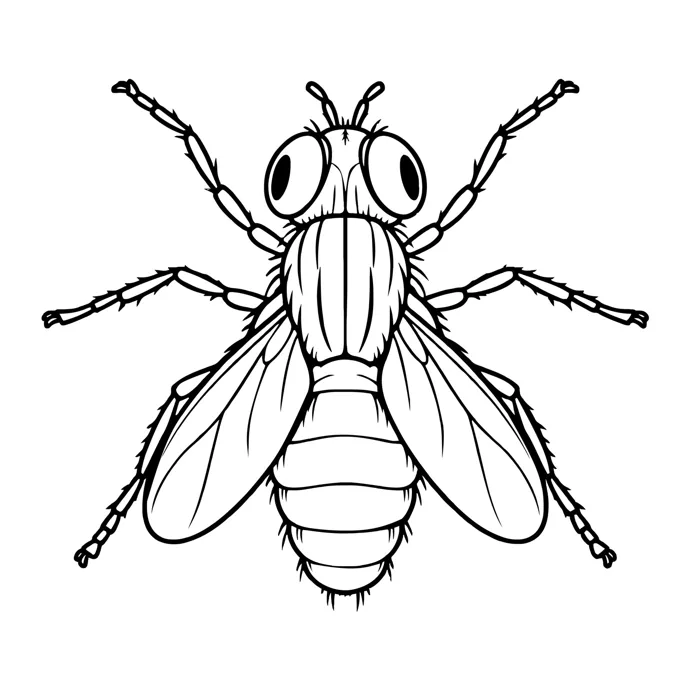
- Prep: Print one sheet per child with four boxes in a circle and arrows between them. Place a printed adult fly (design 12 works well) in the fourth box. Have crayons ready, plus a small piece of brown paper for the pupa.
- How it runs: Read the four stages aloud. Children draw a cluster of tiny white eggs, a white maggot with no legs, and glue on the brown pupa shape.
- Wrap-up: Each table holds up its wheels, and the class says the stages in order while you point to each box.
Ages 8 to 10: how heat changes the clock
- Group size: groups of three or four.
- Time: about 40 minutes.
- Prep: Copy the fruit fly temperature table above onto a worksheet, along with the house fly pupa numbers (2 to 6 days at 95°F, 20 days or more at 57°F). Give each group graph paper, a ruler and two or three printed flies to decorate the chart.
- How it runs: Groups make a bar chart of days from egg to adult at each temperature, then mark the fastest bar with a fly.
- Wrap-up: Each group answers two questions out loud: which temperature was fastest, and why does 86°F take longer than 82°F? (Heat stress slows them down.)
Ages 11 to 13: fly facts poster
- Group size: pairs.
- Time: one 45-minute period.
- Prep: Large paper, markers, a printout of the fly facts list above, and a handful of printed flies from the realistic and outline designs.
- How it runs: Each pair builds a poster that answers “How long do flies live?” with the life cycle, one temperature fact, one “they cannot bite” style fact and one way to keep flies out of a home.
- Wrap-up: Hang the posters for a quick gallery walk. Each pair reads one fact from another poster that surprised them.
Keep the lesson on paper. Students should not catch or keep flies, and they should leave any maggots they spot outdoors alone.
Stickers, labels and posters
The cartoon flies and the three sayings (“Shoo Fly,” “Small Wings, Big Buzz” and “Just Buzzing By”) work for lighter projects. A few that suit a classroom or a home:
- Reward stickers. Print a page of cartoon flies on sticker paper and cut them apart for a bug unit.
- Kitchen reminders. A “Shoo Fly” label on the compost caddy or the trash can lid is a cheerful nudge to keep it closed.
- Bulletin board. Add the realistic flies to a “life cycle” or “insects around us” board, next to the student wheels.
The art is solid black with the pale areas left open, so print on white or light paper. On dark paper or fabric those open areas take on the background color and the drawing loses contrast. Fine wing veins can run together at small sizes, so print one test sticker at your planned size before you print a full sheet. The license that comes with the set is a personal one: you can use it at home, with your own students, or inside one school for its own activities, but not to make stickers or posters for sale.
If your class is in the middle of a bug unit, the bug crafts roundup has hands-on projects to go with the lesson, and the nature scavenger hunt ideas give kids a way to look for insects outdoors without disturbing them.
Printables from this article
Related articles
Clipart & SVG Cut Files
How to Draw a Truck: Easy Pickup, Big Rig and Cartoon
Split a pickup into three parts before you draw a single wheel: a bed, a cab and a hood. Keep the roof about 2.2 wheels tall and the bed rail level with the hood, and the truck looks right even before the details go on.
Clipart & SVG Cut Files
How to Draw a Train: Steam Engine, Cars and Tracks
Split the page into a 10-square grid, lay a long boiler tube across the middle, set a box cab at the back and a tall stack at the front, hang two big driving wheels under the cab end, then couple cars behind and run the rails to a vanishing point.
Clipart & SVG Cut Files
Hawk vs Falcon: Wings, Size, Hunting Style and Eagles
A falcon has long, narrow wings that taper to sharp points and flies on steady, quick wingbeats; a hawk has broader wings with rounded tips and either soars in slow circles or flaps hard and glides. Falcons kill with a notched beak and hawks with their talons, and eagles are the largest, heaviest-billed members of the hawk family.