How Do Bees Make Honey? Honey Bee Facts and Bee vs Wasp
Bees make honey by drying out nectar. A forager honey bee sips nectar from flowers into a special honey stomach, where enzymes start breaking its sugar down. Back at the hive it passes the load to younger house bees, who work it between their mouthparts and then spread it in open wax cells. The colony fans air over those cells until the nectar, which started at about 70 to 80% water, is down to roughly 18%. Then the bees seal each full cell with a wax cap.
That’s the whole answer in one paragraph. Below, each step gets its numbers, followed by the honey bee facts kids usually ask next, a bee vs wasp table, and a version of the story for preschoolers, early grades and older kids.
How bees make honey, step by step
Five things happen between the flower and the capped comb. The table is the quick version for a worksheet or a whiteboard; the steps below explain each one.
| Step | Who does it | Where | What changes |
|---|---|---|---|
| 1. Collect | Forager bee | Flowers | Nectar goes into the honey stomach |
| 2. Add enzymes | Forager bee | In flight, in the honey stomach | Sucrose starts splitting into glucose and fructose |
| 3. Pass it on | House bees | Inside the hive | Nectar is bubbled bee to bee and loses some water |
| 4. Dry it | The whole colony | Open comb cells | Fanning wings pull water out until it’s about 18% |
| 5. Seal it | Worker bees | The comb | A wax cap closes each finished cell |
1. A forager collects nectar
Honey starts with nectar, the sugary liquid inside flowers. A forager sucks it up through its long tongue, the proboscis, and stores it in its honey stomach, also called the honey crop. Wikipedia’s entry on honey describes this crop as a separate cavity sitting above the bee’s food stomach, so the nectar isn’t digested for the bee’s own meal.
A full load is small and slow to gather. In the western honey bee the honey stomach holds about 40 milligrams, roughly half the weight of an empty bee, and filling it can take visits to more than a thousand flowers. When nectar is plentiful, that can still mean more than an hour of steady work for one load.
Nectar isn’t the only raw material. Bees also collect honeydew, the sugary liquid that aphids and similar insects leave on plants, and make honey from it the same way.
2. Enzymes go to work on the way home
The change from nectar to honey starts inside the forager. Once the nectar is in the honey stomach, the bee adds salivary enzymes and proteins from its hypopharyngeal gland. These begin splitting complex sugars such as sucrose into simpler ones, glucose and fructose.
Another enzyme matters later. Bees add glucose oxidase, which produces gluconic acid and a little hydrogen peroxide. Those two byproducts help make honey acidic and help hold back bacteria, which is part of why finished honey keeps so long.
3. House bees take the load and pass it along
Foragers don’t make honey alone. Back in the hive, a forager brings the nectar back up and hands it to younger hive bees. Each hive bee then works the drop between its mandibles, forming bubbles over and over. The bubbles spread the nectar thin, so more water escapes into the warm hive air.
Hive bees do this in relay groups, one bee bubbling the nectar and passing it to the next. Wikipedia’s honey entry says it can take as long as 20 minutes of this before the nectar is ready to store. The job goes to bees of a certain age: worker honey bees usually spend roughly days 16 through 20 of their lives receiving and storing nectar from older bees, before they become foragers themselves.
4. The colony fans it dry in the comb
Fresh nectar goes into open honeycomb cells while it’s still far too wet. At this stage it can still be up to 70% water, enough for yeast to grow in it and spoil it. The bees solve that with heat and moving air.
The honey storage area of a hive is usually kept around 95°F (35°C). Bees fan their wings together to push air across the wet cells, and the moving air carries water and heat out of the hive. They keep this up until the honey is down to between 15.5% and 18% water. At that point there’s so much sugar in so little water that yeasts and bacteria can’t grow.
Kids who want to build this stage with their hands can make the paper hexagon honeycomb in our bee crafts guide, a glue-stick project planned for ages 5 to 8.
5. Workers seal the finished honey with wax
Once a cell of honey is dry enough, workers cap it with beeswax. The cap seals the honey from dirt and moisture and stops more water from evaporating. Honey kept at about 18% water or less has an indefinite shelf life, both in the hive and in a jar.
The wax itself comes from the bees. Worker bees have eight wax glands on the underside of their abdomen and turn sugar from honey into small wax scales, which hive workers shape into comb. Wax is expensive for a colony. In one older experiment, 6.66 to 8.80 kilograms (14.7 to 19.4 pounds) of honey went into making one kilogram (2.2 pounds) of wax.
Why bees make honey in the first place
Honey is stored food. Bees burn sugar to power their flight muscles and feed honey to their young, and they stockpile it for times when flowers aren’t blooming. In cold climates the colony stays in the hive all winter, packs together in a cluster and eats honey to make heat. The University of Minnesota Extension says that with enough honey in the nest, a strong colony can survive long stretches down to -30°F or colder.
That’s the reason the process is built around drying and sealing. Watery nectar would ferment as yeasts ate its sugar. Honey that is concentrated and capped stays usable through a long winter, and it packs far more energy into the same space than the nectar it came from.
Honey bee facts kids ask about next
Once the steps make sense, the questions turn to the bees themselves. These come from Wikipedia’s entries on the western honey bee and the waggle dance, the species most beekeepers keep.
- A colony is huge. A healthy hive in midsummer can hold 40,000 to 80,000 bees.
- There are three kinds of bees in a hive. One queen lays the eggs. Thousands of female workers do everything else. A smaller number of males, called drones, exist mainly to mate with new queens. Drones have no stinger and don’t collect nectar or pollen.
- Workers change jobs as they age. For about their first 10 days they clean the hive and feed larvae. Next they build comb, then they receive and store nectar, and after about day 20 they leave to forage for the rest of their lives.
- Summer workers don’t live long. Workers born in spring and summer live only a few weeks. Workers born in autumn can stay inside the hive for several months over winter. A queen usually lives three to five years.
- Bees give directions by dancing. A forager that finds good flowers runs a figure-eight “waggle dance” on the comb. The angle of the waggle run shows the direction of the flowers compared with the sun, and the length of the waggle shows how far away they are.
- A bee’s life starts in a cell. The queen lays one egg in each comb cell. It hatches into a larva that nurse bees feed for about a week, then the cell is sealed while the larva becomes a pupa, and about a week later an adult bee emerges.
- Honey bees usually die after stinging a person. A worker’s stinger is barbed, so it catches in skin and pulls free of the bee’s body. It doesn’t always catch in other insects, so a bee doesn’t always die after stinging.
- Honey bees aren’t the only honey makers. Bumblebees and stingless bees also make honey, and a few wasp species in Central and South America do too.
Bee vs wasp: how to tell them apart
The fastest way to tell a honey bee from a wasp is the body. A honey bee is fuzzy and golden brown. A yellowjacket, the wasp most often mixed up with it, is bright yellow and black with a hard, shiny, nearly hairless body. The University of Minnesota Extension notes that yellowjackets can be mistaken for honey bees, so look for the fuzz before you look at the color.
This table uses the Extension’s descriptions for the three insects people mix up most in a backyard:
| Honey bee | Yellowjacket | Paper wasp | |
|---|---|---|---|
| Body | Fuzzy; thorax covered in branched hairs | Hard, shiny, few hairs | Slender, long legs that dangle in flight |
| Size | About 1/2 inch | 3/8 to 5/8 inch | 1/2 to 1 inch |
| Color | Golden brown with thin black stripes | Bright yellow with black lines, spots or diamonds | European paper wasps are black and yellow |
| Wings at rest | Lie flat and open over the abdomen | Fold into a narrow strip on top of the abdomen | Not described on the Extension page |
| Food | Only nectar and pollen | Catch insects and spiders for their young | Catch insects for their young; also sip nectar |
| Nest | Vertical wax honeycomb, mostly in managed hives | Paper pulp combs, often underground in old rodent burrows | Small open paper “umbrella” under eaves and overhangs |
| Colony lasts | Year after year | One season | One season |
| Stinger | Barbed; usually stays in the skin | Can sting more than once | Can sting more than once |
A few clues hold up best outside. Only bees carry pollen, and a honey bee’s hind leg has a flattened part for it, so a loaded leg is a giveaway. A papery nest means wasps, because honey bees build with wax. And a black and yellow insect at your soda can in late summer is very likely a yellowjacket; the Extension says some yellowjackets turn into aggressive scavengers around food and drinks in late summer and fall.
Bumblebees are the other common look-alike. They’re very fuzzy, roundish and usually black and yellow, from under 1/2 inch to about 1 inch long, and they’re bees, not wasps.
Watch any of these from a few steps away rather than up close, and keep everyone back from hives, nests and swarms. Stings can cause serious allergic reactions in a few people, so anyone with a known sting allergy should take extra care around flowers and nests.
Explaining it to kids at different ages
The process is the same at every age, but the way in changes. Pick the version for the youngest child in the group, then add detail for older kids.
Ages 4 to 6, about 10 minutes. Tell it as three verbs: sip, carry, dry. A bee sips flower juice with a tongue like a straw, carries it home in a special tummy, and the bees fan it with their wings until it gets thick and sweet. Let them drink water through a straw to feel what “sip” means, and flap their arms like fanning wings. Skip the enzymes.
Ages 7 to 9, 15 to 20 minutes. Turn step 3 into a relay. One child is the forager and carries a cup of “nectar” across the room to a house bee, who passes it to the next house bee and the next, and the last one sets it in a “cell” on the table. It shows why one load of honey needs many bees. Then read the step table together and match each child’s job to a step.
Ages 10 and up, 20 to 30 minutes. Do the water numbers. Nectar starts at 70 to 80% water and honey ends at about 18%, so most of the water in the nectar has to leave the hive as vapor. Ask why the bees bother, and let them work toward the answer: wet nectar spoils, and dry honey lasts all winter. This group can also handle the bee vs wasp table as a quiz.
Two mistakes come up with every age. Kids often think bees make honey from pollen. They don’t; honey comes from nectar or honeydew, and pollen is the protein food bees eat separately. The other is that honey is “bee throw-up.” The honey stomach is a storage pouch that sits above the bee’s food stomach, so the nectar is carried and handed over, not digested and thrown back up.
Eating honey: the rule for babies
Honey should never go to a baby under 1 year old. The CDC’s botulism prevention page puts it plainly: “Do not feed honey to a child who is younger than 1 year old.” The same page explains that honey can contain the bacteria that cause botulism, and it warns against giving infants honey or products made with it, including honey pacifiers.
That matters at home and at school. If you’re doing a honey tasting with a class or a family group, check whether anyone has a baby sibling along, and keep the honey, honey sticks and any honey snacks out of reach of children under 12 months. For everyone older, a spoonful of honey on toast is a good way to end the lesson, since kids can see and taste how thick the dried-out nectar became.
Using beehive clipart for a bee lesson or project
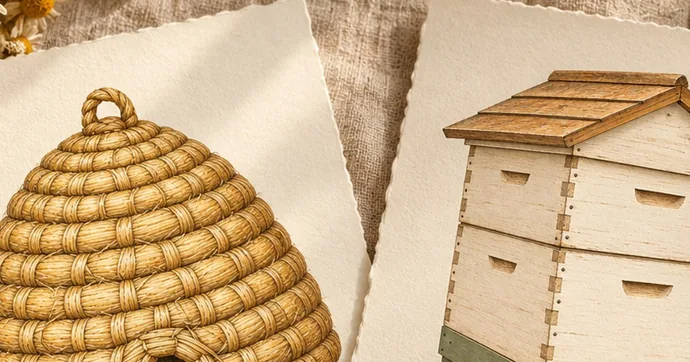
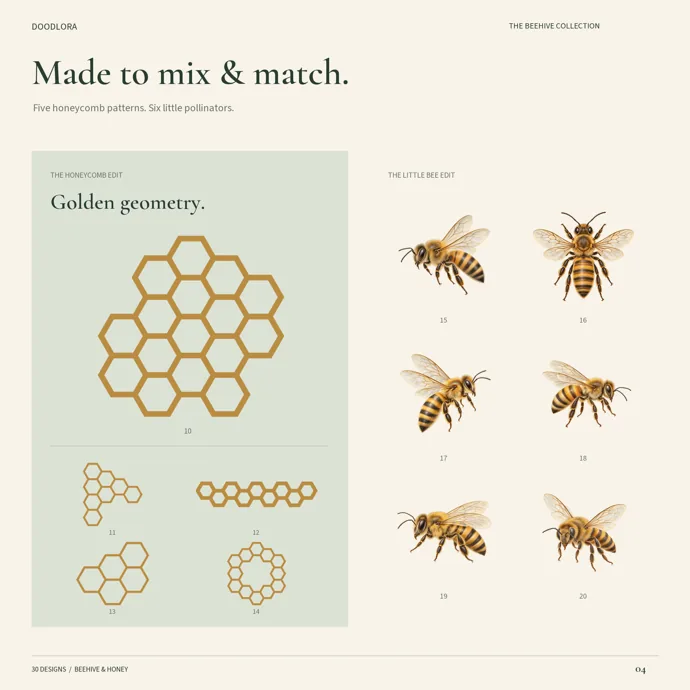
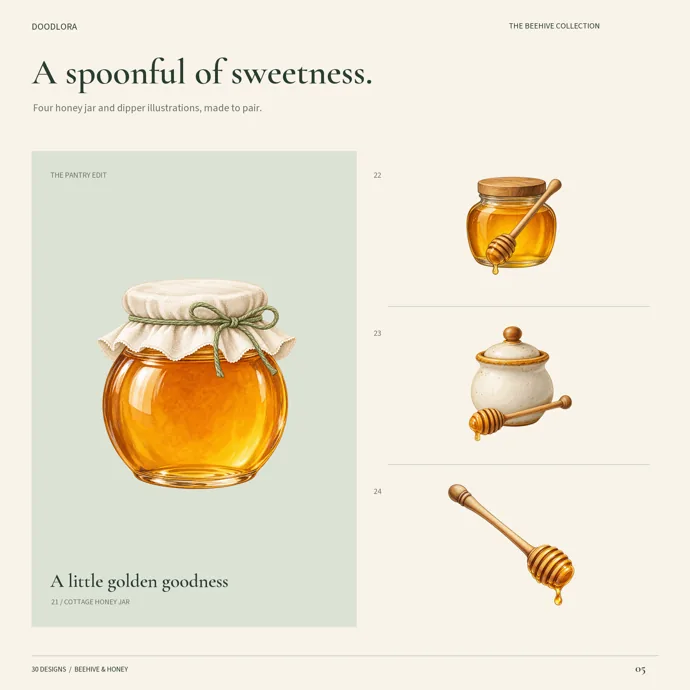
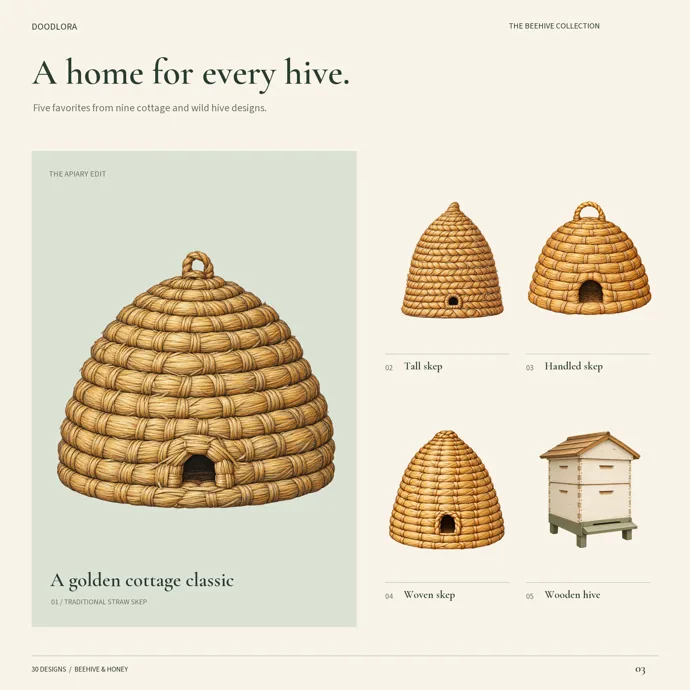
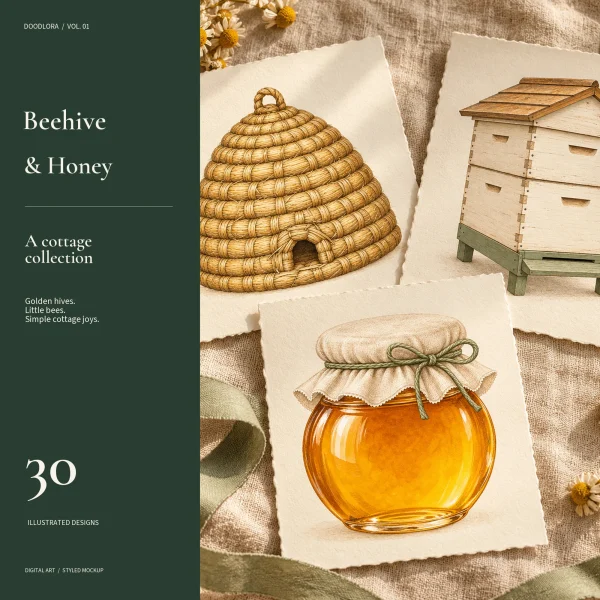
Pictures help this topic, because most kids have never seen comb up close. In our beehive clipart set, the 30 illustrated designs are four straw skeps (01 to 04), three wooden box hives (05 to 07), two wild combs hanging from branches (08 and 09), five honeycomb outline patterns (10 to 14), six honey bees (15 to 20), four honey jar and dipper designs (21 to 24) and six short sayings (25 to 30), such as “Bee Kind” and “Home Sweet Hive.”
Here’s how the pieces fit the lesson above:
- Honeycomb outlines (10 to 14) are plain gold hexagons. Print the 16-cell sheet (10) on Letter paper for a step 4 and 5 worksheet: kids color some cells “open” and some “capped.”
- The top-down bee (16) shows the head, thorax and abdomen, two antennae, four wings and six legs. Older kids can label it. It’s an illustration, not a scientific diagram, so count the parts with them before you hand it out as a key.
- Wooden hives (05 to 07) are labeled as Langstroth hives in the file names, the stacked-box style; skeps (01 to 04) are dome hives made from coiled straw. They make a good “hives then and now” pair for a poster, but don’t use either one to explain how to open or work a hive.
- Honey jars (21 to 24) fit a tasting table sign or a recipe card.
Each design comes in color and in one color. The download has SVG and DXF files for cutting machines and transparent PNG files at 3600 x 3600 pixels, which print at 12 inches square at 300 dpi, plus a one-page quick-start guide. A commercial license is offered for this set too, with its terms listed on the product page. For more on file types and where each one works, see what clipart is and how the formats differ.
Quick answers
How long does it take bees to make honey? The steps inside one bee and the relay of hive bees take minutes; Wikipedia’s honey entry gives up to 20 minutes of bubbling before nectar is ready to store. Drying it in the comb to about 18% water takes longer, and the bees cap each cell only when it’s done.
Do bees eat their own honey? Yes. It’s their food for cold weather and for times without flowers, and they feed it to their young.
Is honey made from pollen? No. Honey is made from nectar or honeydew. Bees collect pollen too, but they eat it for protein.
Do wasps make honey? Most don’t. A few wasp species in Central and South America make honey, but the yellowjackets and paper wasps in North American backyards feed their young insects instead.
Can babies have honey? Not before 1 year old. The CDC says not to feed honey to a child younger than 1.
Printables from this article
Related articles
Clipart & SVG Cut Files
How to Draw a Truck: Easy Pickup, Big Rig and Cartoon
Split a pickup into three parts before you draw a single wheel: a bed, a cab and a hood. Keep the roof about 2.2 wheels tall and the bed rail level with the hood, and the truck looks right even before the details go on.
Clipart & SVG Cut Files
How to Draw a Train: Steam Engine, Cars and Tracks
Split the page into a 10-square grid, lay a long boiler tube across the middle, set a box cab at the back and a tall stack at the front, hang two big driving wheels under the cab end, then couple cars behind and run the rails to a vanishing point.
Clipart & SVG Cut Files
Hawk vs Falcon: Wings, Size, Hunting Style and Eagles
A falcon has long, narrow wings that taper to sharp points and flies on steady, quick wingbeats; a hawk has broader wings with rounded tips and either soars in slow circles or flaps hard and glides. Falcons kill with a notched beak and hawks with their talons, and eagles are the largest, heaviest-billed members of the hawk family.