Chinese Zodiac Compatibility Chart: Best Matches and Clashes
The traditional Chinese zodiac compatibility chart pairs signs by their place in the twelve-year cycle. Signs four years apart are best matches, and so are six fixed pairs.
Signs six years apart clash, and six more pairs are said to harm each other. Every other pair has no traditional label at all.
Each of those patterns has a Chinese name and a written source, some of them well over a thousand years old.
Below is the full chart, then where each rule comes from, then the step most charts skip: making sure both people are reading the right row.
The Chinese zodiac compatibility chart, sign by sign
Find your sign in the first column. The trine partners and the union partner are the traditional best matches, and the clash and the harm are the two signs tradition warns about.
| Sign | Trine partners | Union partner | Clash | Harm |
|---|---|---|---|---|
| Rat | Dragon, Monkey | Ox | Horse | Goat |
| Ox | Snake, Rooster | Rat | Goat | Horse |
| Tiger | Horse, Dog | Pig | Monkey | Snake |
| Rabbit | Goat, Pig | Dog | Rooster | Dragon |
| Dragon | Rat, Monkey | Rooster | Dog | Rabbit |
| Snake | Ox, Rooster | Monkey | Pig | Tiger |
| Horse | Tiger, Dog | Goat | Rat | Ox |
| Goat | Rabbit, Pig | Horse | Ox | Rat |
| Monkey | Rat, Dragon | Snake | Tiger | Pig |
| Rooster | Ox, Snake | Dragon | Rabbit | Dog |
| Dog | Tiger, Horse | Rabbit | Dragon | Rooster |
| Pig | Rabbit, Goat | Tiger | Snake | Monkey |
Each animal gets five labeled partners, which leaves six of the other eleven unmarked. Across all 66 possible pairs of two different signs, 30 carry a label and 36 don’t.
So most couples land on a pair the tradition has no opinion about.
An unmarked pair isn’t a weak match. The chart simply doesn’t comment on it.
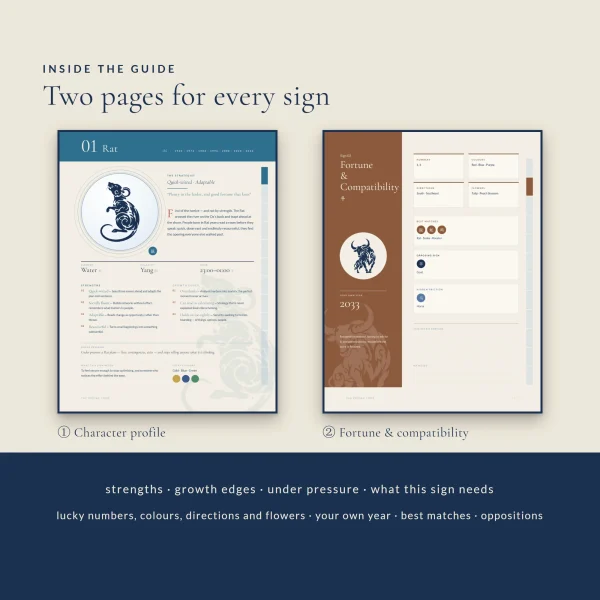
Our Chinese zodiac guide, The Zodiac Code, lays the same four relationships out as a 12 x 12 grid, one symbol per cell. It calls the clash the “opposing” sign and the harm “hidden friction.”
Each sign’s own compatibility page in the guide repeats its row: three best matches, one opposing sign and one hidden friction sign.
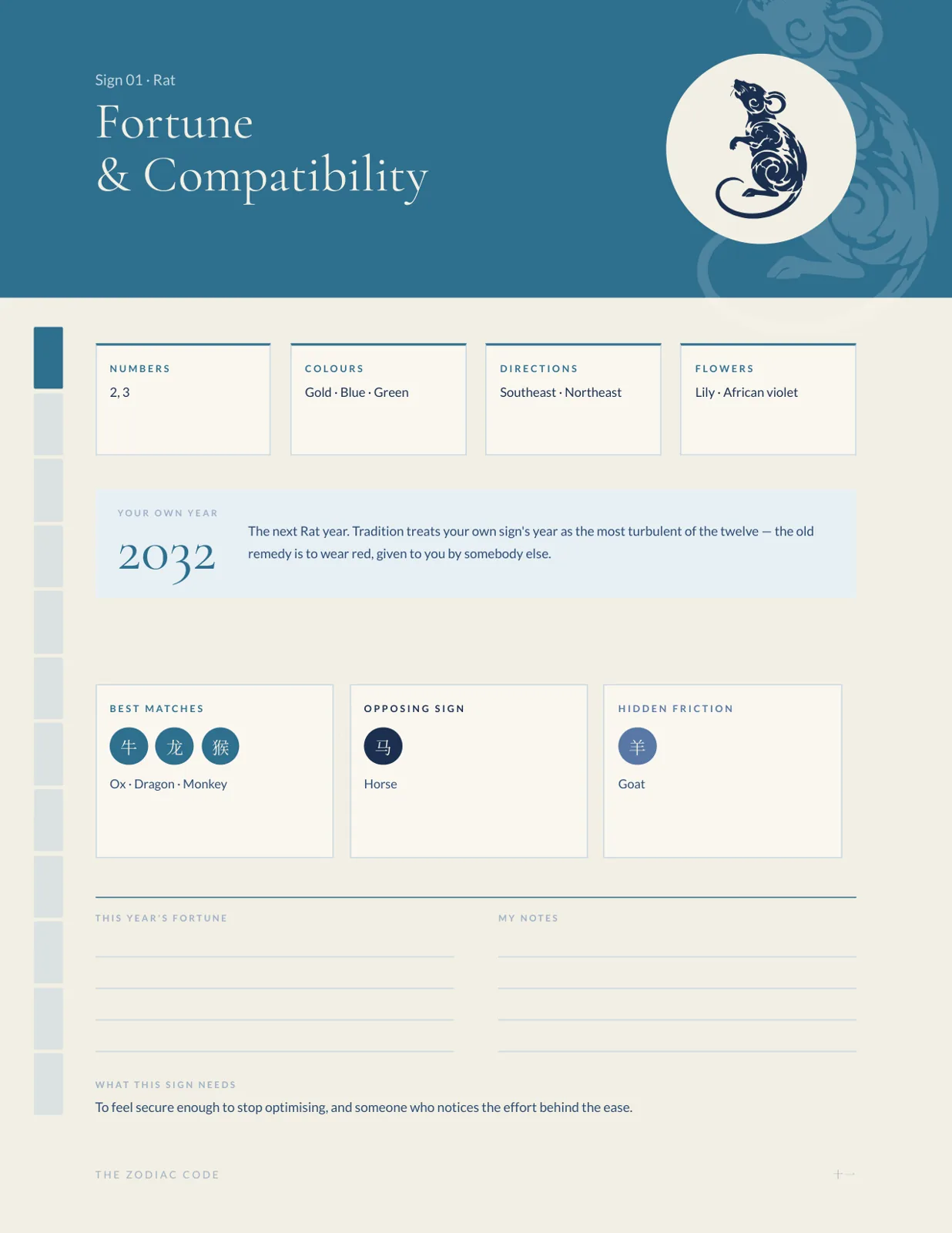
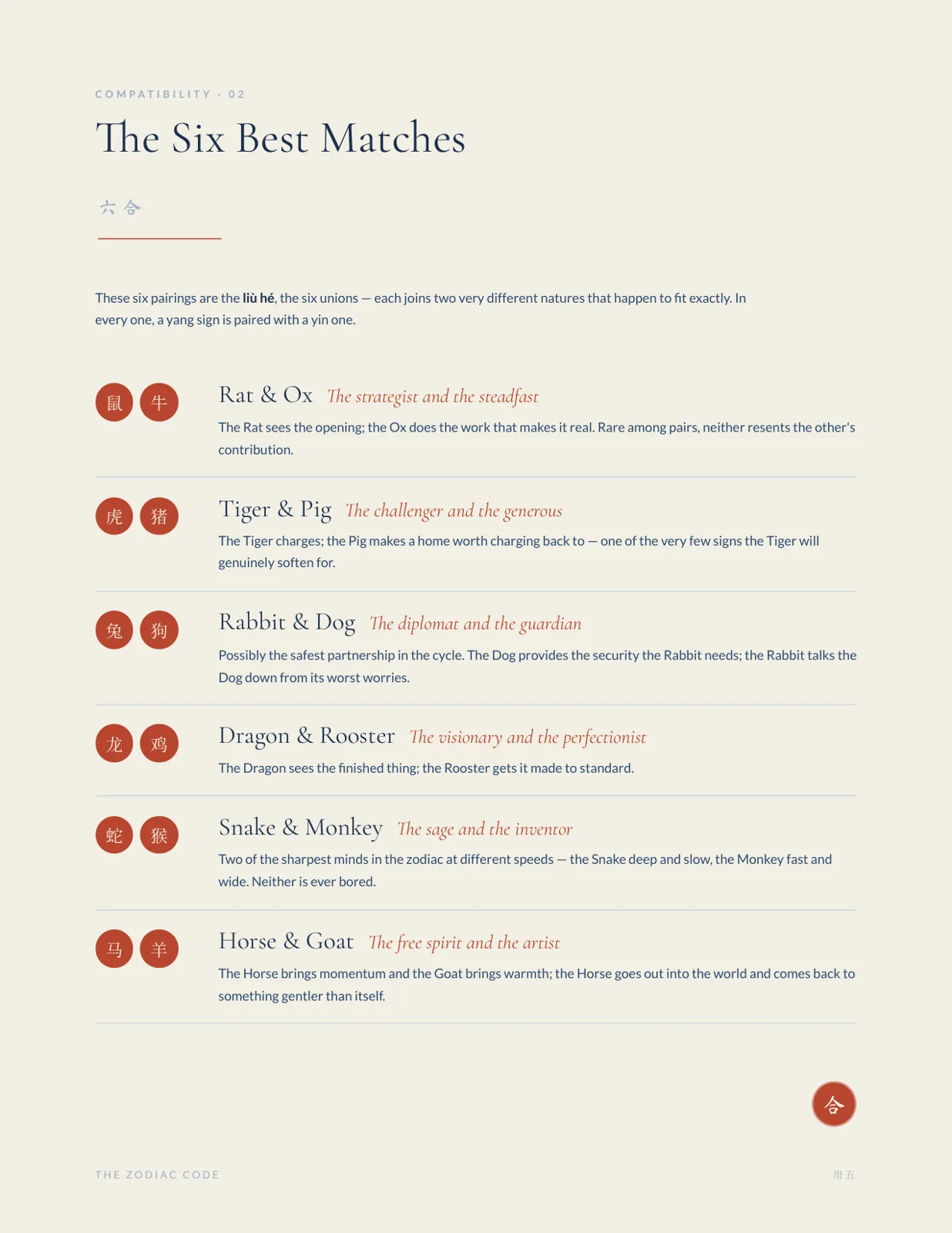
Best matches: the four trines (sānhé) and six unions (liùhé)
The best matches in the chart come from two separate rules. One works by counting years, and the other doesn’t.
The four trines: signs four years apart
A trine is a group of three signs spaced four years apart. The Chinese name is sānhé (三合), “three in harmony.” Each trine is tied to one of the five elements:
- Rat, Dragon and Monkey: water
- Ox, Snake and Rooster: metal
- Tiger, Horse and Dog: fire
- Rabbit, Goat and Pig: wood
The groups already appear in the Huainanzi, a Han dynasty book from the 2nd century BCE. It names three points in each element’s life: where it’s born, where it’s strongest and where it dies.
Wood, for example, is born in the Pig’s position, peaks in the Rabbit’s and dies in the Goat’s.
Those three positions sit four steps apart around the circle of twelve. That spacing is the whole reason a trine partner is always four years older or younger.
You can find your trine partners without a chart. Add four to your birth year and subtract four, using your lunar year if you were born in January or February.
Someone born in 1988, a Dragon year, lands on 1984 and 1992, a Rat year and a Monkey year.
Rat, Tiger, Dragon, Horse, Monkey and Dog are the yang signs, and the other six are yin. Signs four years apart always fall on the same side, so every trine is either all yang or all yin.
The six unions: fixed pairs
The unions are six pairs: Rat and Ox, Tiger and Pig, Rabbit and Dog, Dragon and Rooster, Snake and Monkey, and Horse and Goat. The Chinese name is liùhé (六合), “six harmonies.”
Counting years won’t find these. Rat and Ox sit one year apart, Tiger and Pig three, Rabbit and Dog five.
The Wuxing Dayi (五行大義), a treatise on the five elements written in the Sui dynasty (581 to 618), explains them with the sky. For each month it pairs the position the Big Dipper’s handle points to with the position where the sun and moon meet.
In the first month the handle points to the Tiger’s position and the sun and moon meet in the Pig’s, so Tiger and Pig form a union.
Unlike the trines, every union mixes yin and yang. The Ming dynasty astrology manual Sanming Tonghui (三命通會) puts it plainly: one yin and one yang in harmony is what makes a union.
Clashes and harms: the pairs tradition keeps apart
The warning side of the chart also has two rules. The first is pure geometry, and the second is built out of the unions you just read about.
The six clashes: directly across the circle
The clashes are Rat and Horse, Ox and Goat, Tiger and Monkey, Rabbit and Rooster, Dragon and Dog, and Snake and Pig. The Chinese name is liùchōng (六冲), “six clashes.”
Each pair sits directly across the circle, six years apart.
In the Sanming Tonghui it’s counted the Chinese way, starting with your own sign as one, so the clash is “the seventh position.”
The same twelve signs also name the two-hour periods of the traditional day, and the clash shows up there too. The Rat’s hours are 11 p.m. to 1 a.m. and the Horse’s are 11 a.m. to 1 p.m., opposite ends of the day.
A clash isn’t a flat “no” in the sources, though. The Sanming Tonghui calls clashes mostly unlucky, then describes cases where one turns out well.
Its summary is that clashes can go either way and can’t be judged in general terms.
The six harms: a clash by way of a union
The harms are Rat and Goat, Ox and Horse, Tiger and Snake, Rabbit and Dragon, Monkey and Pig, and Rooster and Dog. The Chinese name is liùhài (六害), “six harms.” The Wuxing Dayi lists the same six pairs.
The harms have no fixed spacing, so the Sanming Tonghui explains them through the other rules. The Rat fears its clash with the Horse.
Meanwhile the Goat is the Horse’s union partner, so it sides with the sign that opposes the Rat. That makes the Goat the Rat’s harm.
Put simply, your harm sign is the union partner of your clash sign.
You can check it against any row of the table. The Tiger clashes with the Monkey, the Monkey’s union partner is the Snake, and the Snake is the Tiger’s harm.
The Zodiac Code’s name for it, hidden friction, fits better than a word like “enemy.” Nothing about the harm sign opposes you directly. It’s allied with the sign that does.
Check which Chinese zodiac sign you are before reading the chart
Every pairing above hangs on the year animal, and that’s where most lookups go wrong. The animal changes at Lunar New Year, not on January 1.
Between 1948 and 2033, Lunar New Year fell as early as January 21 and as late as February 20.
A baby born on February 5, 2024, is a Rabbit, because the Dragon year didn’t start until February 10. The current Horse year began on February 17, 2026, and runs through February 5, 2027.
The Zodiac Code follows Lunar New Year. Its lookup page lists each animal’s years from 1948 to 2032, with the Lunar New Year date for every year from 1984 to 2033.
All 50 of those dates match the Gregorian to lunar calendar conversion tables published by the Hong Kong Observatory.
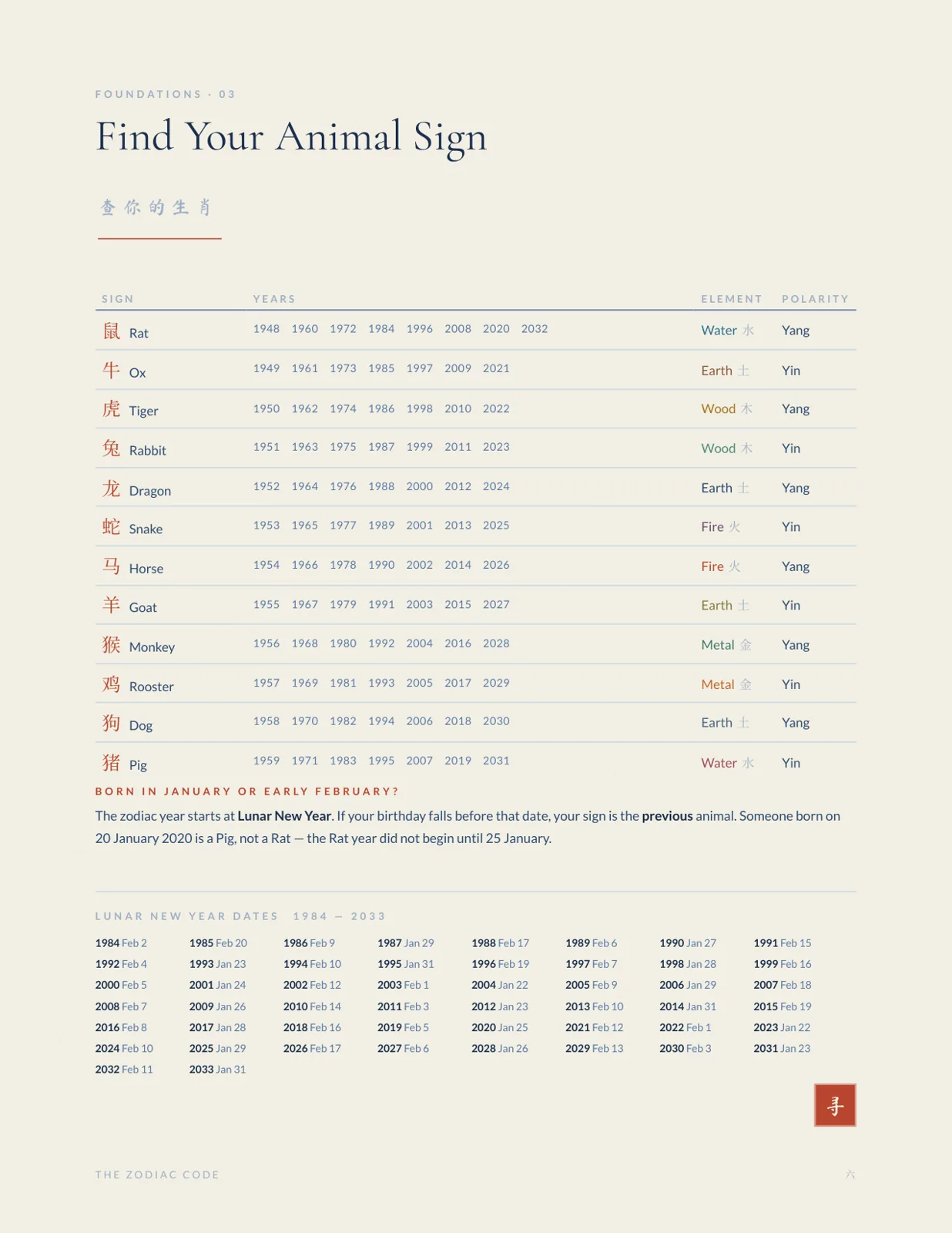
The table below goes back to 1948, with each date taken from the same observatory tables. Find your birth year, then check whether your birthday falls before the date in parentheses.
If it does, you belong to the animal one row up, or to the Pig if you’re on the Rat row.
| Sign | Years, with the date each one began |
|---|---|
| Rat | 1948 (Feb 10), 1960 (Jan 28), 1972 (Feb 15), 1984 (Feb 2), 1996 (Feb 19), 2008 (Feb 7), 2020 (Jan 25) |
| Ox | 1949 (Jan 29), 1961 (Feb 15), 1973 (Feb 3), 1985 (Feb 20), 1997 (Feb 7), 2009 (Jan 26), 2021 (Feb 12) |
| Tiger | 1950 (Feb 17), 1962 (Feb 5), 1974 (Jan 23), 1986 (Feb 9), 1998 (Jan 28), 2010 (Feb 14), 2022 (Feb 1) |
| Rabbit | 1951 (Feb 6), 1963 (Jan 25), 1975 (Feb 11), 1987 (Jan 29), 1999 (Feb 16), 2011 (Feb 3), 2023 (Jan 22) |
| Dragon | 1952 (Jan 27), 1964 (Feb 13), 1976 (Jan 31), 1988 (Feb 17), 2000 (Feb 5), 2012 (Jan 23), 2024 (Feb 10) |
| Snake | 1953 (Feb 14), 1965 (Feb 2), 1977 (Feb 18), 1989 (Feb 6), 2001 (Jan 24), 2013 (Feb 10), 2025 (Jan 29) |
| Horse | 1954 (Feb 3), 1966 (Jan 21), 1978 (Feb 7), 1990 (Jan 27), 2002 (Feb 12), 2014 (Jan 31), 2026 (Feb 17) |
| Goat | 1955 (Jan 24), 1967 (Feb 9), 1979 (Jan 28), 1991 (Feb 15), 2003 (Feb 1), 2015 (Feb 19), 2027 (Feb 6) |
| Monkey | 1956 (Feb 12), 1968 (Jan 30), 1980 (Feb 16), 1992 (Feb 4), 2004 (Jan 22), 2016 (Feb 8), 2028 (Jan 26) |
| Rooster | 1957 (Jan 31), 1969 (Feb 17), 1981 (Feb 5), 1993 (Jan 23), 2005 (Feb 9), 2017 (Jan 28), 2029 (Feb 13) |
| Dog | 1958 (Feb 18), 1970 (Feb 6), 1982 (Jan 25), 1994 (Feb 10), 2006 (Jan 29), 2018 (Feb 16), 2030 (Feb 3) |
| Pig | 1959 (Feb 8), 1971 (Jan 27), 1983 (Feb 13), 1995 (Jan 31), 2007 (Feb 18), 2019 (Feb 5), 2031 (Jan 23) |
All of these are China’s calendar dates, and China Standard Time runs 13 to 16 hours ahead of the continental US in winter.
A baby born in Chicago at 7 p.m. on February 9, 2024, arrived when it was already the morning of February 10 in Beijing. If your birthday is that close to the line, find out which date your chart is going by.
A second school of Chinese astrology changes the animal at lìchūn (立春), the start of spring on the solar calendar. Between 1948 and 2033 it always fell on February 3, 4 or 5.
If your birthday falls between the two dates, the two methods give you different animals.
Why Chinese zodiac compatibility charts disagree
Compare two charts online and you’ll often find the same pair marked good on one and bad on the other. Usually neither chart is wrong. They’re counting different rules.
The four rules above aren’t the only relationships in the classical texts. Two more turn up in the same books: xíng (刑), “punishment,” and pò (破), “break.”
The Wuxing Dayi sets out the punishments. The Rat and Rabbit punish each other, the Ox, Dog and Goat form a chain, and so do the Tiger, Snake and Monkey.
Four signs, the Dragon, Horse, Rooster and Pig, are said to punish themselves. Of all these rules, that’s the only one with anything to say about two people who share a sign.
For the breaks, the Sanming Tonghui lists Rabbit and Horse, Ox and Dragon, Rat and Rooster, and Goat and Dog.
Fold those in and several neutral pairs turn negative. One widely read chart lists the Rat’s least compatible signs as the Rabbit, Horse and Rooster.
Only the Horse is a clash. The Rabbit is a punishment pair and the Rooster is a break.
Some pairs end up on both sides at once. Snake and Monkey are a union and also part of a punishment chain, and the Wuxing Dayi raises that exact question itself: how can a union also be a punishment?
Tiger and Snake, likewise, are both a harm and a punishment.
So when one chart calls Snake and Monkey a best match and another lists them as a warning, both can point to a classical source. What differs is which rules each one decided to show.
What a compatibility chart can and can’t tell you
The older texts don’t treat these pairings as a verdict on a couple.
The Wuxing Dayi describes them as tools for choosing days and hours and for divination. The Sanming Tonghui reads them inside a whole birth chart, where the year is one of four parts along with the month, day and hour.
Both books also warn against reading any single label too hard. Right after listing the unions, the Wuxing Dayi notes that in every pairing of yin and yang, good and bad are evenly weighed.
In its words, the unlucky is never wholly unlucky, and the lucky is never only lucky.
Read that way, the chart is a map of what the tradition says about two year animals, and why. A red dot means the two signs share a trine or a union, and a cross means they sit across the circle.
An unmarked cell means the system is silent, which is true for most pairs.
The Zodiac Code frames it the same way in its own introduction. It treats the zodiac as a personality framework for reflection rather than a way to predict the future.
Its pages on the six unions and six clashes describe how each pair tends to get along instead of giving a yes or no.
If you’re looking up a pair, check both birthdays against the date table first, then find the row. When the label matters to you, ask which rule produced it.
A trine, a punishment and a break are three different claims, and a chart that shows only one color can’t tell them apart.
More printable references on Chinese culture, including the solar terms and Chinese tea, are on the guides page.
Printables from this article
Related articles
Printable Guides & Magazines
How to Start Homeschooling: Steps for Beginners
A first-year plan for new homeschool families: where state rules live, the order for leaving school, curriculum, daily hours, records, friends and the first 90 days.
Printable Guides & Magazines
Year of the Goat 2027: Fire Goat Dates, Years and Customs
When the 2027 Year of the Goat starts and ends, every Goat year with its exact dates, why 2027 is a Fire Goat, what tradition says about Goat people, and what to do when it's your own year.
Printable Guides & Magazines
Chinese Zodiac Signs: 12 Chinese Zodiac Animals by Year
The twelve Chinese zodiac animals in order, the years that belong to each, what tradition says about them, and how to work out your own sign from your birthday.