Christmas Card Ideas: Handmade, Printable & Kid-Made Cards
The best Christmas card idea depends on how many cards you need. For a list of 30 or more, print a folded card or a postcard at home and save the handmade touch for a short note. For a dozen close friends, a pop-up or washi tape card takes about 15 minutes each. Kids can turn out thumbprint reindeer or cut-paper trees in one sitting.
Pick a row from the table first, then jump to that idea for the supplies, the steps and the spot where people usually go wrong. The times are our planning estimates for one card once you’ve set up, not a promise for your first try.
| Your situation | Idea to try | Time per card | What you need |
|---|---|---|---|
| 30+ cards, short on time | Printed folded card | About 5 minutes to trim and fold | Printer, cardstock, ruler, craft knife or scissors |
| Big list, want it even faster | Printed postcard | About 2 minutes | Printer or photo print service, envelopes |
| Family card with your name on it | Flat 7 x 5 greeting | About 3 minutes after editing once | Printer, cardstock, a 5 x 7 envelope |
| 5 to 15 close friends | Pop-up card | 15 to 20 minutes | Cardstock, scissors, glue stick |
| Craft night with adults | Washi tape tree card | About 10 minutes | Blank cards, washi tape, a star sticker |
| Kids ages 3 to 6 | Thumbprint reindeer or lights | 10 minutes plus drying | Washable ink pads, fine markers |
| Kids ages 5 and up, or a class | Cut-paper tree card | 15 to 20 minutes | Pre-cut triangles, glue sticks |
| A gift tucked in the card | Colored bookmark insert | 30 to 60 minutes to color | Printed bookmark, colored pencils |
| Friends who don’t celebrate Christmas | Winter or New Year card | Same as a folded card | Printer, cardstock |
Christmas card ideas for a long list you print at home
Printing is the only way most people get through a long Christmas card list without buying a boxed set. A printed card still feels personal when you sign it by hand and add one line written for that person. They’re listed from most traditional to fastest.
A folded card printed on one sheet
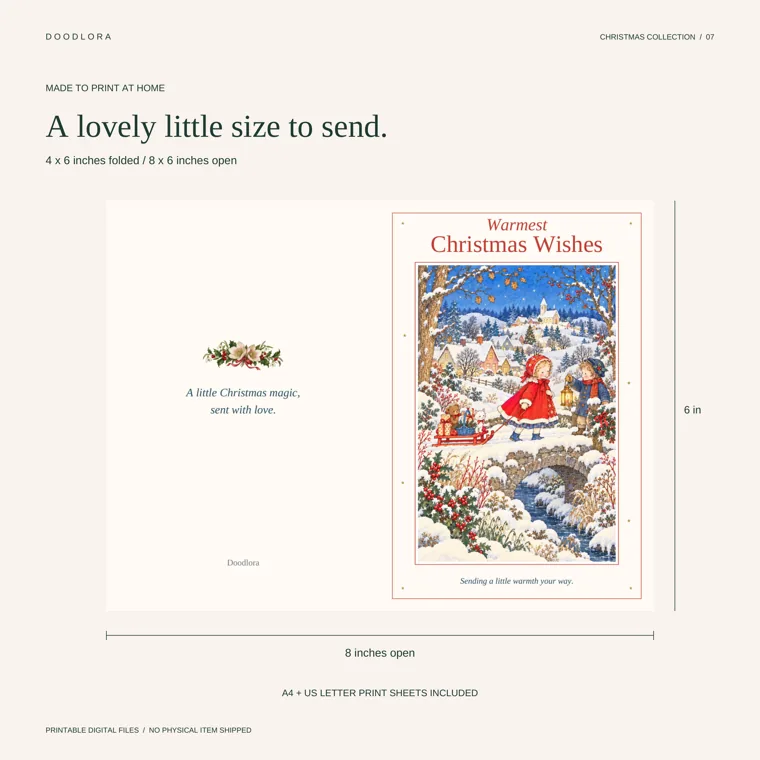
A folded card is the closest thing to a store card. One landscape sheet carries the back panel on the left and the cover on the right. Print it, trim it, fold it, and you’ve got a standing card with a blank inside for writing. That’s the whole job.
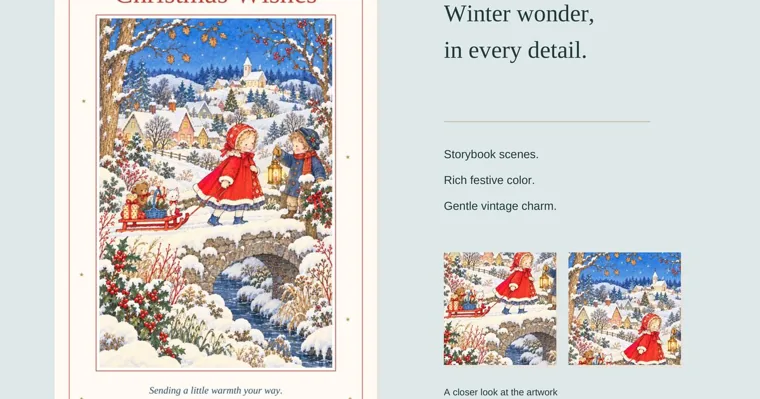
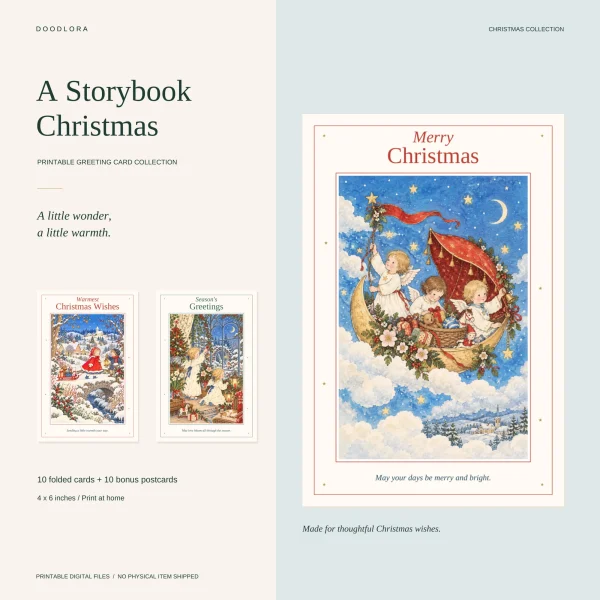
Our printable Christmas cards work this way. Each of the 10 designs prints on one US Letter or A4 sheet. You cut at the four corner crop marks to get an 8 x 6 inch piece, score down the middle and fold it to a 4 x 6 inch card. The scenes are vintage storybook pictures of angel children skating, baking gingerbread and singing carols in the snow.
To set up a batch, you need printer-compatible white or warm-white cardstock, a ruler, a craft knife and cutting mat or sharp scissors, and something with a blunt point for scoring, such as an empty ballpoint pen or a bone folder. Don’t skip scoring. Run the point along the ruler before you fold. Cardstock folded without a score line cracks along the crease and won’t lie flat.
The common mistake is printing with “Fit to page” switched on. The printer shrinks the sheet a little, and the card no longer measures 8 x 6 when you trim at the marks. Print at Actual Size or 100%, and run one copy on plain paper first to check.
If you want a printed verse inside, it goes on the back of the same sheet before you trim. Printers flip paper in different ways, so mark one corner of a test sheet, feed it back in, and fold it to check the verse comes out upright. For a blank inside, print the outside only.
Postcards for the fastest batch
A postcard’s even faster. There’s no trimming or folding at all. You print a picture on one side, write on the other and you’re done, which makes postcards the quickest card for a list of 50 or more.
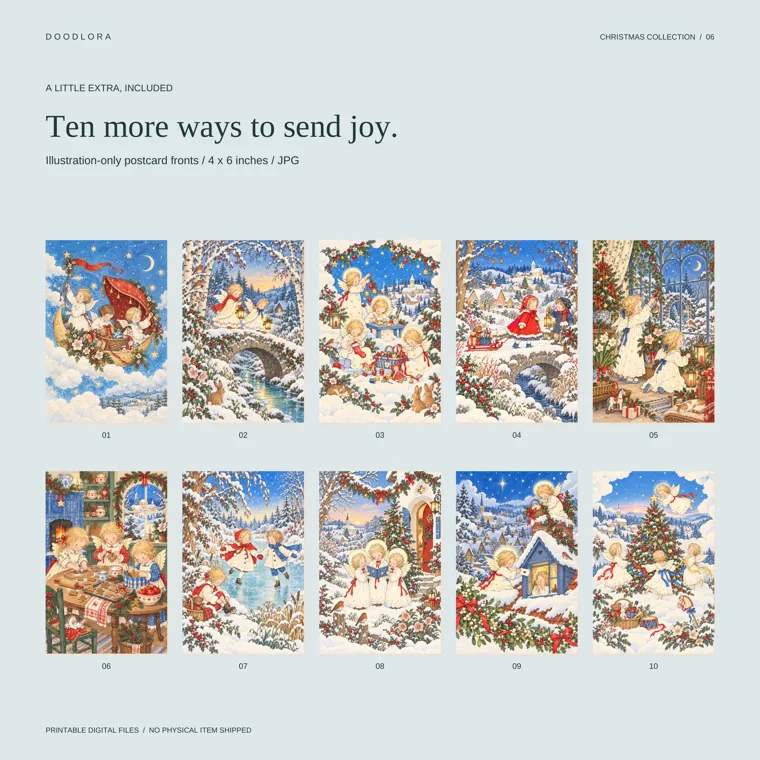
The same printable Christmas card set includes the 10 scenes as plain postcard JPGs at 1024 x 1536 pixels, sized for 4 x 6 inch prints. A photo print service gives you color to the very edge. On a home printer, automatic borderless printing enlarges the picture slightly and can crop the edges, so a slim white margin is the safer choice.
The print guide suggests putting postcards in an envelope for mailing. An envelope also protects a home-printed front, since inkjet ink can smudge if it gets wet in a mailbox.
A flat family greeting with your name printed on it
A flat card suits a family that wants its name printed instead of signed 40 times. You’ll type the wording once, print as many as you need and write a short line on the back of each.
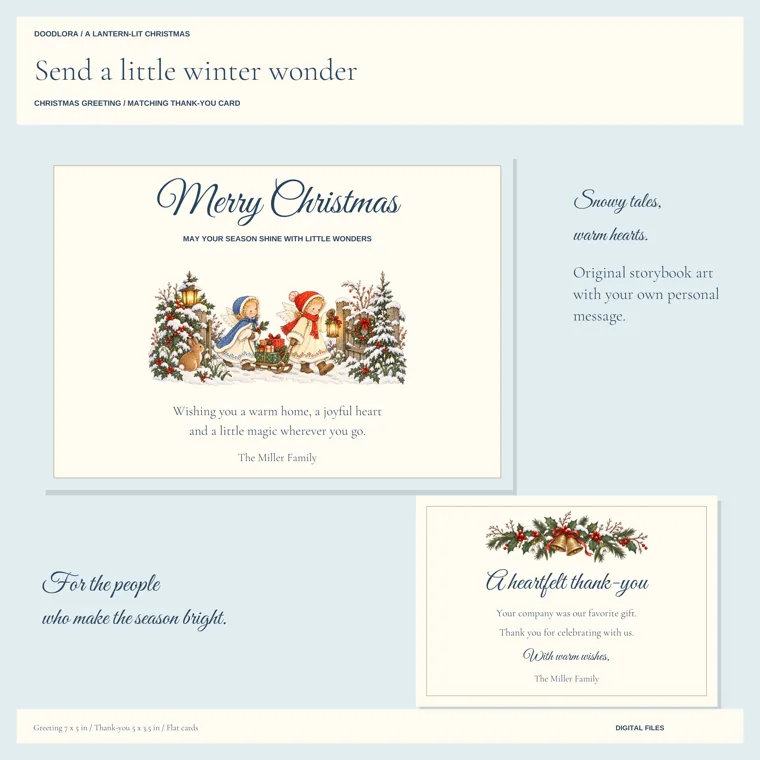
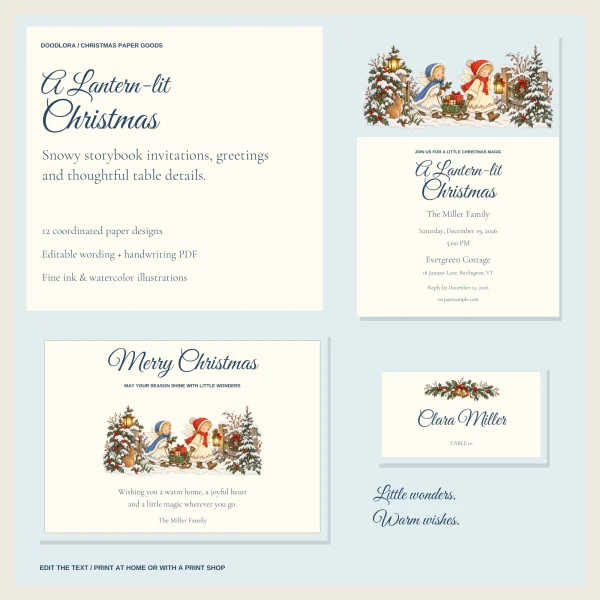
The Christmas greeting in our Christmas party invitation and card suite is a landscape 7 x 5 card. The sample reads “Merry Christmas” over two angel children and a gift sled, then “Wishing you a warm home, a joyful heart and a little magic wherever you go.” with a family name at the bottom. The editor runs in a desktop browser without going online, and you replace the sample wording and name with your own.
The editor doesn’t remember changes when you close the tab. Click “Save my edits” before you leave so you can load your wording again next year. A 7 x 5 card needs a 5 x 7 envelope, often sold as A7.
A printed photo tucked inside
A photo card doesn’t have to be a photo printed on the cover. Order 4 x 6 prints of your family photo, then slip one inside each folded card. They’ll keep the picture on the fridge long after the card’s gone to recycling.
A 4 x 6 print fits flat inside a 4 x 6 folded card, so you won’t need a bigger envelope. Write your note on the left inside panel and let the photo sit loose on the right.
Handmade Christmas card ideas for an afternoon with friends
Handmade cards don’t scale well. They’re for a short list. Each one takes 10 to 20 minutes, so plan on five to 15 cards in an afternoon. A craft night with friends works well if you set out one shared supply table and let each person pick an idea.
Start every handmade card from a plain folded blank. A US Letter sheet of cardstock cut in half gives two 5.5 x 8.5 inch pieces, and each folds to a 4.25 x 5.5 inch card. That size fits a standard A2 envelope.
A pop-up card
A pop-up card hides a small shape that stands up when the card opens. You’ll need cardstock, scissors, a ruler, a glue stick and a cut-out shape such as a tree, a star or a snowman about 2 inches tall.
- Fold a piece of cardstock in half and keep it closed.
- Cut two parallel slits about 1 inch long into the fold, about 1 inch apart.
- Open the card and push the strip between the slits through to the inside, so it forms a small box when the card is half open.
- Close the card firmly to set the new creases, then glue your shape to the front face of the box.
- Glue the pop-up page inside a second folded card to cover the holes on the back.
The usual mistake is a shape that’s taller than half the card. The top sticks out past the edge when the card closes. Hold the shape against the closed card before you glue. It’s a five-second check.
A washi tape Christmas tree
A washi tape tree is the easiest handmade card for adults who say they can’t craft. Stick strips of patterned tape across the front of a blank card, longest at the bottom and shorter as you go up, until they form a triangle. Trim the ends at an angle, add a small brown paper trunk and finish with a star sticker on top.
Five to seven strips make a full tree on a 4.25 x 5.5 inch card. Trim the strips on a cutting mat rather than on the card, because a craft knife slip leaves a cut you can’t hide.
Cards with buttons, bows or bells
Three-dimensional trims look great but cost more to mail. The US Postal Service lists letters that have “clasps, strings, buttons, or similar closure devices” or contents that make the thickness uneven as nonmachinable, and nonmachinable letters pay a surcharge. A button glued to the front counts as uneven thickness.
Keep raised trims flat and small, such as a paper bow or a sticker, if the card goes in the mail. Save buttons and bells for cards you hand out in person. They’ll survive that trip fine.
Christmas cards for kids to make
Kids can make real cards if the steps are short and the drying time is built in. Set up the table before the kids sit down, with supplies in the middle and a drying spot for finished cards to one side. Plan on one or two cards per child in a sitting. After that, they’re usually done.
The ages below are rough guides. A careful 4-year-old can manage the cut-paper tree with pre-cut shapes, and a restless 7-year-old may prefer the thumbprints.
Thumbprint reindeer or Christmas lights (ages 3 to 6)
Thumbprint cards are the classic first card for preschoolers. You’ll need a blank card, washable ink pads in brown and a few bright colors, a fine black marker and a red marker or red dot stickers. Plan on about 10 minutes plus 15 minutes for the ink to dry.
For reindeer, the child presses a thumb on the brown pad and prints three or four thumbprints across the front. Once the ink is dry, an adult or older child draws antlers, dots for eyes and a red nose on each one. For Christmas lights, draw a looping wire across the card first, then print colored thumbprints along it as bulbs.
Smudging is the usual problem. Kids try to draw on wet ink, and the marker drags it across the card. Set the cards aside to dry and have a second activity, like coloring, ready for the wait.
A cut-paper Christmas tree (ages 5 and up, or a classroom)
A cut-paper tree works for a whole class because the cutting can happen before the kids arrive. Pre-cut three green triangles per child in a small, medium and large size, plus a brown rectangle for the trunk and a yellow star. Kids glue the triangles in a stack on the card front, add the trunk and star, then decorate with markers or round stickers.
For a class of 25, that’s 75 triangles, 25 trunks and 25 stars. Cut them from folded stacks of construction paper to save time. Plan 15 to 20 minutes of craft time and give each table its own glue sticks, because one shared glue stick stalls a whole table.
Kids who can write their own names should sign the card themselves. A child who can’t write yet can dictate one line to an adult, who writes it inside. For more ideas to fill the weeks before the holiday, see our Christmas activities for kids.
A bookmark to color and slip inside the card
A small flat gift turns a card into a present without changing the postage much. A bookmark works well because it’s thin, it fits the envelope and the person keeps it long after the card’s gone.
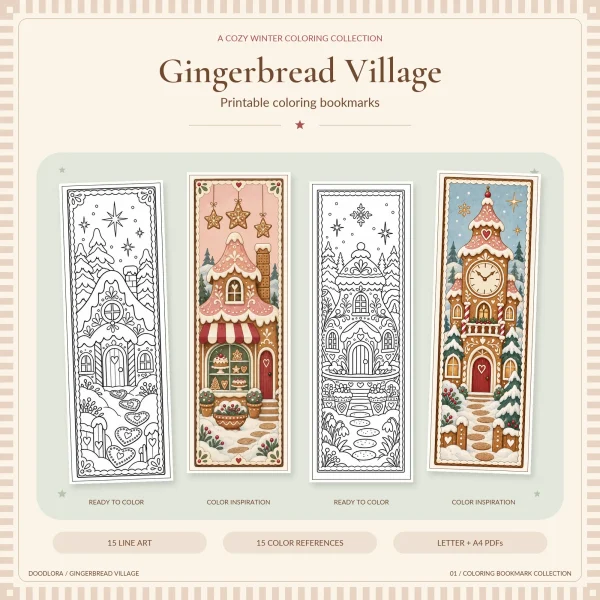
Our Gingerbread Village Christmas coloring bookmarks are 15 gingerbread houses, from a teapot cottage to a windmill with waffle-cookie sails, printed three to a page. Each bookmark measures 2 x 6 inches, so it rides flat inside a 4 x 6 card and its envelope.
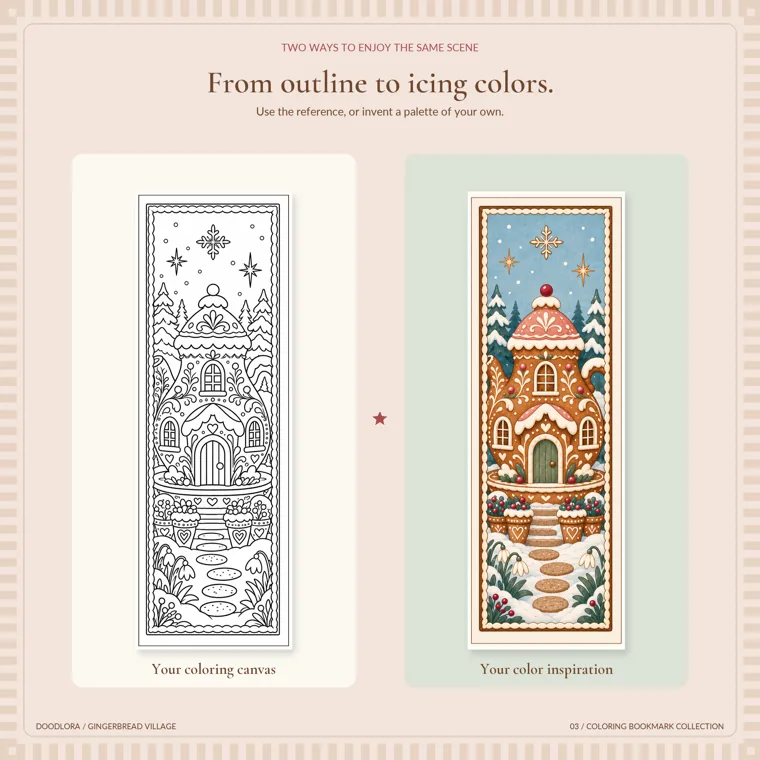
The outlines are bold, but the icing dots, window panes and fence hearts are small. The print guide suggests colored pencils or fine-tip pens, which makes these a better fit for older kids and adults than for preschoolers with fat crayons. Print on cardstock, color first, then cut along the outer rectangle so the scalloped frame stays on the bookmark.
Winter and New Year cards for friends who don’t celebrate Christmas
A winter card works for neighbors, coworkers and friends who celebrate something else or nothing at all. The picture carries the season and the greeting stays neutral, so you can send one design to your whole list.
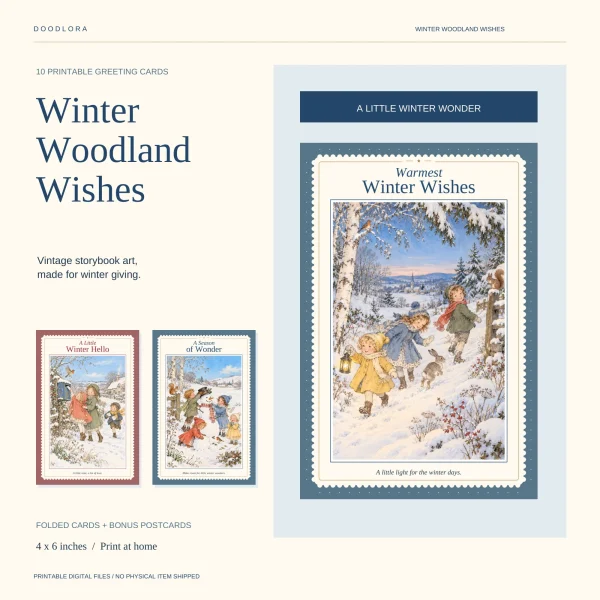
Our winter cards are 10 folded 4 x 6 inch cards with snowy storybook scenes of sledding, a snowman and children feeding a fawn. None of the covers says Christmas. Card 09 says Happy New Year, which also helps if your cards are running late and won’t arrive by December 25.
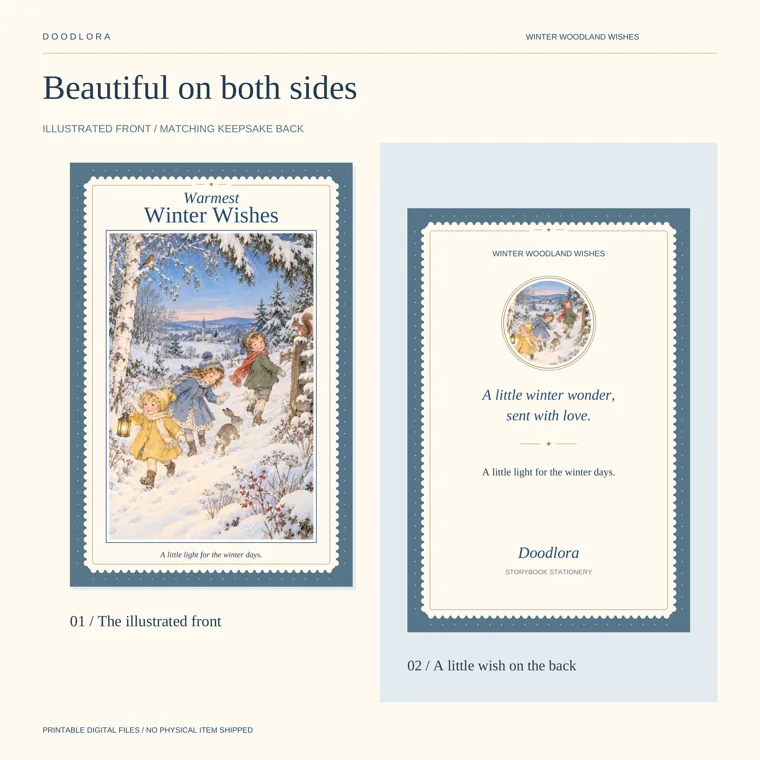
The colored border on these covers is printed right out to the crop marks and has no bleed. Cut exactly on the marks, because cutting outside them leaves a thin white edge on one side. Wording for non-Christmas cards is covered in our Christmas card messages guide, along with what to write for family, friends and coworkers.
How to send Christmas cards so they arrive in one piece
A card that arrives bent or with postage due spoils the effort. It’s also avoidable. Most problems come from the envelope, not the card. Check the size, the shape and the thickness before you buy stamps for the whole stack.
Match the envelope to the card size
Buy envelopes made for the finished size of the card, with a little room to spare. These are the usual pairings for the cards above.
| Finished card | Envelope to buy |
|---|---|
| 4.25 x 5.5 inch folded blank | A2 envelope |
| 4 x 6 inch folded or postcard | A6 envelope |
| 5 x 7 inch flat card | A7 envelope |
Printable card sets don’t come with envelopes, so order them with your cardstock. A card that’s rattling around in an envelope two sizes too big gets bent in sorting.
Avoid square envelopes and lumpy contents
Square envelopes look pretty but cost more to mail. The Postal Service treats a letter as nonmachinable if its length divided by its height is less than 1.3, and a square envelope works out to 1.0. A 4 x 6 card in an A6 envelope stays above that line.
Letter-size mail also has limits. A First-Class letter can be up to 11-1/2 inches long, 6-1/8 inches high and 1/4 inch thick. A folded card with a bookmark or a photo inside stays well under that thickness, but a card with a jingle bell glued on may not.
Don’t turn the envelope sideways. Write the address parallel to the long side. The Postal Service lists an address running along the short side as another nonmachinable trait.
Plan your mailing dates
Christmas Day 2026 falls on a Friday. The Postal Service publishes recommended holiday mailing dates each fall, so check those before you set your own deadline. Cards going overseas need more time. Don’t leave them for last.
A simple plan is to print and trim in one evening, write in batches of 10 over the next few nights, and mail everything at once. Writing is the slowest part, so start there earlier than you think you need to. For more printable stationery and coloring pages, start from the Doodlora Studio home page.
Printables from this article
Related articles
Printable Invitations & Cards
What Is a Golden Birthday? Meaning, Ages and Party Ideas
Your golden birthday is the year you turn the same number as the day of the month you were born. Find yours from the day, not the month, plan around the number, and say what it means on the invitation.
Printable Invitations & Cards
Christmas Pregnancy Announcement Ideas: Holiday Card Wording
Pick the reveal by who you're telling: something private and small for your partner on Christmas morning, a stocking or a gift box at the family gathering, a job for an older child, a quick joke for friends, and a card or phone image for everyone far away.
Printable Invitations & Cards
How to Wrap a Gift: Easy Steps, Ideas and Gifts From Santa
Cut paper that goes around the box with about 2 inches to spare and reaches a little past halfway up each end, tape the seam on the bottom, then fold each end in like an envelope: sides in, top down, bottom up.