Types of Whales: 11 Baleen and Toothed Whales Explained
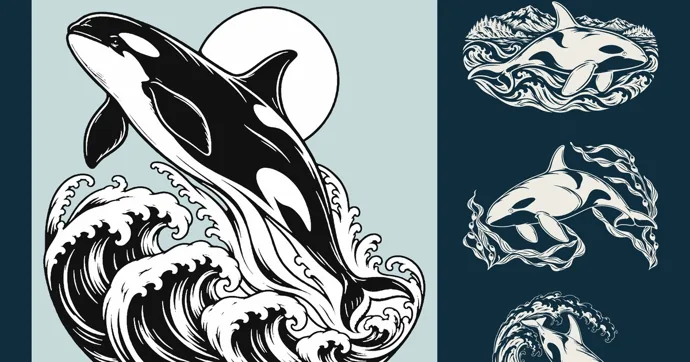
Every type of whale belongs to one of two groups: baleen whales, which strain small food through plates of baleen, and toothed whales, which have teeth and hunt larger prey. Wikipedia counts 16 living species of baleen whales. Toothed whales are a much bigger group of about 73 described species, but most of those are dolphins, porpoises and beaked whales. The orca, or killer whale, is one of the toothed whales, and it’s actually the largest member of the dolphin family.
Below are 11 whales you’re most likely to read about or meet on a boat trip: seven baleen whales and four toothed whales. For each one you’ll get its size, where it lives and the clues that separate it from the others, starting with the blow, the back fin and the tail. After the species come the shape-of-the-spout clues for a whale watch, where in the US each whale turns up, NOAA’s distance rules, and a few ways to teach the two groups with printable whale pictures.
Baleen whales vs toothed whales: the first split
Whether a whale has baleen or teeth decides almost everything else about it. You can’t see inside the mouth from a boat, so use the outside clues in this table.
| Baleen whales (Mysticeti) | Toothed whales (Odontoceti) | |
|---|---|---|
| Mouth | Baleen plates instead of teeth | Teeth |
| Blowholes | Two, side by side | One |
| Size | Includes the biggest animal ever known | From small porpoises up to the sperm whale |
| Families | Rorquals, right whales, the pygmy right whale, the gray whale | Sperm whales, belugas and narwhals, beaked whales, plus dolphins and porpoises |
| Examples here | Blue, fin, humpback, minke, gray, North Atlantic right, bowhead | Sperm whale, orca, beluga, narwhal |
The word “whale” is loose. In everyday speech it means the big members of the order Cetacea, and dolphins and porpoises are left out. Scientists treat dolphins and porpoises as part of the same group, which is how the orca can be a killer whale and a dolphin at once. To make the split stick with kids, print the species pages from our whale outlines and silhouettes set (more on it below) and sort them into a “baleen” pile and a “teeth” pile. Our ocean crafts guide has whale silhouette and whale tail bookmark crafts to follow up with.
11 types of whales compared side by side
Lengths are the largest measured or typical adult lengths from each whale’s Wikipedia entry or NOAA species page, so most whales you see will be smaller.
| Whale | Group | Length | Where it lives | Fastest clue |
|---|---|---|---|---|
| Blue whale | Baleen | Up to about 98–100 ft | Every major ocean | Very tall, straight blow; tiny back fin far back |
| Fin whale | Baleen | Up to about 85–90 ft | All major oceans, polar to tropical | Long, slim, brownish-gray body; hooked back fin |
| Humpback whale | Baleen | 46–56 ft (NOAA: up to about 60 ft) | Oceans worldwide; migrates between poles and tropics | Very long white flippers; knobs on the head |
| Common minke whale | Baleen | Longest caught about 31–33 ft | Northern oceans | Small, pointed head; blow often faint or not seen |
| Gray whale | Baleen | 49–50 ft | North Pacific, Alaska to Mexico | No back fin, a row of “knuckles” instead; mottled gray |
| North Atlantic right whale | Baleen | Up to 61 ft | Western North Atlantic, Canada to Florida | No back fin; V-shaped, heart-shaped blow |
| Bowhead whale | Baleen | Females 52–59 ft | Arctic and sub-Arctic only | Huge triangular head; no back fin |
| Sperm whale | Toothed | Males average 52 ft | Worldwide | Square head; bushy blow angled forward and left |
| Orca (killer whale) | Toothed, dolphin family | Up to 32 ft | Every ocean, most in cold water | Black and white; tall back fin |
| Beluga | Toothed | Males up to 18 ft | Arctic and sub-Arctic | All white; no back fin |
| Narwhal | Toothed | 9.8–18 ft, plus tusk | Arctic | Males have a long spiral tusk |
Baleen whales: the seven big filter feeders
Six of these are the whales most people picture: huge, slow-looking and blowing tall spouts. The seventh, the bowhead, almost never leaves the Arctic.
Blue whale
The blue whale is the largest animal known to have ever lived. The longest confirmed ones reached about 98 to 100 feet and weighed up to around 200 metric tons. Its body is long and slender, grayish blue on top and lighter underneath, and it looks blue under the water.
The head is broad and U-shaped when seen from above. The back fin is small and sickle-shaped and sits close to the tail. Its two blowholes push a spout 30 to 39 feet into the air, the tallest blow on this list. Blue whales live in every major ocean, split into four recognized subspecies. One of them, the pygmy blue whale, lives in the Indian Ocean and the South Pacific.
Fin whale
The fin whale is the second-longest whale after the blue whale, with the biggest reported at 85 to 90 feet. It’s long and slim, brownish gray above and paler below. Its scientific name, physalus, comes from a Greek word for breath, a nod to its strong blow.
Look for a large, hooked back fin about two feet tall, set well back on the body. The blow rises 13 to 20 feet. When fin whales are feeding they blow five to seven times in quick succession, but when traveling they blow only once every minute or two. They’re found in all the major oceans, from polar to tropical water.
Humpback whale facts: long flippers and a one-of-a-kind tail
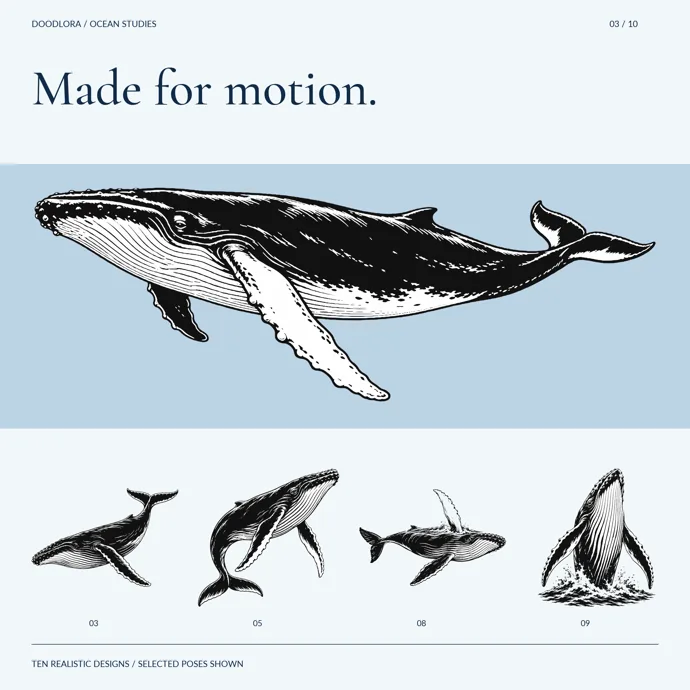
The humpback is the whale on most whale-watch posters, because it’s often near the surface doing something big. Humpbacks breach (jump out of the water) and slap the surface with their flippers and tails, which makes them a favorite with whale watchers.
- Size: Adults are 46 to 56 feet long by Wikipedia’s measure. NOAA gives up to about 60 feet and up to about 40 tons.
- Flippers: Very long pectoral fins. They gave the humpback its scientific name, Megaptera, which means “big-winged.”
- Head: Humpbacks are the only large whales with knobs, called tubercles, on the head and along the front edge of the flippers.
- Color: Mostly black, with differing amounts of white on the flippers, belly and underside of the tail.
- Back fin: Short. On some whales it’s barely there, while on others it’s longer and curved.
- Tail: Up to 18 feet wide, jagged along the trailing edge and pointed at the tips.
The tail is the humpback’s ID card. NOAA notes that the pattern on the underside of the flukes, along with the fluke’s shape and any scars, is unique to each animal. That’s why whale researchers photograph the tail as a humpback dives.
Humpbacks also make one of the longest migrations of any mammal. Some travel 5,000 miles between cold summer feeding grounds and warm winter waters where they mate and give birth. In the North Pacific, some swim from Alaska to Hawaii, about 3,000 miles, in as few as 28 days. Males sing a complex song that typically lasts 4 to 33 minutes.
Common minke whale
The common minke is the smallest rorqual and the second-smallest baleen whale. Norwegian whalers once claimed minkes of 35 feet, but those were likely guessed by eye. The longest measured in later years were about 31 to 33 feet.
Minkes are hard to spot because the blow often isn’t there to see. A minke may exhale before it surfaces, or show only a narrow or low, bushy blow. The better clue is the back fin. It’s tall, upright and curved, about a foot high on average, and set about two-thirds of the way along the back. A dwarf form of the minke lives in the Southern Hemisphere.
Gray whale
The gray whale reaches 49 to 50 feet and gets its name from the gray patches and white mottling on its dark skin. It has no back fin. In its place is a row of 6 to 12 raised bumps, called knuckles, running along the back toward the tail.
In calm weather the two blowholes can make a heart-shaped blow. The larger of the two populations, about 27,000 whales, lives in the eastern Pacific and travels between the waters off northern Alaska and Baja California Sur in Mexico. That route runs along the whole US West Coast, which is why gray whales are a common whale-watch sighting there.
North Atlantic right whale
The North Atlantic right whale is one of the most endangered whales in the world. The largest measured were 61 feet long. Its head makes up a quarter of its length, and its broad back has no back fin at all. The flippers are short and paddle-shaped, and the mouth is a long arch that starts above the eye.
The V-shaped blowhole gives it a heart-shaped blow, so a heart-shaped spout alone won’t tell you whether it’s a right whale or a gray whale. The ocean does. Right whales live in the western North Atlantic and travel between feeding grounds in the Labrador Sea and winter calving areas off Georgia and Florida. Gray whales live in the Pacific. That calving area sits in heavy shipping traffic, one reason the whale is in trouble.
Bowhead whale
The bowhead is the only baleen whale that lives only in Arctic and sub-Arctic waters. It’s named for its massive triangular skull, which it uses to break through sea ice. Females usually grow to 52 to 59 feet and males to 46 to 52 feet.
Bowheads have the largest mouth of any animal, almost a third of the body length, and the longest baleen of any whale. There’s no back fin. The blow can rise up to 20 feet. They may also be the longest-lived of all mammals.
Toothed whales: the sperm whale, orca, beluga and narwhal
Toothed whales have a single blowhole, and they hunt fish, squid and, for some orcas, other mammals. Most toothed species are dolphins and porpoises. These four are the ones people usually call whales.
Sperm whale
The sperm whale is the largest toothed whale and the largest toothed predator. Mature males average 52 feet, and the big square head can make up a third of that length. Sperm whales live across the world’s oceans. Females and young males stay together in groups, while grown males live alone outside the mating season.
The sperm whale has the easiest blow to recognize. The single S-shaped blowhole sits at the very front of the head, shifted to the whale’s left, so the spray is bushy and angled forward. On the back there’s no true fin, only a series of ridges. The biggest ridge, which whalers called the hump, can be mistaken for a fin. The tail flukes are triangular and very thick, and a sperm whale lifts them high out of the water as it begins a feeding dive.
Orca facts: the biggest dolphin
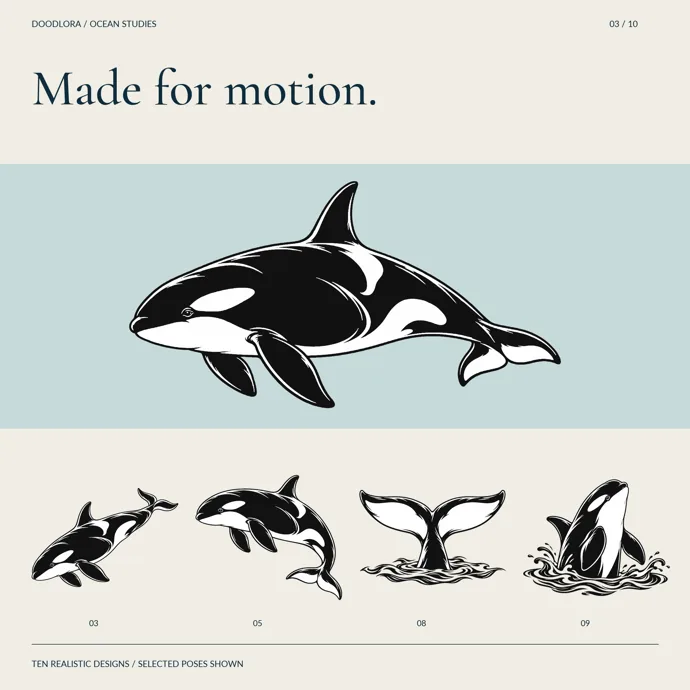
The orca, or killer whale, is the largest member of the oceanic dolphin family, Delphinidae. So it’s a toothed whale and a dolphin at the same time. It’s also the only living species in its genus, Orcinus.
- Size: Up to 32 feet and up to 11 tons, per NOAA.
- Colors: Mostly black on top and white underneath, with a white eye patch and a gray or white saddle patch behind the back fin.
- Fins: Adult males grow much larger flippers, back fins and tails than females, so a very tall, straight back fin usually means a grown male.
- Range: Every ocean in the world. Orcas are the most widely distributed of all whales and dolphins, most common in cold water like the Antarctic, the North Atlantic and the North Pacific.
- Family life: Some populations live in stable family groups traced through the mothers, called pods.
- Lifespan: 30 to 90 years, per NOAA.
Orcas in different places eat different things and behave differently. Off the west coast of North America there are fish-eating “residents” and mammal-eating “transients.” NOAA notes that residents tend to have rounded back fins with varied saddle patches, while transients have straighter fins and mostly solid white saddle patches. Scientists have even proposed splitting orcas into separate subspecies or species. That’s why the IUCN lists the orca as data deficient for now.
Beluga
The beluga, also called the white whale, lives in Arctic and sub-Arctic waters. Adults are all white, and there’s no back fin, only a low ridge. That helps it swim under ice. Males grow up to 18 feet.
Belugas are sometimes called sea canaries because of their high-pitched calls. They can change the shape of the head by moving air around the sinuses. Most groups spend the winter near the Arctic ice and move into warmer river mouths and coastal water in summer, when the sea ice melts.
Narwhal
The narwhal is the beluga’s only living relative in the family Monodontidae. It lives in the Arctic and grows 9.8 to 18 feet long, not counting the tusk. Like the beluga, it has a shallow ridge instead of a back fin.
Males have the tusk, a long, spiral left canine tooth that is 4.9 to 9.8 feet long. Scientists aren’t sure what it’s for. Ideas include showing off to mates, fighting, feeding and sensing the water around it. Calves are born about 5 feet long and white or light gray.
How to tell whales apart from a boat or the shore
On a whale watch you usually see three things: the blow, the back as it rolls, and maybe the tail. Check them in that order.
1. The blow. Look at its height and shape before the whale surfaces again.
| What the blow looks like | Likely whale |
|---|---|
| Very tall and straight, 30 ft or more | Blue whale |
| Tall, 13–20 ft, several in a row while feeding | Fin whale |
| Heart-shaped or V-shaped | Gray whale (Pacific) or North Atlantic right whale (Atlantic) |
| Bushy and angled forward and to the left | Sperm whale |
| Faint, low or not visible at all | Common minke whale |
2. The back and fin. No fin at all points to a gray, right, bowhead, beluga or narwhal. A row of knuckles means a gray whale. A tall, straight fin on a black and white body is a male orca. A small fin far back near the tail fits a blue whale. A big, hooked fin fits a fin whale.
3. The tail. A humpback’s tail shows a white-and-black pattern underneath, with a jagged trailing edge. A sperm whale lifts thick, triangular flukes high before a deep dive.
The pitfall is the sperm whale’s hump. From a distance it looks like a low back fin, so check the blow angle and the square head too. The other pitfall is the heart-shaped blow, which two different whales make. Where you are tells you which one it is.
US whale-watching spots and NOAA’s distance rules
| Place | Whales | Rule from NOAA |
|---|---|---|
| Hawaii | Humpbacks in winter, after the migration from Alaska | Stay 100 yards away |
| Alaska | Humpbacks in summer, on their feeding grounds | Stay 100 yards away |
| Washington State inland waters (Puget Sound) | Orcas | Stay 200 yards away and out of their path within 400 yards |
| US West Coast | Gray whales on their Alaska–Mexico migration; orcas | 100 yards for large whales unless a stricter rule applies |
| East Coast, Canada to Florida | North Atlantic right whales; calving off Georgia and Florida in winter | Stay 500 yards away, about a quarter mile, anywhere in US waters |
NOAA’s general rule is to watch whales from at least 100 yards, the length of a football field, unless a species-specific rule asks for more. NOAA also says not to swim with, ride, pet, touch or try to interact with whales and other marine mammals in the wild. Don’t chase, circle or leapfrog them with any boat. Pack binoculars instead, and book a tour with an operator that follows these rules.
Teaching the types of whales to kids
The baleen-or-teeth split is easy to teach because it boils down to one question: does it strain its food or bite it? Here’s how it works at different ages.
Ages 4–6 (10–15 minutes, small group). Print a page of whale pictures and cut them apart. Ask “Does this whale have teeth?” and sort the cards into two piles. Keep it to five or six whales: blue, humpback and gray for baleen, and orca, beluga and narwhal for toothed. Talk about one fact per whale, like the narwhal’s tusk or the beluga’s white skin.
Ages 6–9 (20–30 minutes, a class or a family). Lay out a length line. Mark 100 feet on a playground or hallway with a tape measure and chalk or masking tape, then mark where a blue whale (about 100 ft), humpback (about 50 ft), orca (up to 32 ft) and narwhal (up to 18 ft) would end. Have one child lie down at the start of the line to show how small a person looks next to it. Check the space first, because 100 feet is longer than most classrooms.
Ages 9–12 (one class period). Give each student a species from the table above and have them make a fact card with the blow, back fin, tail, size and where it lives. Then play “which whale?” by reading only the clues.
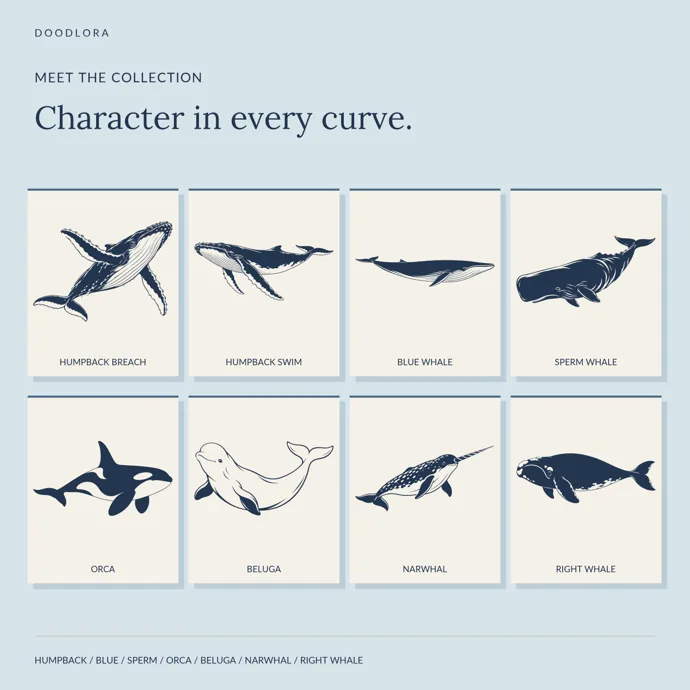
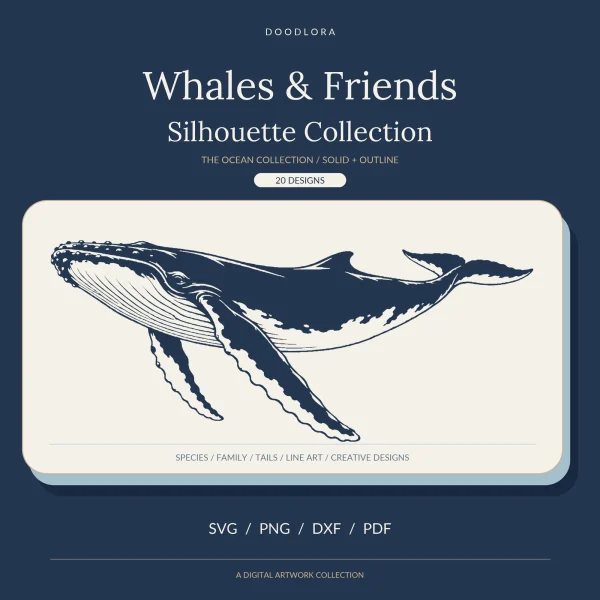
Our Whale Outlines and Silhouettes set is the easiest base for the sorting game. Its 20 designs include named drawings of a humpback in two poses, a blue whale, sperm whale, orca, beluga, narwhal, right whale and bowhead. It also comes as printable US Letter and A4 PDFs with one, four or six copies of a design per page. One catch: design 19 is a stylized skeleton whose small bones were thickened and joined, so don’t use it as an anatomy chart.
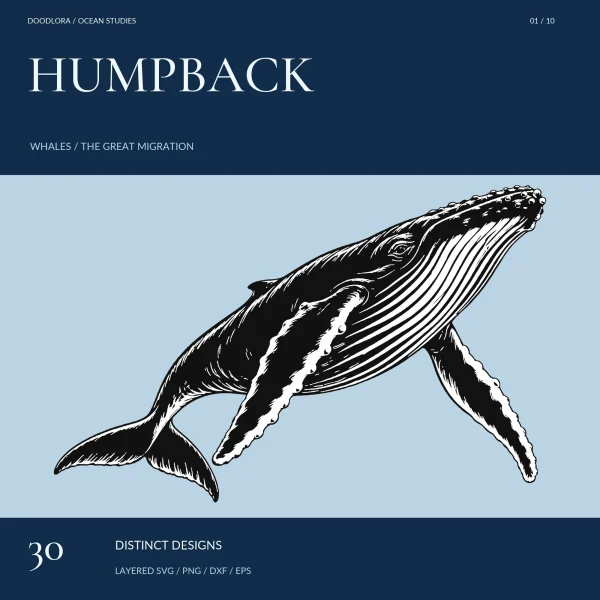
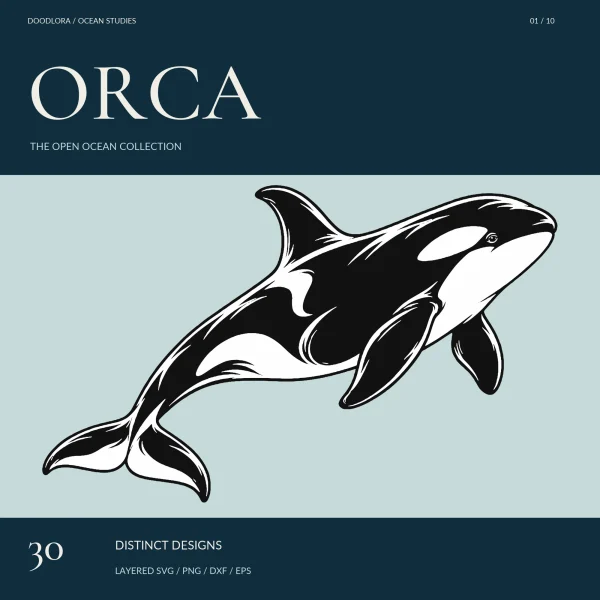
For older kids, display boards or a whale-watch scrapbook, the Humpback Whale Clipart and Orca Clipart sets are each 30 engraved black and white designs. The humpback set covers 10 adults, 4 contour studies, 6 calves and young whales, 4 ocean scenes, 2 tail flukes and 4 lettered designs. The orca set has 10 adults, 8 young orcas, 4 framed designs, 4 scenes and 4 lettered designs. Both come as SVG and PNG files, plus DXF files for a cutting machine. The fine engraving lines are the part to watch on small pieces, so print or cut a test at your real size first.
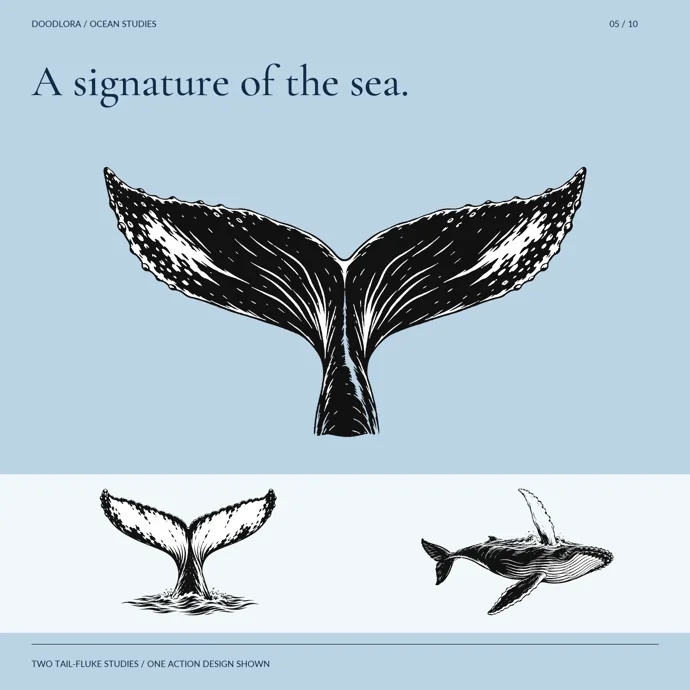
None of these drawings are field-guide plates. They’re decorative clipart, so use the facts and tables in this guide, not the pictures, when kids want to know which whale is which. If you’d rather end the lesson with something to make, the whale tail bookmark in the ocean crafts guide takes about 20 minutes with cardstock, scissors and ribbon.
Quick answers about whale types
How many types of whales are there? Wikipedia lists 16 living species of baleen whales and about 73 described species of toothed whales. Most of the toothed species are dolphins, porpoises and beaked whales, which is why counts of “whales” vary from list to list.
Is an orca a whale or a dolphin? Both. It’s a toothed whale and the largest member of the oceanic dolphin family.
What is the biggest whale? The blue whale, at up to about 98 to 100 feet. The biggest toothed whale is the sperm whale.
Which whales have no back fin? The gray whale, North Atlantic right whale, bowhead, beluga and narwhal. The sperm whale has ridges and a hump instead of a true fin.
Printables from this article
Related articles
Clipart & SVG Cut Files
How to Draw a Truck: Easy Pickup, Big Rig and Cartoon
Split a pickup into three parts before you draw a single wheel: a bed, a cab and a hood. Keep the roof about 2.2 wheels tall and the bed rail level with the hood, and the truck looks right even before the details go on.
Clipart & SVG Cut Files
How to Draw a Train: Steam Engine, Cars and Tracks
Split the page into a 10-square grid, lay a long boiler tube across the middle, set a box cab at the back and a tall stack at the front, hang two big driving wheels under the cab end, then couple cars behind and run the rails to a vanishing point.
Clipart & SVG Cut Files
Hawk vs Falcon: Wings, Size, Hunting Style and Eagles
A falcon has long, narrow wings that taper to sharp points and flies on steady, quick wingbeats; a hawk has broader wings with rounded tips and either soars in slow circles or flaps hard and glides. Falcons kill with a notched beak and hawks with their talons, and eagles are the largest, heaviest-billed members of the hawk family.