Secret Santa Rules: How to Draw Names, Budget and Reveal

Secret Santa is a gift exchange where each person in a group is randomly assigned one other person to buy for. Wikipedia’s entry on the custom notes that some groups keep the giver secret for good, while others reveal every giver at the end. The core rules fit in one sentence: everyone draws one name, buys one gift under a shared price limit, tells no one, and brings the gift to a single exchange.
Most arguments about Secret Santa start with a rule nobody settled before the draw. Settle these six in the invitation and the rest of the season runs itself.
| Rule | A common choice | Settle it by |
|---|---|---|
| Who plays | Opt-in, 4 or more people | The sign-up deadline |
| How names are drawn | Slips in a hat, a shuffled list or an online generator | The draw date |
| Price limit | A range, such as $20 to $25 | The invitation |
| What the giver learns | A short wish list from each player | The draw |
| Reveal | At the exchange, after a guess, or never | The invitation |
| Delivery | All gifts at one party, or shipped by a set date | The invitation |
The ranges and timings in this guide are our planning suggestions. Adjust them to your group. Groups that would rather roll dice or pass gifts to a story will find those formats in our gift exchange games. If your group wants stealing instead of assigned gifts, that’s a different game with its own white elephant rules.
Who Secret Santa suits, and why you need at least four people
Secret Santa works for any group that will shop ahead: a family spread over several households, a group of friends, an office team, a classroom or a remote team. Wikipedia lists the same custom under other names, among them Kris Kringle in Canada and Australia.
Four players is the practical minimum. With three people and no one allowed to draw themselves, the names can only run in a circle. If you drew Sam, then Sam drew the third person, and the third person drew you. Every player can work out their giver in a few seconds. With four or more, the secret holds.
There’s no top limit, but a large group takes longer at the exchange. Opening one gift at a time, with a moment for everyone to watch, comes to roughly two minutes a gift. So 12 players fill about 25 minutes, and 30 players fill an hour. Above 20, split into smaller groups by table, team or household, each with its own draw.
Young children can join a family draw. A child who can’t read the slip, or who will happily tell everyone, needs an adult to read the name with them and help with the shopping. Pair each young child with a parent for the draw, and keep the parent’s own slip separate.
Invitation and timeline: put the rules in writing
Send the rules in the invitation, not by word of mouth on the day. Write the price limit, the draw date, the exchange date and whether gifts are shipped or brought. Then nobody can say they didn’t know.
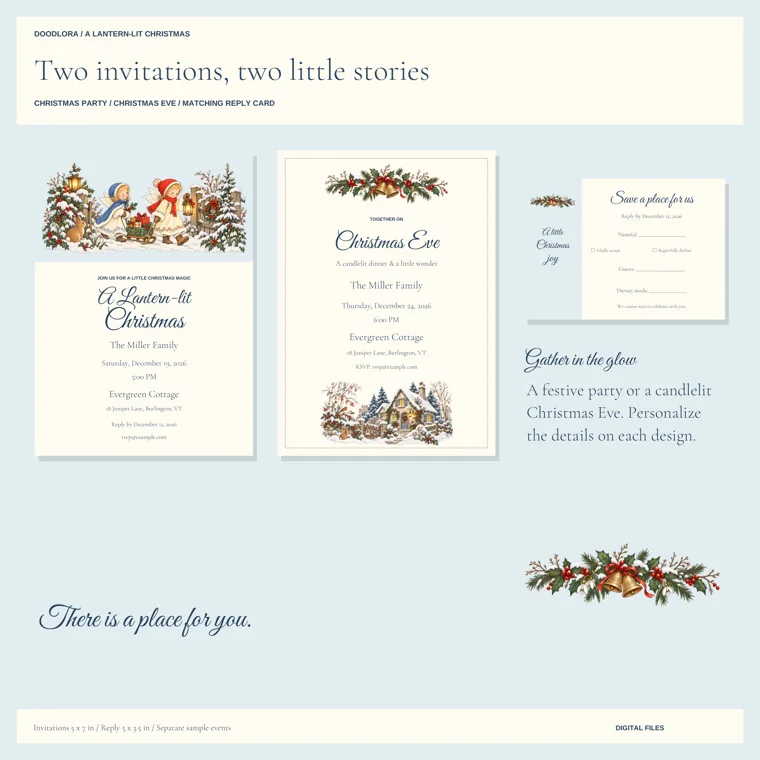
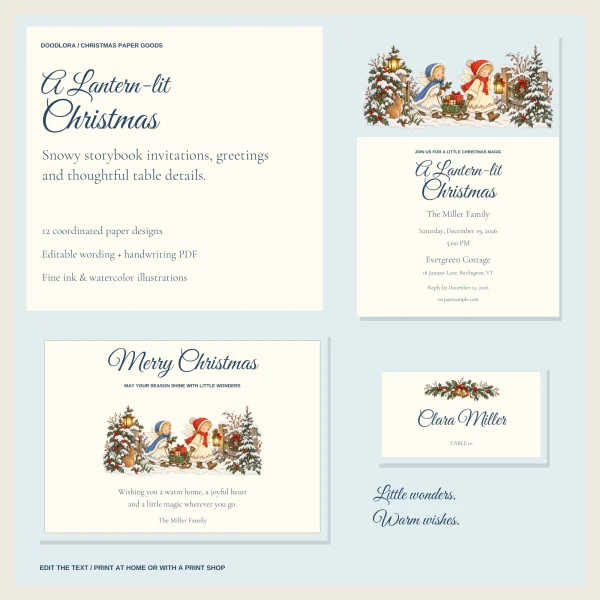
Our Christmas party invitation set has a 4 x 6 gathering details card with a panel headed Bring a Little Joy. In the editor, that panel’s sample text reads “A favorite side dish or dessert.” Replace it with your Secret Santa line, for example: “Your Secret Santa gift, wrapped, $20 to $25.” The editor shrinks long text to fit and shows a warning when a line gets too long, so keep the wording short. The reply card has a line for names, which doubles as your sign-up list.
A workable timeline runs backward from the exchange day. The one below assumes an exchange on Friday, December 18, 2026. Thanksgiving falls on November 26 that year, so a family drawing names at the Thanksgiving table only shifts the draw by a day.
| When | What happens |
|---|---|
| About 4 weeks before (around November 20) | Invitations out, with the rules and a sign-up deadline |
| About 3 weeks before (around November 27) | Sign-ups close; names are drawn and sent |
| About 2 weeks before | Wish lists shared; remote players confirm addresses |
| 1 week before | Shipping deadline for mailed gifts |
| Exchange day | Gifts opened, giver revealed if your group chose that |
How to draw names for Secret Santa
The draw has one job: give every person exactly one recipient, never themselves, with no one else knowing. Each method below meets that job in a different way.
Names in a hat
Write every name on an identical slip, fold each one the same way and put them all in a bowl. Players draw one at a time and read their slip in private.
The catch is how often someone pulls their own name. Mathematicians call a shuffle where no item lands in its own place a derangement. As the group grows, the share of shuffles that are derangements settles at about 37 percent. In other words, for any group of four or more, roughly two straight draws in three will hand at least one person their own name.
So set the redraw rule before the first slip comes out. Anyone who draws themselves says so at once, puts the slip back and draws again. If the last player is left holding only their own name, everyone returns their slips and the whole draw starts over. Saying out loud “I drew myself” doesn’t give anything away, as long as no one says who they drew instead.
A shuffled list and a circle
One person shuffles the names into a random order and writes them in a list. Each person buys for the next name down, and the last name buys for the first. No one can get themselves, and there’s never a redraw.
The weak point is that the organizer knows every match. Either the organizer sits out, or a person outside the group does the shuffle, or the group accepts that one player knows. This is also the easiest method for exclusions. To keep couples or members of one household from drawing each other, check that they don’t sit next to each other in the list.
An online generator
Wikipedia notes that Secret Santa generators tell each participant whom to buy for. Each player gets a private message, and the organizer doesn’t have to see the matches. It’s the natural choice for a remote team or a family in different states.
Typos are what break it. Before the draw, have everyone confirm the email address or phone number the generator will use. After the draw, ask everyone to reply “got it” to the organizer, without the name. A player who never received a match is the one person who can’t tell you anything is wrong.
Exclusions to decide before any draw
- Couples and households: most groups keep partners from drawing each other, since they’d buy for each other anyway.
- Last year’s match: in a group that plays every year, keep the old list and redraw if someone gets the same person.
- Very young children: let an adult draw for the child, and keep that adult out of the child’s draw.
Setting a Secret Santa budget
Use one number for everyone, written in the invitation. A range works better than a ceiling. With “under $25,” one person spends $6 and another spends $25, and the $6 gift gets opened in front of everyone. “$20 to $25” keeps every gift in the same band.
Settle three small questions with the budget:
- Does shipping count? For mailed gifts, say whether the limit includes postage.
- Are gift cards allowed? Some groups ban them because they feel impersonal. Others welcome them for a hard-to-shop-for player.
- Can gifts be handmade? If yes, say that handmade gifts don’t need to hit the price, so nobody feels outdone.
At work, pick a number every person on the team can afford without thinking about it. A low budget with an opt-in sign-up keeps the exchange from feeling like a bill.
Keeping it secret: wish lists, questions and gift tags
The secret is the whole game, so give givers a way to shop well without asking anyone directly.
Ask each player for a short wish list when they sign up: three gift ideas, any sizes that matter, and anything they can’t use (allergies, no candles, no mugs). The organizer forwards each list to the right giver. A giver with a question sends it to the organizer, who passes it on without saying who asked.
Labeling the gift is where most secrets slip. Handwriting on a tag can give the giver away in a small office or a family. Type the tag instead, with the recipient’s name and “From: Your Secret Santa.”
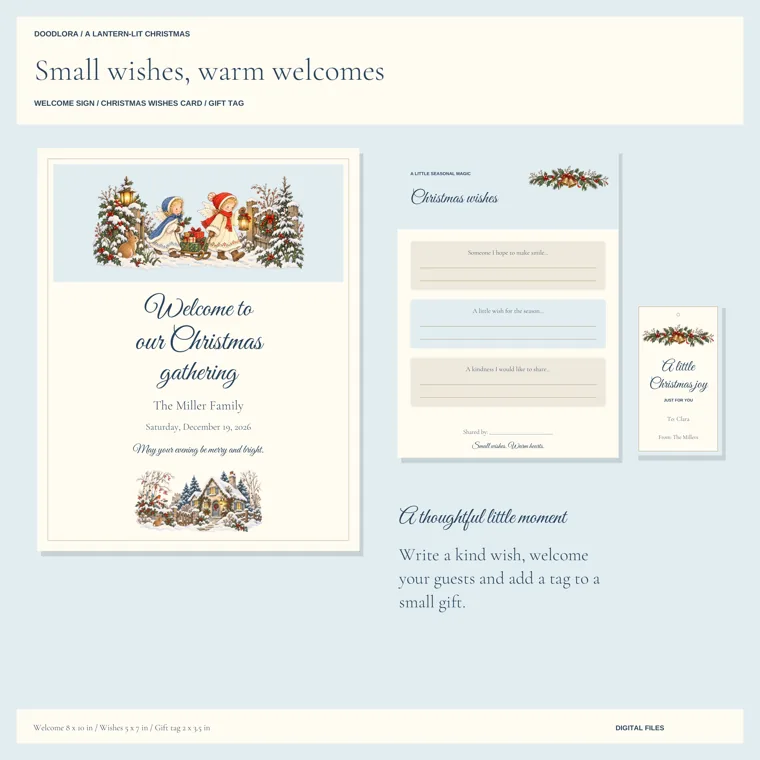
The gift tag in our invitation set is 2 x 3.5 inches and reads “Just for You” with a To line and a From line. Typed in the editor, the From field can say “Your Secret Santa” and no one learns anything from the lettering. The set also has a blank handwriting version of every piece, which is fine for the recipient’s name but not for a disguised From line.
A few more habits keep the secret intact:
- Don’t put the wrapped gift on a shared desk or table until the exchange starts.
- For online orders, choose gift options so the packing slip doesn’t show the buyer’s name.
- Ask everyone to leave last-minute “who did you get?” questions unanswered, even as a joke.
Exchange day and the Secret Santa reveal
Count gifts against the sign-up list before anything opens. If a gift is missing, you’ll know who is short before the first person unwraps.
Open the gifts one at a time, in any order the group likes, so everyone sees each one. The exchange ends when the last gift is open and, if your group reveals, the last giver has owned up. Choose one of three reveals in the invitation:
- Reveal at opening: the giver speaks up as soon as the gift is opened. It’s quick and suits large groups.
- Guess first: each recipient makes one guess before the giver steps forward. This is the guess-the-giver version of the game, and it suits close friends or relatives who can make a real guess.
- No reveal: the giver stays secret for good. It suits an office where some people would feel awkward being thanked in public.
Some givers like to reveal themselves in a card tucked inside the wrapping. A folded card with a blank inside gives room for a note and a name.
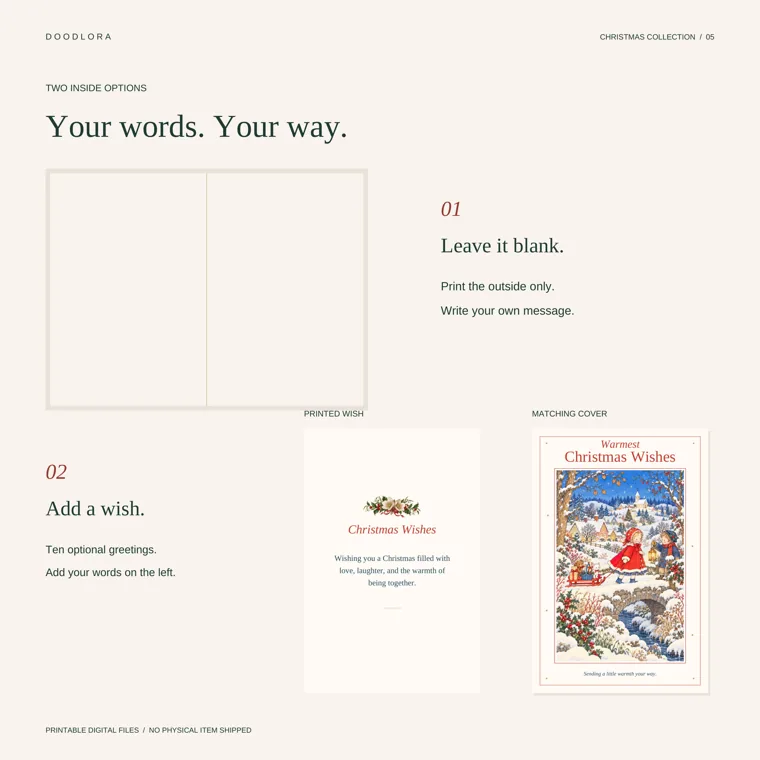
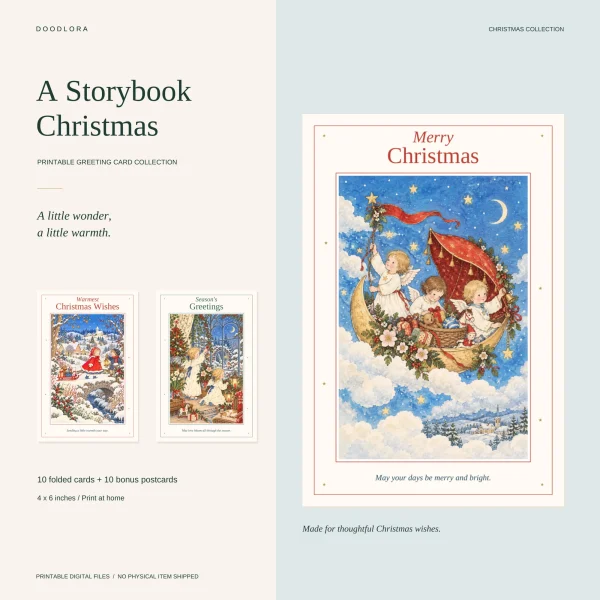
Our printable Christmas cards are ten folded cards, each printed on one sheet and finished at 4 x 6 inches once folded. Card 09, Sending Christmas Cheer, carries the line “A little Christmas wish, sent with love.” on the front, which suits a reveal note. Print only the outside and the inside stays blank for writing. For a guess-first group, keep the note inside the card unsigned and add the name once the guess is made.
Office Secret Santa rules
A workplace exchange needs the same rules plus a few of its own. Most of them protect coworkers who’d rather not take part, or who’d be embarrassed by the wrong gift in front of the team.
- Make it opt-in. People who skip it can still come to the party and watch the opening.
- Keep gifts suitable for work. Rule out anything about a person’s looks, weight or age, and anything you wouldn’t open in front of a manager. If alcohol is a gift some coworkers won’t want, say no alcohol in the invitation.
- Plan around leave. Someone may be out on exchange day. Decide in advance whether their gift waits on their desk or gets opened on a video call.
- Same budget for everyone. A manager shouldn’t spend more on one person than the rest of the team does.
Run the exchange near the end of the party, once everyone who signed up has arrived. Games sorted by team size and a running order for the whole work party are in our office Christmas party games.
Remote and long-distance Secret Santa
When the group can’t meet, the rules shift to delivery. Every giver needs an address, a deadline and a plan for opening together.
- Addresses go only to the giver. The organizer collects addresses, asks each person if theirs can be shared with one giver, and sends each giver one address.
- Set a shipping deadline. Give it a week or more before the exchange, since parcels slow down in December.
- Mark the box. Ask givers to label it “Do not open until December 18” or whatever date your group picked.
- Open together. Everyone opens on a video call in turn. If a parcel is still on its way, that person goes last or opens it during a later call.
If mailing feels like too much for a remote team, the photo-and-link version described in our gift exchange guide avoids shipping until after the call.
When something goes wrong
A few problems turn up in almost every year’s exchange. Here’s how to fix each one without redrawing every name.
Someone drops out after the draw
Only the organizer can fix this, because the fix needs two matches. Say Jordan drew Riley, and Riley drops out. Jordan takes over Riley’s recipient instead. Nobody else’s assignment changes.
There’s one catch. If Riley had drawn Jordan, the fix hands Jordan their own name. In that case, swap with another pair: Jordan takes someone else’s recipient, and that giver takes over Jordan instead. Do it quietly, and only the two people affected need to hear.
Someone joins late
Pick any giver, say Alex, who drew Morgan. Alex now buys for the newcomer, and the newcomer buys for Morgan. Two people get a new name and nobody else is touched. Let the newcomer know the budget and the dates.
A gift doesn’t arrive, or someone forgets
Keep one spare wrapped gift within the price limit. If a player turns up empty-handed, their recipient still opens something. The forgetful giver brings the real gift later, and the spare goes back in the closet for next year.
Someone guesses their giver early
Carry on. The giver doesn’t have to confirm or deny it, and the exchange still works. If the group plays a guess-first reveal, the early guesser simply gets their guess right on the day.
One gift is far over or under the budget
Say nothing on the day. Next year, change the ceiling to a range and write both numbers in the invitation.
Secret Santa rules, in short
Settle who plays, the draw, the price range, the wish lists and the reveal before anyone draws a name. Draw with a redraw rule, a shuffled circle or a generator. Keep handwriting off the tags, keep a spare gift, and the organizer handles every dropout quietly. If the exchange is one part of a longer evening, pick a couple of rounds from our Christmas party games to play while guests arrive.
Printables from this article
Related articles
Printable Party Games
How to Plan a Baby Shower: Timeline, Food & 2-Hour Schedule
A baby shower plan from the first talk with the parents-to-be to the last gift: timing, guest list, budget, venue, a two-hour schedule, safe food and backup plans.
Printable Party Games
How to Plan a Bridal Shower: Timeline, Budget and Schedule
A host's plan for a bridal shower, from the first talk with the bride and co-hosts to the guest list, invitations, a timed party schedule, the gift opening and what to do when something slips.
Printable Party Games
35th Birthday Ideas: Party, Trip, Theme and Gift Ideas
Ways to celebrate turning 35, sorted by how many people the birthday star wants around, with group size, time, prep and the snag to plan for in each.