Human Skeleton Bones and Names for Kids, Head to Toe
How many bones are in the human skeleton, and what are they called? An adult skeleton usually has 206 named bones, according to the SEER training modules from the National Institutes of Health. A newborn starts with about 300, KidsHealth (Nemours) explains, and many of them grow together during childhood. This guide names the bones kids learn first, from the skull down to the toes, with where each one sits and what it does. It ends with an age-by-age plan, a game for finding bones on your own body and coloring pages that match.
Why a baby has about 300 bones and an adult has 206
The number drops because small bones fuse. KidsHealth says a baby’s body has about 300 bones at birth, and these eventually fuse, or grow together, into the 206 bones adults have. Some of a baby’s bones are made entirely of cartilage, a soft and flexible material, and others are only partly cartilage. During childhood, that cartilage is slowly replaced by bone.
Three fusions are easy to point out on a skeleton picture:
- The sacrum at the bottom of the spine is five vertebrae fused into one bone, and the coccyx below it is four more, according to KidsHealth.
- Each hip bone is made of three parts, the ilium, ischium and pubis. Wikipedia notes that in humans the three parts are separate before puberty.
- A baby’s skull has spaces between its bones. As the child grows, KidsHealth explains, the spaces close and joints called sutures connect the bones.
Don’t worry if a library book gives a different number. Wikipedia’s human skeleton article says around 270 bones at birth, and SEER describes the adult total as “usually” 206. Sources simply count a newborn’s bones differently, so treat both figures as rough. Adults vary a little too: KidsHealth notes that some people are born with an extra rib. For a child, “about 300 as a baby, 206 as a grown-up” is the version to remember.
SEER also splits the 206 into two groups. The 80 bones of the axial skeleton run down the body’s center line: the head, the spine, the ribs and the breastbone. The other 126, the appendicular skeleton, are the arms and legs plus the shoulder and hip bones that attach them. KidsHealth counts 54 bones in the two hands and wrists and 52 in the two feet and ankles. That adds up to 106, so more than half of a person’s bones are in the hands and feet.
This page stays with the bones themselves. To see where the skeleton fits beside the muscles, heart, lungs and the other organ groups, read our human body systems for kids overview.
Names of bones in the human skeleton, from head to toe
The table lists the bones that most kids’ books and skeleton diagrams label. The everyday name comes first and the science name second, because a labeled diagram usually prints the science one. The counts come from SEER’s list of the 206 bones.
| Everyday name | Science name | Where it is | What it does | How many |
|---|---|---|---|---|
| Skull | Cranium and facial bones | The head | Surrounds the brain and shapes the face | 28, counting the lower jaw and 6 tiny ear bones |
| Lower jaw | Mandible | Bottom of the face | Holds the lower teeth; opens and closes for talking and chewing | 1 (one of the skull’s 28) |
| Backbone | Vertebral column: vertebrae, sacrum, coccyx | Middle of the back, from the neck to the hips | Holds the body upright, lets it bend and twist, protects the spinal cord | 26 |
| Ribs | Ribs | Around the chest, from the spine to the front | Make a cage around the heart and lungs | 24 (12 pairs) |
| Breastbone | Sternum | Center front of the chest | Forms the front of the rib cage; ribs join it with cartilage | 1 |
| Collarbone | Clavicle | Front of each shoulder, below the neck | Braces the shoulder between the breastbone and the shoulder blade | 2 |
| Shoulder blade | Scapula | Upper back, one on each side | Links the upper arm bone to the collarbone | 2 |
| Upper arm bone | Humerus | Shoulder to elbow | Connects the shoulder blade to the two forearm bones | 2 |
| Forearm bones | Radius and ulna | Elbow to wrist; radius on the thumb side, ulna on the little-finger side | Let the forearm turn the palm up and down | 2 of each |
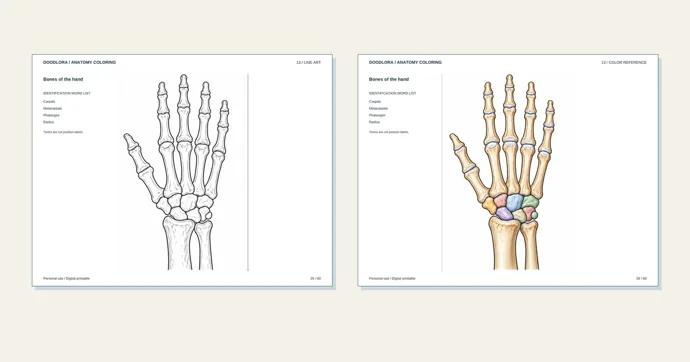
| Wrist, hand and finger bones | Carpals, metacarpals, phalanges | Wrist, palm and fingers | Grip, write, pick things up | 27 in each hand |
| Hip bones | Hip bones (ilium, ischium, pubis) | The hips; with the sacrum and coccyx they form the pelvis | Support the spine and connect it to the legs | 2 |
| Thigh bone | Femur | Hip to knee | Supports the body’s weight; the longest bone in the body | 2 |
| Kneecap | Patella | Front of the knee | Covers and protects the front of the knee joint | 2 |
| Shinbone | Tibia | Front and inner side of the lower leg | The larger, stronger lower-leg bone; links the knee and the ankle | 2 |
| Calf bone | Fibula | Outer side of the lower leg | The thinner lower-leg bone; forms the outer side of the ankle | 2 |
| Ankle, foot and toe bones | Tarsals, metatarsals, phalanges | Ankle, arch and toes | Standing, balance and walking | 26 in each foot |
An older child who adds up the last column will get 205, not 206. The missing bone is the hyoid, a small bone in the neck that SEER lists on its own, apart from the skull. Finding that gap is a good puzzle for a 10-year-old who likes numbers.
Skull, spine and ribs: the bones along the body’s center line
Most of the 80 axial bones from the table guard something soft. SEER’s overview pairs them up: the skull surrounds the brain, the vertebrae surround the spinal cord, and the ribs help protect the heart and lungs.
The skull and the lower jaw
The skull is not one bone. SEER’s list has 8 cranial bones that wrap around the brain and 14 facial bones, plus 6 tiny bones inside the ears. Ask a child to press the back of the head a few inches above the neck. Then touch just under the eyes to feel the ridge of bone around each eye socket. KidsHealth suggests both spots for feeling the skull.
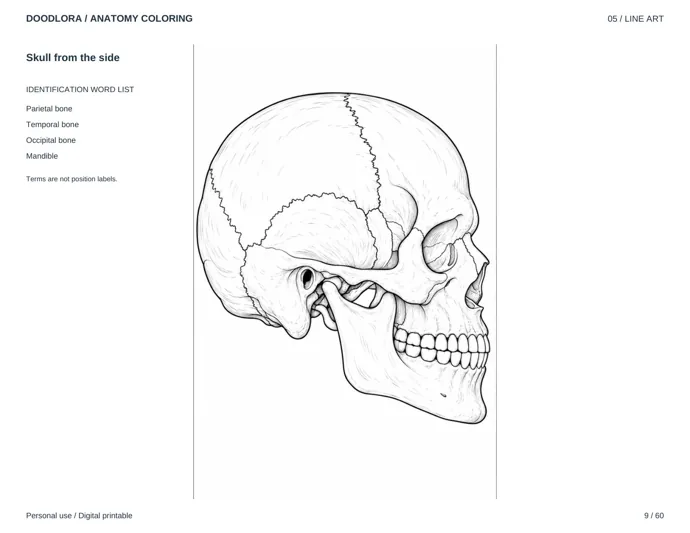
The lower jaw, or mandible, is the only bone in the head you can move, KidsHealth notes. It opens and closes for talking and chewing. The smallest bone in the body is in the head too: the stirrup bone behind the eardrum, which KidsHealth puts at 0.1 to 0.13 inches (2.5 to 3.3 millimeters) long.
The spine and its vertebrae
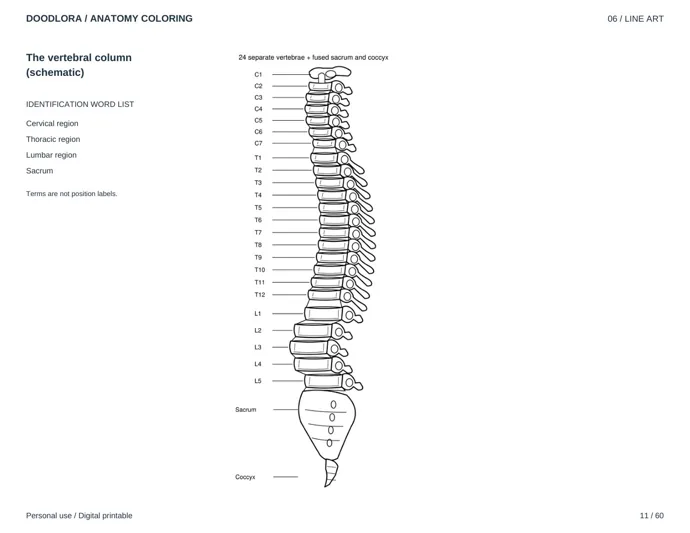
The spine is a stack of ring-shaped bones called vertebrae. KidsHealth names the regions from the top: 7 cervical vertebrae in the neck, 12 thoracic vertebrae that anchor the ribs, and 5 lumbar vertebrae in the lower back. Below them come the sacrum and the coccyx. Small disks of cartilage sit between the vertebrae and cushion them. To find the spine, reach around to the middle of the back and feel the bumps under your fingers.
Kids often run into two different totals here. KidsHealth says the spine is made of 33 bones, because it counts the 5 vertebrae of the sacrum and the 4 of the coccyx one by one. SEER counts the adult spine as 26 bones: 24 separate vertebrae, plus the sacrum and the coccyx as one bone each. Both describe the same spine, so tell children which way their worksheet counts.
The ribs and the breastbone
Most people have 12 pairs of ribs, and all 12 pairs attach to the thoracic vertebrae at the back. KidsHealth explains how the front differs. The first seven pairs join the sternum, or breastbone, directly. The next three pairs are held by cartilage to the ribs above them. The last two pairs are floating ribs: they don’t reach the front at all, but they’re firmly attached to the spine.
Wikipedia describes the sternum as shaped roughly like a necktie, which gives a child an easy picture. A deep breath makes the ribs easy to feel at the front of the chest, and the bottom edge of the rib cage can be traced along the sides.
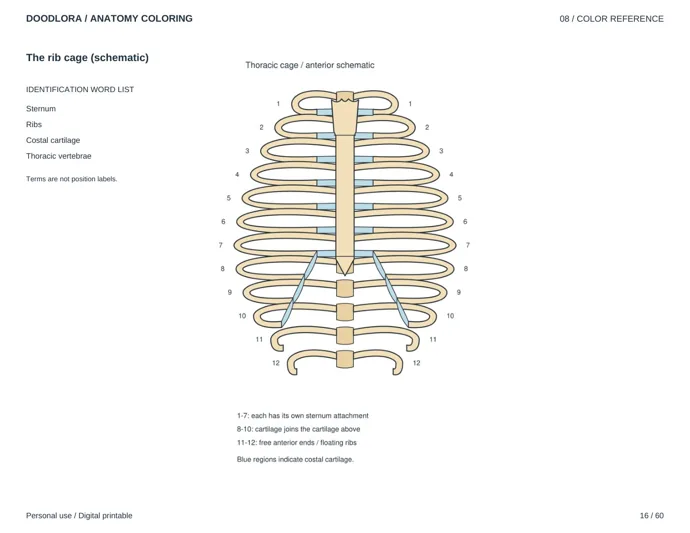
One catch when you print this study: the line-art page carries the same note, “Blue regions indicate costal cartilage,” even though nothing on it is blue yet. Have the child color the cartilage strips blue first, with the color page open as the key. After that, the note makes sense.
Shoulder, arm and hand bones
The arms belong to the other group, the appendicular skeleton, and each arm hangs from two shoulder bones. The clavicle, or collarbone, runs across the front of the shoulder as a brace between the breastbone and the shoulder blade. Wikipedia calls it the only long bone in the body that lies horizontally. The scapula, or shoulder blade, is a large triangular bone on the upper back.
Below the shoulder, the arm has three long bones. The humerus runs from the shoulder to the elbow. The radius and the ulna run side by side from the elbow to the wrist. The radius ends on the thumb side of the wrist and the ulna on the little-finger side. A child can hold up a thumb to remember which is which: the radius rides with the thumb.
The hand holds the biggest crowd of small bones. KidsHealth describes eight small wrist bones at the end of the forearm, five bones in the center of the hand, and three bones in each finger except the thumb, which has two. In science names, those are 8 carpals, 5 metacarpals and 14 phalanges, or 27 bones in one hand.
Hip, leg and foot bones
The pelvis links the spine to the legs. KidsHealth describes it as a bowl-shaped ring made of the two large hip bones in front, with the sacrum and the coccyx behind. It supports the spine and forms a ring of protection around parts of the digestive, urinary and reproductive systems.
The femur, or thigh bone, runs from the hip to the knee and is the longest bone in the body. Its round top fits into a socket in the pelvis to make the hip joint. At the front of the knee sits the patella, or kneecap, a triangular bone that protects the joint.
Below the knee are two bones side by side. The tibia, or shinbone, is the larger and stronger one, on the inner side of the leg. It’s the hard edge you can feel down the front of the shin. The fibula is thinner and sits on the outer side, and its lower end forms the outer part of the ankle.
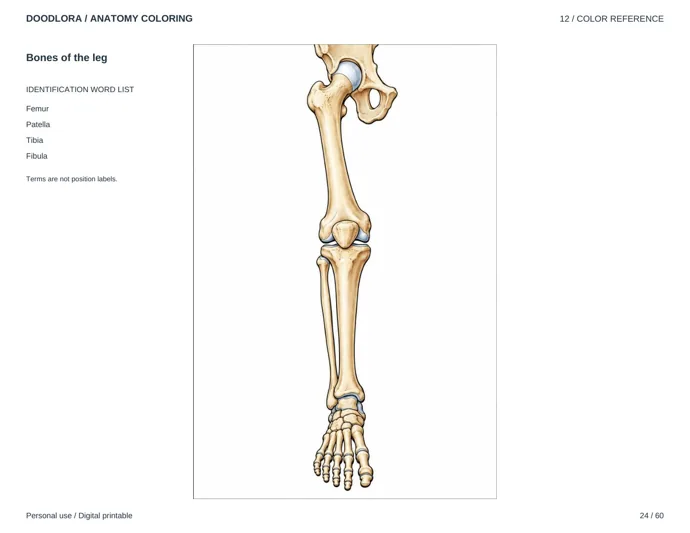
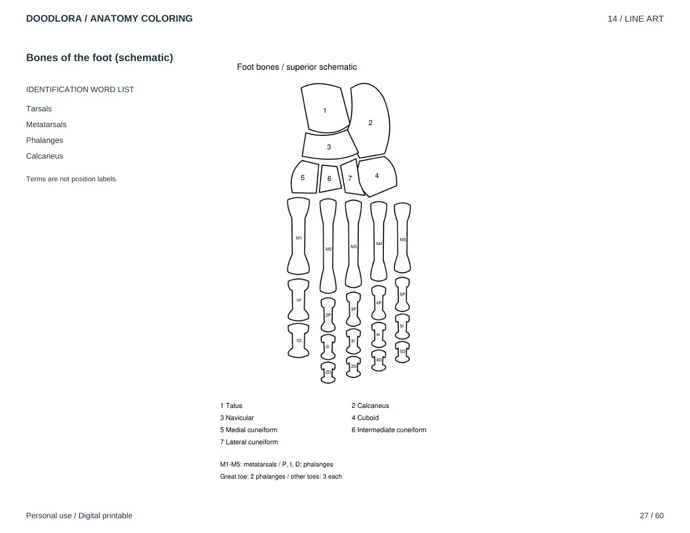
Each foot has 26 bones. KidsHealth explains that the ankle is where the lower leg bones meet a large foot bone called the talus, with six other bones next to it. Five long bones make up the main part of the foot. Each toe has three small bones except the big toe, which has two. Both feet and ankles together hold 52 bones.
How to explain the skeleton at different ages
Start with bones a child can touch, then add science names as the child gets older. Treat the age bands in this table as our suggested starting point, since children differ a lot. A child who already knows “femur” can skip ahead.
| Age | Bones to name | Words that work | What to use |
|---|---|---|---|
| 3 to 5 | Skull, ribs, spine, arms, hands, legs, feet | “Your skull is a helmet for your brain.” | A body puzzle, picture cards, a simple skeleton coloring page |
| 5 to 7 | Add the jaw, collarbone, breastbone and kneecap | Everyday names: collarbone, kneecap, shinbone | The find-your-bones game below, picture cards with one fact each |
| 8 to 10 | Science names for the big bones: femur, humerus, tibia, sternum, clavicle | “Femur” said next to “thigh bone” | The head-to-toe table, one body region per session |
| 11 and up | Groups and regions: carpals, cervical and lumbar vertebrae, true and floating ribs | Counting puzzles: 26 or 33 vertebrae, 205 or 206 bones | Detailed coloring pages and numbered schematics |
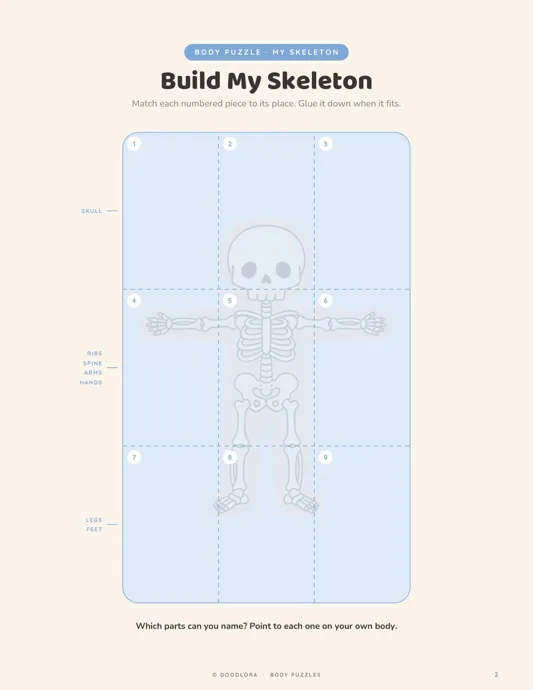
For children from 3 to 7, our human body and five senses activities set turns the skeleton into a 9-piece cut-and-build puzzle. The board labels the skull, ribs, spine, arms, hands, legs and feet, and a line at the bottom asks the child to point to each part on their own body. The picture cards in the same set include the skeleton, skull, spine, rib cage, bones and joints. Each one has a small “Where is it?” body outline, and the Level 2 cards add one sentence, such as “Your skull protects your brain.”
From about 9, most children can learn the science names if an adult reads the harder ones aloud. The detailed anatomy pages later in this guide are drawn like textbook illustrations for older students and adults. A 9- or 10-year-old can still color them with help, and a parent can use them as an accurate picture to teach from.
A find-your-bones game on your own body
Children remember a bone’s name better once they’ve pressed on it. Plan on 10 to 15 minutes. You need no supplies, and the same calls work at the kitchen table or for a class sitting in a circle. In a group, each child touches only their own body.
Call out each bone, say where to find it, and let the children feel for it:
- Skull: press the back of the head, a few inches above the neck.
- Eye sockets: touch just under the eyes and feel the ridge of bone.
- Lower jaw: put two fingers on the chin, then open and close the mouth. This is the head bone that moves.
- Collarbone: run a finger along the front of the shoulder, from the base of the neck outward.
- Breastbone and ribs: press the middle of the chest, then take a deep breath and feel the ribs at the front and sides.
- Spine: reach around to the middle of the back and feel the row of bumps.
- Elbow and wrist: bend one arm at the elbow, then twist the wrist and wave.
- Hip bones: put both hands on the hips and feel the top edge of bone.
- Kneecap: sit with one leg relaxed and find the flat bone on the front of the knee.
- Shinbone and ankle: run a hand down the hard front of the lower leg, then find the bump on the outer side of the ankle, the bottom end of the fibula.
To end the game, switch to science names and have the children touch the spot: “Femur!” “Clavicle!” “Patella!” Whoever touches the right spot first calls the next bone. Stick to bones that are easy to feel from the outside. The coccyx and the hyoid make poor calls, and they tend to end the game in giggles rather than answers.
Skeleton coloring pages and labeled diagrams for the lesson
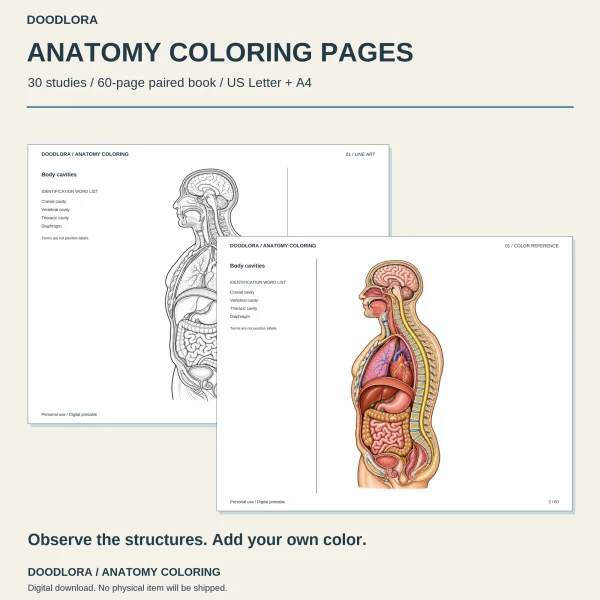
Coloring a bone right after naming it gives a child a second, slower look at its shape. Our anatomy coloring book has 30 studies, and 16 of them cover bones and joints. They show the whole skeleton, the elbow, the skull from the front and the side, the spine and a single vertebra. Then come the rib cage, shoulder, arm, pelvis, leg, hand and foot. The last three show the inside of a long bone, a ball-and-socket hip joint and the knee. Each study prints as two pages in a row, line art first and then a color reference.
Print only the odd pages for coloring. In the 60-page PDF, odd pages are line art and even pages are the color references. The guide in the download suggests printing them that way, in landscape at Actual Size / 100%. The bone outlines are fine lines, so a faint printout loses detail; why coloring pages print gray covers the fix.
Treat the word list as a search list. The four words on the left of each page are terms to find, not labels, and every page says “Terms are not position labels.” Use the color reference or the table above to locate each one. The spine, rib cage and foot studies are the exception. They carry their own numbers and keys, so they work as the labeled human skeleton diagrams in the set.
Use the colors as a key, not as real bone color. The download notes that its colors tell structures apart and don’t claim to show natural tissue colors. Let a child pick one color per bone and keep it for the whole unit, so the femur is the same color on the leg page and the whole-skeleton page.
Teach one region per session. A 20- to 30-minute session fits one region; that time is our planning suggestion, so shorten it for younger children. Begin with Study 02, the whole skeleton, so the child sees where every region sits. After that, take the skull pages one day, the spine and ribs the next, then the arm and hand, and then the leg and foot.
Colored pencils or fine markers handle the small wrist and foot bones better than crayons. For a child who presses too hard or colors past the edges, see our coloring tips for kids and adults, which match supplies to ages. If you teach, the personal license covers using the pages with your own students and printing them inside one school.
Common questions about the bones of the human skeleton
What is the biggest bone in the human body?
The femur, or thigh bone. KidsHealth calls it the longest bone in the body, and Wikipedia describes it as the largest and thickest.
What is the smallest bone in the human body?
The stirrup bone, or stapes, in the ear. KidsHealth puts it at 0.1 to 0.13 inches (2.5 to 3.3 millimeters) long. Each ear has three tiny bones, which is why SEER’s list includes 6 ear bones in all.
How many bones are in one hand and one foot?
SEER’s list gives 27 bones in each hand and 26 in each foot. Together the hands and feet hold 106 of the body’s 206 bones.
Which bones protect which organs?
The skull surrounds the brain, the vertebrae surround the spinal cord, and the rib cage helps protect the heart and lungs. SEER’s introduction to the skeletal system gives all three.
Are the bones in your body alive?
Yes. KidsHealth explains that the bones in your body are alive and keep growing and changing, unlike the dry bones in a museum. Inside many bones is soft bone marrow, which makes blood cells.
Printables from this article
Related articles
Printable Coloring Pages
Types of Christmas Trees: Fir, Spruce, Pine, Real vs Fake
Most real Christmas trees sold in the US are firs, spruces, pines or cypress. Firs have soft needles and the strongest scent, spruces have stiff branches for heavy ornaments, pines hold their needles longest, and Leyland cypress has almost no scent. Here is how each one looks, smells and lasts, and how to keep it fresh and safe.
Printable Coloring Pages
How to Draw a Strawberry: Easy, Cut, Cute and Realistic
Build the berry from a cone with wide shoulders, lay the cap over the top, set the seeds in offset rows that shrink toward the edges, save a white shine spot, and then try a cut berry, a cute face or a shaded realistic one.
Printable Coloring Pages
The 5 Food Groups: MyPlate, the Food Pyramid and Examples
The five food groups the USDA's MyPlate used from 2011 to January 2026 are fruits, vegetables, grains, protein foods and dairy. Here is what MyPlate listed in each one, the foods that land in a surprising group, how the food pyramid turned into MyPlate and then a new pyramid, and a sorting activity built on coloring pages.