When to Send Wedding Invitations: A Timeline for Each Card
Send wedding invitations six to eight weeks before the wedding, and a little earlier when many guests are traveling. Save-the-dates go out much sooner, about eight to ten months ahead, and the RSVP deadline printed on the reply card usually lands three to four weeks before the day. Those three dates hang together: the invitations have to arrive early enough that guests can answer before your caterer needs a final headcount.
The windows below are common practice, not fixed rules. Start from the date your venue and caterer give you, then count backward.
The timeline at a glance
| Card | When it goes out | What it does |
|---|---|---|
| Save-the-date | About 8 to 10 months before | Tells guests the date and place so they can plan travel |
| Invitation (with reply card) | 6 to 8 weeks before; closer to 8 for out-of-town guests | Gives the full details and asks for an answer |
| RSVP deadline | 3 to 4 weeks before, or earlier if your caterer needs it | Gives you a headcount for food and seating |
Wikipedia’s entry on wedding invitations describes them as mailed five to eight weeks ahead, with more time for out-of-town and destination weddings. The save-the-date window comes from the master checklist in our wedding planner, which puts “Send save-the-dates” in its 10-to-8-months block, next to booking the photographer, caterer and officiant.
Save-the-dates: 8 to 10 months before
A save-the-date exists so people can hold the date before the details are settled. The RSVP entry on Wikipedia describes it as a card sent ahead of the invitation when the event is far off or in a distant place, so guests can make travel plans. That tells you who needs one most: anyone who will fly, book a hotel or ask for time off work.
Send them only after the venue is signed and the guest list is close to final. A save-the-date is an early promise of an invitation, and taking it back later is awkward for everyone. If a name is still a maybe, leave it off this round and decide at invitation time.
For a destination wedding, or one on a holiday weekend when flights fill up, aim for the early end of the window. For a local wedding where most guests can drive, the later end is fine. If your engagement is short, you can skip save-the-dates and send the invitations as early as the window allows. Our wedding planning checklist has a section on planning in less than 12 months.

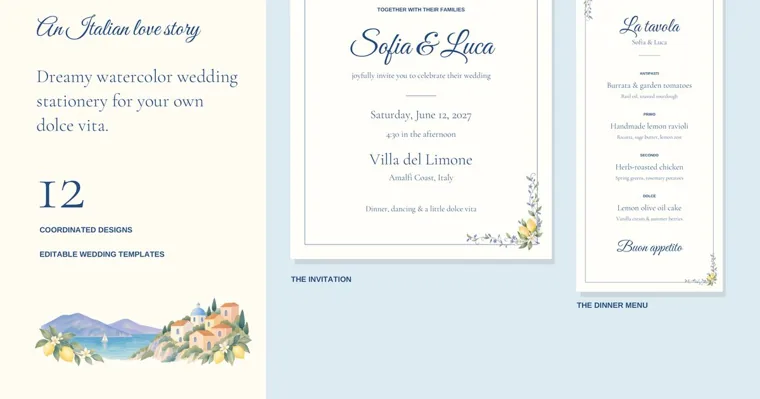
A save-the-date needs only names, date and town. Leave out the time, the reception venue and the reply instructions, because those can still change. The sample in our lemon suite keeps to that: names, a date, a place and “Formal invitation to follow.”
Invitations: 6 to 8 weeks before
Mail the invitations six to eight weeks before the wedding. Eight weeks gives guests time to arrange travel and still answer by a deadline three or four weeks out. Six weeks is the latest end, and it works best when nearly everyone lives close by.
The mailing date is not when the work starts. Our planner’s master checklist lists “Order invitations” at six months and “Mail the invitations” at two months, which leaves room for these jobs in between:
- Settle the wording and proofread every card, including the reply date.
- Print a proof copy and check colors and size before the full run.
- Buy envelopes and stamps, and address every envelope.
- Assemble one complete invitation and have it weighed (more on postage below).
What goes in the envelope usually includes the invitation, a reply card and sometimes a details card with hotel, travel and dress notes. Wikipedia’s article lists maps, directions and accommodation information among the optional extras sent with an invitation. If you have a wedding website, the details card is a good place for its address, so guests can look up hotel blocks instead of calling you.
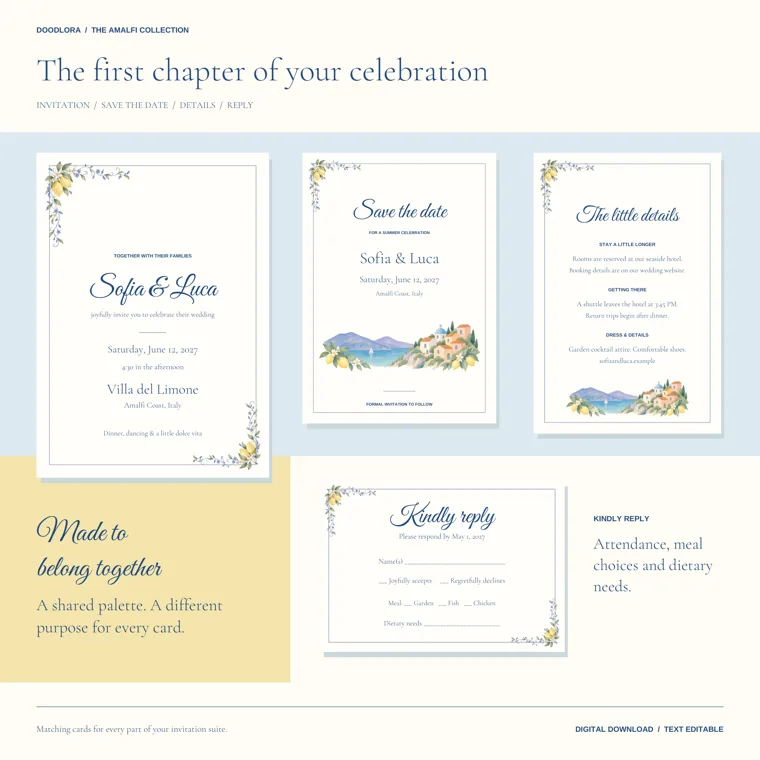
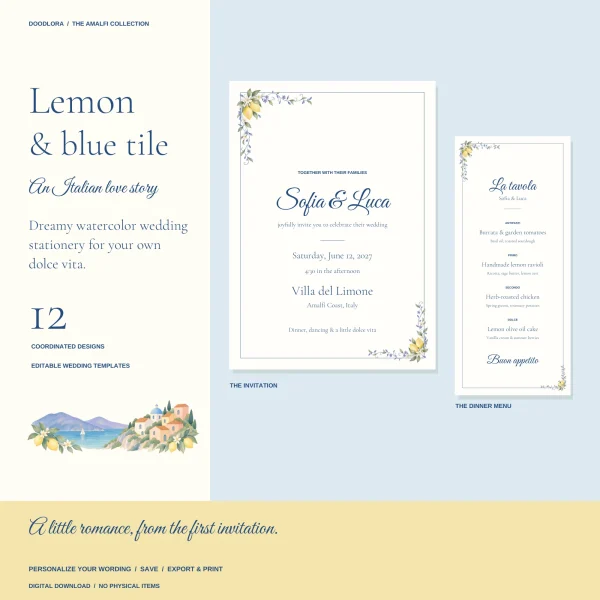
Our lemon wedding invitation suite has a save the date, invitation, reply card and details card in one watercolor style. You type your own wording into an offline editor and print each card at home at its exact size: 5 x 7 inches for the invitation and save the date, 5 x 3.5 for the reply card and 4 x 6 for the details card. The suite comes with no envelopes, so buy those separately and early.
Two things in the editor can catch you out close to a mailing date. Each piece is edited on its own, so the couple’s names and the date have to be typed into every card; changing the invitation doesn’t update the others. And the sample file still shows the example couple, so print only from your own exported designs.
The RSVP deadline: 3 to 4 weeks before
Set the reply date by working back from your caterer, not forward from the invitation. Ask the caterer and venue when they need a final headcount, then put the RSVP deadline a week or two before that. The extra week is for the guests who don’t answer; there are always a few, and you will need to call or text them.
Wikipedia’s entry gives the common range: replies at least two to three weeks before the wedding, with many couples asking for them up to a month ahead. Our planner’s checklist puts “Confirm final headcount” and “Make seating chart” at one month before, so a deadline four weeks out fits that plan.
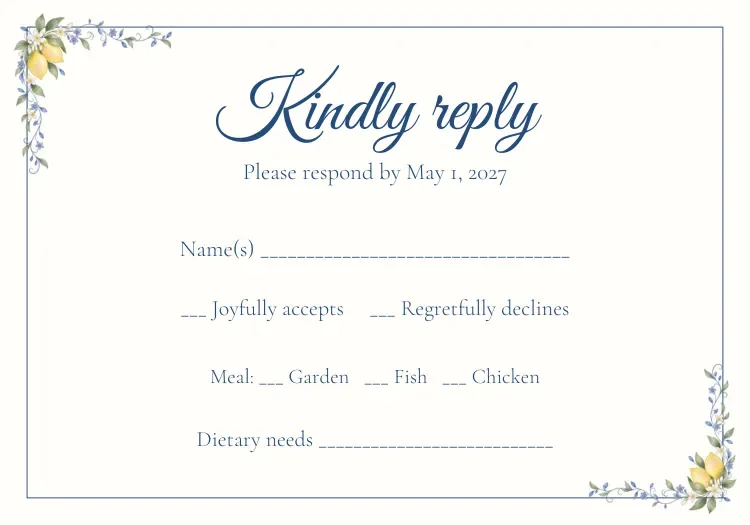
The sample reply card in our lemon suite shows an earlier deadline: “Please respond by May 1, 2027” for a June 12 wedding, six weeks before. An early date like that suits a caterer who wants meal counts well in advance. If you choose it, mail the invitations at the eight-week mark, because guests need at least two weeks to answer.
A reply card with meal choices does double duty. The lemon card asks guests to tick garden, fish or chicken and write in dietary needs, so the replies give you the caterer’s meal counts as well as the headcount. Keep those numbers on the guest list as each card comes back, instead of sorting a pile of cards the night before the caterer’s deadline.
Many couples now take replies online. Wikipedia’s RSVP entry notes that digital replies have become common for weddings. If you use a website for replies, print its address and the same deadline on the reply card or details card, so guests who prefer paper and guests who prefer a link have one date to meet.
Counting back from one wedding date
Here is the whole timeline worked out for a Saturday, September 18, 2027 wedding. Swap in your own date and keep the gaps.
| Job | How far ahead | Date for a Sept 18, 2027 wedding |
|---|---|---|
| Send save-the-dates | 10 to 8 months | Nov 18, 2026 to Jan 18, 2027 |
| Order invitations | About 6 months | Mid-March 2027 |
| Mail invitations | 8 to 6 weeks | Jul 24 to Aug 7, 2027 |
| RSVP deadline | 4 to 3 weeks | Aug 21 to Aug 28, 2027 |
| Call guests who haven’t answered | The days after the deadline | From Aug 22 or Aug 29 |
| Final headcount to caterer | Whatever date the caterer gives | Ask when you book, then set the RSVP date before it |
The pairing that matters is mailing date and RSVP date. Mail on July 24 and ask for replies by August 21, and guests have four weeks to answer. Mail on August 7 and keep the August 21 deadline, and they have about two weeks, which is tight once the mail itself takes a few days.
Postage and envelope checks before you mail
Take one fully assembled invitation, sealed in its envelope with every insert, to the post office and have it weighed before you buy stamps. Thick card stock, a details card and a reply envelope add up quickly. The US Postal Service caps letter-size mail at 3.5 ounces and a quarter inch thick, and a letter over 3.5 ounces pays the higher flat-size price.
Envelope shape changes the price too. Under USPS rules, a letter is nonmachinable when its length divided by its height is less than 1.3, and nonmachinable letters pay a surcharge. Square envelopes fall into that group, so a square invitation needs more postage than a rectangular one of the same weight.
The reply envelope has its own minimum. USPS letter-size mail must be at least 5 inches long, 3.5 inches high and 0.007 inch thick. A 5 x 3.5 inch reply card sits exactly at that minimum, so its return envelope has to be a little larger than the card, and it needs a stamp on it. Wikipedia’s invitation article notes that pre-addressed, pre-stamped response cards are common because they make it easy for guests to answer.
Keeping the timeline in a wedding planner
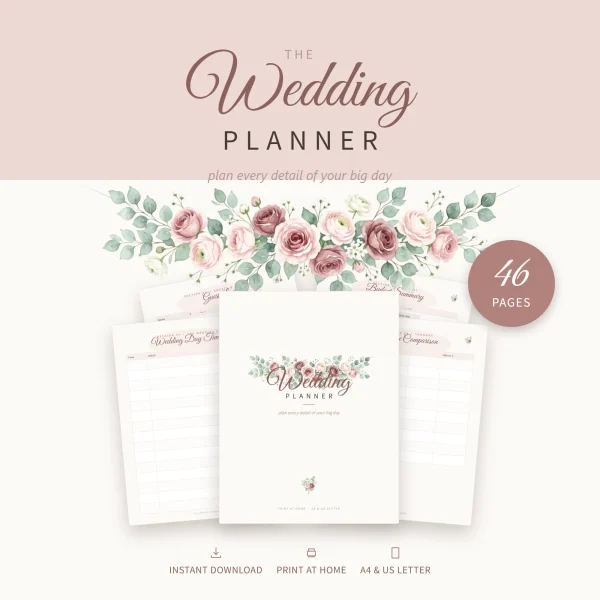
The dates above only help if they’re written down where you’ll see them. Our printable wedding planner has pages for each step:
- Key Dates and Milestones (page 9). Rows run from 12+ months down to the day before. Write the save-the-date date, the invitation mailing date and the RSVP deadline into the matching rows.
- Guest List (pages 13 and 14). Columns for name, number of guests, address, invite, RSVP and meal. Tick “invite” when each envelope goes out and fill in RSVP and meal as answers arrive.
- Guest Count and Save-the-Dates (page 15). A headcount tracker with total invited, confirmed, declined and awaiting reply, and a save-the-date tracker with columns for whether you have the address and whether the card was sent.
The “awaiting reply” line is the one to watch in the last week before your deadline. When the deadline passes, that number becomes your call list. The planner prints in US Letter or A4, and you can reprint the guest list pages when they fill up.
For everything else that happens around these dates, from booking vendors to the marriage license, the wedding planning checklist linked in the save-the-date section runs month by month.
Printables from this article
Related articles
Printable Guides & Magazines
Year of the Horse Meaning: 2026 Fire Horse Dates and Years
When the 2026 Year of the Horse starts and ends, every Horse year with its exact dates, why 2026 is a Fire Horse, what tradition says about Horse people, and what to do when it's your own year.
Printable Guides & Magazines
How to Start Homeschooling: Steps for Beginners
A first-year plan for new homeschool families: where state rules live, the order for leaving school, curriculum, daily hours, records, friends and the first 90 days.
Printable Guides & Magazines
Year of the Goat 2027: Fire Goat Dates, Years and Customs
When the 2027 Year of the Goat starts and ends, every Goat year with its exact dates, why 2027 is a Fire Goat, what tradition says about Goat people, and what to do when it's your own year.