Types of Pizza: Regional Styles From Naples to Detroit
Most types of pizza are named after the place that made them famous, and four clues tell them apart: how thick the crust is, whether the pie is round or rectangular, how it’s cut, and whether the sauce goes under the cheese or over it. A Neapolitan pizza from Naples is round and soft enough to fold, with a puffy rim. A New York pie is huge and thin and gets cut into eight wide slices. Chicago deep dish is baked in a pan with the chunky tomato on top, Detroit-style is a thick rectangle with a crust of browned cheese around the edge, and a St. Louis pie has a cracker-thin crust cut into small squares.
This guide covers 14 styles that Wikipedia and the Neapolitan pizza association describe in enough detail to recognize on sight: four from Italy, eight American regional styles, and two square pies that started in home kitchens.
The 14 pizza styles at a glance
The last column is the one detail that gives each style away when the box opens.
| Style | Where it’s from | Crust | Shape and cut | The giveaway |
|---|---|---|---|---|
| Neapolitan | Naples, Italy | Soft, about 0.1 inch in the middle, with a puffy rim | Round, roughly 9 to 14 inches | Center so thin and soft it folds |
| Roman (pizza tonda) | Rome | Thin and crisp, with oil in the dough | Round, low edge | Crackly all the way across |
| Pizza al taglio | Rome | Thicker, like focaccia | Big rectangular trays, cut to order | Sold in rectangles by weight |
| Sfincione | Palermo, Sicily | Thick and bready | Rectangular | More dough and sauce, less cheese, often onion and anchovy |
| New York | New York City | Thin, crisp only at the edge | Round, 18 to 24 inches, eight slices | A slice you fold in half lengthwise |
| New Haven (apizza) | New Haven, Connecticut | Thin, chewy, charred | Often oblong, served whole | Black char; the plain pie may have no mozzarella |
| Chicago deep dish | Chicago | Tall crust pressed up the sides of a pan | Round and deep | Chunky tomato on top of the cheese |
| Chicago stuffed | Chicago | Deep crust plus a thin top crust | Round and even deeper | A second layer of dough under the sauce |
| Detroit | Detroit | Thick, airy and chewy, crisp underneath | Rectangle, cut in squares | Browned, lacy cheese along the edges |
| St. Louis | St. Louis, Missouri | Thin and cracker-like | Round, cut in 3- to 4-inch squares | Provel cheese and a sweet sauce |
| Quad City | Quad Cities, Illinois and Iowa | Thin, with malt in the dough | Round, cut in strips | Toppings under the cheese |
| California | California | Thin, New York or Italian style | Round, often one person’s size | Toppings you won’t see elsewhere |
| American Sicilian | Northeastern US | Over an inch thick, crunchy base | Square or rectangle | Thick, airy squares |
| Grandma | Long Island, New York | Thinner than Sicilian, crisp | Sheet-pan rectangle, small squares | Thin square with sauce over the cheese |
Four clues to check on any pizza
Before memorizing names, look at the pizza itself. These four details sort almost every style in the table. Kids can practice the third one on paper: the blank crusts in our pizza coloring pages are easy to draw wedges or squares on.
- Crust thickness. Thin pies (Neapolitan, Roman, New York, New Haven, St. Louis, Quad City) are mostly topping. Thick ones (deep dish, stuffed, Detroit, American Sicilian, sfincione) are mostly bread.
- What it baked on. Round thin pies usually bake right on the oven floor. Square and deep pies bake in pans, which is where Detroit’s browned cheese edge and deep dish’s tall sides come from.
- The cut. Wedges are the default for round pies. St. Louis pizza is cut into small squares, often called a party cut or tavern cut, and Quad City pizza is cut into strips. Square pan pizzas are cut into squares.
- Where the sauce sits. On most pizzas the sauce goes under the cheese. Chicago deep dish ladles crushed tomato over the cheese, Detroit pies often finish with stripes of sauce on top, and grandma pizza usually puts the cheese down first.
Pizza styles from Italy
Neapolitan pizza
Neapolitan pizza is the round pizza of Naples: a soft, thin center with a raised, puffy rim. The Associazione Verace Pizza Napoletana (AVPN), which certifies pizzerias that follow the Naples method, sets the center at about 0.25 cm (about 0.1 inch) and the rim, called the cornicione, at 1 to 2 cm (about 0.4 to 0.8 inch). A finished pie should be soft and elastic enough to fold.
The rules are strict. The dough is only flour, yeast, salt and water, with no fat or sugar, and it’s shaped by hand, never with a rolling pin. The pizza bakes directly on the oven floor for 60 to 90 seconds, with the floor at about 380 to 430 °C (about 716 to 806 °F) and the dome near 485 °C (about 905 °F). AVPN’s dough guide pairs dough balls of 200 to 280 grams with pizzas 22 to 35 cm across, roughly 9 to 14 inches.
Since February 5, 2010, pizza napoletana has carried the European Union’s TSG label, which protects a traditional recipe and method, and UNESCO lists the craft of the Neapolitan pizza maker as intangible cultural heritage.
How to recognize it: a soft, foldable middle and an airy, golden-brown rim. AVPN’s rules call for a rim without big bubbles or burned spots. The two classic toppings, per AVPN, are the marinara (tomato, oil, oregano and garlic, no cheese) and the margherita (tomato, oil, mozzarella or fior di latte, grated cheese and basil).
Roman pizza (pizza tonda)
In Rome, a sit-down pizzeria usually serves a whole round pizza with a thin, crisp base. It’s sometimes called pizza bassa, “low pizza,” to set it apart from the taller Neapolitan. The dough has oil added, which is what makes it crackle. Romans call that crunch scrocchiarella. Unlike Neapolitan pizza, the Roman style has no official definition, so expect some variety.
How to recognize it: a flat, even edge and a crust that snaps instead of folding.
Pizza al taglio
Pizza al taglio means “pizza by the cut.” It’s baked in large rectangular trays, and the shop cuts off a piece as big as you ask for, then prices it by weight. The base is thicker, close to focaccia. It started in Rome and is now found all over Italy as a takeout food, often eaten standing up outside the shop.
How to recognize it: rectangles cut from a long tray and weighed on a scale.
Sicilian sfincione
Sfincione comes from Palermo. It’s rectangular, with more dough and sauce and less cheese than a Neapolitan pie, and a traditional version is topped with herbs, onion, tomato sauce, a strong cheese and anchovies. Some makers put the sauce on top so it doesn’t soak into the thick dough. Sfincione is the ancestor of the American Sicilian square further down.
How to recognize it: a thick, spongy rectangle with lots of sauce and only a little cheese.
Regional American pizza styles
New York–style pizza
New York–style pizza grew out of the Neapolitan pizza that Italian immigrants made in New York City in the early 1900s. It’s a large, hand-tossed pie, typically 18 to 24 inches across, cut into eight slices. The crust is thick and crisp only at the edge and stays thin and soft under the toppings. The basic version is a light layer of tomato sauce and shredded mozzarella. High-gluten bread flour gives the crust its chew.
How to recognize it: a wide slice you fold lengthwise to eat, often sold one slice at a time.
New Haven–style pizza (apizza)
New Haven, Connecticut, calls its pizza apizza, pronounced roughly “ah-BEETS.” The style started in 1925 and is baked in coal-fired ovens hotter than 650 °F (343 °C). The crust is thin, chewy, often oblong and charred in spots. It’s drier and thinner than a New York pie and is sold whole, not by the slice.
A “plain” New Haven pizza is crust, oregano, tomato sauce and a little grated pecorino romano. Mozzarella counts as an extra topping, and the plain pie is sometimes called a tomato pie. The white clam pie, with clams, garlic, olive oil, oregano and grated cheese, was invented here.
How to recognize it: dark char on an irregular oval, and a plain pie that may come without mozzarella.
Chicago deep-dish pizza
Deep dish was invented at a Chicago pizzeria in 1943. The dough is pressed into a deep round pan so the crust rises up the sides, and some recipes add cornmeal. Meats, vegetables and mozzarella go on the crust first. Crushed tomato is ladled over the top and the whole pie bakes in the pan. A slice comes out looking more like a wedge of pie than a flat slice.
How to recognize it: tall crust walls and red tomato on top, with the cheese hidden underneath.
Chicago stuffed pizza
Stuffed pizza came from two Chicago chains in the mid-1970s. It’s deeper than deep dish, with more cheese and a second, thinner layer of dough laid over the fillings. The tomato sauce goes on top of that second crust.
How to recognize it: cut a slice and look for a sheet of dough between the cheese and the sauce. Deep dish doesn’t have one.
Detroit-style pizza
Detroit-style pizza was first made in 1946 at a Detroit bar, baked in blue steel trays that factories used for small auto parts. It’s a thick rectangle with an open, airy crumb and a crisp bottom. The dough is wetter than most, at 70 percent hydration or more, and the crust is about 1½ inches thick.
The cheese, traditionally Wisconsin brick cheese, is spread right to the edge of the pan, where it melts down the hot sides and browns into a lacy, crunchy rim called frico. Pepperoni often goes straight onto the dough, and the sauce goes on last in dollops or two or three “racing stripes.”
How to recognize it: a rectangle with dark, crunchy cheese around the edges and stripes of sauce on top.
St. Louis–style pizza
St. Louis pizza has a thin, crisp, cracker-like crust. It’s topped with a sweet, oregano-heavy tomato sauce and Provel, a white processed cheese made from cheddar, Swiss and provolone. Instead of wedges it’s cut into squares of 3 or 4 inches, a party cut or tavern cut. One common myth is that the dough has no yeast. Most major makers and the old recipes do use yeast.
How to recognize it: little squares from a round pie, with a smooth, gooey cheese instead of stretchy mozzarella.
Quad City–style pizza
Quad City pizza comes from the Quad Cities on the Illinois–Iowa border and dates to 1952. The dough has a lot of malt, which gives it a toasted, nutty taste, and it’s stretched to an even quarter inch with a small lip at the edge. The sauce is spiced with red chili flakes and cayenne, the toppings go under the cheese, and the pie is cut into strips. A 16-inch pizza yields about 14 strips.
How to recognize it: long strips instead of wedges, with sausage or other toppings hidden under the cheese.
California-style pizza
California-style pizza began around 1980 in San Francisco and Berkeley restaurants. It puts a New York or Italian thin crust under toppings from California cooking, often baked in a wood-burning oven and served one pie per person. Early versions used goat cheese, duck sausage and smoked salmon with crème fraîche, and barbecue chicken pizza was invented for a California chain.
How to recognize it: a thin, personal-size pie with toppings you wouldn’t find at a classic slice shop.
Square pizzas that started in home kitchens
American Sicilian pizza
In the US, “Sicilian pizza” means a square cheese pizza with dough over an inch thick, a crunchy base and an airy inside. Sicilian immigrants brought it over as a version of sfincione, and it’s still common in the Northeast, from Massachusetts to New Jersey and Pennsylvania. In parts of coastal Massachusetts and New Hampshire it’s called “beach pizza.”
How to recognize it: a thick, bready square with a crisp, fried-looking bottom.
Grandma pizza
Grandma pizza is the thin, rectangular pie of Long Island, New York. It recreates what Italian-American home cooks baked without a pizza oven: dough pressed into a sheet pan, cheese laid down first, tomato sauce on top, baked in an ordinary kitchen oven and cut into small squares. Long Island pizzerias began selling it in the 1990s, and the name caught on with pizzerias well beyond Long Island in the late 2000s and early 2010s.
The difference from Sicilian is mostly time. Sicilian dough gets a long second rise in the pan, so it bakes up thick and bready. Grandma dough goes into the oven after a short rest, so it stays thinner and crisper.
How to recognize it: a thin square with spots of red sauce over the melted cheese.
Making a sheet-pan pie at home with kids
A grandma-style pie is the easiest style to copy at home, because it was invented for a home oven and a sheet pan. Kids can do most of the hands-on part: pressing the dough toward the corners of an oiled pan, scattering cheese and spooning sauce over it, then adding toppings. An adult puts the pan in the oven, takes it out and does all the cutting. Cut it into small squares the way grandma pizza is served, so every piece has some crisp edge or crisp bottom.
Styles people mix up
| These two | The quick difference |
|---|---|
| Neapolitan vs New York | Neapolitan is personal-size, soft in the center and baked in about a minute and a half. New York is 18 to 24 inches, crisp at the edge, cut into eight slices and folded to eat. |
| Deep dish vs Detroit | Both bake in pans. Deep dish is round with tall crust walls and tomato on top. Detroit is rectangular with a browned cheese edge and sauce in stripes. |
| Deep dish vs stuffed | Stuffed pizza adds a thin second crust over the fillings, under the sauce. |
| Sicilian vs grandma | Same square pan. Sicilian rises longer and comes out thick. Grandma is thinner, crisper and has the sauce over the cheese. |
| New Haven vs New York | Both are thin. New Haven is charred, chewier, often oblong and sold whole. |
| St. Louis vs Quad City | Both are thin Midwest pies not cut into wedges: squares and Provel in St. Louis, strips and malted dough in the Quad Cities. |
Margherita, marinara and other names on a menu
Some words on a pizza menu name a topping combination, not a regional style. A margherita (tomato, mozzarella and basil) and a marinara (tomato, garlic, oregano and oil, with no cheese) are the classic Neapolitan pies, and AVPN also lists the quattro stagioni (four seasons) and capricciosa among the traditional ones. A New Haven white clam pie and a California barbecue chicken pizza are toppings tied to a style. Pepperoni, veggie or ham and pineapple can go on almost any crust, so a “pepperoni pizza” could be New York, Detroit or St. Louis.
Coloring pages for a pizza lesson or pizza night
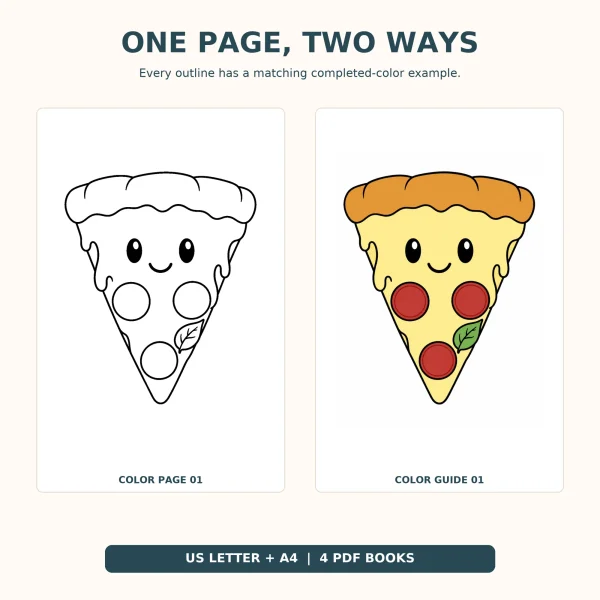
The pizza coloring book doesn’t try to draw each regional style, so they aren’t a guide to telling them apart. They’re useful for the conversation around this list instead. It holds 30 designs. You get two PDFs, outlines to color and a colored reference copy, with the cover as page 1, which puts design 20 on page 21. Both PDFs are sized twice, once for US Letter and once for A4.
- Blank crusts (designs 26 to 28). Kids design their own toppings. Have them draw the toppings for a style from the table above, such as tomato, garlic and oregano for a marinara, or sauce stripes for a Detroit pie.
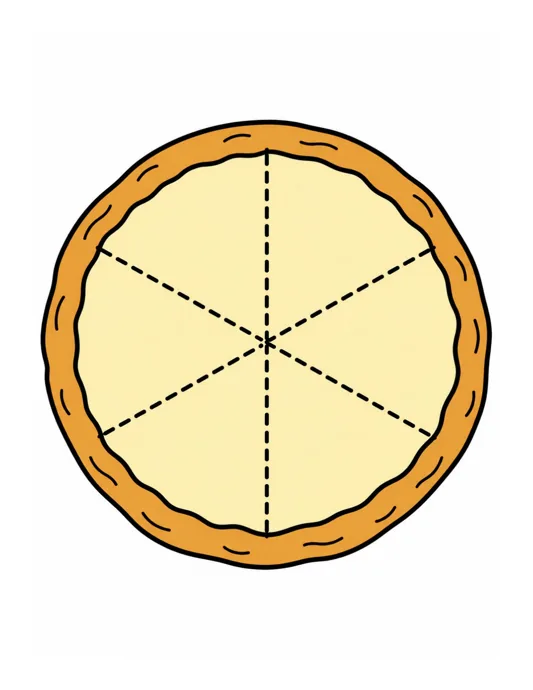
- Cutting styles. Design 27 is a flat crust with six wedge lines already dashed in. Print two copies, leave the wedges on one, and on the other have a child draw a grid of small squares with a ruler. Side by side, they show the difference between a wedge cut and a St. Louis tavern cut.
- Fractions (designs 29 and 30). Two small pizzas split into halves and quarters, and one large pizza cut into eighths, with the fraction printed below. Eight slices is also how a New York pie is cut, so it ties straight back to the lesson.
- Pizzeria scenes. A brick oven, a chef tossing dough, a delivery car and a takeout window give younger kids something to color while older ones read the style descriptions aloud.
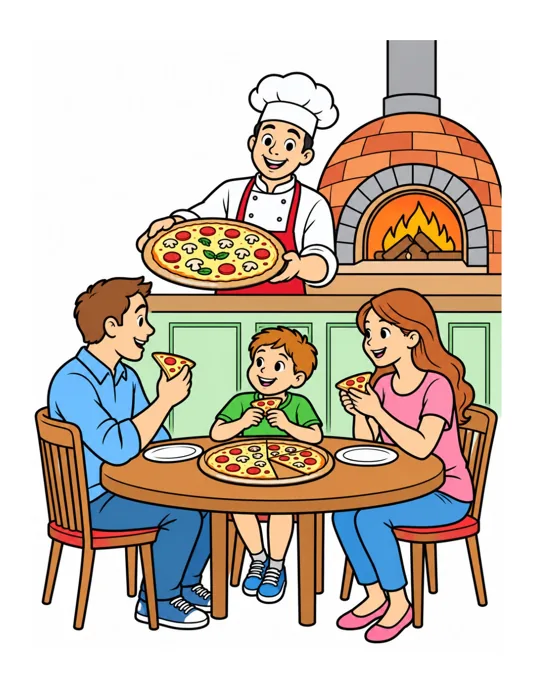
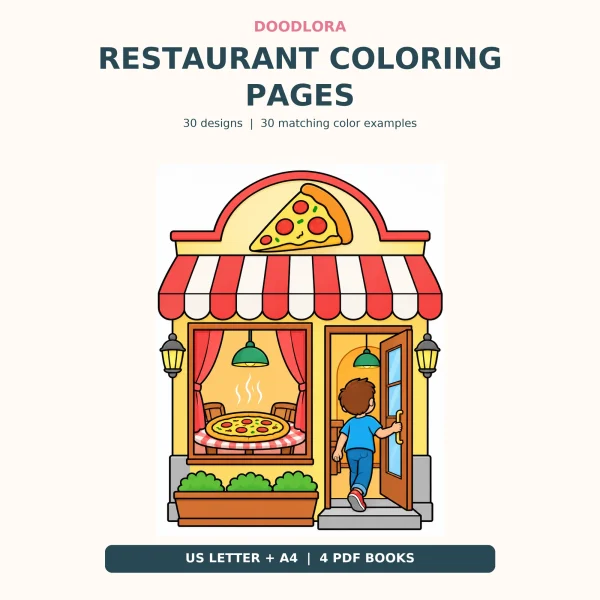
The restaurant coloring pages set the pizza inside a night out. Design 01 is a family sharing a pizza at a round table while a chef holds up another in front of a brick oven, design 12 is a single veggie pizza on a wooden board, and design 27 is a pizza shop with a blank sign that a child can name. The other pages cover burgers, ice cream, sushi and waffles, plus four mazes and four matching games, one of which pairs four toppings with four pizza slices. It’s a good fit for a pretend-restaurant afternoon, with one child as the server taking pizza orders by style name.
Both books use a personal license. That covers printing at home, and it also covers a teacher copying pages for the students in their own class. Set the printer to Actual Size rather than Fit to Page so the outlines keep their size; if the lines come out pale, how to print coloring pages walks through the fix. For a crust that looks baked instead of flat yellow, try the layering ideas in these coloring tips. If pizza night is a regular part of your week, the meal planning guide shows where it fits.
Shape, thickness, cut and sauce: check those four the next time a pizza lands on the table, and you can usually name the style before the first bite.
Printables from this article
Related articles
Printable Coloring Pages
Types of Christmas Trees: Fir, Spruce, Pine, Real vs Fake
Most real Christmas trees sold in the US are firs, spruces, pines or cypress. Firs have soft needles and the strongest scent, spruces have stiff branches for heavy ornaments, pines hold their needles longest, and Leyland cypress has almost no scent. Here is how each one looks, smells and lasts, and how to keep it fresh and safe.
Printable Coloring Pages
How to Draw a Strawberry: Easy, Cut, Cute and Realistic
Build the berry from a cone with wide shoulders, lay the cap over the top, set the seeds in offset rows that shrink toward the edges, save a white shine spot, and then try a cut berry, a cute face or a shaded realistic one.
Printable Coloring Pages
The 5 Food Groups: MyPlate, the Food Pyramid and Examples
The five food groups the USDA's MyPlate used from 2011 to January 2026 are fruits, vegetables, grains, protein foods and dairy. Here is what MyPlate listed in each one, the foods that land in a surprising group, how the food pyramid turned into MyPlate and then a new pyramid, and a sorting activity built on coloring pages.