 1 / 8
Dinosaur Fuse Bead Patterns: 24 Dinos plus a Fossil, Egg and Volcano
Sixteen dinosaur species drawn small and round, from a mint T. rex to a blue therizinosaurus with long claws, then eight of them again in forest, rust and slate tones. Six extras finish the scene, including a hatching baby, a fossil in stone and a little volcano.
$4.99
Buy any 3 or more printables and save 20% at checkout.
- Download right after payment — link works for 30 days, up to 5 downloads
- Files arrive as a ZIP with your license PDF inside
- Secure checkout by Stripe · Refund policy
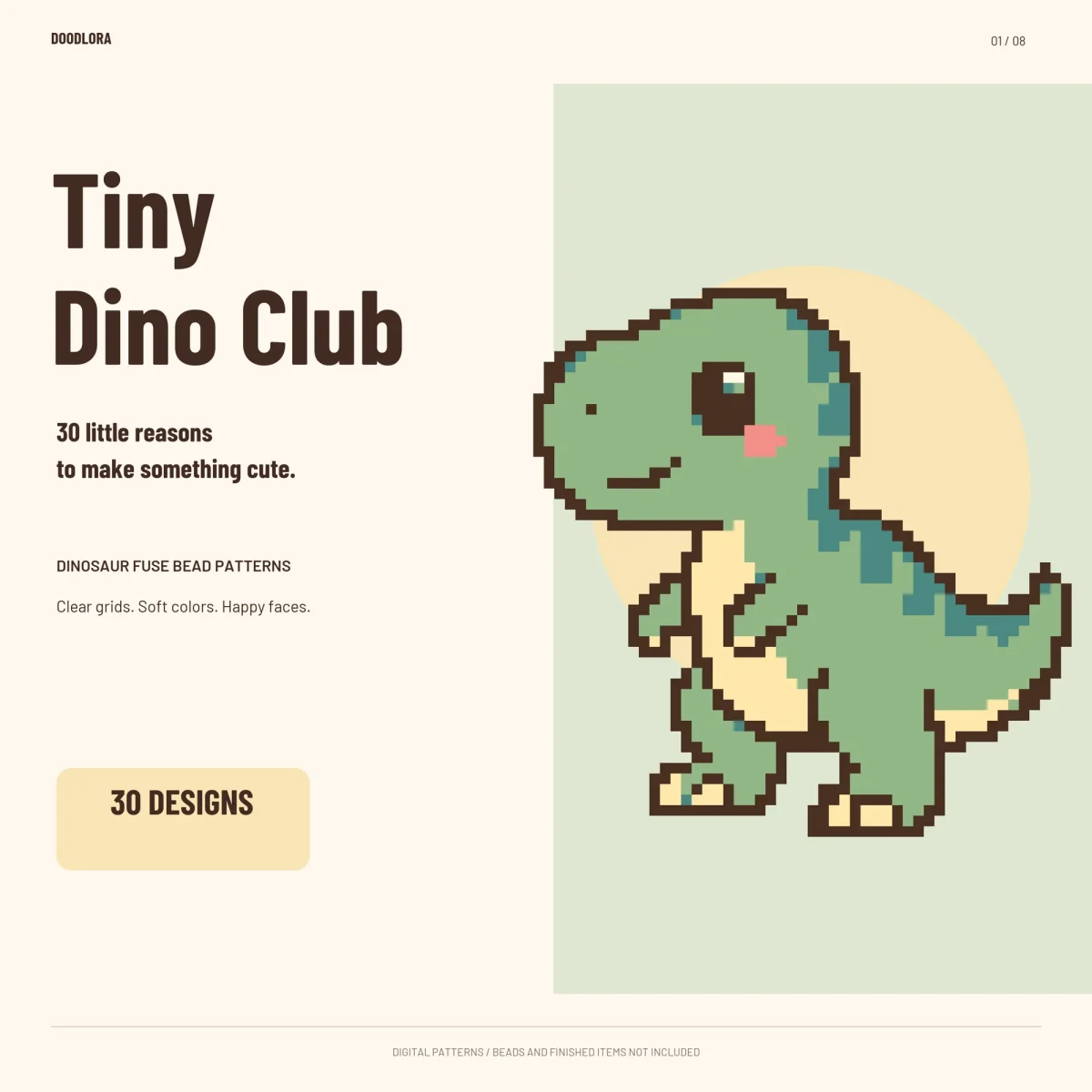
Sixteen species in soft pastels open this set of 30 dinosaur fuse bead patterns: a mint T. rex, a peach triceratops with a frilly coral collar, a sage stegosaurus with yellow plates, a lavender brachiosaurus, and on through a carnotaurus, an oviraptor, an iguanodon and a therizinosaurus with its long claws. All of them have big dark eyes and a pink cheek.
Two sets of dinosaurs
The second batch of eight goes back over eight of those species in darker, earthier colors: a forest green tyrannosaurus, a terracotta triceratops, an olive stegosaurus with rust plates, a slate brachiosaurus, a deep teal spinosaurus, a brown ankylosaurus, a rust parasaurolophus and a sage velociraptor. They’re not recolors of the first set. Each is a separate drawing, and a smaller one: 798 to 1,150 beads, against 1,408 to 2,019 for the pastel sixteen. If you want two of the same dinosaur side by side, or a quicker build in the same species, that’s the pair to use.
The six extras
A spotted egg, a baby dinosaur breaking out of its shell, a three-toed footprint, a skeleton set in a fossil stone, a small erupting volcano and a fern. They need only 2 to 4 colors each and between 776 and 1,238 beads, and they’re drawn to be set out around a finished dinosaur as a little scene.
Sizes and sheets
Measured on the beads they actually fill, designs run 38 to 75 beads on their longest side. On 5 mm beads that’s about 7.5 to 14.8 in (19 to 37.5 cm); the sprout diplodocus is the longest at 75 beads. On 2.6 mm beads the same grids come out at about 3.9 to 7.7 in (9.9 to 19.5 cm).
The 5 mm book gives each design as many sheets as it needs, from one for the egg and the footprint up to five for the diplodocus, whose grid would need a sixth sheet that holds no beads and is left out. Sheets meet edge to edge with no repeated rows, so line them up by the column and row numbers printed on each one. In the 2.6 mm book, every design fits on one page except the diplodocus and the allosaurus, which take two. Print either book at 100% and check the 50 mm (1.969 in) line before you start. The 63-page reading book is for counting at a comfortable size, in color or black and white, not for laying beads on.
Colors
The codes run from Z01 to Z32 and are specific to this set, with a hex value for each; they aren’t any bead maker’s numbers, so match them by eye to the beads you have. Every chart lists only the codes that design uses, with a count beside each. The palette table adds the whole set up to 41,402 beads.
Use the 5 mm book with standard fuse beads such as Perler and the 2.6 mm book with minis. There’s no affiliation between Doodlora Studio and the Perler brand. The pieces involve small parts that aren’t for children under 3, and an adult should do the ironing.
Questions
- Are these accurate dinosaur reconstructions?
- No. The setup page says the artwork is stylized. The dinosaurs have big eyes and pink cheeks, though each one keeps the feature it's known for, such as the stegosaurus plates or the parasaurolophus crest.
- Which pattern is quickest to make?
- The three-toed footprint uses 781 beads in just 2 colors and fits on a single 5 mm sheet. The egg is also a one-sheet pattern.