Celebration of Life Ideas and How It Differs From a Funeral
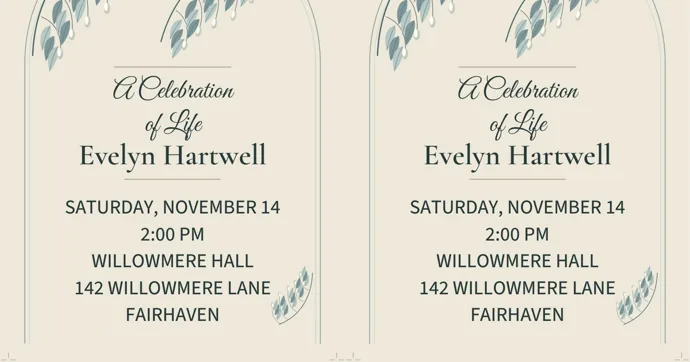
A celebration of life is a memorial gathering held without the body present, usually after the burial or cremation, that centers on the life the person lived rather than on the farewell itself. A funeral is the ceremony tied to the burial or cremation, so it happens soon after the death, often within a week, and usually follows a set religious or family order. A celebration of life can wait weeks or months, take place almost anywhere and be led by family and friends.
Below are ideas sorted by venue, by the number of guests and by timing, then who speaks and for how long, a simple order of events, and invitation wording you can copy.
| If the gathering is… | Try | Guests | Allow |
|---|---|---|---|
| Close family only | A backyard or living room gathering | 10–25 | 2–3 hours |
| Friends from many parts of a life | A drop-in open house | 40–150 | 3–4 hour window |
| A person who loved one place | A favorite restaurant, park pavilion or club room | 20–80 | 2–3 hours |
| Family spread across the country | A short program plus a livestream | Any | 60–90 minutes |
| Already held a private funeral | A gathering a few weeks or months later | Any | 2–3 hours |
| Marking a date | The birthday or the first anniversary | 10–40 | An afternoon |
What is a celebration of life, and how is it different from a funeral?
A celebration of life is a kind of memorial service. Wikipedia defines a memorial service as a funerary ceremony held without the remains of the deceased, and notes that it usually takes place after the burial, entombment or cremation. The focus is on the life that was lived. Photos and flowers, sometimes with an urn, sit where a casket would stand at a funeral.
| Funeral | Memorial service | Celebration of life | |
|---|---|---|---|
| Body present | Usually yes | No | No |
| When | Soon after the death, often within a week | Any time after | Any time after, often weeks or months |
| Tone | Formal, set order | Quieter, flexible | Warmer, stories and laughter welcome |
| Who leads | Clergy or a funeral director, often | Family or an officiant | Family and friends, often |
| Where | Funeral home, church, graveside | Anywhere | Anywhere that suited the person |
The labels overlap in real life. Many families hold a short private funeral or burial and then a larger celebration of life later, so that friends who live far away can plan travel. Others skip the funeral entirely after a cremation. What you call the gathering mostly tells guests what to expect: “funeral” signals formal and somber, “celebration of life” signals that stories, music the person loved and a lighter dress code are welcome.
If the family follows a faith tradition, ask its clergy or community leader what belongs in the gathering and what should happen at a separate service. Some traditions have their own timing and rites, and a celebration of life may sit alongside them rather than replace them. Whatever the family chooses, friends who can’t come can still send a note, and our guide on what to write in a sympathy card has short messages by relationship and faith.
How to plan a celebration of life
A celebration of life has fewer fixed parts than a funeral, which is both the freedom and the trap: without a set order, the planning tends to land on whoever answers the phone. Settle these six things in roughly this order.
- Pick one point person. AARP’s planning advice is to name a close friend or family member as the point person for the event. That person fields questions, keeps the guest list and is the name on the RSVP line.
- Choose the date and tell people early. For a gathering a few weeks out, send a save-the-date message as soon as the date is firm and the printed or digital invitation about three to four weeks ahead. Guests who need to fly will thank you.
- Book the venue. Match the room to the guest count in the table above, and check that it has seating for older guests, a spot for a photo table and a sound system or space to speak without shouting.
- Ask the speakers. The Emily Post Institute suggests asking eulogists early in the planning, in person or by phone if possible, because the request is personal. More on how many and how long below.
- Gather photos and stories. AARP suggests collecting memories, photos and letters from family and friends, and using a shared online document so everyone involved can see and comment on the plan.
- Decide on food. Something as simple as coffee and the person’s favorite dessert is enough. If you serve a drink the person loved, have alcohol-free options for anyone driving home.
Celebration of life ideas by venue
The venue sets the tone more than anything else you decide. Pick the place first, then let it shape the rest.
At home or in the backyard
Best for close family and old friends, roughly 10 to 25 people, and for a person whose life centered on that house. Set up a photo table near the door, a few chairs in loose circles rather than rows, and one spot where people can stand to share a story. The catch is hosting while grieving: hand the kitchen and the front door to two friends so the family can sit down. Rent or borrow folding chairs, because a crowded living room tires older guests fast.
A favorite restaurant, café or pub
Best for 20 to 80 guests and for someone who had a regular table somewhere. Book a private room or a slow afternoon slot, and ask the manager whether a microphone and a place for photos are allowed. Order a set menu or a buffet so nobody is waiting on checks during the stories. The catch here is noise: an open dining room drowns out a speaker, so ask for a room with a door.
A community hall, club room or church hall
AARP lists a VFW post, a favorite restaurant or a community center among possible venues, and these rooms handle 50 to 150 people with tables, a kitchen and parking. They suit a person with a big circle from work, a club, a team or a congregation. Bring tablecloths and a few framed photos to warm up a plain room, and confirm the setup and cleanup times in writing, since many halls rent by the hour.
A park, garden, beach or trail
Best for someone who lived outdoors: a gardener, a hiker, a fisherman, a dog walker with a regular loop. A park pavilion fits 20 to 60 people with benches and shade. Check whether the park takes pavilion reservations, plan a rain location and bring a portable speaker only if the space allows it. The catch is comfort, so think about older guests: a short walk from the parking lot, shade and real seating matter more than the view.
A house of worship
For a family that wants prayer, hymns or scripture in the gathering. AARP notes that some people prefer the intimacy of a service at home, while others choose a church or synagogue. A celebration of life held there can still include open-mic memories and a photo display. Ask the clergy early which parts they will lead and which the family may add.
Ideas by size: small, large and far away
A small gathering for close family
Ten to 25 people, two to three hours, usually at home or in a private room. Skip the formal program. Instead, go around the table and ask each person to share one story or one thing the person taught them. Keep a notebook on the table so someone writes the stories down while they’re told; families often wish later that they had.
A large drop-in open house
Forty to 150 people over a three- or four-hour window, with guests arriving and leaving at their own pace. Print the start and end times on the invitation and say “drop in any time.” Set up stations instead of a program: a photo table, a memory card table, a slideshow on a loop and a guest book. If you want speeches, pick one fixed time, say an hour after the start, and put it on the invitation.
A livestream for family far away
AARP suggests offering livestreaming and telling everyone who will read or perform in advance that the program will be streamed. Keep a streamed program to 60 to 90 minutes, test the connection in the room the day before and give one person the job of watching the chat. AARP also suggests letting someone read tributes from people who can’t attend, which works well when an aunt overseas emails a memory.
Ideas by timing: weeks later, a birthday, an anniversary
A few weeks or months after the funeral
The most common pattern: a small private funeral or burial soon after the death, then a larger celebration of life once the family has had time to plan. Mention the earlier service on the invitation if guests might wonder why they weren’t invited: “Following a private family burial, please join us…”
On the person’s birthday
Gathering on the birthday turns a hard date into a shared one. Serve the cake or meal the person always chose for their birthday, and ask guests to bring a photo from any of their birthdays.
On the first anniversary
A year on, the gathering usually becomes quieter and smaller. Many families pair it with a visit to the grave or a favorite place, then a meal. Invitation wording can be shorter and less formal than for the first gathering, and a phone message often works as well as a printed card.
Memorial service ideas: things to do at the gathering
These work at almost any venue and size. Pick two or three rather than all of them, or the gathering turns into a schedule.
- A photo table. Gather framed photos from every decade, not only recent ones. Label the ones younger guests won’t recognize with a name and a year. Wikipedia notes that photos and flowers usually stand where a casket would be at a funeral, so this table often becomes the center of the room.
- Memory cards. Leave blank cards and pens on each table with the prompt “A memory of…” and collect them in a basket. They become a keepsake for the family. A plain memory book works too; the scrapbook ideas we’ve gathered include quiet layouts with lots of white space that suit memorial pages.
- Open-mic stories. After the planned speakers, invite anyone who wants to share a short story. Ask a confident friend to go first so others follow.
- The person’s playlist. Play the music they actually listened to, from their car, their records or their phone, rather than what sounds “appropriate.”
- A favorite meal or recipe. Serve the dish they were known for, or print the recipe on cards for guests to take home.
- A display of their work. Quilts, paintings, woodwork, trophies, a uniform, tools from the bench. These say more about a person than a speech can.
- Something to take home. AARP suggests sharing an item of remembrance. A small printed card with the person’s name and dates, a packet of seeds from their garden or a recipe card fits in a pocket.
- A donation table. If the family names a charity the person cared about, put the details on a small card near the guest book.
Who speaks at a celebration of life, and for how long
The Emily Post Institute suggests limiting eulogists to no more than three when an officiant is also speaking. Its eulogy advice is that each talk should run no less than two minutes and no longer than eight to ten, shorter when there are several speakers. It also suggests practicing the talk several times and speaking in a conversational tone.
For a celebration of life without an officiant, a family member or close friend can act as host and introduce each speaker, which AARP also suggests. A workable lineup is:
- A host who welcomes guests and explains the plan (2 minutes).
- Two or three planned speakers, each from a different part of the person’s life: family, work, a friend from childhood or a club (5 to 8 minutes each).
- Open-mic stories from guests, with the host keeping time gently (15 to 20 minutes).
- A closing from a family member thanking everyone and inviting them to eat, stay and look at the photos (2 minutes).
The common snag is the open mic running long. Tell guests up front, “We’d love to hear your stories, two or three minutes each,” and have the host stand when it’s time to wrap up. If humor comes up, Emily Post’s advice is to handle it with care for how everyone in the room may receive it. A story that makes the family laugh is usually welcome; a joke at the person’s expense isn’t.
A simple celebration of life program
A one-page program helps guests follow along and gives them something to take home. AARP describes programs with photos and memories placed on each seat, and Emily Post notes that the person’s name goes on the cover, with a photograph if you like. A short program needs only the name, a title for the gathering and three to five parts with the person leading each.
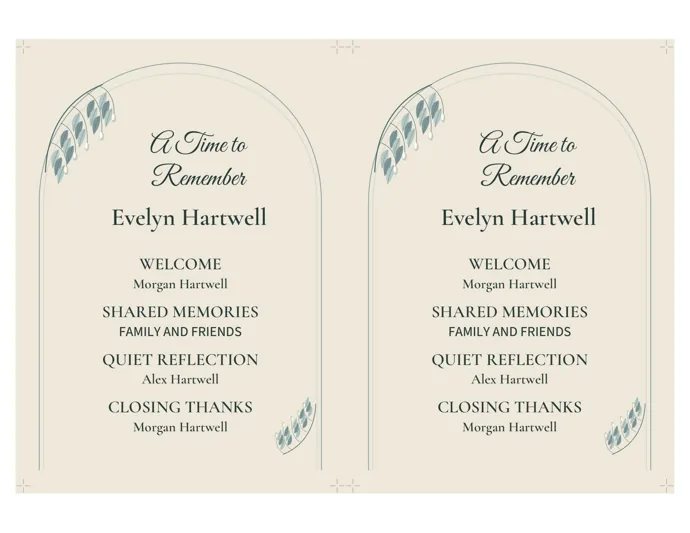
Our celebration of life invitations include a 5 x 7 program set out exactly this way, headed “A Time to Remember,” with Welcome, Shared Memories, Quiet Reflection and Closing Thanks. The names under each part are placeholders, so you edit them in the SVG file before printing. If your gathering has a reading, a song or a meal, change one of the four lines rather than squeezing in a fifth.
Celebration of life invitation wording
Every celebration of life invitation needs the same six things, whether it’s printed, emailed or sent as a phone image:
- The person’s full name, and their dates if you like.
- What kind of gathering it is: “A Celebration of Life,” “In Loving Memory,” “A Memorial Gathering.”
- The day and date.
- The time, with an end time for an open house.
- The place, with the full street address.
- How to reply, with a name, phone number or date.
Optional lines include the dress code (“Casual dress, or wear his favorite color”), what to bring (“Bring a story or a photo to share”), food (“Lunch to follow”) and a charity (“In lieu of flowers, donations to…”). Don’t put the cause of death on an invitation.
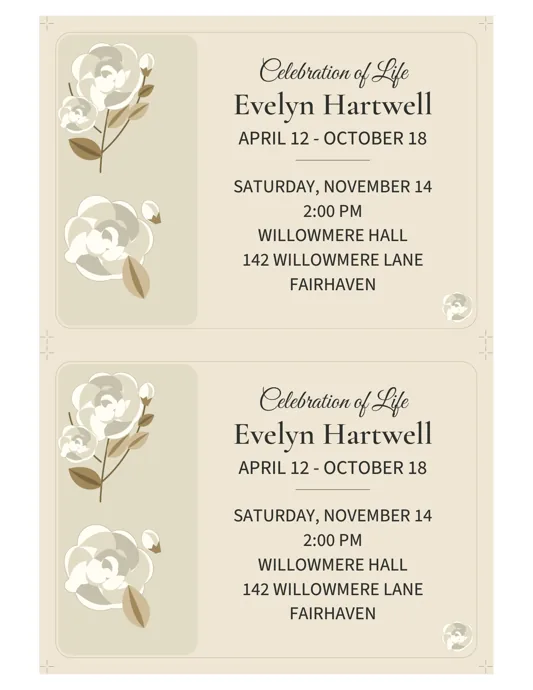
Neutral wording
Use these when the family wants no religious language, or when guests come from many traditions.
A Celebration of Life
Margaret Ellen Doyle
Please join us to share stories and remember a life well loved.
Saturday, March 8, at 2 p.m.
The Oak Room, 410 River Road, Millbrook
Kindly reply to Susan by March 1Join us in celebrating the life of
Robert “Bobby” Alvarez
with music, food and the stories he loved to tell.
Sunday, June 15, from 1 to 4 p.m.
Lakeside Park Pavilion B
RSVP to Daniel at (555) 014-2298
Faith wording
These suit a Christian family; swap in your own tradition’s wording if it differs.
In Loving Memory
Thomas James Whitaker
“Blessed are they that mourn: for they shall be comforted.” Matthew 5:4
A memorial service and celebration of his life
Saturday, April 12, at 11 a.m.
Grace Fellowship Hall, 220 Church Street
Lunch to follow in the parish hallWith grateful hearts we invite you
to give thanks for the life of
Lillian Rose Carter
Friday, October 3, at 10 a.m.
St. Mark’s Church, 18 Elm Avenue
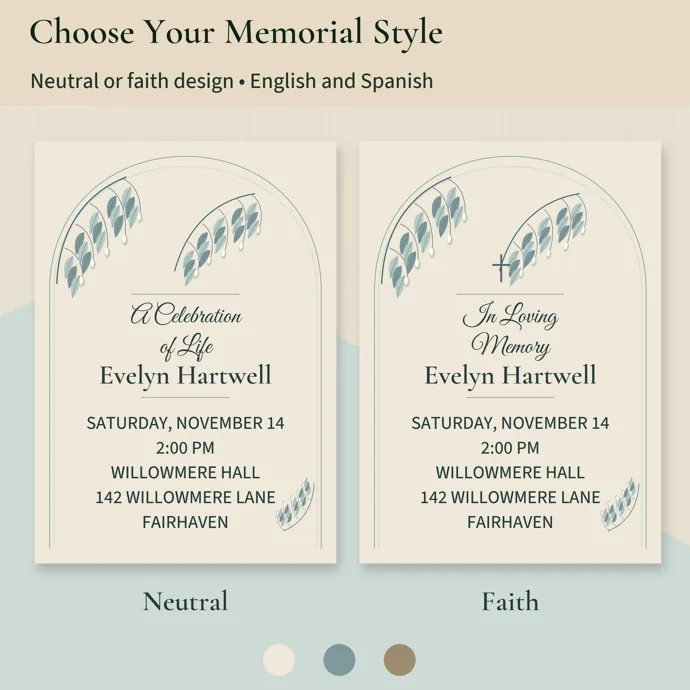
Our celebration of life set prints both: a neutral front reading “A Celebration of Life” with a back that says “A Life Remembered,” and a faith front reading “In Loving Memory” with a small cross and Matthew 5:4 from the King James Version on the back. The verse is live text in the SVG file, so it can be changed or removed, and a family of another faith can keep the design and use its own text.
Casual and open-house wording
For a backyard, a pub or a drop-in afternoon.
Come raise a glass and share a story
for our dad, Mike Kowalski.
Saturday, May 17, any time from 2 to 6 p.m.
The back room at Murphy’s, 55 Main Street
No need to RSVP, just come as you are.Please drop by our home to remember Grandma June.
Coffee, her lemon bars and lots of old photos.
Sunday, August 24, 1 to 4 p.m.
14 Birch Lane
After a private funeral or burial
Following a private family burial,
please join us for a celebration of the life of
Carol Ann Hughes
Saturday, November 22, at 3 p.m.
Riverside Community Center
First anniversary
One year on, we’d love to gather
and remember Peter together.
Dinner at our home, Saturday, February 7, at 6 p.m.
Let Anna know if you can come.
The reply card
A separate reply card keeps the invitation itself uncluttered. Ask for only what you need to plan: the guest’s name and how many are coming.
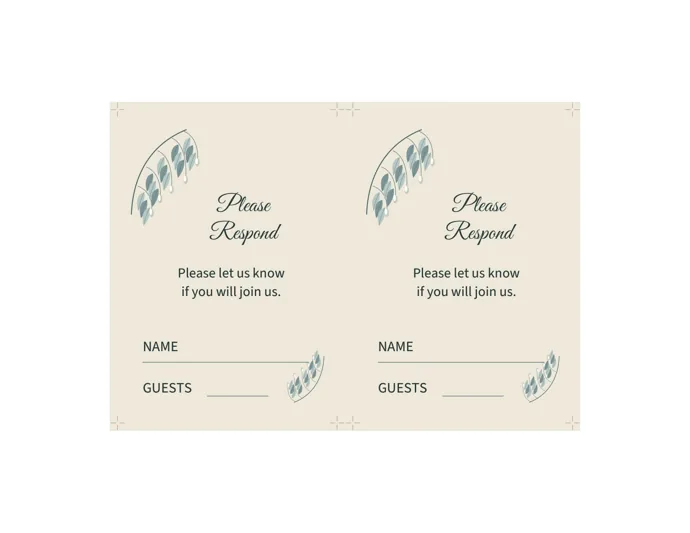
The reply card in our set reads “Please let us know if you will join us” with lines for a name and the number of guests. Add the reply-by date and the point person’s phone number to the invitation itself, since the card has no space for them.
Printing the invitations and remembrance cards at home
Both of our memorial sets are printable files with editable SVG versions. Neither one uses Canva. To change the name, date and place, install the included open-license fonts, open a copy of the SVG file in an SVG editor, replace the wording and check the line breaks before you export. Keep an untouched copy of the original file.
When you print, choose the Letter or A4 file that matches your paper, print at actual size or 100% and turn off fit-to-page. Check the first sheet with a ruler before printing the rest. Folded thank-you cards print outside and inside on separate pages, so test one pair on plain paper first, especially with automatic two-sided printing, where printers flip pages differently. Trim on the marks, score the center and fold.
The celebration of life set prints 30 pages per paper size: eight invitation fronts (neutral or faith, with or without a photo frame, in English or Spanish), plus the matching backs, reply cards, folded thank-you cards and programs. It also includes eight phone images for sending by text or email. The photo frames are empty, so you place your own photo inside the frame in the SVG file.
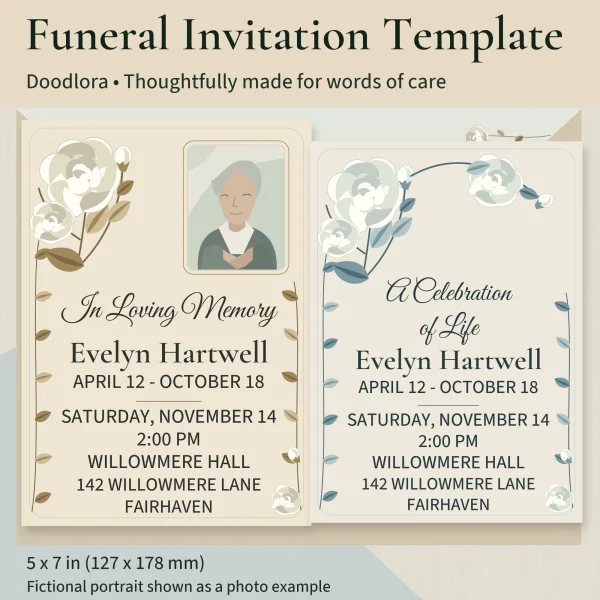
If you’d rather have a notice that shows the person’s dates under the name, our funeral invitation template reads either “In Loving Memory” or “A Celebration of Life,” in ivory and gold or soft blue, as a 5 x 7 portrait or 7 x 5 landscape card. It adds remembrance cards, 2.5 x 4.25 inches, printed six to a sheet with bleed or eight to a sheet in a separate no-bleed file. The back carries a short verse headed “Always Remembered.” These are the small take-home cards mentioned above, and they work at any gathering size.
After the gathering
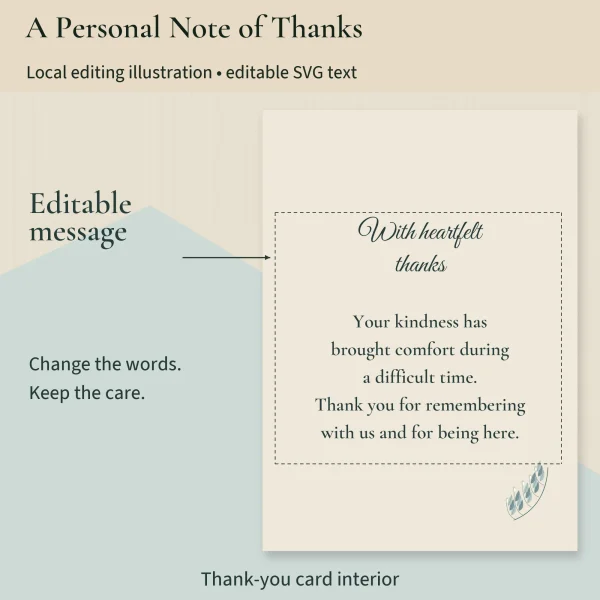
A short thank-you note to the speakers, the host of the venue and anyone who cooked or carried chairs is enough; it doesn’t need to be long. Both sets include a folded thank-you card that reads “With heartfelt thanks.” Keep the memory cards, the program and a copy of the invitation together in one envelope or box; on the first anniversary, they make a quiet place to start.
Printables from this article
Related articles
Printable Invitations & Cards
Sweet 16 Wishes: What to Write in a 16th Birthday Card
A good sweet 16 wish names what sixteen actually brings, like a license, a first job or a later curfew, and says one true thing about the teen. Here are wishes sorted by who is signing the card, from parents to a coach, plus a section for boys and a list of lines to keep out of a post.
Printable Invitations & Cards
Happy Birthday Mom: Wishes, Messages & What to Write
What you write to your mom depends on who's holding the pen and where things stand between you. Here are birthday wishes for mom from daughters, sons and little kids, plus messages for a stepmom, a mother-in-law, a mom far away, a new mom's first birthday as a mom, milestone ages and a relationship that's complicated.
Printable Invitations & Cards
Birthday Wishes for a Friend: Best, Old and New Friends
A good birthday wish for a friend mentions something only the two of you share and points to the next time you'll see each other. Here's what to include for a best friend, an old friend, a new friend, a long-distance friend, a friend you just made up with and a group card, with sample wishes for each.