What to Write in a Sympathy Card: Condolence Messages

A sympathy card needs only two to four sentences: say you’re sorry, name the person who died, add one memory or quality you’ll miss, and offer one specific kind of help before a warm closing. You don’t have to explain the loss, find a bright side or write anything wise. Short and sincere reads as kind; long and careful often reads as nervous. Below is that four-part shape, then condolence messages sorted by who you’re writing to, faith and non-religious wording, the phrases to leave out, and what to do when your card is weeks late.
| Who you’re writing to | How much to write | What to include | Closing that fits |
|---|---|---|---|
| A coworker or your boss | 1 to 2 sentences | Sorry, the name, time off is covered | With sympathy, |
| A friend | 2 to 4 sentences | A memory, a specific offer | With love, / Thinking of you, |
| A neighbor or acquaintance | 1 to 2 sentences | Sorry, the name if you know it | With deepest sympathy, |
| Someone who lost a mother or father | 2 to 3 sentences | One thing you knew about the parent | Holding you close, |
| Someone who lost a spouse or partner | 1 to 3 sentences | The partner’s name, a practical offer | With love, |
| Parents who lost a child | 1 to 2 sentences | The child’s name and nothing else to explain | With all our love, |
How to write a sympathy card in four parts
Every good sympathy note in this guide follows the same four parts, and you can drop any of the middle two when you don’t have them. The Emily Post Institute puts the whole rule in five words: “Say what you truly feel.” Its guidance adds that one sincere line about the person who died is enough.
- Open with the plain fact. “I’m so sorry about your mom.” “We were heartbroken to hear about Sam.” A direct opening is gentler than a roundabout one.
- Name the person who died. Use the name the family used. A grieving reader often notices when everyone else wrote “your loss.”
- Add one memory or quality, if you have one. “Sam taught half the street to ride a bike.” Emily Post’s advice calls a specific memory a welcome addition but entirely optional, so skip it rather than invent one.
- Offer one specific thing, then close. “I’ll walk Biscuit every morning this week” works better than “let me know if you need anything,” because the second line asks a tired person to come up with a job for you.
Address the envelope to the person you know. Emily Post’s advice is to write to the closest relative, usually the widow, widower or eldest child, when you knew only the person who died. If a friend’s parent died, write to your friend, even if you never met the parent.
Short condolence messages when you don’t know what to say
When nothing sounds right, a short line is the right length, not a fallback. These work for almost anyone, from a neighbor to a client, and each one stands on its own with your name under it:
- “I’m so sorry. I’m thinking of you and your family.”
- “We were so sad to hear about Marcus. He’ll be missed on our street.”
- “Holding you close in my thoughts.”
- “Sending you love and a little quiet in the middle of all of it.”
- “I’m sorry for your loss. No need to reply to this card.”
- “We’re thinking of you and remembering Rosa with you.”
- “There aren’t good words for this. I’m just so sorry.”
“No need to reply” deserves a place in more cards. Families often feel they owe a thank-you note to everyone who wrote, and that one line takes a small task off the list.
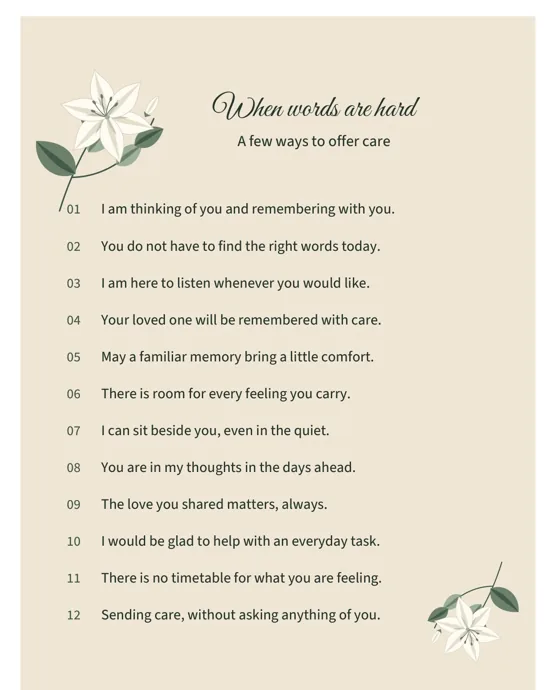
If you’re stuck staring at a blank inside panel, our printable sympathy cards end with a “When words are hard” page of twelve short lines to borrow from or build on. It prints on its own sheet, so it stays on your desk while the card goes in the envelope.
Condolence messages for coworkers, friends and neighbors
How close you were sets the length more than anything else. A coworker card can be a single line, while a close friend usually needs the memory and the offer.
Coworkers and your boss
At work, keep the message short and leave out anything about how the person died. Two lines are plenty, and one line that takes work off their mind is often the most welcome thing in the card.
- “I’m so sorry about your father. Please don’t think about the Henley report; we’ve got it covered.”
- “Thinking of you and your family. Take all the time you need.”
- “We’re so sorry, Dana. The whole team is thinking of you.”
- For your boss: “I’m very sorry about your sister. Everything here is on track, so please focus on your family.”
On a group card passed around the office, write one line and your full name. Five people writing “So sorry for your loss” in a row reads as copied, so add a small change, such as the name or the offer. Emily Post’s guidance says an email can come first, but it shouldn’t replace a handwritten note, so a card from the team still matters after the group chat message.
Close friends
A friend’s card is where the memory belongs. Pick one small, true thing, not a eulogy, and follow it with an offer you’ll keep.
- “I’ll never forget your mom teaching us to make dumplings at midnight. I’m so sorry, Jen. I’m dropping off dinner Thursday.”
- “Ellie was so proud of you, and she said so every time I saw her. I love you and I’m here for the long haul.”
- “I keep thinking about the lake trips with your dad. I’m so sorry. I’ll call on Sunday, and you don’t have to pick up.”
- “I don’t have the right words, but I have a free weekend. I’ll take the kids Saturday if that helps.”
Neighbors, acquaintances and people you didn’t know well
When you knew the person only a little, say so honestly and keep it brief. A short note from a neighbor still tells the family someone noticed.
- “We were so sorry to hear about Walt. He always waved from the porch, and we’ll miss that.”
- “I didn’t know your grandmother, but I know how much she meant to you. Thinking of you.”
- “With deepest sympathy to you and your family from all of us at number 14.”
If the loss is a pet, the same short shape works: name the animal and one thing it did.
Sympathy messages for the loss of a mother or father
Losing a parent is the most common reason people search for sympathy messages, and the best cards mention the parent as a person, not only as “your mom.” If you never met them, write about what your friend told you, or simply about your friend.
Loss of a mother
Name her if you knew her, and use the word your friend used: mom, mother, mama. One detail about her is worth more than any verse.
- “Your mom made everyone feel like the guest of honor. I’m so sorry, and I’m thinking of you.”
- “I know how close you and your mother were. Sending love, and I’ll check in next week.”
- “I never met your mom, but I’ve heard her laugh in every story you tell. I’m so sorry.”
- “Mrs. Alvarez was the first adult who ever called me by my nickname. I’m so sorry for your loss.”
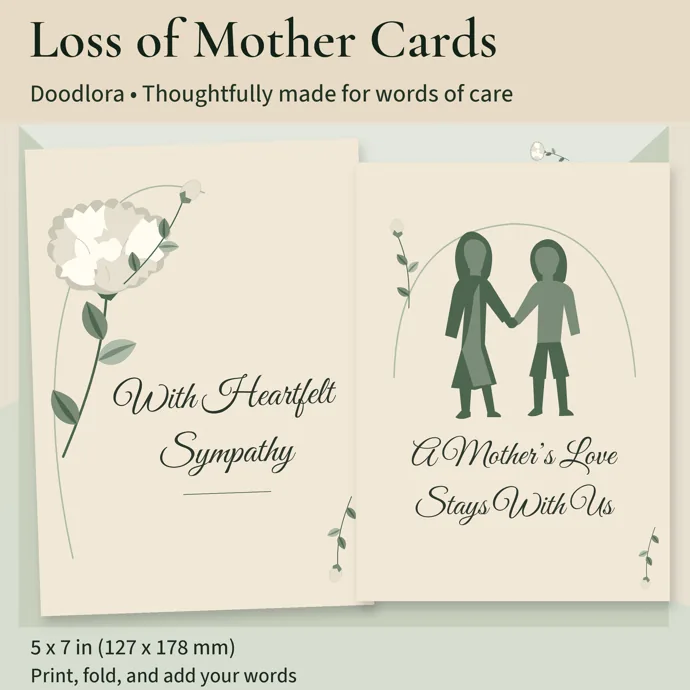
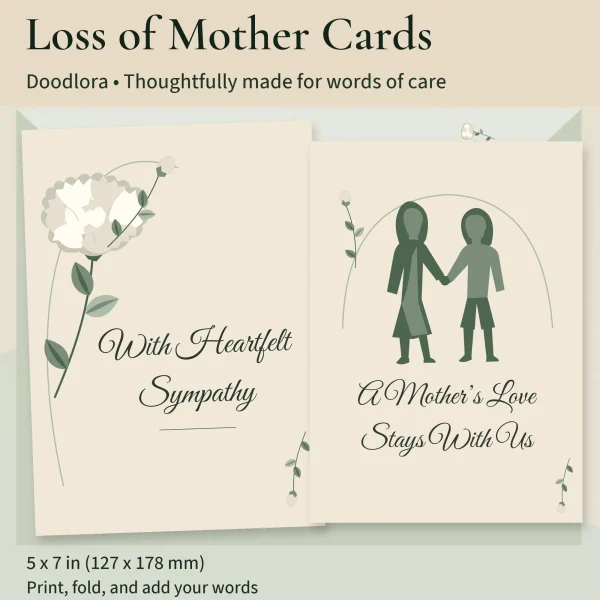
Mother’s Day is a hard date after a loss, and a card around that weekend tells your friend you remembered. Our sympathy cards for the loss of a mother include an inside written for a first Mother’s Day: “On this first Mother’s Day without your mom beside you, there is room for every feeling.” Add your own line on the left panel.
Loss of a father
Cards for the loss of a father often go to people who say little themselves. Keep the message plain, and if you have a story about him, put it in.
- “Your dad’s handshake could crush a walnut, and his advice was just as solid. I’m so sorry.”
- “I’m thinking of you as you remember your father. I’d love to hear any story about him, whenever you want to tell one.”
- “Mr. Chen coached us through three losing seasons and never once made it feel like losing. We’ll miss him.”
- “So sorry about your dad, Tom. I’ll mow the lawn this month, no arguments.”
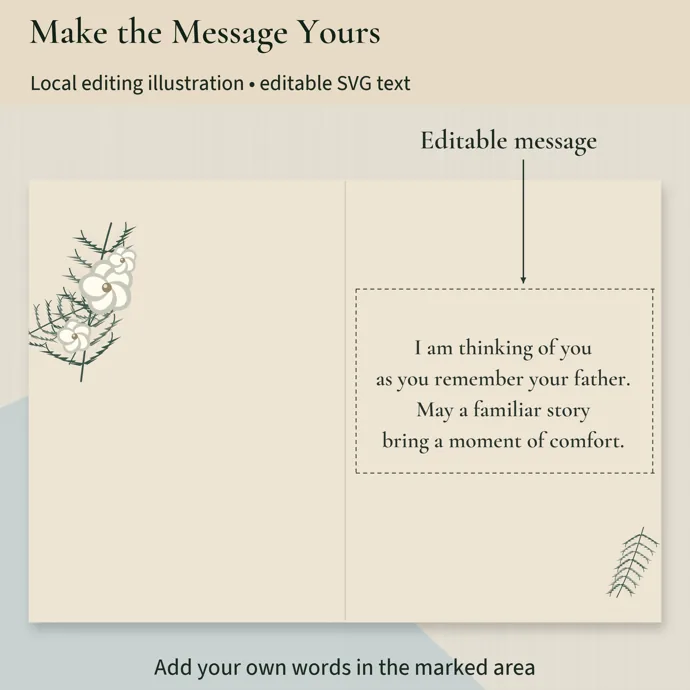
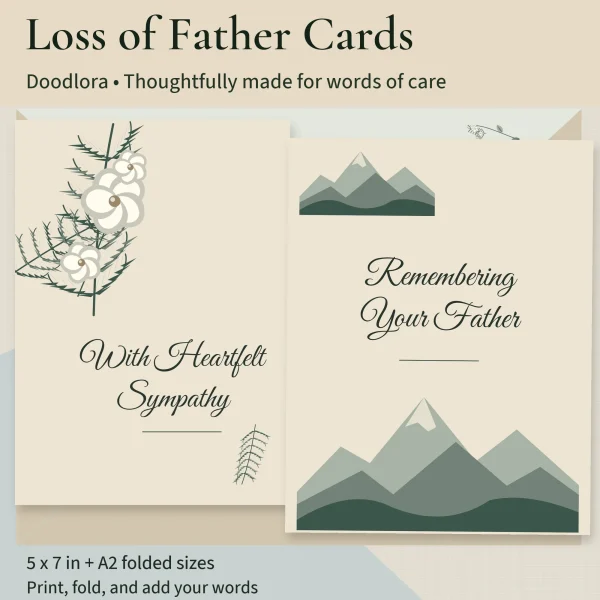
The printed line inside our sympathy cards for the loss of a father reads “I am thinking of you as you remember your father. May a familiar story bring a moment of comfort.” If you’re printing it, the handwritten part only needs your story and your name.
Writing to someone who lost a spouse or a child
Cards for a widow, a widower or bereaved parents are where shorter is kinder. The family is often reading dozens of them in a week, and a long letter can feel like one more thing to get through.
Loss of a husband, wife or partner
Use the partner’s first name and offer help with the everyday tasks that the partner used to handle, such as meals, the yard or school pickup. Avoid any line about the future, such as “you’re young” or “you’ll find love again.”
- “I’m so sorry about David. He adored you, and it showed every single day.”
- “Thinking of you and missing Jamie with you. I’ll bring groceries Monday; just leave the porch light on.”
- “Linda was one of a kind. I’m here, and I mean it.”
Loss of a child
For parents who lost a child, of any age, keep the card to one or two sentences and say the child’s name. Never compare, explain or look ahead. Emily Post’s list of things not to say includes “You can have other children,” and that line is a good example of everything to avoid here.
- “We’re so sorry. We love you, and we’ll always remember Lily.”
- “There are no words. We’re holding you and Noah’s memory close.”
- “Thinking of you every day, and remembering Ava’s beautiful smile.”
Religious sympathy messages and wording that doesn’t mention faith
Faith wording helps when you know the family shares it, and it can feel like a lecture when they don’t. If you aren’t sure what the family believes, write a non-religious message; nobody minds a card that leaves faith out.
Christian sympathy messages and Bible verses
These suit a family you know to be Christian. If you quote scripture, quote it exactly and keep it to one verse; the verse is the support, and your own line is still the message. Each quotation below is from the King James Version.
- “Praying for you and your family as you remember Grace.”
- “Holding you in prayer. ‘Blessed are they that mourn: for they shall be comforted.’ (Matthew 5:4, KJV)”
- “‘The LORD is nigh unto them that are of a broken heart.’ (Psalm 34:18, KJV) We’re praying for you, and we’ll be at the service Saturday.”
- “‘Let not your heart be troubled.’ (John 14:1, KJV) We love you and we’re lifting you up.”
A line like “she’s in a better place now” belongs only in a card to someone who you know believes it. Even then, it works better as your shared hope (“We believe she’s at peace”) than as a statement of fact.
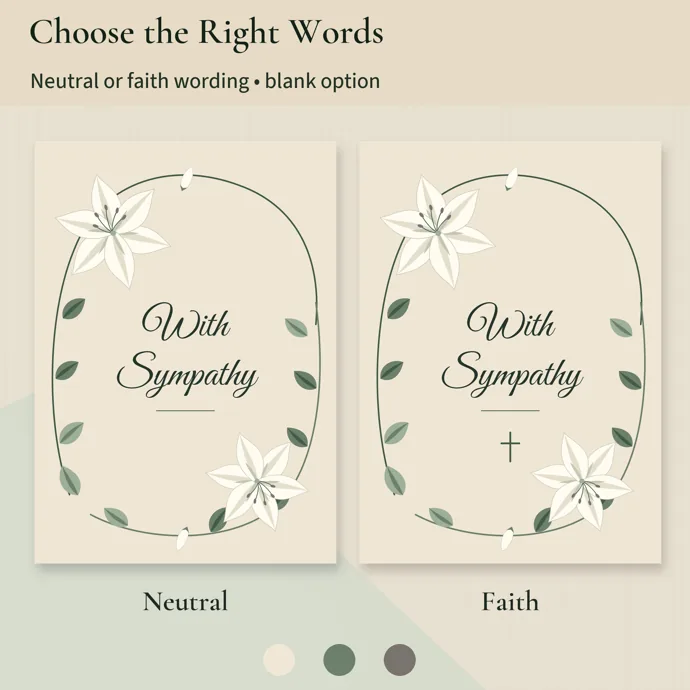
If the family follows another faith, a neutral message is safer than borrowing a phrase you aren’t sure of. You can always ask a mutual friend what the family would find comforting.
Non-religious sympathy messages
These suit anyone, including families whose beliefs you don’t know.
- “Remembering Pete with you and sending all my love.”
- “He was such a good man, and the world is quieter without him.”
- “I hope the stories people share about your sister bring you some comfort.”
- “Wishing you peace and people around you who knew her.”
What not to write in a sympathy card
Most clumsy sympathy lines come from trying to make the loss make sense. The Emily Post Institute names several to avoid, including “Everything happens for a reason,” “It is God’s will” and “I know just how you feel.” Its sympathy note guidance also warns against dwelling on the illness or how the person died, and against calling the loss a blessing in disguise.
A few more to leave out:
- “At least…” Anything that starts with “at least” ranks the loss and finds it smaller.
- “Let me know if you need anything.” It isn’t wrong, but it hands the work back to the family. Name the task instead.
- Your own loss story. One line, such as “I remember how hard it was when my dad died,” can show you understand. A paragraph about your loss shifts the card onto you.
- Advice. Skip suggestions about how to grieve, sleep or move on. A sympathy card is for comfort, not guidance.
- Questions that need answers. “What happened?” or “How are you holding up?” asks the reader to write back. A statement asks nothing.
How to write a sympathy card that’s late
A late card is better than no card, so send it. Don’t spend the first lines apologizing at length; one plain sentence covers it, and then the card is about them again.
- “I’m sorry this card is late. I’ve been thinking about you and about Ray since I heard.”
- “I only just heard about your mom, and I’m so sorry. I hope you’re surrounded by people who loved her.”
- “It’s been a few months, and I know the cards have stopped coming. I’m still thinking of you and missing Joe.”
That last kind of message matters more than it looks. Emily Post’s advice for a bereaved neighbor a few weeks on is to send a note now and then, simply to say you’re thinking of her. Birthdays, the first holidays and the anniversary of the death are natural times for a short card, and on a holiday card to someone grieving, our Christmas card messages include wording for a hard year.
Closings and signatures for a sympathy card
The closing should match the warmth of the message. “With deepest sympathy” is the classic choice, and Emily Post’s advice names it as a warm way to close. Other closings that fit:
- Anyone: With sympathy, / With deepest sympathy, / Thinking of you,
- Friends and family: With love, / Holding you close, / All my love,
- Faith cards: In prayer, / With prayers and love,
Sign with your full name on any card to a coworker, client or neighbor, because the family may know several people named Kate. If the card is from your whole family, list the first names or write “the Brennan family.” A card from a couple can carry both names in one hand; nobody checks whose handwriting it is.
Printing a sympathy card at home
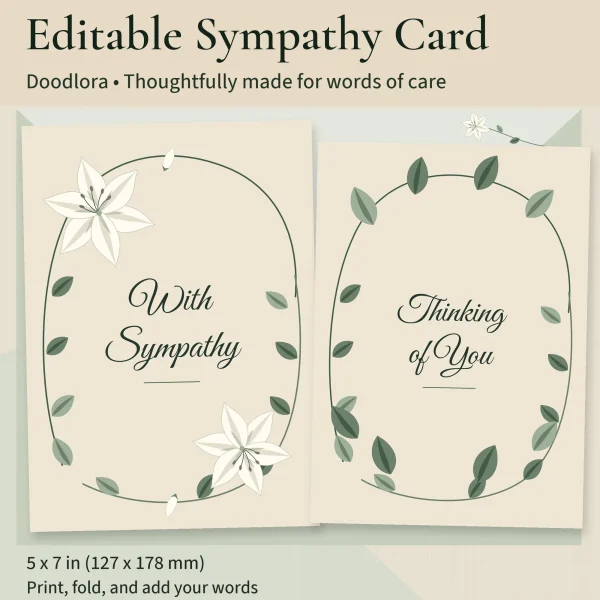
A printed card lets you match the front to the person and still write the message yourself. All three of our sympathy sets are folded 5 x 7 in cards on a soft cream ground. Each card prints as an outside page and a separate inside page, and every design has a blank inside for a fully handwritten note.
- Not sure of the family’s faith? The general printable set works for any loss, with no card naming a parent, partner or pet. Each of the four designs has a neutral and a faith version, and each version has three printed insides plus a blank one.
- Writing to someone who lost a parent? The father set has four fronts in two sizes, 5 x 7 in and the smaller A2 at 4.25 x 5.5 in. The mother set has four fronts, each with a faith version.
- Sending it by text first? The general set and the mother set each include four portrait phone images, 1080 x 1920 px. A text can go out the same day, with the paper card to follow; Emily Post’s advice is that an email or message shouldn’t replace the handwritten note.
The print guide in each set gives the same three steps that save the most paper. Print at actual size (100%) with fit-to-page turned off, check the first sheet with a ruler, and test one outside and inside pair on plain paper before using cardstock. Inside and outside are separate pages, so a two-sided print that flips the wrong way puts the message upside down behind the front. If your printer does two-sided printing on its own, try the short-edge flip setting on that plain-paper test. Then trim on the marks, score the center line and fold.
Write the message after printing, in a pen you’ve tried on a scrap of the same cardstock, since some gel pens can smear on smooth card. For a fully handmade card, the quiet sympathy card in our card making ideas takes about 15 minutes with a cream blank and one narrow floral strip.
Printables from this article
Related articles
Printable Invitations & Cards
Sweet 16 Wishes: What to Write in a 16th Birthday Card
A good sweet 16 wish names what sixteen actually brings, like a license, a first job or a later curfew, and says one true thing about the teen. Here are wishes sorted by who is signing the card, from parents to a coach, plus a section for boys and a list of lines to keep out of a post.
Printable Invitations & Cards
Happy Birthday Mom: Wishes, Messages & What to Write
What you write to your mom depends on who's holding the pen and where things stand between you. Here are birthday wishes for mom from daughters, sons and little kids, plus messages for a stepmom, a mother-in-law, a mom far away, a new mom's first birthday as a mom, milestone ages and a relationship that's complicated.
Printable Invitations & Cards
Birthday Wishes for a Friend: Best, Old and New Friends
A good birthday wish for a friend mentions something only the two of you share and points to the next time you'll see each other. Here's what to include for a best friend, an old friend, a new friend, a long-distance friend, a friend you just made up with and a group card, with sample wishes for each.