 1 / 8
Stingray Silhouettes: 20 Stingray, Manta, Eagle Ray and Skate Designs
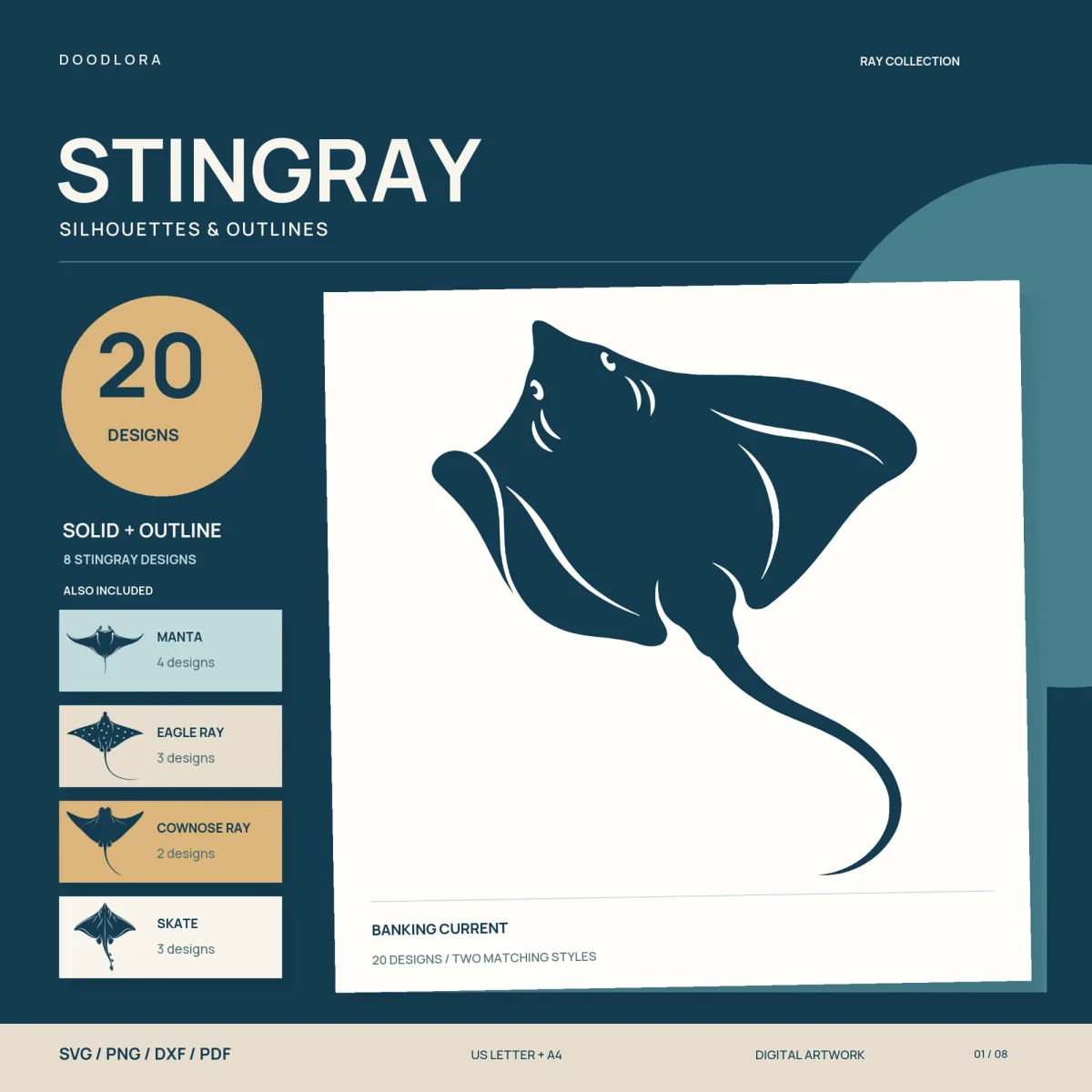
Twenty rays sorted into five groups, from a stingray seen from above with its tail in a loose curl to a manta showing its gill slits from underneath and a skate with a long pointed snout. Each design is a black silhouette with fine white detail lines, plus a matching outline drawn as thin closed bands.
$3.99
Buy any 3 or more printables and save 20% at checkout.
- Download right after payment — link works for 30 days, up to 5 downloads
- Files arrive as a ZIP with your license PDF inside
- Secure checkout by Stripe · Refund policy
Many of these twenty rays are drawn from above, the way you’d see one gliding over sand, so the wide wing shape and the tail do the work. Design-Index.csv sorts them into five groups and notes how many animals are in each design: sixteen show one ray and four show a small group.
Five kinds of ray
- Stingrays (01 to 08). Diamond Drift is a symmetrical top view with the tail in a loose S. Lagoon Glide and Banking Current tilt across the page, Sandbar Profile is a low side view, Spiral Descent curls its long tail up and over its back, and Tidal Rise faces you with both wing tips lifted. Companion Rays pairs a large ray with a small one, and Fever in Motion has three swimming together.
- Mantas (09 to 12). Open Wings spreads straight across with the two horn-like head fins showing, Sweeping Turn banks to one side, Belly Glide shows the underside with its gill slits, and Manta Duet has two mantas curving around each other.
- Eagle rays (13 to 15). All three are covered in spots. Spotted Eagle Soar is seen from above with a long whip tail, Eagle Horizon is a side view, and Eagle Arc swings its tail around in a wide loop.
- Cownose rays (16 and 17). A single ray from above, then three of them in a diagonal line for Cownose Migration.
- Skates (18 to 20). Pointed snouts and thicker tails with small fins near the end, in a top view, a banking turn and a side-on glide.
What the two styles look like
The solid version isn’t a blank shape. Fine white lines mark the wing folds, gill slits and eyes, and the eagle rays keep their white spots. The outline version redraws the edge and those same detail lines as narrow black bands, closed and filled, with the body left open between them. That band is roughly 1.2 mm wide on the 10-inch canvas, so small fins, long tails and the folds inside the body get fragile when you shrink a design, including on the smaller PDF layouts.
Sizing it
In the SVG and DXF files the ray fills about 8.2 inches of a 10-inch canvas, and the PNGs are that same canvas at 3000 pixels. On US Letter the full-page PDFs print the longest side at about 6.2 inches, the four-per-page sheets at about 3.1 inches and the six-per-page sheets at about 2.6 inches. Some programs rescale DXF files when they import them, so the guide asks you to check the size before you cut.
Some designs have separate inner pieces or more than one animal, and the guide suggests transfer material if you make decals. These aren’t bridged stencils for paint, and the files haven’t been cut or printed in a physical test, so try your material and blade settings on one design first.
Questions
- Are these accurate enough to identify ray species?
- No. The guide calls the five groups stylized craft categories, not 20 biological species, and says not to use the drawings for identification.
- How thin is the outline?
- The outline is a closed, filled band about 0.048 inch (1.2 mm) wide at the full 10-inch canvas size, not an open stroke. It gets thinner as you scale the design down, so the guide suggests a larger size or simplifying small details.