 1 / 6
Lobster Clipart: 30 Red and Blue Lobsters, Claws, Buoys, Lobster Traps and Coastal Supper Plates in Color and Mono
Thirty lobsters and harbor pieces with a speckled, painted-look shell, from a top-down red lobster and a deep navy one to a lobster hugging a striped buoy, a wooden trap and a platter with lemon wedges. Every design also comes as a one-color dark teal version for simple single-color work.
$4.99
Buy any 3 or more printables and save 20% at checkout.
- Download right after payment — link works for 30 days, up to 5 downloads
- Files arrive as a ZIP with your license PDF inside
- Secure checkout by Stripe · Refund policy
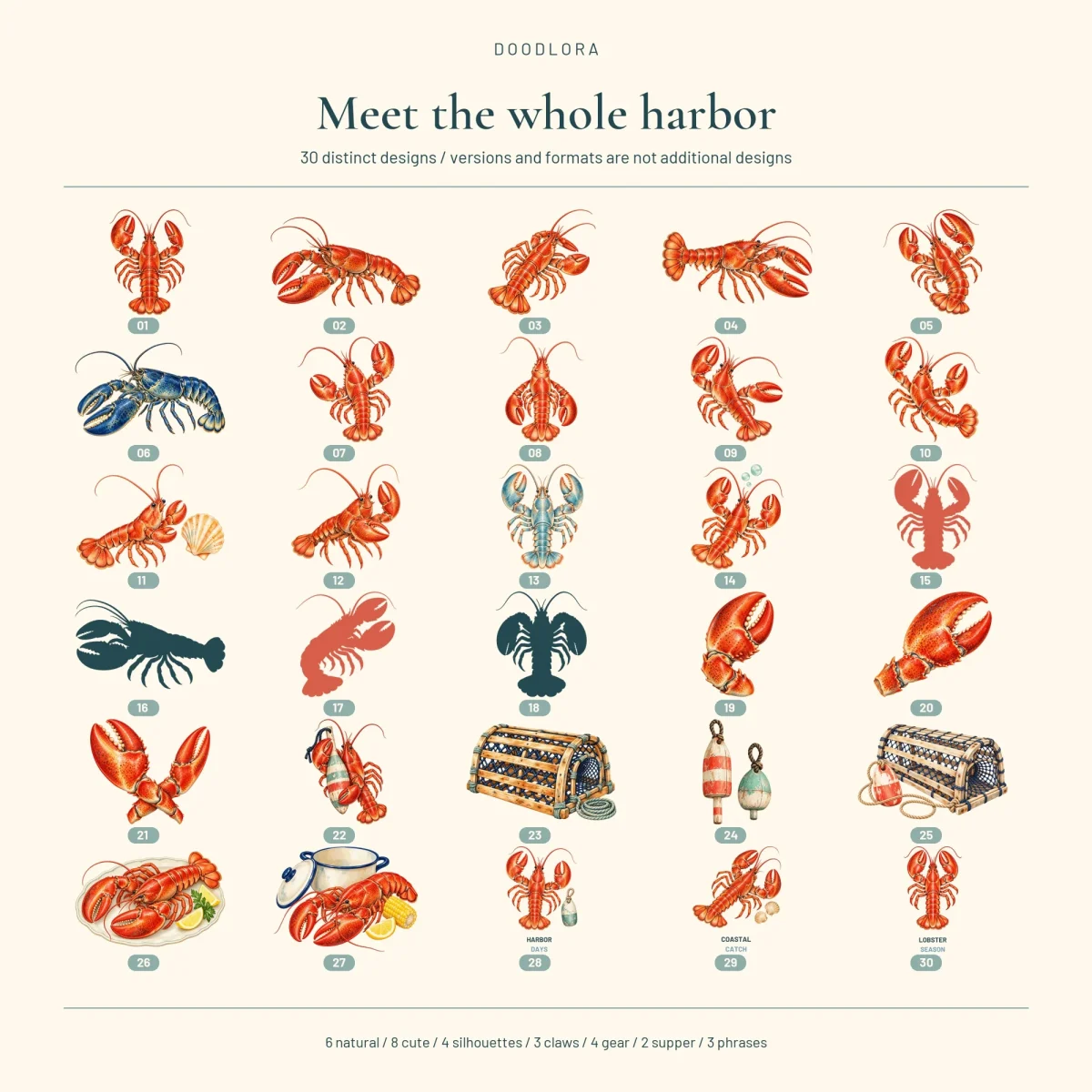
This lobster clipart is built around one look: a red-orange shell with fine dark speckles, pale cream joints and claw teeth, and long thin antennae. Two shells break from the red. Design 06 is a deep navy blue lobster with lighter blue highlights, and 13 is a pale seafoam blue one. The harbor gear around them, rope buoys in red and white or seafoam, lattice traps and a white enamel pot, stays in the same coral, cream and dark teal palette.
For crabs, the site’s crab outline set has 20 designs as black silhouettes and thin outlines. Here the lobster is the subject, in full color first.
What’s numbered where
- Lifelike lobsters, 01–06. Seen straight from above with both claws up, in side profile, crawling on a diagonal, stretched out flat, with the tail curled under in a crescent, and 06 in navy blue.
- Cute lobsters, 07–14. The same speckled shell with round black eyes and livelier poses: one claw raised high, both claws tucked down at the sides, turned on a diagonal, the tail kicked out to one side, crawling toward a scallop shell, lifting a claw toward its face, the pale blue 13 with a tiny smile, and 14 with three bubbles rising.
- Silhouette emblems, 15–18. Flat single-color shapes even in the color files, two in coral and two in dark teal, upright, sideways, curved and with oversized claws.
- Claws, 19–21. One big crusher claw, a long open pincer, and two claws crossed like an X.
- Harbor gear, 22–25. A lobster wrapped around a striped buoy, a wooden lobster pot with blue netting and coiled rope, two buoys hanging from rope loops, and a long trap with a buoy and rope beside it.
- Dinner, 26–27. A red lobster on a scalloped white platter with lemon wedges and parsley, and a lobster beside a lidded enamel pot with corn on the cob and lemon.
- Sayings, 28–30. HARBOR DAYS, COASTAL CATCH and LOBSTER SEASON in small two-line capitals under a lobster, the top word in dark teal and the second in light blue. 28 adds a buoy and 29 a few shells. No font is needed to open them.
Painted PNG or vector?
For anything printed, the painted PNG is the closest match to the product images, speckles and shading included. The color SVG is a traced version: one lobster becomes roughly 1,400 to 2,200 small flat color patches, so it scales cleanly but reads a little blockier up close. Use it when you need to resize or recolor parts in a vector program.
The one-color files
The mono version is a single dark teal (#244850) shape per design rather than black, so set it to any color you like in your software. The antennae, legs and claw edges were thickened so they don’t vanish, and the lattice on the two traps keeps its open squares. Designs 26 and 27 are the exception to the solid look: the platter and the pot become thin outlines around a solid lobster. The DXF files hold these same one-color shapes as closed outlines, from a single outline for the claws up to about 160 for the traps, placed on a 12-inch canvas in inches.
The guide’s suggestion for painted work is to start around 3 to 4 inches tall and check the print at actual size. The one-color shapes can go larger. Antennae and the smallest legs are the first parts to check before a full-size cut.
Questions
- Why does the guide suggest starting painted prints at 3 to 4 inches?
- The painted art was made at about 1,250 to 1,540 pixels on its long side and enlarged to 3600 for the PNG. Design-Index.csv lists each original size, so you can check how far a print will stretch it before you go big.
- Are the claws and legs too thin for a cutter in the one-color files?
- They were thickened for the one-color version, but antennae and the smallest legs still need a reasonable size. Cut one test piece at your final size before the real project.