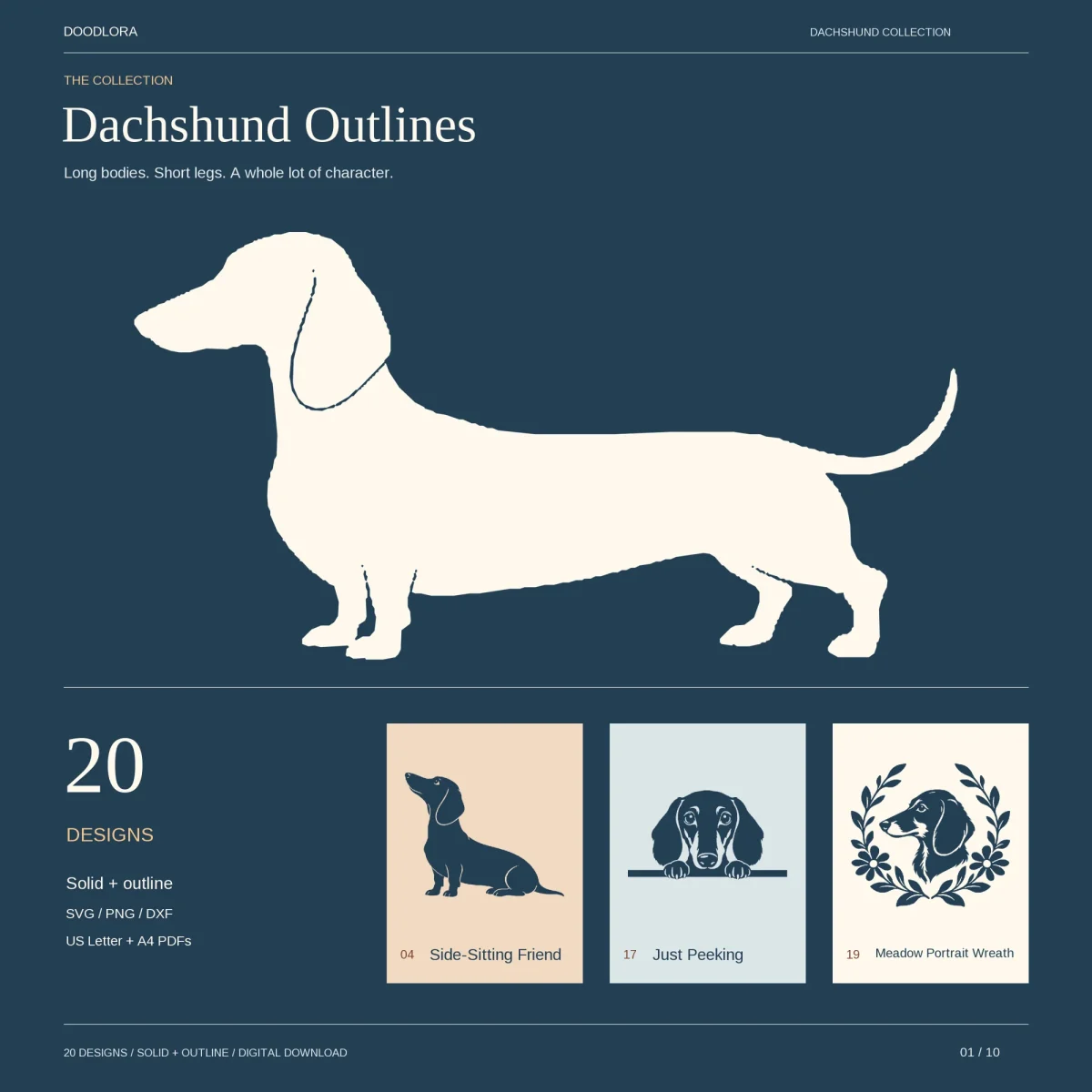
 1 / 10
Dachshund Silhouettes: 20 Smooth, Longhaired and Wirehaired Wiener Dog Designs
Twenty long-bodied, short-legged dachshunds drawn as realistic black shapes, with the smooth, longhaired and wirehaired coats side by side, a doxie in a striped sweater, one sitting up to beg and one rolling belly-up. Every design also comes as a thin outline with small paper bridges built in.
$3.99
Buy any 3 or more printables and save 20% at checkout.
- Download right after payment — link works for 30 days, up to 5 downloads
- Files arrive as a ZIP with your license PDF inside
- Secure checkout by Stripe · Refund policy
A dachshund is easy to recognize from its shadow alone: the long back, the short legs and the big ears that fold down past the jaw. This set keeps that shape front and center with 20 realistic black silhouettes, each paired with a bridged outline of the same dog. There’s no color and no lettering anywhere in it, which is the opposite of the cartoon kawaii dachshund set on this site.
Three coats, then everything a doxie does
The first three designs show one standing dog in each coat. The smooth coat (01) is a clean, sleek edge. The longhaired coat (02) feathers out along the chest, belly and tail. The wirehaired coat (03) gets a scruffy beard, bushy brows and a rough outline all over. Several of the later poses carry the longhaired feathering on the ears and tail too, including the trot and the full-speed run.
From there the set works through the day. There’s a side-on sit with the nose pointed up (04), a front-facing sit with a pale chest (05), an easy trot (06) and a flat-out run with the ears flying back (07). Design 08 is a play bow with the tail high. Then come a dog lying flat (09), one curled up asleep (10) and one rolling belly-up with all four paws in the air (11). In 12 it walks with its nose down on a scent, and in 14 it sits up on its back legs to beg. Design 13 wears a striped sweater with a ribbed collar and cuffs, and the stripes show in both versions.
Faces and keepsake shapes
Six designs move in close. There’s a head in profile (15), a front-facing portrait with the long ears hanging down both sides (16) and a dachshund peeking over a ledge with two front paws hooked on it (17). The other three frame the dog: a whole standing dachshund set inside the main pad of a paw print (18), a head in a wreath of leafy branches and daisies (19), and a head inside a heart (20).
Choosing between solid and outline
Pick the solid file when you want the shape to read in one go, on a print, a sticker or a gift tag. Its fine details, such as the eye, the fold of the ear, the wire coat’s beard and the sweater stripes, are thin white cuts through the black. That looks sharp printed, but cut from paper those cuts leave loose slivers.
The outline is the paper-friendly version. It traces the dog with one line that looks continuous from a distance but is broken by short gaps, and those gaps hold the inside of the dog to the paper around it. Keep the gaps when you edit, and check the narrowest ones at the size you plan to use, since they shrink with the design. Nothing has been through a physical cut test, so start on scrap.
Files and pages
- SVG and PNG: SVGs on a 1200 x 1200 canvas with no real-world unit, PNGs at 2400 pixels square with a transparent background. All the art is black.
- DXF: millimeter files where every design opens exactly 4 inches wide, so a long dog like the run is only about 1.3 inches tall at that size. Scale in your software as needed.
- PDFs: US Letter and A4, 60 pages each. A cover, all 20 solids one per page, all 20 outlines one per page, then 4-up and 6-up sheets of both, and a guide page at the end. Choose Actual Size (100%) in the print dialog so nothing gets rescaled.
Questions
- Is this the same as the kawaii dachshund set?
- No. That set is cartoon color art with sayings. These are realistic black silhouettes and outlines with no color and no lettering, drawn from different artwork.
- Why are there gaps in the outline lines?
- They're paper bridges. They keep the paper inside the outline attached to the paper around it, so leave them in when you edit or resize. The files haven't been test-cut, so try one at your size on scrap first.