 1 / 8
Bug Outlines and Silhouettes: 20 Fine-Line Tattoo Designs from Ladybug to Garden Snail
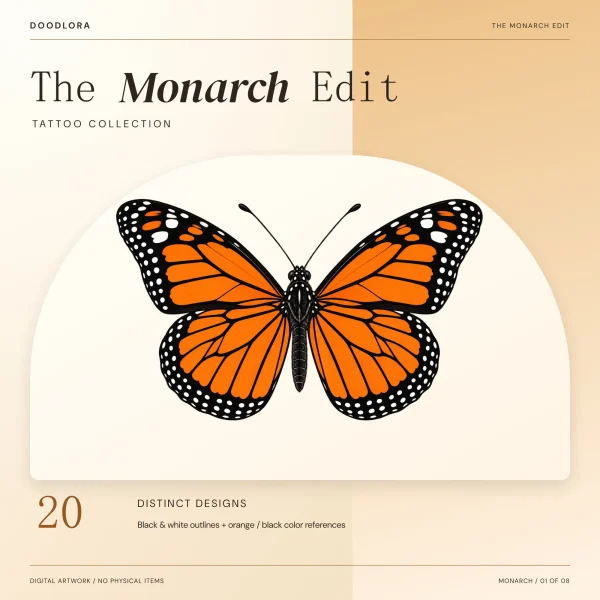
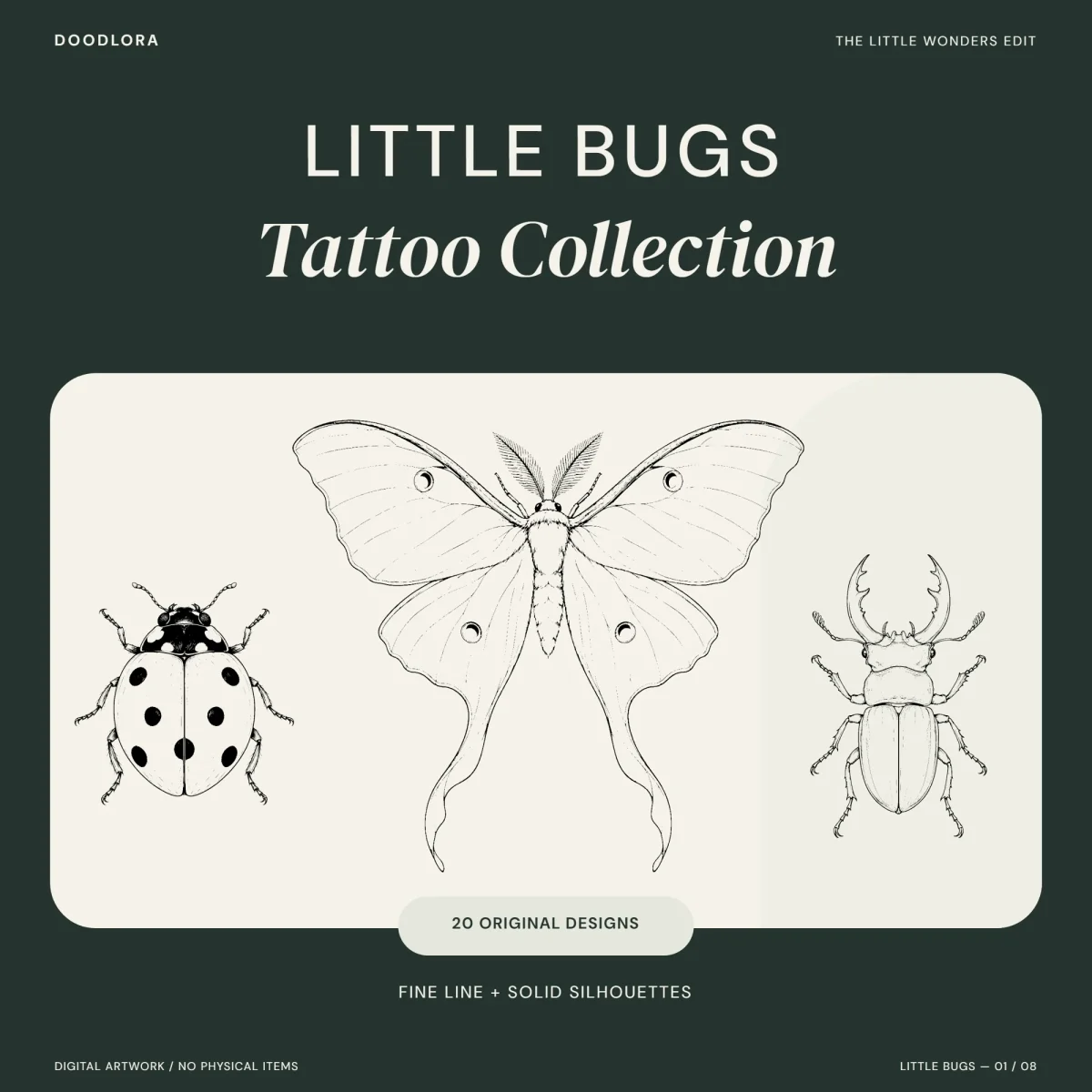
One of each, twenty times over. A seven-spot ladybug, a luna moth, a stag beetle, a praying mantis, a garden snail and fifteen more small creatures are drawn in fine ink-style lines with stippled shading, and every drawing has a matching solid black silhouette.
$3.99
Buy any 3 or more printables and save 20% at checkout.
- Download right after payment — link works for 30 days, up to 5 downloads
- Files arrive as a ZIP with your license PDF inside
- Secure checkout by Stripe · Refund policy
This bug outline set has twenty different creatures and only one drawing of each, laid out like the plates in an old natural-history book: legs spread, wings flat, every body segment in place. Thirteen are seen from straight above. The snail, ant, mantis, grasshopper and cricket stand in profile, and the bumblebee and rhinoceros beetle turn three-quarters toward you.
Who’s in the twenty
- Beetles: a seven-spot ladybug with a black, pale-spotted shield behind the head, a stag beetle with antler-like jaws, a rhinoceros beetle with one curved horn, a jewel beetle that narrows to a point, and a long-bodied firefly.
- Broad wings: a luna moth with four eyespots and long trailing tails, an atlas moth with hooked wing tips, and a swallowtail butterfly.
- Clear, veined wings: a dragonfly, a slim damselfly, a lacewing and a cicada.
- Bees and flies: a striped honeybee, a round fuzzy bumblebee and a hoverfly with big eyes and a banded body.
- Walkers: an ant, a praying mantis with its forelegs folded, a grasshopper, a cricket with antennae longer than its body, and a garden snail. The guide is upfront that the snail is there as a garden creature, not as an insect.
Ink texture or one clean shape
The fine-line drawings get their look from stippled dots and short hatching: fur on the bumblebee, growth lines on the snail’s shell, the net of cells in a dragonfly wing. Lots of those marks stand apart from the main drawing, from about 20 on the swallowtail to roughly 400 on the snail. That’s what makes them read like pen work on paper.
The silhouette of each bug is a single connected black shape with nothing open inside. Spots, eyespots and wing veins drop out, and what’s left is the edge: legs, antennae, the ladybug’s dome, the luna moth’s tails. Choose it when the shape has to read at a glance, or when you want something you can trace around in one pass.
Pages, flash sheets and size
Pages 1 to 40 put one bug on each sheet, fine-line first and then the silhouettes, at up to about 7.2 inches across on US Letter. The upright ones, like the stag beetle, firefly, cicada, damselfly and jewel beetle, run as tall as 8.5 inches instead. The last ten pages are flash sheets with four bugs per page in the same order, each drawing about 3.5 to 3.8 inches on its long side. Every page carries the bug’s name at the top and a page number at the bottom, so take the SVG or PNG when you need the artwork on its own.
The guide’s one sizing rule: keep a fine-line bug at least 3 inches (7.6 cm) wide on paper so the small detail survives. It says plainly that this is a paper figure and wasn’t tested on skin. If one of these is headed for your own tattoo, print it at the size you have in mind and take that page to your tattoo artist. For temporary tattoo paper, the guide sends you to the paper maker’s own printing and mirroring steps.
In the SVG files each drawing is one black filled path on an 8-inch square, so a single fill setting changes its color. The PNGs are the same 8-inch square at 2400 pixels with a transparent background, and the artwork fills about 6.9 inches of it on its longest side.
Questions
- Can the fine-line versions be cut on a cutting machine?
- They aren't single shapes. Each fine-line drawing is a main outline plus many loose dots and short strokes for shading, and the fine-line DXF traces both edges of every stroke as a closed outline rather than one engraving line. The silhouettes are the one-piece versions. None of the files has been tried on a machine, so cut a test piece first.
- Do the flash sheets add more designs?
- No. The ten flash sheets repeat the same 20 bugs, four to a page, first in fine-line and then in silhouette.