How to Address Wedding Invitations: Inner & Outer Envelopes
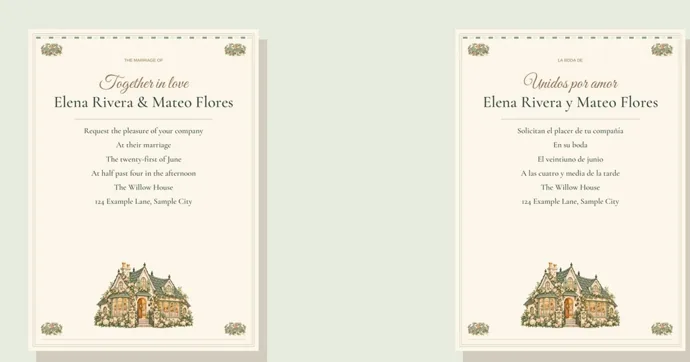
To address wedding invitations, write the outer envelope like formal mail: titles, full names and the complete street address, with words such as “Street” spelled out. If you use an inner envelope, it carries only titles and last names, and it names exactly who is invited, children included. Everything else comes down to the guest in front of you: a couple who don’t share a last name, a cousin bringing a date, a widowed aunt, a family with teenagers.
Most forms on this page come straight from the Emily Post Institute’s published advice on addressing, and the few it doesn’t spell out follow the same logic. Treat them as the formal default, not a test you can fail. A relaxed backyard wedding can loosen them, and a guest’s own preference always beats the textbook version.
Quick answers by guest
Find the guest, then copy the pattern. All names and addresses here are made up.
| Who you’re inviting | Outer envelope | Inner envelope |
|---|---|---|
| Married couple, same last name | Mr. and Mrs. Daniel Ortiz | Mr. and Mrs. Ortiz |
| Married couple, different last names | Ms. Priya Nair and Mr. Owen Fields | Ms. Nair and Mr. Fields |
| Two married men | Mr. and Mr. Leon Brandt, or The Messrs. Brandt | Mr. and Mr. Brandt |
| Couple living together, not married | Ms. Hannah Cole and Mr. Marcus Webb | Ms. Cole and Mr. Webb |
| Family with young children | Mr. and Mrs. Daniel Ortiz | Mr. and Mrs. Ortiz, then each child on a line below |
| Single guest with a plus-one | Ms. Claire Donovan | Ms. Donovan and Guest |
| Doctor married to a non-doctor | Dr. Priya Nair and Mr. Owen Fields | Dr. Nair and Mr. Fields |
| Widowed guest, preference unknown | Mrs. Robert Hale | Mrs. Hale |
| Divorced guest | Ms. Laura Hale, or the name she now uses | Ms. Hale |
The sections below explain each line and the cases the table can’t hold. They cover only the envelopes. For the lines printed on the card itself, from “request the honor of your presence” to a casual “come celebrate with us,” see our wedding invitation wording guide.
What goes on the outer envelope
The outer envelope is the one the mail carrier handles, so it holds the full mailing details. Traditionally it’s written out in full:
- Titles are abbreviated. Mr., Mrs., Ms., Mx. and Dr. stay short.
- Other words are spelled out. Write Street, Avenue, Boulevard and Road in full, not St. or Blvd.
- No middle initials. Either write the whole middle name or leave it off. “Daniel James Ortiz” or “Daniel Ortiz,” never “Daniel J. Ortiz.”
- State names are your choice. Emily Post’s guide says the state may be written in full or as the two-letter postal abbreviation.
A finished outer envelope looks like this:
Mr. and Mrs. Daniel Ortiz
2418 Larkspur Avenue
Springfield, Illinois 62704
Keep each part on its own line, centered or aligned to the left. The traditional advice is to address every envelope by hand. Emily Post’s dos and don’ts put it bluntly: no address labels for wedding invitations, even with hundreds of guests.
Your return address goes on the outer envelope too. Emily Post’s guide notes that guests tend to send both replies and gifts to that address. If replies should go somewhere else, such as a parent who is collecting them, print that address on the reply envelope instead. Apartments, PO boxes, APO mail and letters abroad each need their own lines, and how to address an envelope has an example of each.
What goes on the inner envelope
The inner envelope is optional and goes unsealed inside the outer one. Its job is precision: it names the specific people invited, so a guest who opens it knows at a glance whether the invitation includes their partner or their kids. Anyone not named isn’t invited, and you never have to say so.
Because the mailing work is done, the inner envelope drops first names and addresses:
Mr. and Mrs. Ortiz
Sofia Ortiz
Mateus Ortiz
For close relatives, family names are fine here. “Aunt Rosa and Uncle Dan” or “Grandma” reads warmly on the inner envelope and is one of the few places that informality is traditional.
If you skip the inner envelope, the outer envelope has to do both jobs. List invited children on lines below their parents, and add a short note about plus-ones inside, since there’s nowhere else to say it.
Married couples
Etiquette guides agree on one point: a married couple is invited together. Address the invitation to both people even when you know only one of them can come.
Same last name. The most traditional form uses the husband’s full name, as in “Mr. and Mrs. Daniel Ortiz.” If you know the couple would rather see both first names, the less formal “Elena and Daniel Ortiz” does that.
Different last names. Write each person with their own title and name, joined by “and.” Emily Post’s addressing guide adds that the order doesn’t matter, so either name can go first:
Ms. Priya Nair and Mr. Owen Fields
If the line runs too long, break it and indent the second line:
Ms. Priya Nair
and Mr. Owen Fields
One combination to avoid is “Mr. and Ms. Owen Fields.” “Ms.” signals that she uses her own name, so it shouldn’t be attached to his.
Same-sex couples and gender-neutral titles
Two men can be addressed as “Mr. and Mr. Leon Brandt” or as “The Messrs. Brandt.” Emily Post’s guide suggests asking the couple which they prefer. A quick text settles it.
For two women, follow the same logic as any couple: give each person the title and name she actually uses. “Ms. Jo Whitley and Ms. Ana Whitley” works for a couple who share a name. If they don’t share one, use “Ms. Jo Whitley and Ms. Ana Duarte,” on one line or broken onto two.
For anyone who doesn’t use a gendered title, “Mx.” is the neutral option and is written like the others: “Mx. Sam Avery.” When you’re not sure what someone uses, ask them or ask a mutual friend before the calligraphy starts.
Couples who live together
An unmarried couple sharing one address gets one invitation, with both names joined by “and.” Emily Post’s addressing guide prefers a single line:
Ms. Hannah Cole and Mr. Marcus Webb
On the inner envelope, use titles and last names: “Ms. Cole and Mr. Webb.” A couple who live apart should each get an invitation at their own address, unless you’re inviting one of them with a plus-one.
Families with children
The outer envelope traditionally goes to the parents only, even when the children are invited. The children’s names go on the inner envelope, on lines below their parents, with no addresses. If there’s no inner envelope, list them on the outer envelope under the parents’ names.
A family of four, using an inner envelope:
Outer: Mr. and Mrs. Daniel Ortiz
Inner: Mr. and Mrs. Ortiz / Sofia Ortiz / Mateus Ortiz
Write out every invited child by name rather than “and Family.” The name list is what tells parents whether a toddler or a teenager is included. If children aren’t invited, only the parents’ names appear, and the reply card can say the same thing again in its own wording.
Grown children are where hosts most often choose differently. A son or daughter who is an adult can get an invitation of their own, addressed to them alone, even if they still live in the same house. Emily Post’s guide notes that children can receive their own personal invitations instead of being listed with their parents. For girls, Emily Post’s addressing guide notes that “Miss” is usually for those under 18. Younger children can also simply be listed by first and last name, as in the example above.
Single guests and plus-ones
Writing “and Guest” on the outer envelope is something etiquette guides steer you away from. Instead, use the two envelopes:
Outer: Ms. Claire Donovan
Inner: Ms. Donovan and Guest
Better still, find out the companion’s name. Emily Post’s dos and don’ts say using the real name is warmer and more welcoming. Once you know it, you can write “Ms. Donovan and Mr. Reyes” on the inner envelope, or send that partner an invitation of their own.
With only one envelope, there’s no polite place for “and Guest.” Slip in a short handwritten note instead, along the lines of “You’re very welcome to bring someone. Just add their name to your reply card.”
Doctors and other titles
Professional titles stay on the envelope, and they’re abbreviated like the social ones. The common doctor patterns from Emily Post’s addressing guide, with our own sample names:
| Situation | Outer envelope |
|---|---|
| One doctor, one not, different last names | Dr. Priya Nair and Mr. Owen Fields |
| One doctor, one not, same last name | Dr. Elena Ortiz and Mr. Daniel Ortiz |
| Two doctors, same last name | The Doctors Ortiz, or Drs. Elena and Daniel Ortiz |
| Two doctors, different last names | Dr. Priya Nair and Dr. Owen Fields |
For military guests, Emily Post’s addressing guide gives one rule worth knowing: when one partner outranks the other, the higher-ranking name goes first. Ranks, judges and clergy each have their own forms beyond that. If you have guests like these, ask them or their family how they like to be addressed rather than guessing.
Widowed and divorced guests
A widow’s name is personal, so the best answer is the one she uses. When you don’t know, Emily Post’s guide gives her late husband’s name, “Mrs. Robert Hale,” as the traditional form. If she goes by her own first name, “Mrs. Margaret Hale” or “Ms. Margaret Hale” is just as correct, and following her lead is the point.
A divorced woman traditionally stops using her former husband’s first name, so “Mrs. Robert Hale” is no longer right for her. Depending on her choice, she might be “Mrs. Laura Hale,” “Ms. Laura Hale,” or “Ms. Laura Bennett” if she has returned to her maiden name. It isn’t unusual to keep the married last name, especially if their children share it. Check how she signs her own cards or emails, and copy that.
The return address and the reply envelope
The reply card needs its own small envelope, and the traditional choice is to send it already addressed and stamped. Guests only have to tick a box and drop it in a mailbox. Address it to whoever is collecting replies. That is usually the couple, or the hosts if parents are hosting. Lightly pencil a number on the back of each reply card that matches the guest list, so a card that comes back with no name on it can still be matched to a guest.
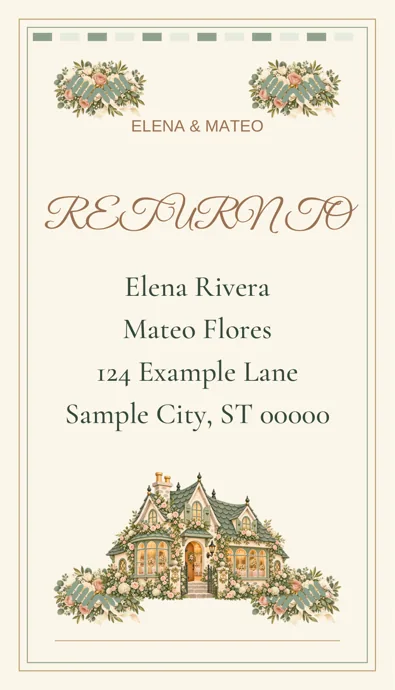
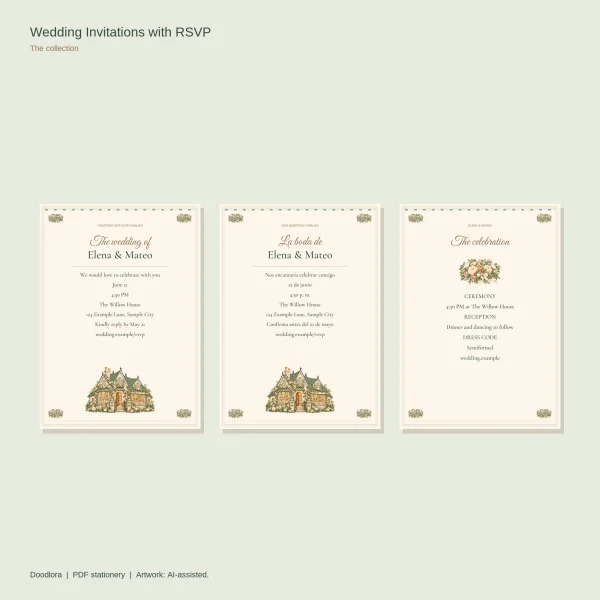
For the reply envelopes, the wedding invitations with RSVP come with a printed “Return to” card with the couple’s names and address under a script heading. Its sample address reads “124 Example Lane / Sample City, ST 00000,” so swap in your real details before printing. Two cards print side by side on each Letter or A4 sheet, sized 2 x 3.5 inches. It’s a quick way to put the same return address on every reply envelope in matching type, and the set’s Kindly reply card already has lines for name, guests and meal.
Handwriting the envelopes, or printing the address
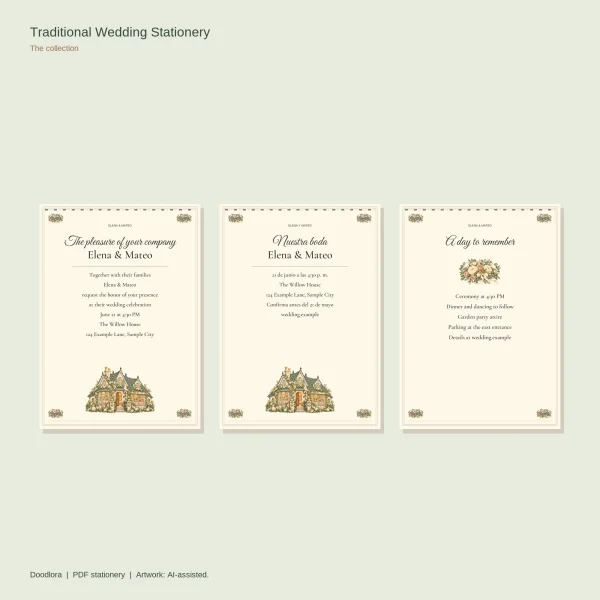
Hand-addressing is the traditional choice, and the sets on this page don’t change that advice. Our wedding invitation cards also include a printed “To” card in the same cottage design, laid out with two guest names, a street and a city line. You can use it two ways:
- As a layout model. Keep a printed copy beside you while you address by hand. It shows a clean line order and spacing, with names on their own lines and the address below.
- As a printed address card. For a relaxed wedding where a printed address suits you, type each guest’s name and address into it. It’s a static PDF, so you’ll need a PDF editor to change the text.
Notice the sample uses “Road” in full but abbreviates the state. That matches the guide above, because either form of state name is acceptable. Pick one style and use it on every envelope.
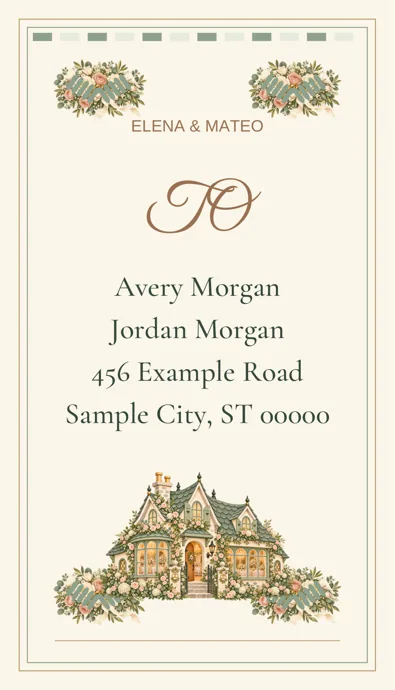
Every card in these sets prints with sample names, including the small “Elena & Mateo” line across the top. Change that line too, not just the address. None of the sets include envelopes or envelope liners, so buy envelopes sized to your printed cards from a stationery or office supply store. Reprint the cards whenever your guest list grows, because the license on these sets covers your own wedding. What it doesn’t cover is designing or selling invitations for someone else’s.
Assembling and sealing each envelope
Once both envelopes are addressed, put each invitation together in the same order:
- Lay the invitation face up.
- Stack the enclosures on top of it, printed side up, smallest on top. That means the reply card with its envelope, plus any reception or details card.
- Slide the stack into the inner envelope so the printed side faces you when the flap opens. Leave the inner envelope unsealed.
- Put the inner envelope into the outer one with the names facing the back flap, so they’re the first thing the guest sees.
- Check that the inner and outer names match before you seal anything.
Step 5 is the one that goes wrong on a long night of stuffing. Two families with the same last name, or a cousin whose plus-one changed, can end up in each other’s envelopes. Work from the guest list one household at a time instead of addressing all the inner envelopes in one batch.
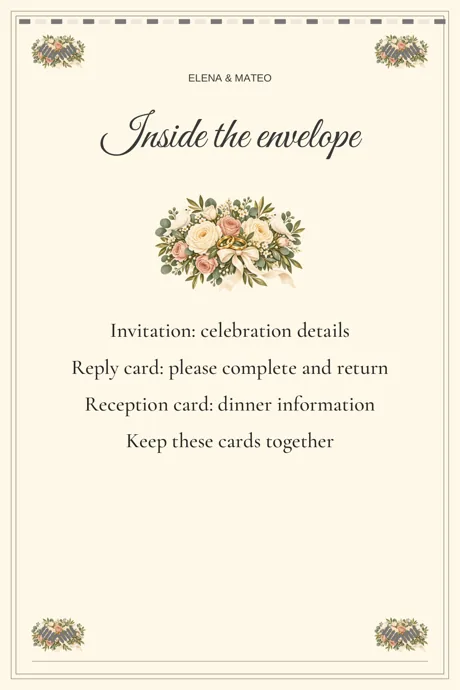
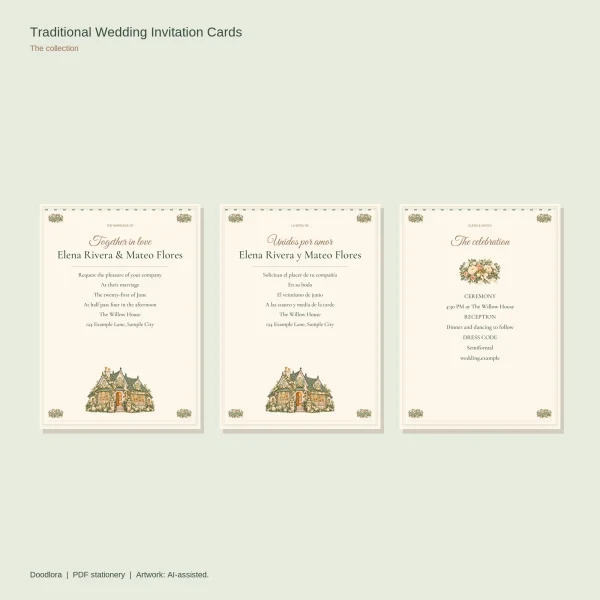
When a guest opens a thick envelope, a small “Inside the envelope” card from the traditional wedding invitations explains the pile. It lists the invitation, the reply card to complete and return, and a reception card, then ends with “Keep these cards together.” It helps if you’re sending several enclosures, and it saves guests from losing the reply card in the recycling.
An inner envelope, extra cards and heavy paper all add weight, so let the post office weigh a finished sample before you buy postage for the whole stack. The mailing dates and reply deadlines that come next are laid out in when to send wedding invitations, along with the smallest reply envelope the mail will take.
Matching the envelope to the invitation
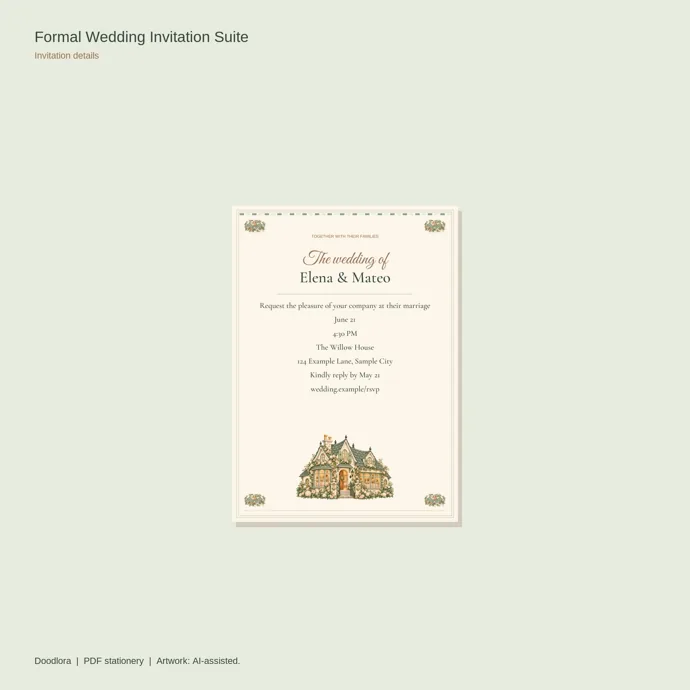
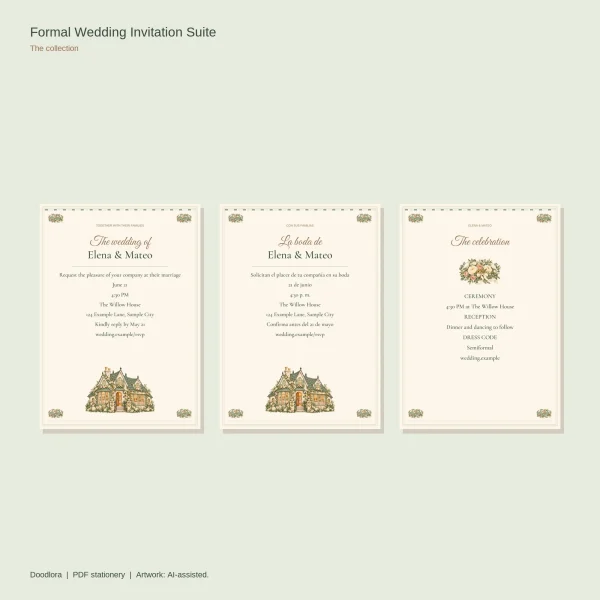
How formal the envelope is should follow the invitation inside it. A card worded in the third person, such as “request the pleasure of your company,” calls for full names, titles and the inner envelope. Our formal wedding invitations use that wording. They also include a one-page guide to formal wording for three kinds of hosts: the bride’s parents, the couple, or both families. A casual invitation can go out in a single envelope addressed simply to “Daniel and Elena Ortiz.”
Mistakes to catch before the envelopes go out
These are the slips that show up most once a stack of envelopes is finished. Each one is easy to fix before the flap is sealed and hard to fix after.
- Abbreviated street words. “Oak St.” and “Elm Blvd.” are the most common shortcuts on a formal envelope. Spell them out.
- Middle initials. Write the full middle name or none.
- “Mr. and Ms.” on one surname. A wife who uses “Ms.” keeps her own name on the envelope.
- “And Family” with no names. It leaves parents guessing which children are invited. List each child on the inner envelope.
- Mismatched inner and outer names. Check each pair as you assemble it, not afterward.
- A former name on a divorced or widowed guest. When you’re unsure, ask a relative quietly.
- Two different state styles. Choose either “Illinois” or “IL” for the whole list.
Spend ten minutes reading the finished stack against your guest list. Correct spelling of each guest’s name matters more than any rule on this page, and it’s the thing people notice.
Printables from this article
Related articles
Printable Invitations & Cards
Engagement Party Ideas: Themes, I Do BBQ & Stock the Bar
An engagement party is where the people on the wedding list meet the couple and each other. Start with who hosts and who gets invited, then pick from seven themes, from a garden party or an I Do BBQ to a stock the bar party, and run it on a simple three-hour plan.
Printable Invitations & Cards
Rehearsal Dinner Ideas: Who Hosts, Toast Order, Wording
Hold it the evening before the wedding, keep it simpler than the reception, invite everyone with a part in the ceremony plus their partners, let the host give the first toast, and match the invitation's first line to whoever is hosting.
Printable Invitations & Cards
Wedding Anniversary Wishes: Card Messages & What to Write
Anniversary card messages sorted two ways: by the year being celebrated, from the first to the fiftieth and beyond, and by who's writing, from a spouse to adult children, friends and coworkers. Includes what the traditional gift lists say, gentle wording for a hard anniversary, and how to sign and date the card.