 1 / 6
Oyster Clipart: 30 Designs with Oyster Shells, Pearls, Ice Platters, a Shucking Knife, Engravings, Silhouettes and Coastal Phrases
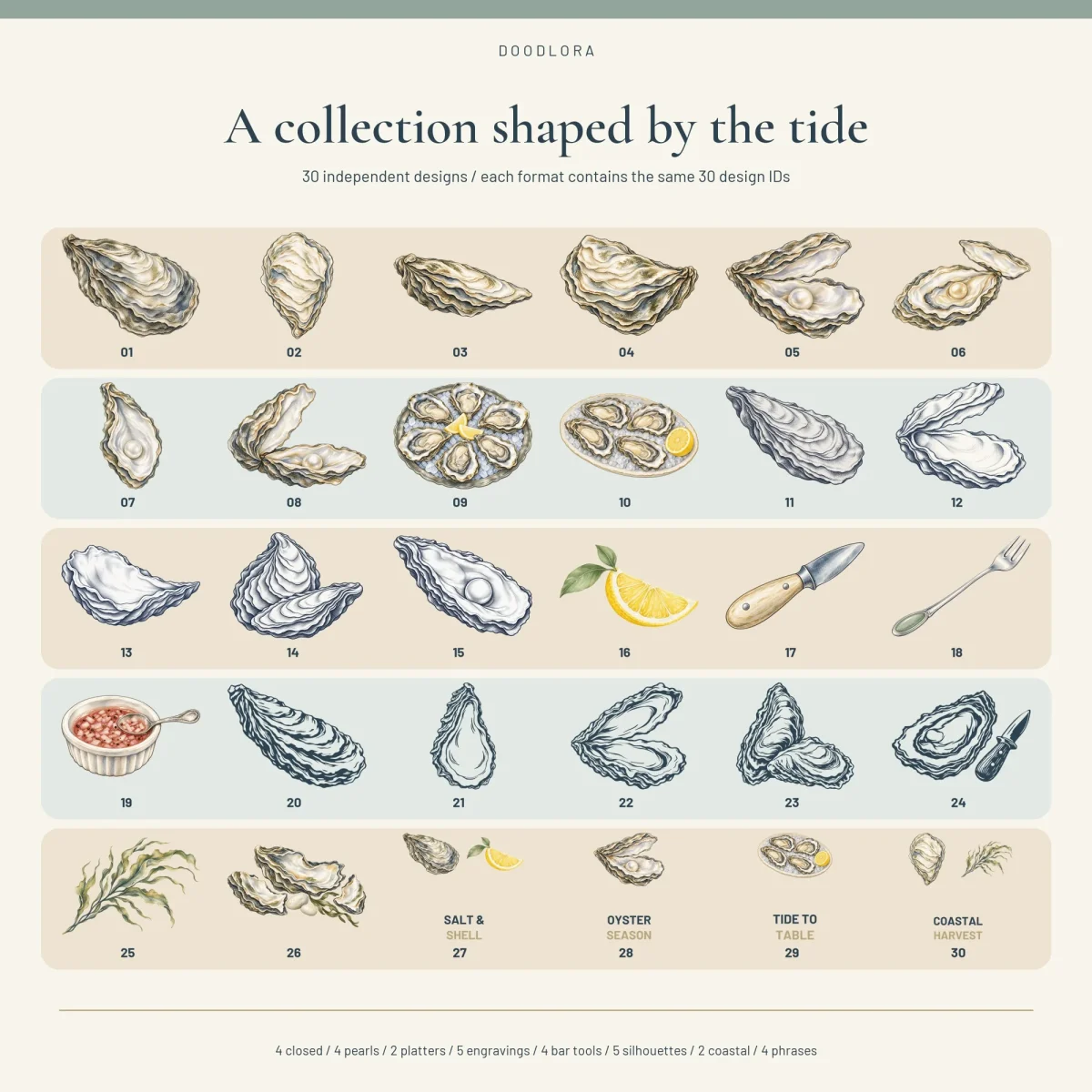
Rough, layered oyster shells in cream, olive, ochre and slate blue, shown closed, cracked open around a pearl and laid out on crushed ice with lemon. Around them sit the oyster bar extras (a shucking knife, a tasting fork, a lemon wedge and a bowl of mignonette), five navy etchings, five dark slate silhouettes and four two-tone phrases such as Tide To Table.
$4.99
Buy any 3 or more printables and save 20% at checkout.
- Download right after payment — link works for 30 days, up to 5 downloads
- Files arrive as a ZIP with your license PDF inside
- Secure checkout by Stripe · Refund policy
The shells here look the way oysters actually look: rough, frilled at the edge and stacked in uneven layers, in cream, olive, ochre and slate blue with a pearly lavender sheen inside the open ones. They’re set up like an oyster bar rather than a beach, with the shells joined by ice platters, a lemon wedge, the knife, the fork and the shallot sauce, and there isn’t a cartoon sea creature anywhere in the set.
The four groups of artwork
Shells, pearls and platters (01–10). Four closed oysters at different angles, one long and low, one upright and rounded, one shallow and ridged, one wide and heavy. Then four opened ones with a single pearl resting inside, three with the top shell lifted like a lid and one (07) a lone half shell. 09 is a round platter of six oysters on crushed ice around lemon wedges, and 10 is an oval tray of four with a round of lemon.
Etchings (11–15). Five separate drawings in navy line on white, with fine curved hatching along every ridge: a closed shell, an open pair, a cupped half shell, two shells leaning together and an open oyster with a pearl. They’re drawn on their own, not a filter laid over the color oysters.
Oyster bar and coastal (16–19, 25–26). A lemon wedge with two leaves, a shucking knife with a pale wooden handle, a slim tasting fork with a sage green handle, a ramekin of pink mignonette with a spoon, a loose sprig of olive seaweed, and a small heap of oyster shells with pebbles and a strand of seaweed.
Silhouettes and phrases (20–24, 27–30). The five silhouettes are one dark slate blue (#2D4250), but they aren’t solid blobs: the ridges and the inside of each shell are cut out as lines, so they read like bold stamps. The last one adds a shucking knife beside the shell. The phrases set a short line in Barlow capitals under a small oyster scene, slate blue on top and sand on the second line: SALT & SHELL with an oyster and lemon, OYSTER SEASON with a pearl oyster, TIDE TO TABLE with the oval tray, and COASTAL HARVEST with a closed shell and seaweed. The letters are already shapes, so nothing needs installing, and they can’t be retyped.
The pearl oysters are decorative, not a guide to which species make pearls.
Using the PNG and vector files
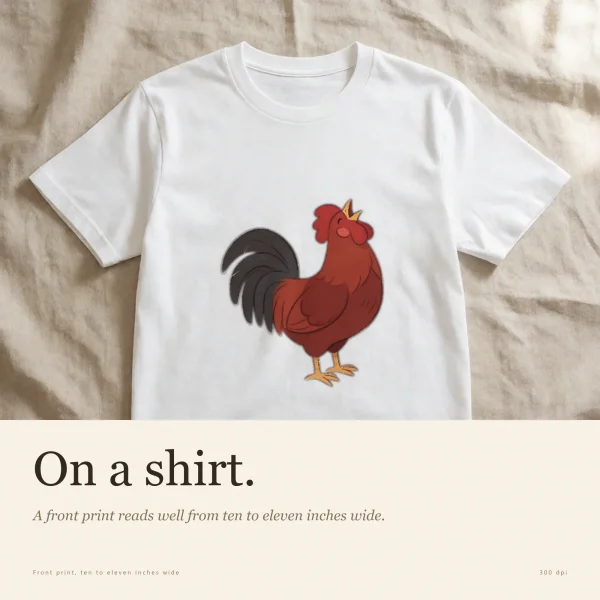
Every PNG is a 3600-pixel square with a transparent background, enlarged from smaller originals, mostly 1536 x 1024 (the index lists each one), so check the detail at your final size before printing big. The guide’s starting points are 10 to 11 inches on an adult shirt, 7 to 8 inches on a child’s and 3 to 4 inches on a mug. The SVG and EPS versions break the shading into hundreds or thousands of small closed color patches on a 12-inch square, close to the PNG at normal sizes and fully editable.
The DXF files
The DXFs open in inches at roughly 8 to 10 inches across, and they store closed region outlines rather than single center lines. What you get depends on the group. The color shells, platters and bar pieces are a single outer outline each, the seaweed and shell pile a handful of pieces. The etchings hold 475 to 757 regions: the stronger dark areas are kept and the faintest hatching is left out, and the guide warns they aren’t meant for small heat-transfer vinyl pieces. The silhouettes come to 75 to 105 pieces, the phrases to 15 to 30. For a first cut, a silhouette or a single-outline shell is the easier start, and the thin ridge lines are worth trying on a scrap of your material at your final size before the real piece.